THE SHORT ANSWER
AI search visibility is how often, and how prominently, AI systems like ChatGPT, Gemini, Perplexity, and Claude reference your brand and content inside generated answers. It matters because buyers now ask AI tools for vendor shortlists before they ever type a query into Google.
AI search visibility is how often, and how prominently, AI systems like ChatGPT, Gemini, Perplexity, and Claude reference your brand and content inside generated answers. It matters because buyers now ask AI tools for vendor shortlists before they ever type a query into Google. The single best first move is running a structured audit: sample 10 to 20 prompts your buyers would actually ask, then track which brands get named.
TL;DR:
Regularly track the mention and citation rates across multiple AI platforms to understand your brand’s visibility and impact in AI-generated responses.
Focus on adding clear, sourced statistics and quotable content to increase your chances of being cited in AI answers.
Ensure your website’s technical health, including crawlability, indexing, and schema markup accuracy, before implementing advanced AI-specific tactics.
Use free tools like Google Search Console and Bing Webmaster Tools to establish a baseline of AI visibility and monitor changes over time.
Tie AI visibility improvements directly to lead generation by tracking how citations influence traffic, inquiries, and conversions in your sales funnel.
What Does AI Search Visibility Actually Mean?
AI search visibility, often called generative engine optimization (GEO) or answer engine optimization (AEO), measures whether AI platforms mention, cite, or quote your brand when someone asks a relevant question. It’s related to SEO but not the same discipline.
Traditional search ranking is positional. You rank #1, #4, or #12, and that spot is visible and stable across sessions. Generative engines work differently. There’s no fixed ranking page. Instead, a model synthesizes an answer from multiple sources, and your brand either shows up in that synthesis or it doesn’t. What matters now includes:
Whether you’re cited with a clickable link, mentioned by name with no link, or omitted entirely
How much of the response draws on your content, sometimes called position-adjusted word count
Whether the same prompt, asked five different ways, still surfaces you
Traditional SEO fundamentals haven’t gone away. Google’s own guidance states plainly that generative AI features build on existing search fundamentals. A page has to be indexed and eligible for a regular Search snippet before it has any shot at appearing in an AI-generated answer. GEO is a layer on top of SEO, not a replacement for it.
How Do AI Platforms Discover and Cite Content?
Most AI platforms don’t crawl the web fresh for every question. They lean on a mix of their own indexes, licensing deals, and retrieval systems that pull from existing search infrastructure. Understanding each platform’s habits helps you know where to focus.
Gemini draws heavily on Google’s search index and tends to favor pages that already rank well organically.
ChatGPT browses through Bing’s index for real-time queries and blends that with its training data, so Bing indexing hygiene matters more than people assume.
Perplexity is aggressive about citing sources directly and shows a visible bias toward recent, well-structured content with clear statistics.
Claude relies more on its training corpus for many queries but increasingly grounds answers in retrieved web results for anything time-sensitive.
A key mechanic behind all four is “fanning out”: the model doesn’t just search your exact query, it silently generates several related sub-queries and pulls from whichever pages answer any of them best. Search Engine Land’s breakdown of AI crawlers explains this retrieval behavior in detail, and it changes how you should think about keyword coverage. You’re not optimizing for one phrase, you’re optimizing for a cluster of related questions.
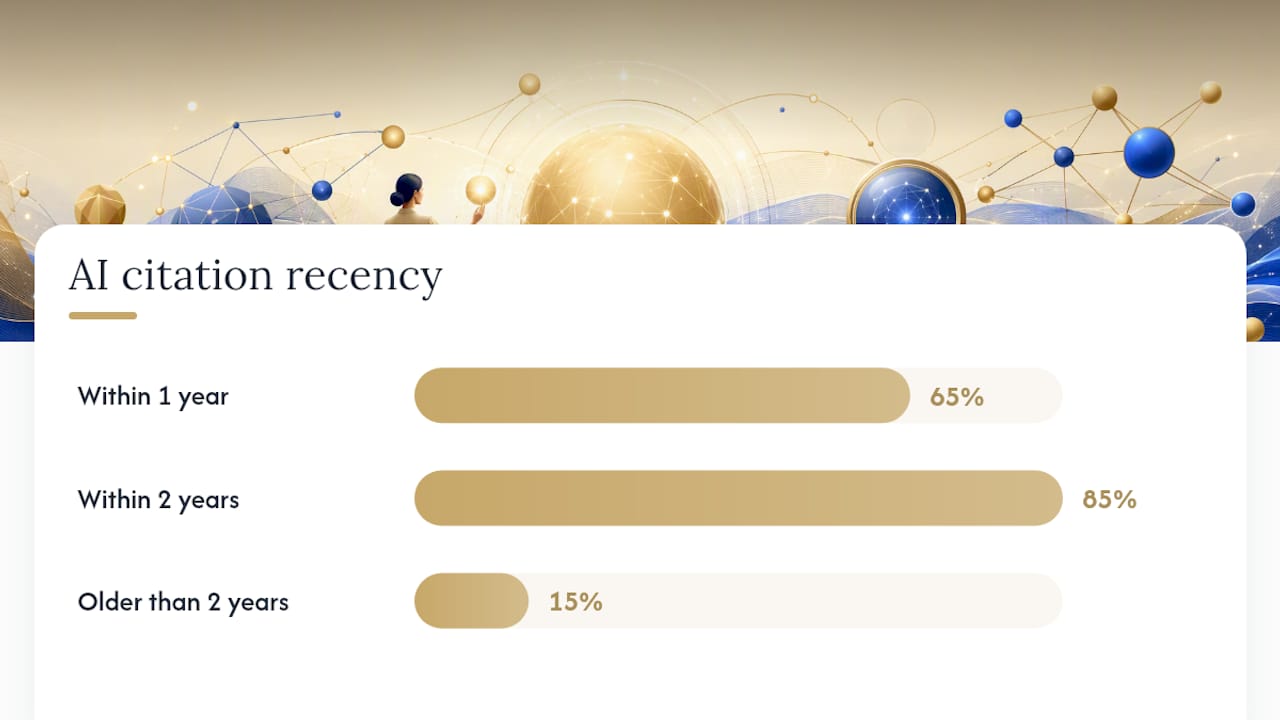
Recency matters more than most SEO veterans expect. One analysis found that roughly 65% of AI citations pointed to content published or updated within the past year, and 85% within two years, according to the same Search Engine Land research. Stale evergreen pages lose ground fast in this environment.
What Metrics Actually Measure AI Search Visibility?
You can’t improve what you don’t track, and most marketing teams have never tracked this before. Here’s a practical framework:
Mention rate. Across your sampled prompt set (10 to 20 questions your buyers realistically ask), what percentage of responses name your brand at all, cited or not?
Citation rate. Of the responses that mention you, how many include a clickable link or clear source attribution versus a bare-name mention?
Position-adjusted word count. GEO research from arXiv uses this metric to weigh how much of an answer’s substance comes from your content versus competitors’, not just whether you’re present.
AI share of voice. Run the same prompt set against your top three competitors and compare mention frequency side by side.
Sentiment and framing. When you are mentioned, is the framing accurate and favorable, or is the model summarizing outdated pricing or features?
CTR impact. Track how AI overviews affect click-through rate on the queries where your organic listing also shows an AI summary above it.
Set a baseline before you touch anything. Run your prompt set once, record every answer verbatim, and repeat the same set monthly. Without a baseline, any later improvement is a guess.
What Tools Show Your Current AI Visibility?
You don’t need an expensive platform to get your first real signal. Start with what’s free and official.
Google Search Console now surfaces a generative AI performance report showing impressions and clicks tied to AI Overviews, a direct line into how Google’s own AI layer treats your pages.
Bing Webmaster Tools reports similar AI-related performance data, relevant because ChatGPT’s browsing pulls from Bing’s index.
Manual spot checks cost nothing but time. Open ChatGPT, Perplexity, Gemini, and Claude in separate tabs, run your 10 to 20 prompts in each, and log the results in a spreadsheet: mentioned yes/no, cited yes/no, and a one-line note on accuracy.
Vendor visibility checkers have started appearing that automate this sampling and report mention counts across platforms, useful once you’ve outgrown manual tracking but worth validating against your own spot checks first.
Pro Tip: Ask the same question in past tense, present tense, and as a comparison (“best X vs Y”) every time you sample. Models often surface completely different sources depending on question phrasing, and you’ll miss half your visibility gaps if you only test one format.
Automate tracking once you’re checking more than 20 prompts across four or more platforms monthly. That volume becomes tedious fast, and a scheduled export beats a manual spreadsheet grind every single time.
What Tactics Actually Increase AI Citations?
Not every SEO tactic transfers to GEO. Some matter far more here than they ever did for classic ranking, and a few barely matter at all.
Write quotable, self-contained passages. Answer engines lift sentences that stand alone with a clear claim and a number attached. A vague paragraph gets skipped for a competitor’s crisp one-liner.
Add sourced statistics wherever you make a claim. GEO research measuring citation and quotation additions found position-adjusted visibility gains of roughly 30 to 40%, with subjective-impression scores improving 15 to 30%. That’s the single most reproducible lever in this entire discipline.
Match your schema markup to what’s actually on the page. Use Schema types like Article, FAQPage, or Organization, but only where the visible content genuinely supports the markup. Mismatched schema can get ignored or, worse, flagged.
Fix rendering before anything else. If your content loads via client-side JavaScript with no server-side rendering or pre-rendering fallback, several AI crawlers simply never see it. Check robots.txt and canonical tags for accidental blocks too.
Earn unlinked mentions on trusted third-party platforms. Backlinko’s GEO research points to Reddit, LinkedIn, and YouTube as frequently cited sources in AI outputs, meaning a strong presence there feeds visibility even without a backlink.
Timestamp and refresh pages where recency drives trust. Pricing pages, “best of” comparisons, and anything regulatory should carry a visible last-updated date and actual updated content behind it.
Pro Tip: Rewrite your top five landing pages’ opening paragraphs as if they’ll be quoted verbatim in an AI answer. That single edit often does more for citation rate than a month of new blog posts.
How Do You Run an AI Visibility Audit?
A repeatable audit beats a one-off check every time, because visibility shifts month to month as models retrain and index.
Define objectives first. Pick the 10 to 20 prompts your actual buyers would ask, not generic industry terms. “Best CRM for a 20-person sales team” beats “CRM software.”
Run the platform sweep. Ask each prompt across ChatGPT, Gemini, Perplexity, and Claude, and export every answer as evidence, screenshots or copied text both work.
Check technical health. Confirm indexing status in Search Console, test rendering with a JavaScript-disabled view, and verify structured data validates against schema.org’s own definitions.
Audit content for citability. Flag pages missing clear statistics, unambiguous entity names (your company name spelled consistently everywhere), or a quotable summary near the top.
Rank fixes by lead-gen impact. A pricing page invisible to AI matters more than a five-year-old blog post nobody links to.
Pro Tip: Keep a living log of every prompt and answer with a date stamp. Six months from now you’ll want proof of what changed, and screenshots without dates are useless for that comparison.
If you’d rather have this run for you end to end, Flock’s step-by-step audit methodology walks through the exact checkpoints B2B teams use to prioritize fixes.
How Should You Report AI Visibility to Stakeholders?
A dashboard that only marketing understands won’t survive budget season. Build one that ties directly to revenue conversations.
Core metrics to visualize: mention rate trend, citation rate trend, AI share of voice against named competitors, and CTR movement on queries with AI Overviews present.
Cadence: sample monthly at minimum; a quarterly deep dive with year-over-year trend lines works well for leadership decks.
Attribution: tag leads that mention “found you through ChatGPT” or similar in intake forms, and cross-reference spikes in direct traffic against weeks where visibility checks showed new citations.
Escalation triggers: loop in PR when sentiment turns inaccurate or outdated, product when AI answers describe features you no longer offer, and customer success when AI summaries misstate pricing or terms.
Treat visibility the way you’d treat any other funnel metric. It’s a leading indicator, not a vanity number.
Why Fix Crawlability Before Chasing AI Hacks?
Most teams I’ve watched approach this backwards. They want the clever tactic, the prompt injection trick, the schema hack that supposedly gets you cited overnight. Skip that instinct.

Start with the boring stuff: is your site actually crawlable, is your content actually indexed, and are your claims backed by numbers a model can quote cleanly? That’s where nearly all the real gains sit. The GEO research on citation lift backs this up, the biggest, most reproducible gains come from adding quotable statistics and sources, not from gaming any particular platform’s quirks.
The second mistake is treating AI visibility as a vanity metric disconnected from pipeline. If your team can’t tie a mention-rate improvement to a lead source or a conversion bump within a quarter, the initiative dies at budget review. Build the lead-gen link before you build the dashboard, not after.
— Mieke
How Flock Turns AI Visibility Gains Into Qualified Leads
Getting mentioned by an AI assistant means nothing if the resulting traffic never converts. Flock is built for B2B companies that need the audit, the fix, and the qualified leads that follow, not just a visibility report that sits in a folder. A free initial audit covers your technical crawlability, structured data, and content citability, then maps directly into managed campaigns across Meta, LinkedIn, Google, and TikTok, so the visibility work actually feeds your pipeline instead of ending at a screenshot.
Plans generally include qualifying lead forms, CRM integration, and regular optimization to improve AI citations and paid lead channels. If you’re weighing whether to handle this in-house or bring in a managed lead generation service versus a lead marketplace, start with Flock’s free audit and see what your current visibility and lead flow actually look like before deciding. Request your audit at Flockleads and get a clear picture of where you stand.
Sources
Frequently asked questions
What Is the Difference Between GEO and SEO?
SEO optimizes for ranking positions on a search results page, while GEO (generative engine optimization) optimizes for being mentioned, quoted, or cited inside an AI-generated answer. GEO builds on SEO fundamentals rather than replacing them.
How Many Prompts Should I Sample for an AI Visibility Audit?
Start with 10 to 20 prompts that reflect real buyer questions, tested across ChatGPT, Gemini, Perplexity, and Claude, then repeat the same set monthly to track trend movement.
Does Adding Statistics to My Pages Really Improve AI Citations?
Yes. Research on generative engine optimization found that adding citations, quotes, and statistics improved position-adjusted visibility by roughly 30 to 40% 40%, with subjective-impression scores improving 15 to 30%.
Can I Check My AI Visibility for Free?
Yes. Google Search Console’s generative AI performance report, Bing Webmaster Tools, and manual spot checks across ChatGPT, Perplexity, Gemini, and Claude all cost nothing and give you a usable baseline.
How Does AI Search Visibility Affect Lead Generation?
When AI assistants cite your brand accurately, buyers arrive already familiar with your offering, which tends to shorten the sales cycle. Tracking mention rate alongside lead source data shows whether that visibility is actually converting.
NEED A CLEARER PLAN?
Let’s turn your next move into momentum.
Talk to us →