THE SHORT ANSWER
Automated marketing is the use of software to execute repetitive marketing tasks automatically, based on predefined rules and real-time behavioral data. The industry term is “marketing automation,” and understanding what is automated marketing explained in full means going beyond email blasts to see the complete system at work.
Automated marketing is the use of software to execute repetitive marketing tasks automatically, based on predefined rules and real-time behavioral data. The industry term is “marketing automation,” and understanding what is automated marketing explained in full means going beyond email blasts to see the complete system at work. That system runs on five key components: triggers, conditions, actions, delays, and exit conditions. Together, they create personalized, timely communications across every channel your buyers use. For B2B marketers, this is the engine behind consistent lead nurturing, CRM updates, and sales pipeline acceleration, all without manual intervention at every step.
What is automated marketing, and how does it work?
Automated marketing works by connecting a behavioral trigger to a defined response, then executing that response without human input. The difference between a broadcast email and an automated workflow is fundamental: automated workflows fire based on behavior, not a calendar date. That distinction is what makes automation feel personal rather than generic.
The five components that power every workflow are:
Triggers — the event that starts the workflow, such as a form submission, a page visit, or a CRM status change.
Conditions — the rules that determine which path a contact follows, such as “if the contact is in the manufacturing industry, send version A.”
Actions — the actual task the system performs, such as sending an email, updating a CRM field, or notifying a sales rep.
Delays — the wait time between actions, which can be fixed (three days) or dynamic (until the contact opens the previous email).
Exit conditions — the rules that remove a contact from the workflow once they have converted or met a specific criterion.
These components interact to build what marketers call a “workflow” or “sequence.” A B2B example: a prospect downloads a whitepaper (trigger), the system checks whether they are a decision-maker (condition), sends a case study email (action), waits four days (delay), and removes them from the sequence if they book a demo (exit condition). Multi-channel automation extends this logic to social posting, lead capture forms, SMS, and CRM updates, not just email.
Pro Tip: The most common workflow mistake is skipping exit conditions. A contact who already purchased your service should never receive a “why haven’t you signed up yet?” email. Build exit rules before you build actions.

What are the benefits of automated marketing for B2B marketers?
The ROI case for marketing automation is concrete. Organizations earn $5.44 for every $1 spent on marketing automation, with payback typically arriving in under six months. That return reflects both cost reduction and revenue acceleration, two outcomes that matter directly to B2B business owners managing tight budgets and long sales cycles.
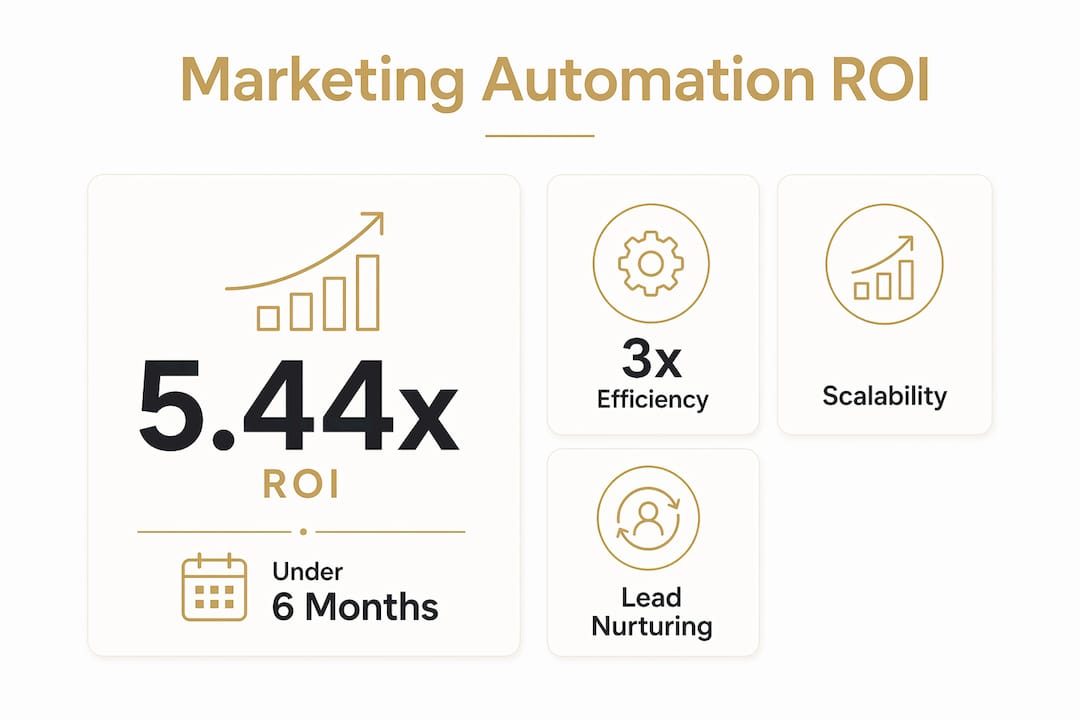
The efficiency gains go beyond cost savings. Automation removes the manual work of sending follow-up emails, updating contact records, and segmenting lists. That freed capacity goes toward strategy, creative testing, and sales alignment. Automation platforms free marketers from repetitive tasks, enabling focus on testing, creative refinement, and strategic planning.
Key benefits for B2B marketers include:
Consistent lead nurturing — automated sequences keep prospects engaged across a 3–6 month B2B buying cycle without manual touchpoints.
Precise targeting — behavioral triggers ensure the right message reaches the right contact at the right moment.
Sales and marketing alignment — CRM integrations automatically notify sales reps when a lead crosses a qualification threshold.
Reduced human error — rule-based systems do not forget to follow up or send the wrong version of a message.
Measurable performance — every workflow generates data on open rates, click rates, and conversion events, making optimization straightforward.
The scalability benefit is particularly significant for growing B2B teams. A team of three marketers can run nurture sequences for thousands of leads simultaneously, something that would require a much larger headcount without automation.
How is AI transforming automated marketing?
Traditional marketing automation runs on if-then logic. AI-driven marketing automation replaces rigid rules with machine learning, enabling real-time behavioral decisions and hyper-personalization at a scale no human team can match. The practical difference is significant: a rule-based system sends email A if a contact visits a pricing page. An AI system analyzes dozens of behavioral signals simultaneously and selects the message, channel, and send time most likely to convert that specific contact.
The shift is accelerating fast. By the end of 2026, 40% of enterprise applications will feature task-specific AI agents, moving marketing toward autonomous campaign execution. That means AI will not just assist marketers. It will plan, execute, and adjust campaigns with minimal human oversight.
Capability | Traditional automation | AI-driven automation |
|---|---|---|
Decision logic | Fixed if-then rules | Machine learning models |
Personalization | Segment-level | Individual-level |
Timing | Preset delays | Predicted optimal moments |
Campaign adjustment | Manual updates | Real-time self-optimization |
Data inputs | Form fields, CRM data | Behavioral, contextual, predictive signals |
The table above shows why AI-driven systems outperform rule-based platforms for complex B2B buying journeys. A B2B SaaS deal with six stakeholders and a four-month decision cycle generates far more behavioral data than a fixed sequence can process. AI systems use that data continuously.
Pro Tip: Before adopting AI marketing tools, audit your data quality first. AI models are only as good as the behavioral data you feed them. Clean CRM records and properly tagged contact properties are the foundation.
What are practical strategies for implementing effective automated marketing?
Effective implementation starts with goals, not software. Defining specific, measurable goals before selecting a tool prevents wasted spending on features you will never use. A B2B company focused on shortening its sales cycle needs different automation capabilities than one focused on reactivating dormant accounts.
Once goals are clear, the implementation strategy should follow this sequence:
Map your buyer journey first. Identify every touchpoint from first contact to closed deal. Automation should mirror that journey, not replace it with generic sequences.
Build behavioral triggers around real actions. Use page visits, content downloads, email clicks, and CRM stage changes as triggers. Avoid time-based triggers alone; they ignore what the buyer is actually doing.
Write conditional logic for each audience segment. A manufacturing executive and a startup founder need different messages. Conditions let one workflow serve both without manual sorting.
Set delays that match your actual sales cycle. B2B buying cycles often run 3–6 months. A sequence that exhausts all touchpoints in two weeks leaves most of your pipeline without coverage.
Build exit conditions into every workflow. Exit conditions prevent irrelevant communications after a contact converts, which protects your brand reputation and reduces unsubscribe rates.
Integrate with your CRM from day one. Automation without CRM integration creates data silos. Sales reps need to see every automated touchpoint a lead received before they make a call.
Test one variable at a time. Change subject lines, send times, or message content in isolation. Testing multiple variables simultaneously makes it impossible to identify what drove the result.
The most common pitfall is building automation before strategy. Teams that select software first and define goals second end up with complex workflows that do not connect to revenue outcomes. Start with the question: “What specific behavior do we want to change, and how will we measure it?”
Pro Tip: Connect your paid traffic strategy to your automation workflows from the start. Leads from paid channels often have shorter decision windows, and your sequences should reflect that urgency.
Key Takeaways
Automated marketing delivers measurable ROI, consistent lead nurturing, and sales alignment when built on clear goals, behavioral triggers, and complete workflow logic including exit conditions.
Point | Details |
|---|---|
Five core components | Every workflow needs triggers, conditions, actions, delays, and exit conditions to function correctly. |
Proven ROI | Organizations earn $5.44 per $1 spent on marketing automation, with payback in under six months. |
AI is raising the bar | By end of 2026, 40% of enterprise apps will include AI agents capable of autonomous campaign execution. |
Goals before software | Define measurable outcomes before selecting a platform to avoid spending on unused features. |
Exit conditions protect trust | Removing converted contacts from active sequences prevents brand damage and reduces unsubscribes. |
Why automation is a tool, not a strategy
After working with B2B marketing teams across industries, the pattern I see most often is this: companies invest in automation software and expect results to follow automatically. They do not. The software executes what you design. If the design is poor, the software executes it perfectly and at scale, which means your mistakes reach more people, faster.
The teams that get real results from automation treat it as a capacity multiplier, not a replacement for thinking. They spend more time on message quality, audience segmentation, and offer design because automation gives them the time to do so. Human judgment remains the critical ingredient; automation handles the execution so marketers can focus on the decisions that actually move revenue.
My honest view on AI in marketing automation is cautiously optimistic. The predictive capabilities are real and the efficiency gains are significant. But I have seen teams adopt AI-driven platforms before their basic data hygiene was in order, and the results were worse than their previous manual processes. Get your CRM clean, your segments defined, and your goals documented before you add AI to the mix. The technology rewards preparation and punishes shortcuts.
Automation also does not fix a weak offer or a misaligned message. If your value proposition does not resonate, automating its delivery just means more people ignore it more efficiently. Use the capacity automation creates to refine what you say, not just how often you say it.
— Mieke
How Flockleads supports your automated marketing goals
Automated marketing works best when the leads entering your workflows are qualified and consistent. Flockleads generates B2B leads and delivers them directly to your website, giving your automation sequences a steady flow of real prospects to engage.
When your CRM receives qualified leads from Flockleads, your automated workflows can trigger immediately, sending the right nurture sequence to the right contact without any manual sorting. That connection between lead generation and marketing automation is where most B2B teams lose time. Flockleads closes that gap. Visit Flockleads to see how engineered lead flow fits into your existing marketing automation setup and keeps your pipeline moving without the manual overhead.
Frequently asked questions
What is marketing automation in simple terms?
Marketing automation is software that executes marketing tasks automatically based on rules and behavioral triggers. It handles emails, CRM updates, lead scoring, and more without manual input for each action.
How does automated marketing differ from email marketing?
Email marketing is one channel. Automated marketing covers multiple channels and tasks including social posting, lead capture, CRM updates, and SMS, all triggered by contact behavior rather than a manual send.
What is a good ROI for marketing automation?
The average return is $5.44 per $1 spent, with most organizations recovering their investment in under six months.
What are exit conditions in marketing automation?
Exit conditions are rules that remove a contact from a workflow once they convert or meet a specific criterion. They prevent contacts from receiving irrelevant messages after they have already taken the desired action.
How long should a B2B automated marketing sequence run?
B2B sequences should match the actual buying cycle, which typically runs 3–6 months for most industries. Sequences that end too early leave prospects without coverage during the decision phase.
NEED A CLEARER PLAN?
Let’s turn your next move into momentum.
Talk to us →