THE SHORT ANSWER
Four B2B companies cut cost per lead, shortened sales cycles, and grew pipeline by rebuilding how they measured success rather than by spending more. The case studies below show exactly what changed, how long it took, and what the numbers looked like before and after, along with a short playbook you can adapt to your own program in 60 to 90 days.
Four B2B companies cut cost per lead, shortened sales cycles, and grew pipeline by rebuilding how they measured success rather than by spending more. The case studies below show exactly what changed, how long it took, and what the numbers looked like before and after, along with a short playbook you can adapt to your own program in 60 to 90 days.
TL;DR:
Fixing conversion tracking by importing offline sales data into ad platforms significantly improves lead quality and reduces low-value lead volume in a few months.
Narrowing the target audience and clarifying qualification rules before scaling spend accelerates sales cycle compression and enhances pipeline quality within five months.
Long-term account maturation, spanning five years, can lower cost per lead by 70%, but immediate results depend on early signal capture and disciplined qualification.
Prioritizing the optimization of pipeline and revenue events over lead volume alone leads to better measurement and more meaningful success in B2B lead generation.
Using external partners to overhaul tracking and campaign management can fast-track results and prevent stagnation caused by overextending internal resources.
The Fast Version: B2B Lead Gen Case Studies at a Glance
If you only have five minutes, here’s what the data shows across these programs.
A SaaS company grew pipeline contribution by roughly 80% after switching Google Ads from form-fill optimization to closed-won revenue.
A B2B SaaS firm using LinkedIn ads plus content hit 110 marketing qualified leads (MQLs) per month and cut its sales cycle from 74 to 41 days in five months.
One paid-media account saw cost per lead drop 70% by year five, without sacrificing lead quality.
A large-scale enrichment program delivered 112,091 validated leads over 16 months at full validation accuracy.
Statistic to remember: the paid-search turnaround above didn’t come from a bigger budget. It came from importing CRM data so the ad platform could tell the difference between a form-fill and an actual sale.
Three things worth testing immediately: import offline conversions into your ad platform, tighten your ideal customer profile (ICP) before you scale spend, and give sales a formal feedback loop back into marketing’s lead scoring. Expect the first meaningful signal in 30 to 45 days, and treat anything faster as noise rather than a trend.
Four B2B Lead Generation Case Studies With Real Before/After Numbers
Every program below started with a common symptom: leads were flowing in, but revenue wasn’t following. The fix was different in each case, but the diagnosis rhymed.
Case 1: Fixing the conversion signal in Google Ads
A B2B SaaS company was generating plenty of form fills through Google Ads, but sales kept flagging most of them as junk. The problem wasn’t the ads. It was that Google’s bidding algorithm had no idea which leads actually turned into revenue, so it kept optimizing for the wrong outcome.
The fix involved mapping GCLID data through Salesforce so closed-won deals could feed back into the ad platform, then shifting Smart Bidding to target revenue-generating opportunities instead of raw form submissions. Lead volume actually dropped, from around 400 to 120 per month, but qualified opportunities rose from under 20 to more than 35.
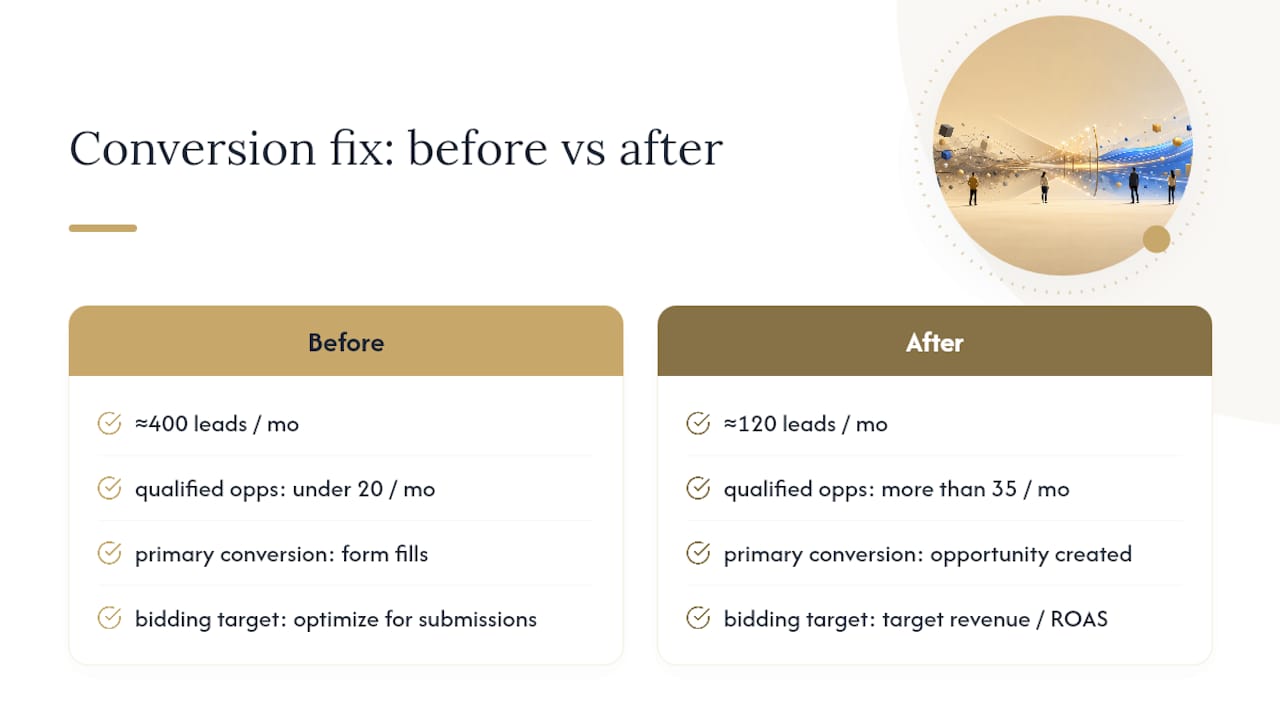
The timeline mattered here. A practical version of this rebuild sets “opportunity created” as the primary conversion event, runs a conservative target cost-per-acquisition (CPA) for 30 to 45 days to let the algorithm learn, then shifts to target return on ad spend (ROAS) once there’s enough opportunity-level volume to bid against.
Case 2: LinkedIn and content compressing the sales cycle
A different B2B SaaS company had a lead-generation problem hiding inside a sales-cycle problem. Leads were coming in, but deals sat in the pipeline for months without moving.
The company paired a LinkedIn content program with tailored Lead Gen Form campaigns aimed at specific job titles inside target accounts. Within five months, MQLs climbed to 110 per month and the average sales cycle compressed from 74 days to 41. The content did the trust-building work upfront that sales reps used to do on the first three calls, so by the time a lead converted, they were already most of the way to a decision.
That compression matters more than the MQL count. A shorter sales cycle means the same sales team can close more deals without adding headcount, and it means cash from new business lands sooner.
Case 3: What five years of account maturity actually buys you
Not every result comes fast.
By year five, cost per lead had dropped 70% from where it started, and the account had generated more than 22,000 leads in total. The lesson isn’t “wait five years and hope.” It’s that early years should prioritize signal capture and qualification discipline, because the payoff in years three through five comes from having enough historical data to rebuild the account structure with confidence instead of guesswork.

Case 4: An anonymized Flockleads pilot snapshot
One Flockleads client, a mid-sized B2B services firm, came in with a familiar complaint: their sales team was drowning in unqualified inquiries from a generic contact form, and nobody could say which channel was actually producing revenue. Flockleads ran a technical SEO audit alongside a paid-campaign restructure across Google and LinkedIn, added qualifying questions to the lead form, and connected the whole funnel to the client’s CRM for instant delivery and weekly optimization.
Within the first pilot cycle, the qualification rate on inbound leads improved enough that the sales team stopped triaging manually and started working every lead that came through. The bigger shift was diagnostic clarity: for the first time, the client could see cost per qualified lead by channel, not just cost per click.
Case | Primary channel | Key before metric | Key after metric | Timeline |
|---|---|---|---|---|
Case 1 | Google Ads (paid search) | ~400 leads/month, <20 qualified opportunities | 120 leads/month, >35 qualified opportunities, pipeline up ~80% | Several months |
Case 2 | LinkedIn + content | 74-day sales cycle | 41-day sales cycle, 110 MQLs/month | 5 months |
Case 3 | Paid media (account maturity) | Baseline CPL, 60%+ qualification rate | CPL down 70%, qualification rate maintained | 5 years |
Case 4 (Flockleads) | Multi-channel + SEO audit | Unqualified inbound leads, no channel-level cost visibility | Improved qualification rate, cost-per-qualified-lead visibility by channel | Pilot cycle |
Case studies like these carry weight with buyers precisely because they include the messy middle: what changed, how long it took, and what the sample size actually was, not just a clean before-and-after headline.
What Actually Repeats Across These B2B Marketing Success Stories
Strip away the channel differences and the same three diagnoses show up in almost every underperforming program.
Poor conversion signal. The ad platform or campaign is optimizing for form fills, clicks, or raw lead volume instead of pipeline events that actually predict revenue.
Fuzzy ICP. Targeting is broad enough to hit volume goals but loose enough that sales spends more time disqualifying than closing.
No qualification discipline. Leads get handed to sales without a consistent scoring or gating process, so the same junk keeps recurring month after month.
The fixes map directly to those diagnoses. Importing offline conversions and reorienting bidding toward opportunity or closed-won events was the single highest-leverage change in the paid-search case above. Sharpening the ICP, before scaling spend rather than after, is what let the LinkedIn program compress its sales cycle instead of just adding volume. And because modern B2B purchases typically involve six to ten stakeholders across different functions, programs that only message one decision-maker tend to stall in committee, no matter how good the initial lead quality looks.
Pro Tip: Don’t try to fix conversion-signal issues and ICP issues in the same sprint. Fix the signal first, let the platform relearn for 30 to 45 days, then tighten targeting. Changing both at once makes it impossible to tell which fix actually worked.
Timelines vary by lever. Conversion-signal fixes can show early movement within a month because they change what the algorithm optimizes for immediately. ICP tightening usually takes a full sales cycle to prove out, since you’re waiting to see whether the narrower audience actually closes at a higher rate. Account-level structural rebuilds, like the five-year CPL story, only make sense once you have enough historical data to justify them.
How to Read Lead Generation Metrics Without Fooling Yourself
The number that matters most in almost every one of these B2B case study examples isn’t lead volume. It’s cost per qualified opportunity, because that’s the metric that survives contact with the sales team.
Four metrics deserve more attention than they usually get:
Cost per opportunity, not cost per lead, since raw lead cost hides how many of those leads sales actually works.
Qualification rate, which tells you whether volume growth is real or just noise.
Pipeline value, which ties lead gen back to what the business actually cares about.
Sales cycle length, since a shorter cycle compounds the value of every other improvement.
When you compare a case study’s numbers to your own program, adjust for scale first. Deal size matters too: a program producing 110 MQLs a month for a $2,000 average contract value needs a completely different sales motion than one producing 15 MQLs a month for $80,000 contracts. And be honest about sample size. A case study built on five months of data, like the LinkedIn example above, is directionally useful; a program running for five years, like the account-maturity case, tells you what’s possible with real historical depth.
That’s the kind of math worth running before you copy any tactic wholesale. For a sense of what qualified leads typically run across industries, it helps to check current cost-per-lead benchmarks before setting your own targets.
Turning These Case Studies Into a 60 to 90 Day Pilot
You don’t need to copy every tactic above. You need to pick the one lever your program is most obviously missing, then test it on a short timeline with clear stop or scale criteria.
Start with a quick diagnostic: if sales is disqualifying most inbound leads, your problem is likely conversion signal or ICP, not volume. If leads look qualified on paper but deals stall for months, your problem is probably the sales cycle and multi-stakeholder engagement, not lead gen at all. If cost per lead keeps creeping up despite similar volume, your account may need the kind of structural rebuild that only comes after gathering enough historical data.
Define your ICP tightly using firmographic and intent signals, favoring dynamic, enriched lists over static purchased ones.
Pick one primary conversion event to optimize for, ideally “opportunity created” rather than form fill.
Set up tracking and offline conversion imports so your CRM data flows back into whatever platform you’re running, whether that’s Google Ads or LinkedIn.
Choose one or two channels rather than spreading thin across five.
Write qualification rules with sales before launch, not after the first batch of leads shows up.
Set expected key performance indicators (KPIs) and a review cadence, typically every two weeks for the first 60 days.
Decide your scale-or-stop criteria in advance: a defined qualification rate or cost-per-opportunity threshold, not a gut feeling three weeks in.
Pro Tip: Write your scale-or-stop criteria down before you launch the pilot, not after you see the first results. It’s much harder to talk yourself into stopping a program you’re already emotionally invested in.
The One Lever Most Teams Skip
If you take one thing from these B2B sales case studies, take this: fixing what your ad platform or campaign counts as success beats almost every other lead-gen tactic in speed and cost. Most teams jump straight to more spend, more channels, or a creative refresh before they’ve checked whether their conversion tracking is even pointed at the right target.
In an anonymized snapshot from a Flockleads pilot, a client’s biggest gain didn’t come from a new channel. It came from finally seeing cost-per-qualified-lead broken out by channel for the first time, which let them cut spend on the two channels that looked fine on paper but never produced a closed deal.
Bring in an outside partner when you’ve diagnosed the problem but don’t have the internal bandwidth to rebuild tracking, rework campaigns, and manage weekly optimization at the same time. Trying to do all three while also running your existing pipeline is usually how good pilots stall out in month one.
— Mieke
How Flockleads Runs This Playbook for You
Flockleads is the alternative to hiring a full in-house team to rebuild your lead-gen stack from scratch. Instead of stitching together ad platforms, CRM integrations, and weekly reporting yourself, Flockleads runs the sector-brand campaigns across Google, Meta, LinkedIn, and TikTok, wires the qualifying lead forms straight into your CRM, and delivers leads instantly while optimizing weekly based on what’s actually converting.
The engagement typically starts with a free audit of your current lead flow and conversion tracking, the same diagnostic step behind every case study above. From there, a short managed pilot tests the channels and qualification rules that fit your ICP, with clear KPI commitments before you commit to anything longer term. If you’re still weighing whether a managed program or a straight lead marketplace fits your situation better, it’s worth reading through how a lead generation agency compares to a lead marketplace before you decide. When you’re ready to see what a pilot could look like for your business, start with a free audit and get a plan built around your actual numbers, not a generic template.
Sources
Frequently asked questions
Can you give an example of a B2B lead gen case study?
Yes. One documented example shows a B2B SaaS company importing CRM offline conversion data into Google Ads and shifting bidding toward closed-won revenue, which grew pipeline contribution by roughly 80% while cutting low-quality lead volume.
What is the rule of 7 in B2B marketing?
The rule of 7 is a marketing principle suggesting a prospect typically needs around seven meaningful touchpoints with your brand before they’re ready to buy. In B2B specifically, this plays out across channels like LinkedIn, email, and content, since buying decisions usually involve six to ten stakeholders who each need their own set of touches before committee alignment happens.
What are the best practices for B2B lead generation?
The strongest programs optimize toward pipeline or revenue events rather than raw form fills, use enriched and intent-based targeting instead of static purchased lists, and build a feedback loop between sales and marketing to keep qualification rules current. Programs that follow this pattern, including several B2B case study examples above, consistently outperform ones that just chase lead volume.
What does “B2B” mean in the context of lead generation?
B2B, or business-to-business, lead generation means identifying and engaging other companies as prospective customers rather than individual consumers. It typically involves longer sales cycles, multiple stakeholders per deal, and higher average deal values than consumer lead generation, which is why platforms like Flockleads build qualification and CRM integration directly into the lead delivery process.
NEED A CLEARER PLAN?
Let’s turn your next move into momentum.
Talk to us →