THE SHORT ANSWER
B2B retargeting means re-engaging entire buying groups, not individual browsers, with account-level ads across channels like LinkedIn, Google, and email. The strongest approach today combines first-party identification with stage-specific messaging synced across two or three coordinated channels rather than one.
B2B retargeting means re-engaging entire buying groups, not individual browsers, with account-level ads across channels like LinkedIn, Google, and email. The strongest approach today combines first-party identification with stage-specific messaging synced across two or three coordinated channels rather than one. Start by building tight, high-intent account segments, then move to the audience-building section below to see exactly how.
TL;DR:
B2B retargeting primarily targets entire accounts and multiple stakeholders, requiring coordinated messaging across two or three channels instead of individual browsers.
First-party identification now relies on IP resolution, CRM data, and firmographic enrichment, as third-party cookies phase out and privacy rules tighten.
High-value segments, such as pricing page visitors and ICP-fit accounts, outperform broad audiences and significantly reduce wasted ad spend.
Combining channels like LinkedIn, Google, and Meta with account-specific messaging greatly improves pipeline contribution and overall campaign efficiency.
Successful B2B retargeting depends on phased escalation, targeted creative for each buying stage, and rigorous measurement of pipeline influence rather than simple ad engagement metrics.
What Is B2B Retargeting and How Does It Differ From B2C Remarketing?
B2C remarketing chases individual shoppers who abandoned a cart. B2B retargeting tracks entire accounts, because a single purchase decision often involves five to ten people across procurement, IT, finance, and leadership. That shift changes everything about how campaigns get built. A consumer ad might push urgency and discount pricing; a B2B ad aimed at a finance stakeholder needs to answer a completely different question than one aimed at a technical evaluator, since buying-group roles require distinct evidence rather than emotional triggers. Sales cycles stretching three to eighteen months also mean impressions need to accumulate patiently instead of chasing a 48-hour conversion window.
A few core retargeting types show up repeatedly in B2B stacks:
Pixel-based retargeting tracks anonymous site visitors through browser cookies, though this method is losing reach as third-party cookies phase out.
List-based retargeting uploads known contacts or accounts (from a CRM or event list) directly to ad platforms.
Email retargeting triggers follow-up sequences based on site behavior or content downloads.
First-party/cookieless retargeting identifies companies visiting your site through IP resolution and CRM data, sidestepping cookie limitations entirely.
For a deeper look at why account-level thinking changes the entire playbook, see how B2B lead generation differs from consumer lead generation.
How Does B2B Retargeting Work With First-Party Data?
Cookie deprecation forced B2B marketers to rebuild identification from the ground up. The workflow now looks less like “drop a pixel and wait” and more like a data assembly line with three distinct stages.
Identify the visitor. Pixels still help, but IP-to-company resolution and CRM-matched lists have become the backbone. Modern B2B retargeting increasingly relies on first-party visitor identification synced to ad platforms, which keeps campaigns running even as cookie access shrinks.
Enrich the record. Raw traffic data is nearly useless without firmographics. Appending industry, company size, and revenue data lets you filter out visitors who will never buy, and IP-based identification paired with firmographic append data is standard practice for excluding irrelevant traffic.
Sync to platforms. Enriched accounts get pushed to LinkedIn Matched Audiences, Google Customer Match, and Meta Custom Audiences on a rolling basis, usually through a CRM connector or a dedicated identification tool.
Consent and privacy rules shape every step of this. Under GDPR and CCPA, first-party identification still requires a lawful basis for processing and a clear privacy notice, so legal review of your data vendor contracts belongs early in setup, not as an afterthought.
Why Does Retargeting Matter So Much in B2B?
Most visitors leave without converting. Only about 2% of website visitors convert on a first visit, which means retargeting is how you recapture the other 98% who researched your site, compared you to competitors, and left. In B2C, that gap gets closed with a discount code. In B2B, it gets closed with patience and precision, because the buyer isn’t one person making an impulse decision.
Retargeting solves three specific constraints that make B2B pipeline building harder than it looks:
Long sales cycles mean a single ad exposure rarely moves anyone. Repeated, role-specific touches keep your company top of mind across a six-month evaluation.
Multi-stakeholder buying groups need alignment, not just individual conviction. Retargeting different creative to different roles on the same account keeps the whole group moving together.
Wasted spend shrinks dramatically when targeting narrows to accounts that actually fit your ideal customer profile, instead of blasting every anonymous visitor.
That last point matters more than most marketers give it credit for. Precision targeting doesn’t just save budget, it improves how sales perceives marketing’s pipeline contribution.
How Do You Build High-Value Retargeting Segments?

Not all traffic deserves ad spend. The gap between a broad “all visitors” audience and a tightly filtered segment is enormous: a small set of high-intent segments, including pricing page visitors, demo abandoners, and ICP-fit accounts, can significantly outperform broad retargeting audiences in conversion rate. That’s not a marginal improvement. It’s the difference between a campaign that pays for itself and one that quietly burns budget.
Start with these building blocks:
Map your ICP and buying-group roles first, so you know which titles and company sizes actually matter before you build a single audience.
Prioritize high-conversion behavioral segments: pricing page visitors, demo abandoners, repeat visitors within a two-week window, and accounts showing third-party intent signals.
Append firmographic data to every visitor record so you can exclude students, job seekers, competitors, and companies well outside your revenue band.
Separate transient lists from persistent ones. A “requested a demo” list should be short-lived and aggressive; a “matches ICP but hasn’t engaged” list can run longer with lighter-touch creative.
Pro Tip: Set up a transient list triggered directly by CRM events like form submissions or demo requests, so accounts move automatically between awareness, nurture, and sales-ready audiences without anyone manually exporting a spreadsheet.
Which Channels Should You Use for B2B Retargeting?
No single platform covers the full buying group, which is why B2B buyers use multiple different channels across a purchase cycle. Retargeting has to show up in more than one place to actually register.
Each channel plays a distinct role:
LinkedIn works best for role-based targeting and thought-leadership retargeting, since job title and company size are native filters. See how LinkedIn ads perform for lead generation if you’re weighing budget allocation.
Google Search and Display capture bottom-funnel intent through Customer Match lists and reach accounts across the broader web.
Meta still delivers reach and lower costs per impression, particularly useful for awareness-stage retargeting to a wider set of stakeholders. Ramp expectations for Meta ads in lead generation apply here too.
Email retargeting sequences follow up on specific behaviors, like a webinar registration or a pricing page visit.
Direct mail earns its place only for the smallest, highest-value accounts, since direct mail can outperform digital channels for the highest-intent, high-value accounts when the deal size justifies the cost.
Running two or three of these in coordination, rather than maxing out one channel, consistently outperforms single-channel spend. Split budget roughly by where your buying committee actually spends time, then adjust weekly based on which channel produces pipeline, not just clicks.
What Tactics Make B2B Retargeting Campaigns Perform Better?
Strategy sets the direction. Tactics determine whether the campaign actually converts. A few operational patterns separate teams that get consistent pipeline from teams that get vanity metrics.
Build ABM triggers around intent signals. When a target account visits a pricing page or downloads a technical brief, that action should automatically escalate the account into a tighter, more aggressive retargeting sequence.
Use list-based matching as your foundation. CRM-uploaded lists tend to outperform pure pixel-based audiences because they already reflect known fit, not just anonymous behavior.
Sequence creative by time and engagement. Show a broad awareness message in week one, a case study in week three, and a demo invitation in week six, rather than repeating the same static ad for a month.
Prioritize budget toward proven segments before testing new ones. Put 70% of spend behind your highest-converting known audiences, and reserve the rest for testing new segment definitions.
The common thread across all four: retargeting works best as an escalating system, not a static campaign that runs unchanged for a quarter.
What Creative and Messaging Work at Each Funnel Stage?
Different stakeholders need different arguments, and B2B retargeting performs best with stage-specific content targeted to buying-group roles, since B2B buyers respond to evidence more than emotional appeals.
Awareness stage: Industry point-of-view content and short infographics work well for stakeholders who haven’t yet defined the problem clearly.
Consideration stage: Case studies, ROI calculators, and technical briefs give evaluators the proof they need to build an internal business case.
Decision stage: Pricing guides, live demos, and proof-of-concept invitations remove the last friction for whoever signs off on the purchase.
Dynamic creative that swaps headlines or case studies based on the visitor’s industry or company size adds a real lift here, since a manufacturing prospect and a healthcare prospect rarely respond to the same proof points.
Pro Tip: If your landing page conversion rate feels stuck regardless of how good your retargeting audience is, the problem often isn’t the ad. Check how to improve landing page conversion rates before you touch the campaign settings again.
How Do You Measure B2B Retargeting Success?
Clicks and CTR tell you almost nothing about whether retargeting is generating revenue. The right measurement model connects ad platforms directly to pipeline data, and measurement should prioritize pipeline and revenue influence metrics over impressions and clicks alone.
Track these instead:
Pipeline influenced, meaning any deal where a retargeted account engaged with an ad before or during the sales process.
Pipeline sourced, meaning deals that originated specifically from a retargeting touch.
View-through conversions, which capture accounts that saw an ad and later converted without a direct click.
Multi-touch attribution across the full buying-group journey, not just last-click credit.
The integration checklist is short but non-negotiable: connect your ad platforms to your CRM, route conversion events into your attribution or reporting tool, and set a weekly cadence for reviewing account-level movement with sales. Coordinating retargeting data with sales avoids duplicated outreach and improves conversion efficiency, since nothing kills trust in a retargeting program faster than sales discovering marketing has been chasing an account that already closed.
Watch for three recurring pitfalls: over-counting influence when multiple channels touch the same account, poor account matching that misattributes activity to the wrong company, and stale lists that keep spending on accounts that already churned or closed. For a broader view of how to structure this tracking, proper lead source tracking is worth reviewing before you finalize your reporting dashboard.
How Do You Launch a B2B Retargeting Campaign?
Getting a first campaign live doesn’t require a massive martech overhaul. It requires getting the fundamentals right before you spend a dollar.
Audit your tracking foundation. Confirm pixels are firing correctly, your CRM fields are clean, consent banners are compliant, and your sending domains are verified for email deliverability.
Identify your top three segments. Pull pricing page visitors, demo abandoners, and your best-fit ICP accounts showing recent intent, and build those as your first audiences.
Map creative and channels to each segment. Decide which message runs on which platform, set a realistic budget per segment, and define the KPI you’ll judge success by before launch.
Run a small test, then scale. Launch with a limited budget, watch for pipeline signals over two to four weeks, and only scale spend once you see a segment actually converting into sales conversations.
Rushing step one is the most common mistake. A campaign built on a messy CRM or unverified pixel will produce misleading data no matter how good the creative is.
What Does Flockleads Learn From Running Managed Retargeting Campaigns?
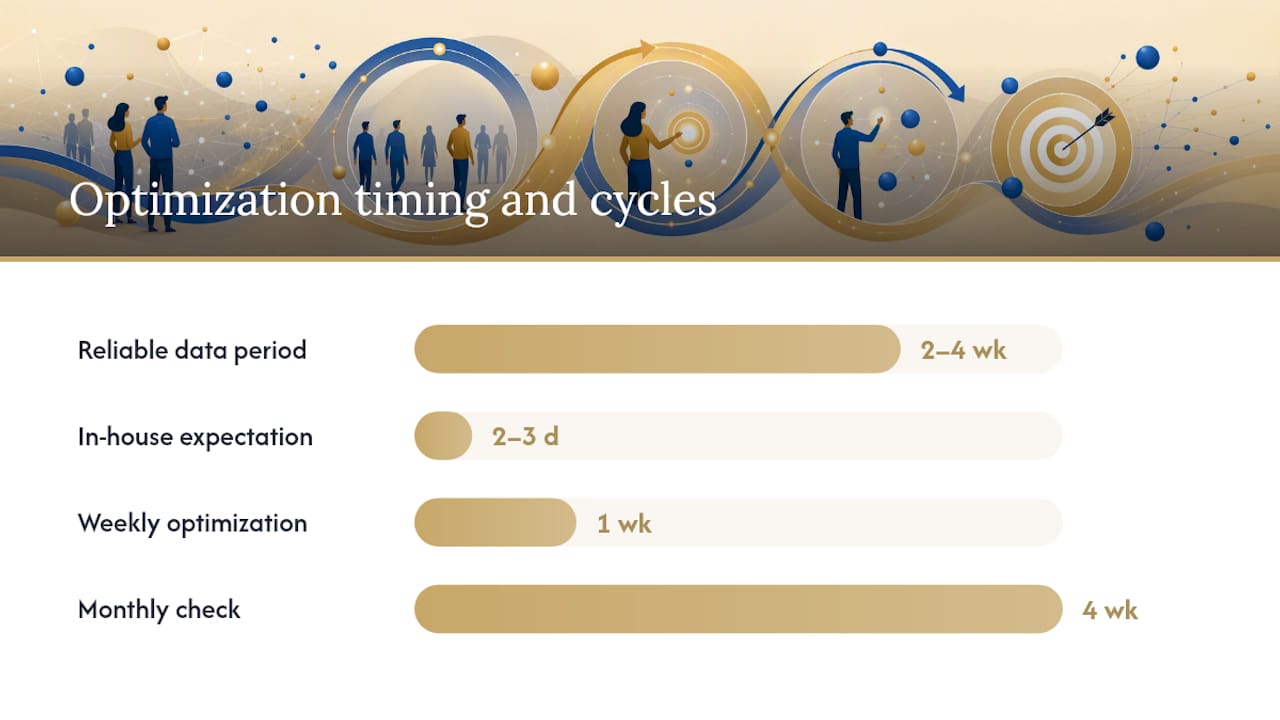
Running retargeting for B2B clients across industries surfaces patterns that a single in-house campaign rarely reveals. Flockleads handles identification, firmographic enrichment, and CRM syncing as one connected pipeline, so leads route instantly into a client’s existing sales workflow instead of sitting in an export file.
A few operational realities show up consistently:
Campaigns typically need two to four weeks of data before optimization decisions become reliable, not two or three days.
Weekly optimization cycles, adjusting audiences, creative, and budget allocation, consistently outperform “set it and check monthly” approaches.
The experiments that most reliably raise lead quality involve tightening firmographic filters, not increasing budget.
Instant lead delivery to CRM shortens sales follow-up time, which measurably improves close rates on retargeted accounts.
When Should You Build In-House Versus Use a Managed Service?
Managed services make sense when you need cross-channel execution and firmographic identification running fast, without hiring three specialists to build it. In-house control makes sense when you already have the data infrastructure and just need more hands.
Before deciding, ask three questions: Does your team already have clean CRM data and consent-compliant tracking? Can you dedicate weekly time to optimization, not just quarterly reviews? Do you need results in weeks, not months? Flockleads exists for teams answering “no” to at least one of those.
— Mieke
Get Retargeting Running Without Building the Stack Yourself
Flockleads runs the entire retargeting operation for you: account identification, firmographic filtering, cross-channel campaign delivery, and instant CRM sync, so leads land in your pipeline the moment they’re qualified, not after a weeks-long setup process.
This fits best for B2B companies that want retargeting live in weeks rather than building identification and enrichment infrastructure from scratch. Clients typically see campaigns stabilize within the first month, with weekly optimization improving lead quality from there. If you’re weighing whether to build this internally or hand it to a team that already runs it daily, compare the trade-offs in lead generation agency versus lead marketplace, then start with a free audit to see what a working setup would look like for your accounts. Full context on how B2B retargeting differs from consumer campaigns is covered in B2B versus consumer lead generation.
Sources
For deeper research, see Salesforce’s B2B digital marketing guide, Adobe’s overview of B2B retargeting, and Leadfeeder’s remarketing playbook. For channel budgeting, check Google Ads versus buying leads.
Frequently asked questions
What Is the Rule of 7 in B2B Marketing?
B2B retargeting relies on repeated, sequenced touches rather than a single ad flight, reflecting the need for multiple exposures before a prospect takes action.
Can You Give an Example of B2B Retargeting?
A common example is targeting everyone from a specific company who visited your pricing page recently with a case study ad on LinkedIn, followed by a demo invitation email later.
What Does B2B Mean in Marketing?
B2B, or business-to-business, refers to marketing aimed at companies and buying groups rather than individual consumers, which is why B2B retargeting targets accounts and stakeholder roles instead of single shoppers.
What Are the Four C’s of B2B Marketing?
Definitions vary by source, but a common version centers on company, category, customer, and competitors, the core factors marketers map before building targeting and messaging strategy.
How Is B2B Retargeting Different From B2B Remarketing?
The terms are largely used interchangeably, though “remarketing” sometimes refers specifically to email re-engagement while “retargeting” more often describes paid ad follow-up across platforms like LinkedIn and Google.
NEED A CLEARER PLAN?
Let’s turn your next move into momentum.
Talk to us →