THE SHORT ANSWER
For most teams, the right stack is Semrush for full-suite competitor and rank data, Ahrefs for backlink-informed keyword strategy, KWFinder for budget-conscious solo operators, Google Keyword Planner as the free PPC-grade baseline, and AnswerThePublic or Frase when the job is mapping questions to content briefs.
For most teams, the right stack is Semrush for full-suite competitor and rank data, Ahrefs for backlink-informed keyword strategy, KWFinder for budget-conscious solo operators, Google Keyword Planner as the free PPC-grade baseline, and AnswerThePublic or Frase when the job is mapping questions to content briefs. Start free, prove the workflow, then upgrade once your publishing cadence or competitive research needs outgrow it.
TL;DR:
Many tools disagree on search volume estimates by 20 to 40 percent, so focus on the relative ranking and verify against Google Search Console.
For small teams or solo operators, starting with Google Keyword Planner and KWFinder or Ubersuggest offers sufficient depth without overpaying.
Agencies and larger teams should trial Semrush and Ahrefs side by side, validating their difficulty scores and export limits before committing.
Prioritize filtering keywords by buying-stage intent and zero-click potential over sheer volume to boost lead generation quality.
Using multiple free tools for ideation and then upgrading for competitor-gap analysis yields better results than relying solely on high-cost enterprise suites.
What Are the Best Keyword Research Tools Right Now?
Every serious keyword research tools comparison in 2026 comes back to the same short list, and for good reason: each tool earns its spot by doing one thing better than the rest. Here’s the shortlist worth trialing before you commit a budget line to any of them.
Semrush — best for agencies and in-house teams running full-funnel SEO and PPC together; the free tier caps you at 10 searches a day, and the standout feature is its keyword magic tool paired with SERP-feature and AI-overview tracking.
Ahrefs — best for content teams that want keyword data tied directly to backlink and content-gap analysis; there’s no permanent free tier beyond limited webmaster tools, and the standout is its Keywords Explorer’s click-through-rate data by country.
Google Keyword Planner — best as the free baseline for PPC-grade volume. and CPC estimates; it’s entirely free but shows broad volume. ranges unless your account has active ad spend.
KWFinder (Mangools) — best for solo consultants and small teams on a budget; a limited free trial exists, and the standout is clean long-tail and local keyword discovery without the enterprise price tag.
AnswerThePublic — best for question-based content ideation and FAQ pages; a few free searches per day are available, and the standout is its visual map of question permutations pulled from autocomplete.
Ubersuggest — best for beginners who need a low-cost entry point into keyword and content-idea research; it has a generous free daily allowance, and the standout is its simple content-idea and domain-overview combo.
SE Ranking — best for teams that want keyword tracking bundled with white-label reporting; a free trial is available, and the standout is its AI-visibility tracking for brand mentions in AI overviews.
Frase — best for turning keyword and question data straight into a content brief; a limited free trial is offered, and the standout is its AI-assisted brief generator that pulls SERP-based topic clusters automatically.
None of these is universally “the best.” The best free tool for a solo blogger publishing twice a month is overkill-free by design, while the best enterprise keyword research tool for a 50-person content team would bankrupt that same blogger in licensing fees. The trick is matching the tool to your actual publishing volume., not the one with the flashiest dashboard.
How Do You Choose the Right Keyword Tool for Your Team?

Picking from a list of best SEO keyword research tools is easy. Picking the right one for your actual workflow is the part most guides skip. Four variables decide it for you before you even open a demo.
Budget sets the ceiling. Publishing frequency sets the floor: a team shipping two articles a month rarely needs the same horsepower as one shipping twenty. Need for competitor-gap analysis (finding keywords rivals rank for that you don’t) pushes you toward Semrush or Ahrefs specifically, since budget tools generally don’t do this well. And AI/zero-click visibility tracking, still new to most stacks, matters more each quarter as AI overviews and answer engines pull traffic away from traditional blue links.
Here’s a workflow that keeps you from overbuying:
Discover for free. Run your seed terms through Google Keyword Planner and cross-reference anything already ranking in Google Search Console. This costs nothing and tells you what’s already working.
Validate with difficulty and click data. Take your shortlist into a tool that shows keyword difficulty alongside estimated organic click-through rate, not just volume… A term with 5,000 monthly searches and a 2% click-through rate because Google answers it directly in a featured snippet is a worse target than a 500-search term with a 40% click-through rate.
Trial a paid tool with a focused test. Pick five to ten priority keywords and run them through Semrush or Ahrefs (or both, most offer short trials) before buying. Compare their difficulty scores and volume. estimates against what Search Console eventually shows you.
During any trial, ask the vendor directly: how often is the keyword database refreshed, is volume. based on clickstream data or modeled estimates, and can you export the data you need without hitting a plan-tier wall. Watch for three red flags: data that hasn’t refreshed in over 60 days, a difficulty score with no visible methodology behind it, and sampling limits so tight the free version is functionally a demo, not a tool.
Pro Tip: Before paying for any keyword planner tools comparison winner, pull your own top 20 ranking keywords from Search Console and plug them into the tool’s checker. If its volume. and difficulty numbers look wildly disconnected from your actual click data, that mismatch will repeat across every keyword you research with it.
Which Keyword Research Tool Fits Your Situation?
Here’s the detail behind each name on the shortlist, what to actually test in a trial, and who each tool is built for.
Google Keyword Planner
Keyword Planner is Google’s own ad-planning tool, repurposed by nearly every SEO on earth as a free volume.-check baseline. It’s the most accurate source for PPC-specific volume. and CPC estimates because it ties directly to live Google Ads impression and bid data, something no third-party tool can replicate exactly.
Best for: Anyone needing a free, authoritative check on search volume. and CPC before spending on ads or content.
Standout feature: Direct access to Google’s own auction data for bid estimates and forecasted conversions.
Free option: Yes, fully free with a Google Ads account, though volume. often shows as a broad range instead of an exact number unless you’re actively running paid campaigns.
Entry price (2026): Free.
Pros: Ties to Google’s actual auction data; no cost at all; ideal starting point for PPC lead-generation planning.
Cons: Volume ranges get vague without ad spend; no difficulty score for organic ranking; limited competitive or content-gap insight.
What to validate: Whether the volume. range narrows meaningfully once you add a small ad budget, and how its numbers compare to Search Console impressions for terms you already rank for.
Semrush
Semrush is the closest thing the industry has to an all-in-one SEO and PPC command center, and it’s usually the first name that comes up in any Semrush vs Ahrefs vs Moz debate. Its Keyword Magic Tool generates enormous keyword lists from a single seed term, and it layers in SERP-feature tracking and, increasingly, tracking for how brands appear inside AI overviews.
Best for: Agencies and mid-to-large in-house teams running combined SEO and PPC strategy.
Standout feature: Keyword Magic Tool plus integrated AI-visibility and SERP-feature tracking.
Free option: Yes, limited to 10 searches per day without an account.
Entry price (2026): Around $139.95 per month for the entry-level Pro plan, with organic research and content tools included.
Pros: Massive keyword database with strong filtering by intent; combines organic and paid research in one dashboard.
Cons: Pricing climbs fast once you need more than a handful of projects; the interface has a learning curve for new users.
What to validate: How its keyword difficulty score correlates with your actual ranking movement over 30 to 60 days, not just the score itself.
Ahrefs
Ahrefs built its reputation on backlink data, and that heritage still shapes how its keyword tool works. Keywords Explorer ties keyword opportunity to link-building difficulty, which matters if your content strategy depends on outranking sites with strong backlink profiles.
Best for: Content and link-building teams that want keyword difficulty contextualized by actual backlink gaps, not just a generic score.
Standout feature: Click-through-rate data segmented by country, showing how many searches for a term actually result in a click.
Free option: Limited free tools exist (like a basic backlink checker), but Keywords Explorer requires a paid plan.
Entry price (2026): Around $129 per month for the Lite plan, though keyword export limits are tight at that tier.
Pros: Click-through-rate transparency is rare among competitors; backlink and content data feed directly into keyword prioritization.
Cons: No meaningful permanent free tier for keyword research specifically; lower-tier plans cap exports aggressively.
What to validate: Whether the Lite plan’s export caps actually cover your monthly research volume. before you commit to a higher tier.
KWFinder (Mangools)
KWFinder is the value pick in nearly every affordable keyword research options roundup, and it earns that spot honestly. It strips away the enterprise clutter and focuses on long-tail and local keyword discovery with a genuinely clean interface.
Best for: Solo consultants, freelancers, and small teams that need solid data without a five-figure annual bill.
Standout feature: Precise local and long-tail keyword filtering, including SERP overview by country and city.
Free option: A limited free trial with capped daily lookups; no permanent free plan.
Entry price (2026): Around $29 per month for the Basic Mangools plan, billed annually.
Pros: Reliable local and long-tail coverage at a fraction of enterprise pricing; simple enough for non-specialists to use immediately.
Cons: Database and feature depth trail Semrush and Ahrefs noticeably at scale; limited competitor-gap analysis.
What to validate: How its keyword lookup limits hold up against your actual monthly research volume. before the trial period ends.
AnswerThePublic
AnswerThePublic doesn’t compete on volume. data. It competes on shape: it visualizes every question, preposition, and comparison people type around your seed keyword, pulled largely from autocomplete patterns.
Best for: Content teams building FAQ pages, voice-search content, or top-of-funnel blog posts driven by real questions.
Standout feature: Visual question-map that clusters queries into who, what, why, and comparison groups.
Free option: Yes, a small number of free searches per day.
Entry price (2026): Paid plans start around $5 per month for limited use, scaling up for unlimited searches and PRO reports.
Pros: Unmatched for surfacing question-based long-tail ideas; genuinely fast for content ideation sessions.
Cons: No search volume. or difficulty scoring built in; data quality can feel thin outside major English-speaking markets.
What to validate: Whether the question clusters it generates actually match the “People Also Ask” boxes you see for your target terms.
Ubersuggest
Ubersuggest positions itself as the accessible entry point for people who find Semrush and Ahrefs intimidating or overpriced. It bundles keyword suggestions, content ideas, and a basic domain overview into one simple dashboard.
Best for: Beginners, small business owners, and solo bloggers who want one affordable tool instead of five free ones stitched together.
Standout feature: Combined keyword and content-idea view that shows top-performing articles for a given term.
Free option: Yes, a generous daily allowance of free searches without an account.
Entry price (2026): Around $12 per month for the Individual plan, among the cheapest paid tiers in this category.
Pros: Extremely low cost of entry; interface is friendly for non-technical users.
Cons: Data depth and accuracy trail the enterprise-grade tools; fewer advanced filtering options for intent or SERP features.
What to validate: How closely its volume. estimates track Search Console data for terms you already rank for, since budget tools vary more here.
SE Ranking
SE Ranking occupies a middle ground: not as deep as Semrush, but more complete than most budget tools, especially for agencies that need white-label reporting alongside keyword tracking.
Best for: Agencies managing multiple client accounts that need branded reports plus AI-visibility monitoring.
Standout feature: AI-visibility tracking that monitors brand mentions inside AI overviews and chat-based answer engines.
Free option: A free trial is available; no permanent free tier.
Entry price (2026): Around $65 per month for the entry-level Essential plan.
Pros: Strong price-to-feature ratio for agencies; white-label reporting saves real time on client deliverables.
Cons: Keyword database is smaller than Semrush or Ahrefs; some advanced features feel less polished by comparison.
What to validate: Whether its AI-visibility tracking actually catches mentions you can verify manually across a sample of AI overview results.
Frase
Frase takes a different angle entirely: instead of handing you a keyword list, it turns keyword and question data directly into a structured content brief, pulling topic clusters from top-ranking pages automatically.
Best for: Content teams and freelance writers who want research and briefing collapsed into one step instead of two.
Standout feature: AI-assisted brief generator that clusters subtopics from competing top-ranking pages for a given query.
Free option: A limited free trial exists; no permanent free plan.
Entry price (2026): Around $15 per month for the Solo plan, with higher tiers for team collaboration.
Pros: Cuts research-to-brief time significantly; genuinely useful for teams outsourcing writing to freelancers.
Cons: Not a true keyword-discovery tool on its own; works best paired with a dedicated keyword database tool.
What to validate: Whether the auto-generated briefs still require heavy manual editing for your specific niche before you rely on them at scale.
How Do These Tools Compare at a Glance?
Volume numbers are the one place every top keyword analysis tool disagrees with the others, sometimes by a wide margin. Independent comparisons find volume. estimates can vary 20 to 40 percent between major tools, which means the exact number matters less than the direction and relative ranking between your candidate keywords.
Tool | Best For | Free Option | Entry Price (2026) | Standout Feature |
|---|---|---|---|---|
Free PPC-grade baseline | Yes, unlimited with an Ads account | Free | Live auction-based CPC and volume. data | |
Full-suite SEO/PPC teams | Yes, 10 searches/day | ~$139.95/mo | Keyword Magic Tool + AI-visibility tracking | |
Backlink-informed keyword strategy | Very limited | ~$129/mo | Click-through-rate data by country | |
Budget-conscious solo operators | Trial only | ~$29/mo | Clean local and long-tail discovery | |
AnswerThePublic | Question and FAQ content | Yes, limited daily searches | ~$5/mo | Visual question-map from autocomplete |
Ubersuggest | Beginners and small budgets | Yes, generous daily limit | ~$12/mo | Combined keyword + content-idea view |
SE Ranking | Agencies needing white-label reports | Trial only | ~$65/mo | AI-overview brand monitoring |
Frase | Turning research into content briefs | Trial only | ~$15/mo | AI-generated content briefs from SERP clusters |
A few practical notes on reading this table. When two tools disagree on volume. for the same term, treat the number as directional and verify against Google Search Console or your own Keyword Planner account, both of which reflect real click and impression behavior rather than a modeled estimate. And you rarely need to choose just one: a common, cost-effective setup is stacking two or three free tools for ideation, then buying a single paid suite once your competitor-gap or rank-tracking needs justify the license.
What Does Keyword Research Look Like Through a Lead-Generation Lens?
Most keyword guides stop at volume. and difficulty. At Flockleads, we care more about which keywords actually turn into a form fill, because volume. without conversion intent is just traffic that bounces. Mapping a keyword to where a buyer sits in their journey (early research, active comparison, ready to request a quote) matters more than chasing the biggest number in the volume. column.
A high-volume. keyword with a weak buying signal is often worse to target than a low-volume. keyword with obvious commercial intent. Filtering by intent and click-through potential, not just search volume., is what separates traffic from leads.
The workflow we run internally follows a simple sequence: discover broad terms, validate them against actual search behavior, prioritize by buying-stage intent, brief the content or landing page, then measure conversion rate against the keyword’s original intent label. We also watch how often a keyword triggers an AI overview, since that visibility increasingly determines whether a click happens at all.
Pro Tip: Pull your top 50 target keywords’ volume. estimates from whichever tool you’re evaluating, then compare them against the same 50 terms in Google Search Console. If the tool’s numbers track closely with your real impression data, trust its difficulty scores too. If they diverge wildly, treat every metric from that tool with skepticism.
What’s the Bottom Line on Choosing a Keyword Tool?
If you’re a solo operator or small business testing the waters, start with Google Keyword Planner and KWFinder or Ubersuggest, and only upgrade once you’re publishing consistently enough to need deeper competitor data. If you’re an agency or a team scaling content production, trial Semrush and Ahrefs side by side on the same ten keywords before signing an annual contract.
A sensible trial order looks like this: Keyword Planner first for the free baseline, then KWFinder for budget-tier depth, and finally a Semrush or Ahrefs trial once you’re confident you need enterprise-level competitor-gap analysis. During each trial, validate four things specifically: how accurate local volume. estimates are for your market, how the difficulty model behaves on keywords you already rank for, what the export limits actually allow at your plan tier, and whether API access exists if you plan to automate reporting later. Skip any of those checks and you risk paying for depth you’ll never use, or worse, discovering the gap only after the invoice arrives.
Our Take: Stop Optimizing for Volume, Start Optimizing for Buyers
The conventional advice on keyword research treats volume. as the north star. That’s backwards for most B2B teams. A keyword with 50 searches a month and obvious purchase intent will outperform a 5,000-search term that’s mostly answered inside an AI overview before anyone clicks through.
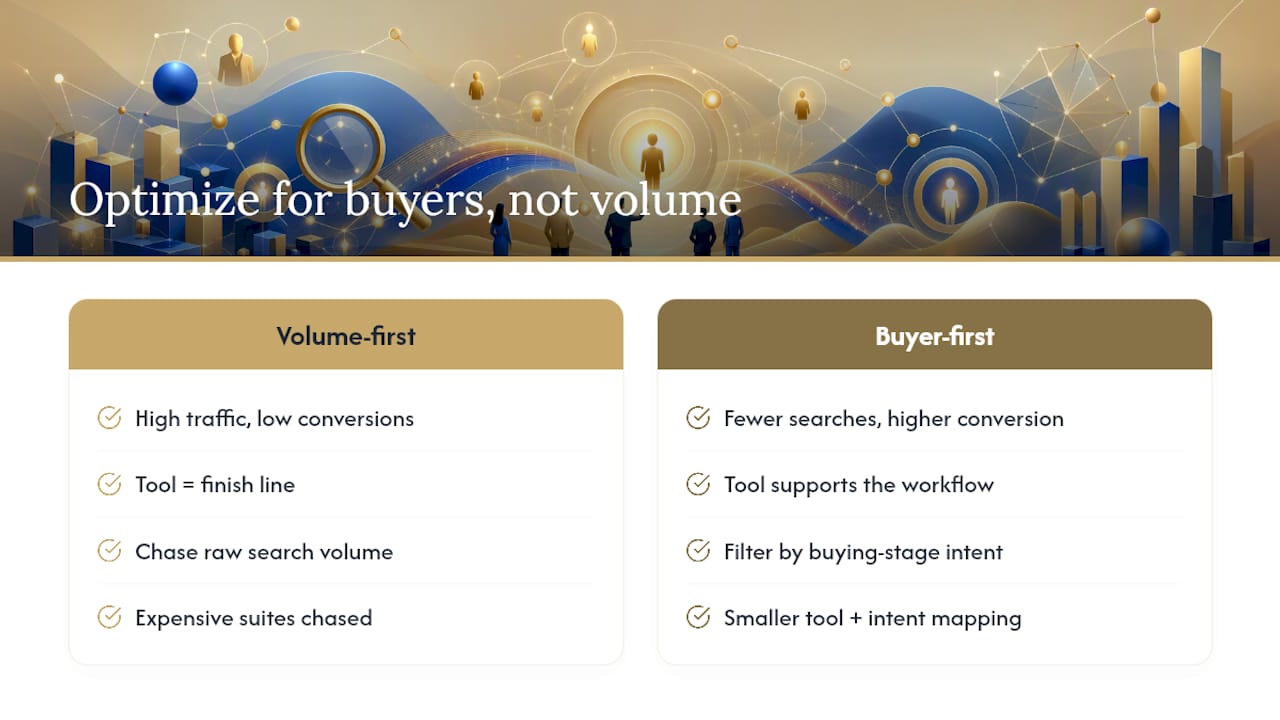
Where most guides fall short is treating tool selection as the finish line instead of the starting point. Buying Semrush doesn’t generate a single lead on its own. What matters is what happens after the export: filtering that list by buying-stage intent, checking which terms already trigger AI overviews or zero-click answers, and briefing content around the terms most likely to convert, not the ones with the biggest number in the volume. column.
If you take one thing from this article, prioritize intent filtering over database size. A smaller, cheaper tool used with disciplined intent mapping will outperform an expensive suite used to chase vanity volume… Get the workflow right first. The tool budget can follow once you know exactly what you’re optimizing for.
— Mieke
Sources
Frequently asked questions
What Is the Most Accurate Keyword Research Tool?
No single tool is universally the most accurate, since volume. estimates vary 20 to 40 percent between major platforms. For PPC-specific accuracy, Google Keyword Planner is the closest to ground truth because it draws on live Google Ads auction data.
Which Free Tool Is Best for Keyword Search?
Google Keyword Planner is a strong free option for volume. and CPC direction, while AnswerThePublic and Ubersuggest are useful free-tier picks for content ideation and long-tail discovery. Most teams get the best results combining two or three free tools before paying for anything.
Does Google Have a Free Keyword Tool?
Yes, Google Keyword Planner is entirely free with a Google Ads account and provides keyword ideas along with volume. and CPC estimates, though volume. often displays as a broad range unless you’re actively running paid campaigns.
Can AI Do Keyword Research?
AI-assisted features now show up inside tools like Frase and SE Ranking, which generate content briefs and track brand visibility in AI overviews, but they still work best paired with a dedicated keyword database rather than replacing one outright.
What Should I Look for Beyond Volume When Comparing Tools?
Focus on intent filters, click-through-rate data, and difficulty-model transparency, since raw volume. alone doesn’t tell you whether a keyword converts. For B2B teams specifically, mapping keywords to buyer-journey stage matters more than chasing the highest search count.
NEED A CLEARER PLAN?
Let’s turn your next move into momentum.
Talk to us →