THE SHORT ANSWER
The strongest campaign naming convention follows a simple pattern: Product_Objective_YYYY-MM_Funnel_Audience_Geo , or a leaner four-field version for smaller teams. The one rule that matters more than any field you choose is consistency: one delimiter, a closed vocabulary of approved codes, and year-first dates every time.
The strongest campaign naming convention follows a simple pattern: Product_Objective_YYYY-MM_Funnel_Audience_Geo, or a leaner four-field version for smaller teams. The one rule that matters more than any field you choose is consistency: one delimiter, a closed vocabulary of approved codes, and year-first dates every time. Everything below covers the templates, platform quirks, and enforcement steps that make that rule stick.
TL;DR:
Consistency in delimiter, case, and date format is essential to ensure campaign names sort correctly and match UTM parameters precisely.
Using a fixed taxonomy and only encoding immutable metadata in campaign names prevents stale or confusing information.
Automated validation via regex and a single source of truth for codes help enforce naming rules and improve data quality.
Campaign hierarchy should be structured so that each level adds unique, non-redundant information, avoiding repeated details across levels.
Relying on managed services like FlockLeads can ensure continuous governance, campaign optimization, and accurate lead attribution beyond in-house capacity.
Quick Checks to Audit Your Campaign Naming Conventions Today
Before rebuilding anything, run your existing accounts through a five-minute audit. Most naming problems trace back to one of these gaps.
Delimiter check: Are you mixing underscores, hyphens, and spaces across campaigns, or using one consistently?
Date format check: Do dates read
2026-03(sorts correctly) orMarch 2026/3-26(sorts badly or not at all)?Closed vocabulary check: Can two people on your team name the same campaign type and land on the exact same code, or does everyone improvise?
UTM mapping check: Does
utm_campaignmatch the actual campaign name, or has it drifted?Ownership check: Is there one person or one document responsible for the convention, or does everyone edit it informally?
Pitfall scan: Look for budgets or performance tiers baked into names (they change; names shouldn’t), plus spaces, ampersands, or slashes that break in exports.
If you fail two or more of these, the rest of this guide tells you exactly how to fix it, field by field.
What Is a Campaign Naming Convention, Exactly?
A campaign naming convention is the written rule set for how you construct a campaign name. It sits between two other things people often confuse: your taxonomy and the name itself.
The taxonomy is your list of what to track: objective, funnel stage, audience, geography, product line. The convention is the how: the order of those fields, the delimiter, the case rules, the exact codes allowed for each field. The name is what comes out the other end when you apply the convention to a specific campaign.
Get this distinction right and you avoid the most common failure mode: teams argue endlessly about naming “style” when the real problem is that nobody agreed on the taxonomy first.
One more boundary matters just as much. A campaign name should only ever encode immutable metadata, information that won’t change after launch. Objective, product, launch month, target audience, and market are fixed the day you build the campaign. Budget, bid strategy, and current performance tier are not; they shift weekly, and baking them into a name guarantees the name goes stale within a month.
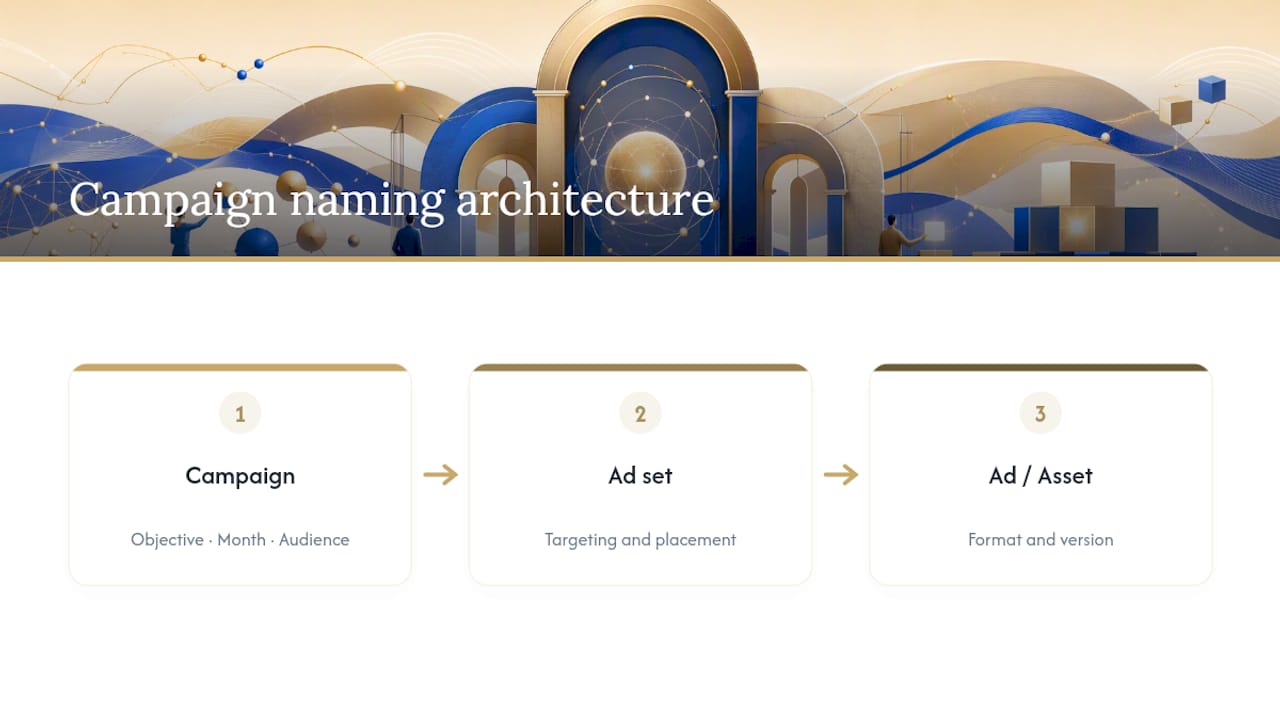
This structure has to work at three levels. Campaigns carry the broad, stable facts. Ad sets or ad groups carry targeting and placement detail. Individual ads or assets carry creative-specific detail like format and version. Each level should add information the parent level doesn’t already state.
Why Standardized Campaign Naming Actually Moves the Needle
Consistent names are what let you join data across systems that otherwise have no idea they’re describing the same thing. Google Analytics, Salesforce, and HubSpot each store campaign data on their own schedule and in their own format. The only reliable key connecting a Google Ads click to a Salesforce opportunity to a HubSpot lead record is the campaign string itself, assuming it was written the same way in all three places.
When that string is inconsistent, someone on your team spends hours every reporting cycle manually reconciling “Spring_Sale_2026” in one platform against “spring-sale-26” in another. That reconciliation time is pure overhead. Standardized names collapse it to near zero, because a pivot table or a BI dashboard can filter and group on the naming fields directly instead of relying on someone’s memory of which campaign was which.
There’s a broader stake here too. Poor data quality is a documented drag on analytics and AI initiatives, and campaign names are frequently the dirtiest field in a marketing dataset because they’re free text with no validation. If your organization is feeding campaign data into a predictive model, an AI-driven budget allocator, or even a quarterly board deck, inconsistent names introduce errors that compound the further downstream they travel. Fixing the naming convention is often the highest-leverage, lowest-cost data quality fix a marketing team can make.
Key Fields Every Campaign Name Should Include
Not every field belongs in every campaign name, but a working convention pulls from the same short list of building blocks. Here’s what each one does and a suggested short code to go with it.
Year/Month (
2026-03): anchors the campaign in time and sorts correctly when written year first.Campaign type or objective (
CONV,LEADS,AWARE,TRAF): tells anyone scanning a report what the campaign was built to do.Funnel stage (
TOF,MOF,BOFfor top, middle, and bottom of funnel): critical for anyone analyzing performance by funnel position rather than by channel alone.Audience or segment (
RTGfor retargeting,LALfor lookalike,BROADfor unrestricted targeting): flags how the audience was built, which matters enormously for cost and conversion benchmarking.Product or offer (
ProductA,WinterPromo): ties the campaign to a specific SKU, service line, or promotional offer.Geo or market (
US,EastCoast,NYC): needed the moment you run more than one region.Unique ID (optional, a short sequential number or hash): useful mainly at enterprise scale, where two campaigns might otherwise produce an identical string.
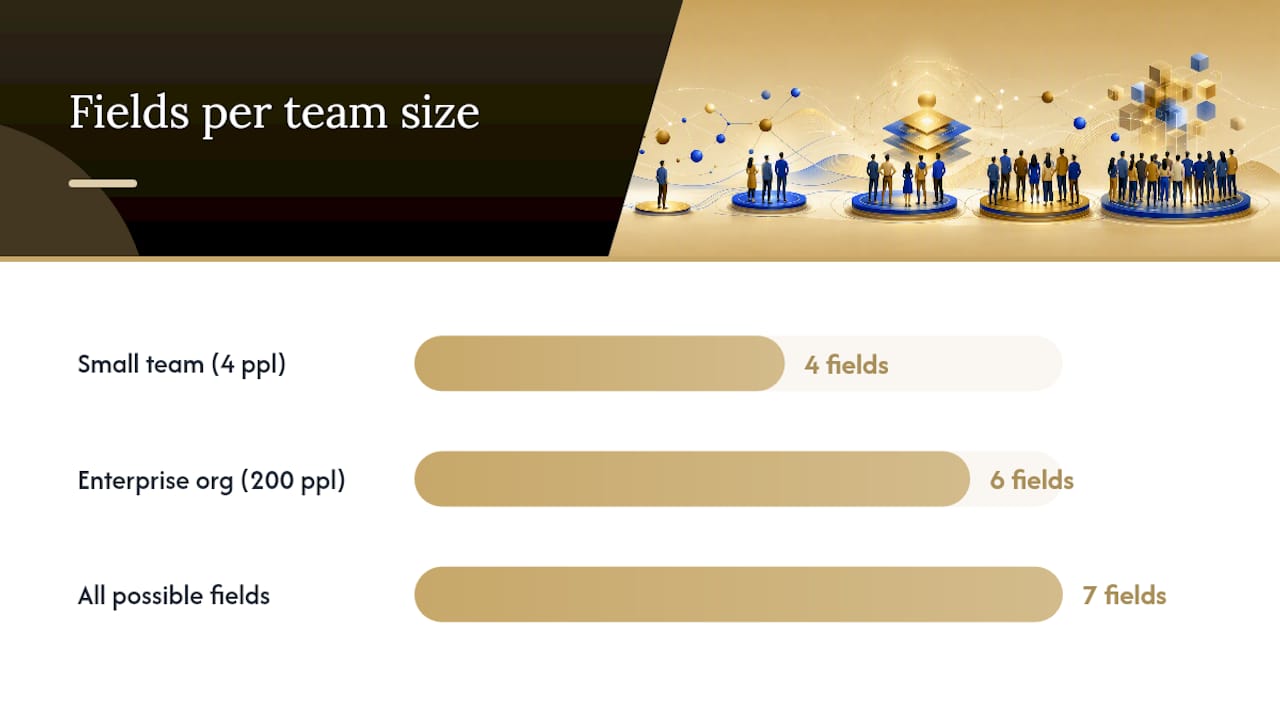
Not every team needs all seven. A four-person marketing team running a handful of campaigns a month does fine with four fields: objective, date, audience, and geo. A 200-person enterprise marketing org running hundreds of campaigns across a dozen product lines usually needs six, including the unique ID, just to avoid collisions.
Pro Tip: Write your controlled vocabulary as an actual reference document, not tribal knowledge. A shared spreadsheet listing every approved code for every field takes twenty minutes to build and eliminates 90 percent of the “wait, is it LEADS or LEAD?” arguments that erode a convention over time.
Building the Hierarchy: Campaign, Ad Set, and Ad Level
Redundant naming is the single most common way a good convention degrades in practice. Someone repeats the campaign’s objective in the ad set name, then repeats the ad set’s audience in the ad name, and within six months every name is twice as long as it needs to be and half as useful. Structure each level to add new information only.
Campaign level holds stable, top-line metadata. This is where objective, product line, and launch month live, since these facts don’t change for the life of the campaign. A campaign name like
WinterPromo_LEADS_2026-01tells you everything you need before you drill in further.Ad set or ad group level holds targeting and placement. This is where audience seed, placement, and, for search, match type or theme belong. An ad set under that campaign might read
RTG_Mobileor, for search,Broad_InstallCostto flag the keyword theme it covers.Ad or asset level holds creative-specific detail. Format, concept, and version number live here, and only here. Something like
VideoTestimonial_v2tells a media buyer exactly which creative variant they’re looking at without repeating the campaign’s product name or the ad set’s audience.
The test for a well-built hierarchy is simple: read all three levels together and confirm no fact appears twice. If it does, push it up to the highest level where it’s true and strip it out everywhere else.
Formatting Rules and UTM Alignment That Actually Hold Up
The delimiter argument is over, and underscores won: they survive exports, CSV parsing, and URL encoding far more reliably than spaces or mixed punctuation, which frequently get mangled into %20 strings or broken commas when a name moves between platforms. Reserve hyphens for inside a single field, like a date range, and never use them as the primary separator between fields.
Pick underscores (
_) as your default delimiter between fields; use hyphens only within a field, such as a date range or a compound offer name.Choose one case standard, either all lowercase or consistent CamelCase, and apply it everywhere; mixing
Winter_Promoandwinter_promoacross campaigns creates duplicate-looking rows in any report grouped by exact string match.Ban spaces, ampersands, slashes, and special characters entirely. They break URL encoding and CSV exports in ways that are hard to trace after the fact.
Format every date as
YYYY-MM. Year-first sorting means your campaign list orders itself chronologically without any manual sort step, which alphabetical formats like “March 2026” never do.
The mapping rule that ties this all together: utm_campaign should be identical to the campaign name itself, character for character. Anything less and you’ve built two parallel systems that drift apart the moment someone edits one but not the other. Google’s Campaign URL Builder is the standard tool for generating that tagged URL, and it forces you to think through each UTM parameter, utm_source, utm_medium, utm_campaign, before the link ever goes live. Mapping the fuller taxonomy is worth doing deliberately too: campaign-level fields map to utm_campaign, while tactic-level detail often belongs in utm_medium or utm_content depending on how granular your reporting needs to be.
Statistic to remember: teams that treat utm_campaign and the platform campaign name as two separate strings routinely produce mismatched attribution in Google Analytics, because the join between ad platform and analytics tool depends entirely on that string matching exactly.
Rolling Out and Enforcing Your Naming Convention
A naming convention that lives only in someone’s head, or in a Slack thread from eight months ago, is not a convention. It’s a suggestion, and suggestions decay fast once more than one person is naming campaigns.
Start with a single source of truth: one document, spreadsheet, or wiki page that lists every field, every approved code, and the exact order and delimiter to use. Assign an owner, not a committee, someone whose job includes updating that document and fielding questions when a new campaign type doesn’t fit the existing vocabulary.
Document the convention in one place everyone on the team can find in under ten seconds.
Assign a single owner responsible for updates and edge-case decisions.
Build automated validation using regex checks that confirm field count, delimiter placement, and closed-vocabulary matches before a campaign goes live.
Run a quarterly audit pulling a sample of live campaign names and checking them against the documented rules.
Add a pre-launch validation step so a malformed name never reaches an ad account in the first place.
Regular expressions are the practical tool for automated validation here. A regex pattern can check that a campaign name has exactly the right number of fields, that the date field matches YYYY-MM, and that each code comes from your approved list, catching a bad name before it launches rather than after it’s polluted a quarter of reporting.
Migrating historical campaigns is the part teams get stuck on. You don’t need to rename every campaign that ever ran. A better approach, and one that avoids breaking historical reports, is adding a canonical Campaign Code field in your CRM or data warehouse that maps old, inconsistent names to a clean standardized code. New campaigns follow the new convention going forward; old campaigns get tagged retroactively without ever being renamed in the ad platform itself.
Pro Tip: Run your validation regex against a handful of live campaigns before you announce the new convention team-wide. Nothing kills adoption faster than rolling out a “mandatory” naming standard that breaks on the first real campaign someone tries to build with it.
Platform-Specific Naming Rules You Can’t Skip
Every platform imposes its own quirks on naming, and a convention that ignores them breaks the first time someone tries to apply it in the ad account itself.
Search campaigns need theme and match type visible at the ad group level, since that’s where keyword strategy actually lives; an ad group named Broad_InstallCost tells a media buyer both the match type and the keyword theme in five characters. Meta’s Advantage+ and dynamic creative tools make audience-building decisions algorithmically, so your convention needs a flag like AdvPlus or BROAD to distinguish algorithm-driven targeting from a manually built audience seed. Skip that flag and every performance comparison between manual and automated targeting becomes guesswork.
Character limits are the other trap. Search campaigns and ad groups generally tolerate long names, but LinkedIn and some Meta placements truncate names in reporting views well before the full string displays. When truncation is unavoidable, keep a canonical lookup table mapping the full name to whatever shortened version a platform forces on you, so you’re never reverse-engineering a chopped-off string during a reporting cycle. Whether to include a platform prefix (GAds_ or Meta_) depends on whether you already segment reports by platform elsewhere; if you do, skip the redundant prefix.
Copy-Paste Templates and Real Examples
Start with whichever template matches your team’s scale, then adjust field order to match your own taxonomy document.
Simple four-field template (small teams): Product_Objective_YYYY-MM_Geo Example: WinterPromo_LEADS_2026-01_US
Full six-field template (enterprise teams): Product_Objective_YYYY-MM_Funnel_Audience_Geo Example: ProductA_CONV_2026-03_BOF_RTG_EastCoast
Match your utm_campaign string to the campaign name exactly, and build the full tagged URL in Google’s Campaign URL Builder rather than hand-typing parameters, which is where most mismatches originate.
Channel | Campaign name example | utm_campaign value |
|---|---|---|
Paid social (Meta) |
|
|
Search (Google Ads) |
|
|
|
| |
Webinar |
|
|
For teams running paid social specifically, campaign naming discipline pays off fastest when applied across Meta campaigns for a specific vertical or a Google Ads account structured around search themes. In these cases, ad group names and keyword themes need to line up cleanly with the campaign-level product field.
The FlockLeads View on Naming Discipline and Lead Tracking
In B2B pipelines, a sloppy campaign name is how leads quietly lose their source. A lead that comes in tagged fb_campaign_2 instead of a structured name gets misattributed the moment it lands in a CRM, and once misattributed, it stays that way through every downstream report. Naming discipline is lead-source integrity, not just tidiness.
FlockLeads treats tracking lead source correctly as a foundational step in campaign setup, not an afterthought layered on later. That same discipline extends to how content gets structured for AI visibility: question-based headings and clearly parsed metadata help both search engines and AI answer engines understand what a page or campaign actually covers.
Where Most Naming Advice Gets It Backwards
Most naming guides treat this as an aesthetic problem, debating whether campaigns should read in Title Case or lowercase, as if the format were the point. The format isn’t the point. The point is whether a machine, a report, or a new hire six months from now can parse the name without asking anyone a question.
That reframing changes what you prioritize. A convention with an ugly but rigidly enforced structure beats a beautiful one nobody follows. The teams that get this right treat their naming document the way engineers treat a style guide: not optional, not a suggestion, checked automatically before anything ships.
The other place conventional advice falls short is scale planning. Most guides write for a five-person team running a dozen campaigns and never mention what breaks when you’re running hundreds across a dozen product lines. That’s exactly where the canonical Campaign Code field earns its place, letting you standardize reporting without a painful bulk rename of every historical campaign in the account.
If you take one thing from this: build the validation before you build the vocabulary. A perfect field list with no regex check behind it will drift within a quarter. A mediocre field list with automated enforcement will outlast it by years.
— Mieke
When In-House Governance Isn’t Enough
A naming convention solves half the problem. The other half is what happens after a well-tagged lead lands, and that’s where a lot of in-house teams stall out, not from lack of discipline, but from lack of hands to run campaigns, tune them weekly, and route leads into a CRM that’s actually kept current.
FlockLeads exists for exactly that gap. Instead of asking your marketing team to build and maintain campaigns across Meta, LinkedIn, Google, and TikTok on top of everything else on their plate, FlockLeads runs the campaigns, qualifies the leads through structured forms, and delivers them straight into your CRM with the tracking and naming discipline this article just walked through already built in. Weekly optimization and reporting come standard, so you’re not the one auditing UTM strings every quarter.
The choice isn’t really “convention versus no convention.” It’s whether your team builds and enforces that governance in-house, or hands the operational load to a service that’s already structured around clean lead source tracking. If you’re a contractor or B2B service business weighing that tradeoff, start with a look at how lead generation actually works for contractors and request a free audit to see what a properly tagged, fully managed campaign setup looks like for your business.
Sources
Frequently asked questions
How do you name a campaign?
Pick a fixed set of fields, typically product, objective, date, and audience or geo, join them with one consistent delimiter (underscore is safest), and always use YYYY-MM date formatting so campaigns sort chronologically.
What are some good campaign naming conventions?
The most reliable ones use a closed vocabulary of short codes (like TOF/MOF/BOF for funnel stage), a single delimiter throughout, and identical text in the campaign name and the utm_campaign parameter.
What are the three types of naming conventions?
Naming approaches generally fall into flat conventions (all fields in one string), hierarchical conventions (different fields at campaign, ad set, and ad level), and code-based conventions that use a canonical Campaign Code mapped to a lookup table rather than encoding every detail in the visible name.
What is a naming convention in marketing?
It’s the documented rule set governing how campaign, ad set, and ad names get constructed, covering which fields to include, what codes are allowed, and how those fields map to UTM parameters for analytics.
How does FlockLeads handle campaign naming for managed accounts?
FlockLeads applies structured naming and UTM mapping across every campaign it runs for a client, so leads arrive in the CRM with clean, traceable source data rather than generic platform labels.
NEED A CLEARER PLAN?
Let’s turn your next move into momentum.
Talk to us →