THE SHORT ANSWER
If your pipeline is thin, a new CRO tool probably won’t fix it. B2B teams with adequate traffic, an internal experimentation owner, and CRM instrumentation already in place should run a structured conversion rate optimization tools comparison and pick a platform that ties test outcomes directly to qualified-lead value.
If your pipeline is thin, a new CRO tool probably won’t fix it. B2B teams with adequate traffic, an internal experimentation owner, and CRM instrumentation already in place should run a structured conversion rate optimization tools comparison and pick a platform that ties test outcomes directly to qualified-lead value. Everyone else — teams where traffic quality, lead qualification, or CRM delivery is the real bottleneck — gets faster pipeline results from a managed lead-gen partner like Flockleads than from any testing suite.
Two facts frame this decision. Google Optimize shut down in 2023, splitting the CRO market into marketer-led visual suites and engineering-led experimentation platforms. And the most common reason B2B optimization programs stall has nothing to do with which tool was chosen: it’s missing CRM integration, so no one can prove a test variant produced a single qualified lead.
Managed lead-gen first if: pipeline velocity is the primary goal, internal experimentation capacity is limited, or CRM instrumentation isn’t in place yet.
Standalone CRO tool if: you have 1,000+ monthly conversions, a dedicated experimentation owner, and CRM/analytics already wired up.
Blended approach if: you need immediate qualified-lead flow while building an internal testing program in parallel.
What does a solid CRO tool comparison require for B2B buyers?
Most CRO software reviews focus on features. B2B buyers need to filter on pipeline impact first.
Tier 1 — Non-negotiable:
CRM webhook or API integration (Salesforce, HubSpot, Pipedrive) with lead-ID linkage
Lead qualification capture at the form level, not just a page conversion event
Pipeline attribution: test variant → contact record → opportunity value
SLA for lead delivery (how fast does a qualified lead reach your CRM?)
Tier 2 — Operational requirements:
Engineering effort to implement (marketer-led vs. developer-required)
US-based data controls and SOC 2 or equivalent compliance
Experiment velocity: how many tests can your team realistically run per month?
Reporting tied to qualified-lead KPIs, not just click-through rate
Tier 3 — Vendor capabilities:
Managed services or a dedicated success team
Integration demo before you sign anything
Published case studies showing pipeline impact, not just conversion-rate lift
CRM and lead-delivery integration is the single highest-impact filter. A tool that lifts form completions but can’t tell you whether those completions became opportunities is measuring the wrong thing.
Pro Tip: Before any vendor demo, send the sales team your CRM field map and ask them to walk through exactly how a test variant ID flows into a contact record. If they can’t demo it live, that gap will cost you months.
Marketer-led vs. engineering-led tools: which fits your team?
The 2023 Google Optimize shutdown forced every B2B buyer to make a choice that previously defaulted to “free Google tool.” The market split cleanly.

Marketer-led tools use visual editors, drag-and-drop variant builders, and integrated behavior analytics (heatmaps, session replay). No developer required for most tests. Fast to launch, limited on server-side logic.
Engineering-led platforms run experiments server-side, support feature flags and SDK-based testing, and handle complex back-end logic. Slower to instrument, but the only option for testing checkout flows, pricing logic, or anything that can’t be changed in a browser.
Dimension | Marketer-led | Engineering-led |
|---|---|---|
Suitability | Marketing teams, limited dev bandwidth | Product/engineering teams, complex test scope |
Required engineering effort | Low (visual editor) | High (SDK, server-side setup) |
Experiment types | Client-side A/B, multivariate | Server-side, feature flags, full-stack |
Measurement orientation | Page-level conversion rate | Product events, pipeline KPIs |
Typical B2B fit | Mid-market, campaign landing pages | Enterprise, SaaS product flows |
Choosing the wrong archetype is the most common cause of stalled CRO programs. A marketing team handed an engineering-led platform runs zero tests in month one. An engineering team given a visual editor builds workarounds that break on the next deploy.
Install session replay and heatmaps before you run a single experiment. Teams that skip behavior analytics end up testing low-impact page elements because they’re guessing at friction points.
What integrations and KPIs actually connect tests to pipeline?
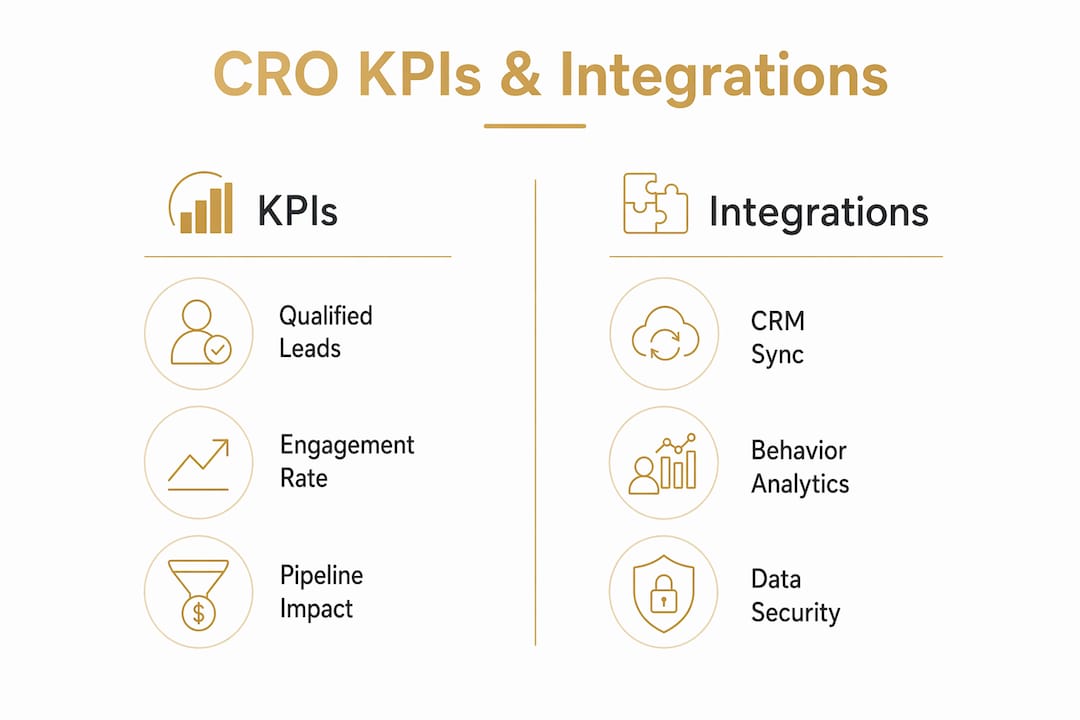
The right CRO stack for B2B lead-gen runs four layers: behavior analytics, a testing engine, GA4, and lead tracking tied to your CRM. Microsoft Clarity covers behavior analytics at zero cost and pairs cleanly with GA4 for qualitative signals.
Mandatory integration points:
CRM webhook or REST API (test variant ID must arrive on the contact record)
Server-side lead delivery with timestamp and source attribution
GA4 event schema aligned to experiment IDs
Form analytics capturing field-level abandonment, not just submission rate
KPIs that measure pipeline impact (not just conversion rate):
KPI | What it measures |
|---|---|
Qualified leads per variant | Which test version produces sales-ready leads |
Lead-to-opportunity rate | Whether form completions become real pipeline |
Pipeline value per variant | Revenue potential tied to each test outcome |
Time-to-close differential | Whether one variant attracts faster-moving buyers |
Validate the integration before you run any live experiment. The smoke test is simple: submit a test form, confirm the lead arrives in your CRM with the correct variant ID, then verify the opportunity record ties back to that contact. If any step breaks, your experiment data is useless.
For US-based B2B data, confirm the vendor stores data on US infrastructure and can provide a Data Processing Agreement. SOC 2 Type II certification is the baseline for enterprise buyers.
What does implementation actually cost and how long does it take?
Timeline and cost vary sharply by tool archetype.
Approach | Pilot timeline | Typical cost range |
|---|---|---|
Marketer-led (visual editor) | 2–4 weeks to first live test | $300/month license |
Engineering-led (server-side) | 6–12 weeks to first live test | $20,000–$120,000+/year |
Managed lead-gen partner | 1–2 weeks to first qualified leads | Monthly subscription, varies by scope |
Enterprise experimentation platforms carry implementation service fees commonly in the $20,000–$120,000 range, plus annual renewal increases of 15–25%. Those costs rarely appear in the headline license price. A managed lead-gen engagement repackages that unpredictability into a fixed monthly spend with a defined lead-delivery SLA.
The hidden cost most buyers miss: data instrumentation. Wiring GA4 events, CRM webhooks, and experiment IDs together correctly takes engineering time whether you’re on a $300/month tool or a $100,000 platform.
How to run a one-week vendor screen and a short pilot
A focused one-week vendor screen reduces procurement risk and surfaces integration gaps before you sign anything.
Discovery call (Day 1–2): confirm tool archetype fit, team composition match, and traffic volume requirements.
Integration demo (Day 2–3): ask the vendor to demonstrate CRM webhook delivery live, with a test lead flowing into your actual CRM instance.
Test-scope agreement (Day 3–4): define the first three experiments, primary KPI (pipeline-qualified leads), and minimum detectable effect.
Security review (Day 4–5): confirm US data residency, DPA availability, and statistical methodology (sequential vs. fixed-horizon testing matters for how early you can call a winner).
Commercial terms (Day 5–7): get implementation fees, renewal terms, and exit clauses in writing before any verbal commitment.
Pilot acceptance criteria:
Duration: 4–6 weeks minimum (enough traffic to reach significance)
Traffic allocation: 50/50 split on the primary lead-gen page
Primary KPI: pipeline-qualified leads per variant, not raw form submissions
Go decision: variant produces statistically significant lift in qualified leads AND lead-to-opportunity rate holds or improves
No-go decision: lift in form submissions but no improvement in lead quality or pipeline value
When evaluating landing-page builders like Unbounce or Instapage, note they optimize pages built inside their platform — not your existing site. That’s the right buy when campaign speed and dedicated pages are the bottleneck, not when you need to test your main site’s lead flow.
Flockleads: managed lead-gen when pipeline velocity is the priority
Most B2B teams evaluating CRO tools are actually solving a different problem: not enough qualified leads reaching their CRM fast enough. Flockleads is built for exactly that. Automated campaigns across Meta, LinkedIn, Google, and TikTok feed qualifying lead forms that deliver contacts directly to your CRM via webhook, with weekly optimization and transparent reporting tied to lead volume and quality, not vanity metrics.
The difference from a standalone CRO tool: Flockleads handles the full loop from ad creative to qualified-lead delivery, so your team isn’t managing platform instrumentation, experiment queues, or data pipelines. For B2B companies where time-to-revenue matters more than building an internal experimentation capability, that’s the faster path to pipeline growth. See how it works for your sector and get a free audit before committing to any monthly plan.
Pro Tip: Run a parallel approach: engage Flockleads for immediate qualified-lead delivery while running a marketer-led CRO tool on your highest-traffic landing page. You get pipeline now and conversion data building in the background.
Key Takeaways
For B2B teams, the right CRO decision starts with pipeline-qualified leads as the primary KPI, not raw conversion rate.
Point | Details |
|---|---|
CRM integration is the top filter | Any tool that can’t tie test variants to CRM contact records is measuring the wrong thing. |
Tool archetype must match team | Marketer-led tools need no dev; engineering-led tools need 6–12 weeks and developer ownership. |
Hidden costs are real | Enterprise platforms carry $20,000–$120,000 in implementation fees plus annual renewal increases of 15–25%. |
Pilot on pipeline KPIs | Measure qualified leads per variant and lead-to-opportunity rate, not form submission volume. |
Flockleads for immediate pipeline | When traffic quality or team capacity is the constraint, managed lead delivery beats a testing tool. |
Why pipeline-qualified leads change everything about tool selection
The most common failure pattern in B2B CRO programs isn’t a bad tool choice. It’s measuring the wrong thing. Teams optimize for form submissions, watch conversion rate climb, and then discover that lead quality dropped because the winning variant attracted tire-kickers. The CRM tells a different story than the testing dashboard.
That gap is why the tool selection criteria in this article lead with CRM integration and pipeline attribution rather than visual editor quality or statistical engine sophistication. Software is an enabler, not a substitute for process. A team without a structured testing process and clear pipeline KPIs will underperform on any platform.
The practical implication: if your team can’t yet answer “which test variant produced the most pipeline value last quarter,” you’re not ready to evaluate enterprise experimentation tools. Start with behavior analytics, wire up your CRM, and measure lead quality before you measure conversion rate. Or skip the instrumentation phase entirely and let a managed partner like Flockleads deliver qualified leads while you build that foundation.
Useful sources
Best Conversion Rate Optimization Tools (2026) | Tailor AI — covers the post-Google Optimize market split and the marketer-led vs. engineering-led taxonomy.
Best Conversion Rate Optimization Tools (2026) | WhatConverts — CRM integration priority, behavior analytics stack recommendations, and Microsoft Clarity as a free complement to GA4.
Optimizely Review 2026 | Spike AI — statistical methodology differences (sequential vs. fixed-horizon) and the process-over-platform argument.
Optimizely pricing and implementation costs | Zendikt — implementation fee ranges ($20,000–$120,000) and renewal inflation data.
Best A/B Testing Tools 2026 | Smarter Ranking — scored comparison of testing platforms with pricing transparency and statistical rigor breakdown.
Frequently asked questions
What is the most important criterion when comparing CRO tools for B2B?
CRM integration that ties test variants to qualified-lead records in your pipeline. Conversion rate lift without pipeline linkage tells you almost nothing about revenue impact.
How long does a typical CRO pilot take for a B2B team?
Marketer-led pilots run 2–4 weeks to first live test; engineering-led server-side setups typically take 6–12 weeks. A managed lead-gen engagement like Flockleads delivers first qualified leads within 1–2 weeks.
What did Google Optimize’s shutdown change for B2B buyers?
The 2023 shutdown removed the default free option and split the market into marketer-led visual suites and engineering-led platforms, forcing buyers to actively choose an archetype that matches their team’s technical capacity.
When should a B2B team choose managed lead-gen over a CRO tool?
When pipeline velocity is the primary goal, internal experimentation capacity is limited, or CRM instrumentation isn’t yet in place. A managed partner delivers qualified leads immediately rather than after a multi-week instrumentation and testing cycle.
What hidden costs should B2B buyers budget for in enterprise CRO tools?
Implementation service fees commonly run $20,000–$120,000, plus annual renewal increases of 15–25%. Data instrumentation (GA4 events, CRM webhooks, experiment ID mapping) adds engineering time regardless of the platform chosen.
NEED A CLEARER PLAN?
Let’s turn your next move into momentum.
Talk to us →