THE SHORT ANSWER
Warm referrals, targeted outreach to a tight list of ideal prospects, and applying to active jobs on marketplaces beat every other tactic for speed. These three moves can put a paid call on your calendar within days, because you’re reaching people who already trust you or already have budget and a problem to solve.
Warm referrals, targeted outreach to a tight list of ideal prospects, and applying to active jobs on marketplaces beat every other tactic for speed. These three moves can put a paid call on your calendar within days, because you’re reaching people who already trust you or already have budget and a problem to solve. ClimbTheLadder’s research on fast client tactics confirms this: putting yourself where buyers are already hiring beats waiting for them to find you.
In the first 7 days, expect to book 3 to 8 discovery calls if you contact 50 to 100 people across your network and a defined ideal customer profile. By day 30, a realistic outcome is obtaining a few paying projects, usually pilots or audits rather than full retainers, because trust takes a few conversations to build. Content and SEO matter, but they’re the wrong tool for this job. Statista’s tracking of content marketing budgets reflects an industry-wide pattern: companies treat content as a compounding, months-long investment, not a next-week solution.
What actually moves the needle in week one:
Reactivating past clients with a specific, time-bound offer
Sending personalized messages daily to a narrow ICP list
Submitting tailored proposals on Upwork, Fiverr, or Toptal
Asking three adjacent professionals for a warm introduction
Key Takeaways
Warm referrals, personalized direct outreach, and marketplace applications produce paying clients within days to weeks, while content and SEO take months to compound.
Point | Details |
|---|---|
Activate warm contacts first | Message 20 to 30 past clients and contacts with a specific offer in the first 48 hours. |
Build a tight ICP list | Pull traits from your five best past clients to filter prospects and marketplace listings. |
Use low-risk offers | A $300 audit or two-week pilot removes buyer hesitation and speeds up the yes. |
Track daily activity | Log messages sent, replies, meetings booked, and proposals to guide week-two decisions. |
Consider managed lead generation | Flockleads runs paid campaigns and CRM integration for companies needing immediate pipeline volume. |
How to Find New Clients Quickly With a 7-Day Sprint
You don’t need a new website, a rebrand, or a content calendar to get your next client. You need a plan that turns your existing relationships and a short list of the right strangers into booked calls this week. Here’s the sprint, broken down day by day.
Days 1 and 2: activate your warm network
Start with the people who already know your work. Message a group of past clients, colleagues, and contacts with a direct, specific offer, not a vague “let me know if you hear of anyone.” Something like: “I’ve got room for two new projects this month and I’m offering a $300 discovery audit to past clients and their referrals, want in or know someone who does?”
Pair this with a referral incentive that benefits both sides. The Lumberjack Strategy takes this further by identifying adjacent professionals, people who already serve your target clients but don’t compete with you, and building a standing relationship so introductions become routine instead of a one-time ask.
Target for these two days: a group of direct messages, one referral asset (a one-paragraph description of your offer they can forward), and several warm replies.
Days 3 and 4: build your outreach list and start marketplace applications
Now build a list of many prospects who match your ICP exactly, industry, company size, job title, and the pain point you solve. Pull this from LinkedIn Sales Navigator searches, industry directories, or your CRM’s tagged contacts. Draft one cold email template and one LinkedIn connection note, personalize each with a single detail (a recent post, a company announcement, a shared connection).

Simultaneously, apply to several active listings on Upwork, Fiverr, or Toptal with proposals tailored to the specific project, not a copy-paste pitch. Treat these first few marketplace jobs as an investment in your rating and portfolio; pricing competitively early to earn reviews pays off once your profile has social proof behind it.
Daily numeric targets for these two days:
50 personalized emails or LinkedIn messages sent
10 marketplace proposals submitted
50 to 100 names added to your tracking sheet
Days 5 through 7: follow up, pitch low-risk offers, and close
Most replies come from the second or third touch, not the first. Follow up with everyone who hasn’t responded, and lead your calls with a low-risk offer: an audit, a two-week pilot, or a fixed-scope micro-project. These convert faster than big proposals because they remove the buyer’s biggest fear, wasting money on an unproven provider.
Book calls as they come in. Aim to convert 1 to 2 prospects into paid pilot work by day 7. That’s a realistic number if your outreach volume held steady, not a guarantee if you sent 15 messages and called it a week.
Pro Tip: Log every touchpoint the same day it happens. A sprint dies quietly when you lose track of who you followed up with and who you didn’t; a simple spreadsheet with name, channel, date contacted, and status beats memory every time.
What to measure daily by the end of the week:
Messages sent and replies received (your response rate)
Calls booked and calls completed
Proposals sent and proposals accepted
One decision rule: if a channel produced zero replies after 30 messages, cut it and double down on whichever channel worked
The Channels That Actually Deliver Clients Fast
Not every channel earns a spot in a speed-focused plan. Here’s what to run now and what to leave for later, once you have breathing room.
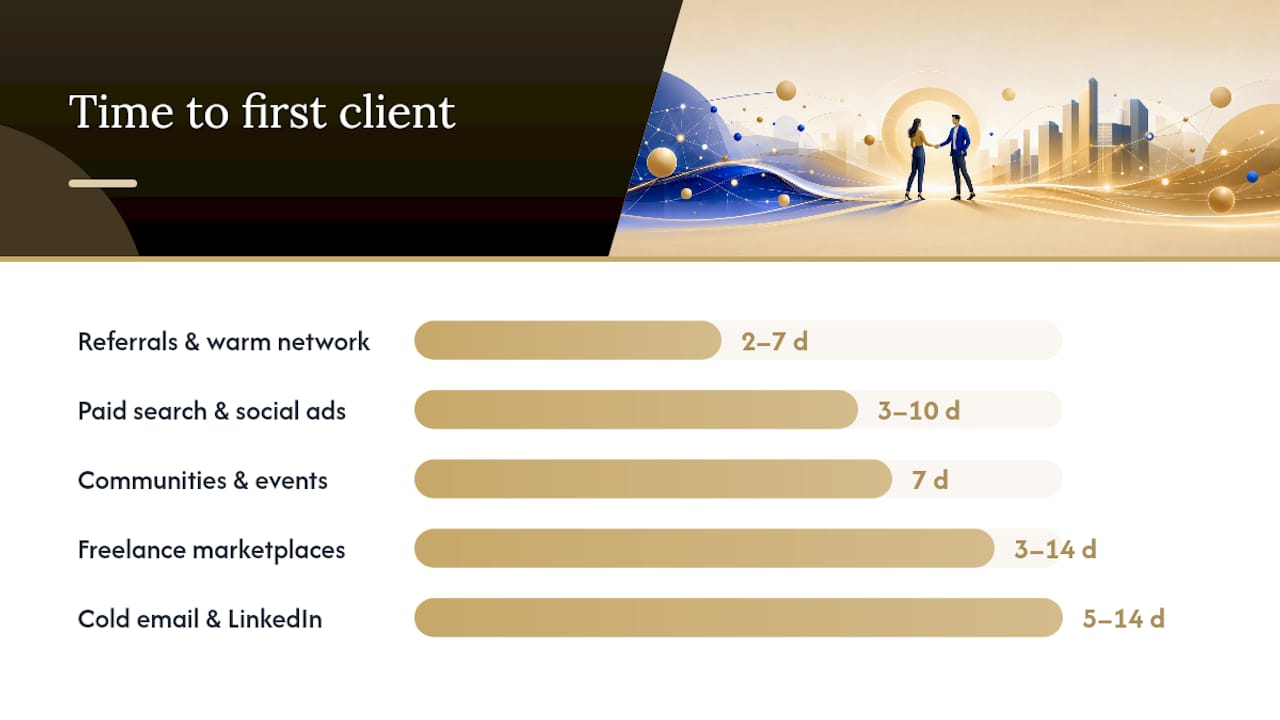
Referrals and your warm network remain the single fastest channel because trust is already established. Setup takes an afternoon: write your ask, list your best 30 contacts, send it. Expect replies within 48 hours and a first paid conversation within the week. A referral program that rewards both the referrer and the new client, a discount or bonus for each side, converts noticeably better than a one-sided incentive, and it can start as a spreadsheet before you ever touch CRM automation.
Targeted cold email and LinkedIn outreach work when your list is narrow and your message references something real about the recipient’s business. Setup: build your list, write two templates, personalize the first line of each message. Expect a 30 to 50 percent lower reply rate than referrals, but it’s the channel that scales once your network runs dry. First response typically lands within 3 to 5 days.
Freelance marketplaces (Upwork, Fiverr, Toptal) put you in front of buyers who’ve already posted a project and a budget. Setup means building a portfolio, writing a tight bio, and submitting tailored proposals rather than templates. Toptal screens talent more heavily and suits specialized, higher-ticket work; Upwork and Fiverr move faster for smaller projects. First paid gig often lands within a week or two, though your win rate improves as reviews accumulate.
Paid search and social ads capture people actively looking right now. Google Local Services and Meta ads can start generating leads within days of launch, though cost per lead varies widely by industry and targeting quality.
Niche communities and events convert fast when someone posts a problem you solve. Slack groups, industry Facebook groups, and local meetups reward showing up consistently with useful answers rather than pitching. Community participation builds credibility that turns into hires faster than most people expect, often within the same week you start engaging.
Channel | How to use it | Expected time to first client |
|---|---|---|
Referrals and warm network | Message past clients with a specific offer and referral incentive | 2 to 7 days |
Cold email and LinkedIn outreach | Personalized messages to a narrow ICP list, 2 to 3 follow-ups | 5 to 14 days |
Freelance marketplaces | Tailored proposals on active job postings | 3 to 14 days |
Paid search and social ads | Launch a targeted campaign with a clear landing page | 3 to 10 days |
Communities and events | Answer questions and show up consistently before pitching | 7 days |
Build Offers That Get a Fast Yes
A prospect who hesitates on a $5,000 proposal will often say yes to a $300 audit in the same conversation. The gap isn’t value, it’s risk. Lower the entry price and the commitment period, and you remove the two biggest reasons people stall.
Three offer formats convert reliably in a speed-focused sprint:
A $300 to $500 paid audit that diagnoses a specific problem and hands over a short action plan
A two-week pilot with one clearly scoped deliverable, priced to cover your time without scaring off a first-time buyer
A fixed-scope micro-project (a single campaign, a single asset, a single fix) with a hard deadline and a defined outcome
Price anchoring matters here. If your standard engagement runs $3,000 a month, framing the audit at $300 makes it feel like a reasonable first step rather than a full commitment. Pair it with a dual-benefit referral: give the referring client a discount on their next month and the new client a discount on their first, so both sides have a reason to say yes.
Pro Tip: Ask every pilot client for a testimonial or a short case study before the engagement wraps, not after. A testimonial secured while the results are fresh becomes the proof point that shortens your next five sales conversations.
Before you send any of these offers, run through a one-line contract checklist: scope, deliverables, timeline, payment terms, and permission to use their name or results as a testimonial. Skipping this step is how a $300 audit turns into a three-week scope-creep headache.
Define Your ICP and Qualify Prospects in Minutes
Chasing everyone wastes the time you don’t have. Pull your five best past clients, the ones who paid well, decided fast, and got real results, and find what they have in common. That pattern is your Ideal Customer Profile, and a hyper-specific version of it consistently converts better than a broad, generic list.
Capture these fields for each ICP segment:
Industry and company size (or a budget proxy if size doesn’t apply)
Job title of the decision-maker
Core pain point your service solves
Buying trigger (what event pushes them to act now)
Average deal value from past clients who matched this profile
Once you have the profile, qualify new prospects fast with three questions: Do they have the need? Do they have the budget, even roughly? Do they have a timeline that’s weeks, not “someday”? Score each yes as a point. Prospects scoring 3 out of 3 go to the top of your outreach list; anything under 2 gets deprioritized until your best leads run dry.
ICP field | Example value | Why it matters |
|---|---|---|
Industry | Home services, B2B SaaS, professional services | Determines which channels and messaging resonate |
Company size | 10 to 50 employees | Proxy for budget when revenue isn’t public |
Decision-maker title | Owner, VP of marketing | Tells you who to contact directly |
Core pain point | Inconsistent lead flow | Shapes your opening message |
Buying trigger | New funding round, seasonal demand spike | Signals urgency and timing |
Use this same profile to filter marketplace listings and LinkedIn searches. A generic search for “marketing help needed” wastes time; a search for your exact ICP’s industry and company size doesn’t.
Track the Numbers That Predict Client Growth
A sprint without measurement is just busywork with better intentions. Log four things daily and you’ll know by the end of week one whether to keep pushing or pivot.
Metric | Short-term target | How to capture it |
|---|---|---|
Messages sent | 50 per day | Spreadsheet or CRM outreach log |
Reply rate | 10 percent | Track replies against messages sent |
Meetings booked | 3 to 8 in week one | Calendar tool linked to your outreach sheet |
Proposals delivered | 5 to 10 per week | CRM pipeline stage or tracking sheet |
Pilot conversions | 1 to 2 by day 30 | Mark closed-won deals in your tracker |
Standardizing your pipeline stages even in a basic spreadsheet keeps you from losing track of who’s warm and who’s gone cold. A basic tool like Pipedrive or a shared Google Sheet works fine at this stage; you don’t need enterprise software to run a two-week sprint.
Set a minimum daily activity floor and don’t drop below it: 15 personalized outreach messages, one follow-up batch, and one hour dedicated to marketplace applications. After week one, consistent daily volume outperforms sporadic bursts of effort. If a channel produces zero replies after your first 30 to 40 attempts, cut it and reallocate that time to whatever’s actually working.
Scripts and Templates You Can Send Today
Copy these, swap in your own details, and send them within the hour, not after a week of polishing.
Warm referral request: “Hey [name], I’ve got room for two new clients this month. If you know anyone who needs help with [specific problem], I’d love an introduction, and I’ll take care of you for the referral.”
Cold email opener: “I noticed [specific detail about their business]. I help companies like yours fix [specific pain point], and I’m running a $300 audit this month for a few new clients. Worth a 15-minute call?”
LinkedIn connection note: “Saw your post on [topic], really resonated. I work with [industry] companies on [specific outcome] and would love to connect.”
Marketplace proposal opener: “I read through your project description and noticed [specific detail]. Here’s exactly how I’d approach [specific deliverable] and why it fits what you’re looking for.”
Pilot offer close: “Rather than jump straight into a full engagement, let’s start with a two-week pilot on [specific scope]. If it delivers what I think it will, we scale from there.”
Personalization hooks to swap in: a recent company announcement, a specific pain point visible on their site, or a mutual connection’s name.
Follow-up cadence that works:
First follow-up at day 3, short and casual
Second follow-up at day 7, add one new piece of value (an insight, a resource)
If no response by day 14, move them to a slower nurture list and focus elsewhere
When Managed Lead Generation Beats DIY Outreach
Running this sprint yourself works when you have hours to spare and a network worth activating. It stops working when you’re already at capacity, need leads at a volume outreach alone can’t hit, or simply don’t have anyone to call yet.
That’s the gap managed lead generation fills. A rapid-launch setup typically includes:
An initial audit of your current lead flow and website conversion points
ICP mapping based on your best past clients, similar to the worksheet above but built into ad targeting
Ad creative and landing page setup across channels like Meta, LinkedIn, Google, or TikTok
CRM integration so qualified leads land directly in your pipeline
Weekly optimization based on which ads and audiences convert
The businesses that shorten their ramp time the most are the ones that ask a managed provider three questions upfront: how leads are qualified before delivery, what the reporting cadence looks like, and how the CRM integration actually works day to day.
Ask any provider about tracking transparency and integration steps before signing anything. A managed setup doesn’t replace the sprint above, it runs in parallel once you need volume beyond what personal outreach can sustain.
Where Most Sprints Actually Break Down
The biggest mistake isn’t a bad script or a weak offer. It’s over-relying on one channel because it feels comfortable, usually content or social posting, while skipping direct outreach entirely. Content builds an audience over months; it doesn’t fill a calendar this week.
The second mistake is sending generic proposals. A prospect can tell within two sentences whether you read their project or copy-pasted a template. Specificity beats polish every time in a fast sprint.
Three rules I lean on when helping someone compress their timeline: reach out before you’re ready, because waiting for the perfect pitch costs more than an imperfect one sent today. Qualify hard and fast, because chasing a bad-fit prospect for two weeks is time you’ll never get back. And never let speed erode your delivery quality, a rushed pilot that disappoints costs you the referral that would have replaced ten cold emails.
A Faster Path When You Need Leads Now
Everything above works, but it takes your time, your list, and your follow-through. If you’re a B2B company that needs qualified leads flowing now, not after two weeks of daily outreach, a managed option shortens that timeline considerably. Flockleads runs the ad campaigns across Meta, LinkedIn, Google, and TikTok, builds the qualifying forms, and connects everything to your CRM so leads show up ready to call, not buried in a spreadsheet you have to build yourself.
This fits companies that don’t have someone free to run 50 outreach messages a day, or that need pipeline volume beyond what one person’s network can produce. Expect an initial audit, ICP mapping based on your actual best clients, campaign setup, and weekly optimization once leads start flowing. Understanding how B2B lead generation differs from consumer lead gen helps clarify whether this approach fits your sales cycle before you commit to anything. The entry point is a free audit, no cost, no obligation, just a clear look at where your current lead flow stands and what a managed campaign could add.
Sources
Frequently asked questions
How Do I Get New Clients Fast?
Activate your warm network with a specific offer, send personalized outreach to a narrow list of ideal prospects, and apply to active marketplace listings; these three moves typically produce calls within days.
How Do I Find Clients Easily Without a Big Budget?
Referrals and marketplace applications require no ad spend, just time and a clear offer, making them the lowest-cost starting point before you invest in paid channels.
How Do I Get My First 100 Clients?
Start with pilots and low-risk offers to build testimonials and social proof, then use that proof to fuel referrals and marketplace credibility, compounding your client base one converted lead at a time.
What Is the 10-5-3 Rule in Customer Service?
Definitions of this rule vary across sources and it isn’t tied to a single verified standard, so treat any specific version cautiously rather than as an established framework.
When Should I Consider a Managed Lead Generation Service?
If you lack the time to run daily outreach or need pipeline volume beyond what personal networking can deliver, a managed option like Flockleads can shorten your ramp time considerably.
NEED A CLEARER PLAN?
Let’s turn your next move into momentum.
Talk to us →