THE SHORT ANSWER
A sales funnel is a structured framework that maps how potential customers move from first discovering your brand to completing a purchase. Understanding how a sales funnel works gives you a clear picture of where prospects drop off, where they convert, and what messaging moves them forward.
A sales funnel is a structured framework that maps how potential customers move from first discovering your brand to completing a purchase. Understanding how a sales funnel works gives you a clear picture of where prospects drop off, where they convert, and what messaging moves them forward. The funnel metaphor captures a real pattern: many people enter at the top, but only a fraction reach the bottom. Attrition rates per stage range from 20% to 80%, which means every stage you ignore costs you real revenue. The tactics that fill and move prospects through this funnel include email marketing, social media, qualifying quizzes, and personalized outreach.
How does a sales funnel work, stage by stage?
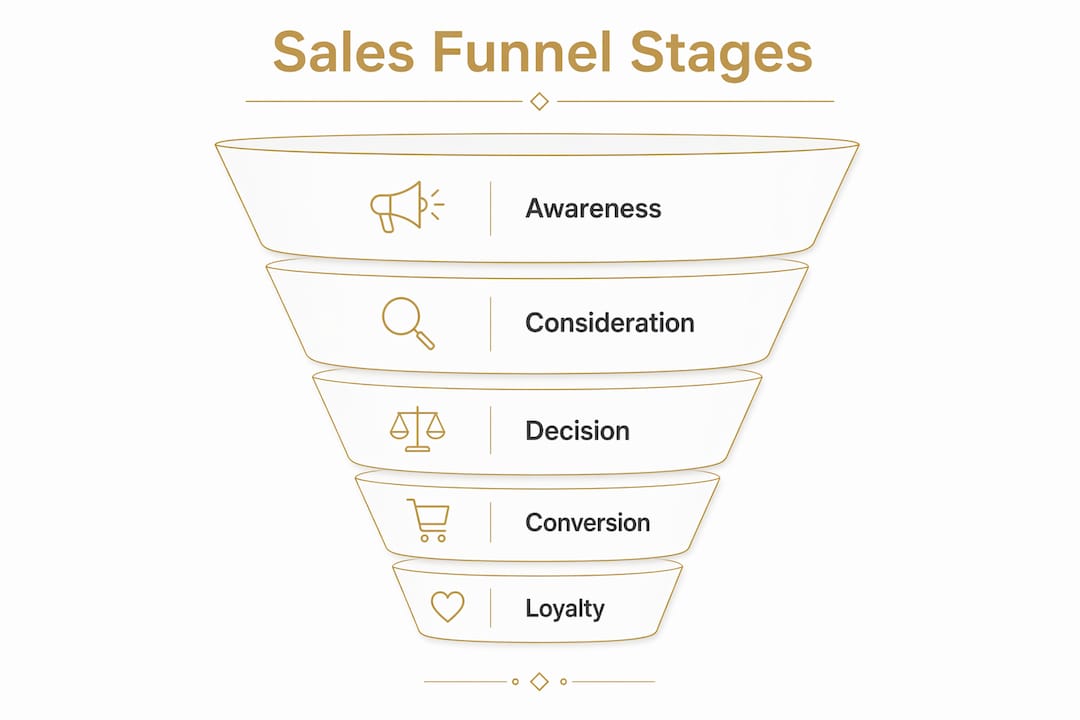
A sales funnel moves prospects through five core stages: Awareness, Consideration, Decision, Conversion, and Loyalty. Each stage has a distinct goal, a different prospect mindset, and a different set of tactics that work.
Awareness is where prospects first encounter your brand. The goal is reach, not persuasion. Paid ads, SEO content, and social media posts all serve this stage. Most people who enter here will not move further, which is why funnel attrition is highest at the top.

Consideration is where prospects evaluate whether your solution fits their problem. They read case studies, watch demos, and compare options. Your job here is to reduce doubt and build credibility. Email sequences, webinars, and comparison content all perform well at this stage.
Decision is the moment a prospect chooses to buy or walk away. Pricing pages, testimonials, and limited-time offers all influence this stage. A weak decision stage is the most common cause of abandoned carts and stalled deals.
Conversion is the completed transaction. But the funnel does not end there. Loyalty is the stage most businesses underinvest in. Repeat buyers cost far less to acquire than new ones, and a strong loyalty stage turns customers into referral sources.
Stage | Prospect goal | Your goal | Key tactics |
|---|---|---|---|
Awareness | Discover a solution | Generate reach | Paid ads, SEO, social content |
Consideration | Evaluate options | Build credibility | Email nurture, case studies, demos |
Decision | Choose a provider | Remove objections | Testimonials, pricing pages, offers |
Conversion | Complete purchase | Close the sale | Checkout optimization, follow-up |
Loyalty | Get ongoing value | Drive retention | Onboarding, upsells, referral programs |
One important nuance: consumers often loop between exploration and evaluation before they buy. The funnel is not a straight line. Treating it as one causes you to miss prospects who are circling back with higher intent.
What are quiz funnels and challenge funnels?
Modern sales funnels go well beyond a landing page and an email sequence. Two formats have produced measurable results: qualifying quiz funnels and challenge funnels. Both work by creating engagement before the pitch, which reduces resistance and increases conversion.
Quiz funnels
A qualifying quiz funnel uses an interactive questionnaire as the primary landing page. Instead of presenting a static offer, you ask prospects about their situation, goals, or pain points. The quiz collects data and simultaneously delivers targeted messaging that speaks to each prospect’s specific concern.
The results are concrete. One anti-aging brand used a quiz as its ad landing page and achieved a 9.8% conversion rate from start to purchase, along with a 42.6% increase in average order value. That is not a marginal improvement. It reflects what happens when you replace a generic pitch with a personalized experience.
Interactive quizzes collect user data while delivering persuasion checkpoints that validate user concerns mid-flow. This reduces funnel leak because prospects feel understood rather than sold to.
Quiz funnels work best when questions are specific and outcomes feel personalized.
Each quiz result should map to a distinct product recommendation or offer.
The transition from quiz result to offer should feel like a natural next step, not a pivot.
Pro Tip: Keep your quiz to five to seven questions. Longer quizzes increase drop-off before completion, which defeats the qualification purpose.
Challenge funnels
A challenge funnel guides prospects through a short, structured experience, typically three to five days, before presenting an offer. The key mechanic is proof by experience. Prospects do something, get a result, and then trust your method enough to buy.
Challenge funnels that deliver a quick win within the first 30 minutes of participation see significantly higher retention and conversion rates. The early win eliminates the biggest objection: “Does this actually work?”
A VIP upsell offered immediately after registration is a proven lead qualification tool. It is typically priced low, but its real function is to identify high-intent buyers. A VIP segment of 5–10% of challenge participants accounts for 45% of high-ticket sales. That ratio shows why early qualification matters more than volume.
Pro Tip: Price your VIP upsell low enough to be an easy yes. Its job is not to generate revenue directly. Its job is to identify who is serious.
How does a sales funnel differ from a marketing funnel?
The terms “sales funnel” and “marketing funnel” are often used interchangeably. They are not the same thing. Confusing them leads to misaligned tactics and revenue leakage.
A marketing funnel covers the journey from brand awareness to lead generation. It ends when a qualified lead is handed to sales. A sales funnel picks up from that handoff and guides the qualified lead to a closed deal. Marketing fills the top. Sales converts the bottom.
Confusing marketing funnels and sales funnels leads to inefficient strategies that leak revenue. Marketing nurtures and qualifies. Sales converts. When one team tries to do both without a clear handoff, prospects fall through the gap between awareness and close.
The practical risk is this: if your marketing team is running bottom-of-funnel conversion tactics, they are spending budget on audiences who are not yet ready to buy. If your sales team is running top-of-funnel awareness content, they are wasting time on cold prospects instead of closing warm ones.
The clearest way to separate the two is by lead temperature:
Marketing funnel: cold to warm. Tactics include content marketing, paid social, SEO, and email nurture.
Sales funnel: warm to closed. Tactics include demos, proposals, objection handling, and follow-up sequences.
A well-run B2B operation defines the exact moment marketing hands off to sales. That moment is usually a specific behavior, such as a demo request, a pricing page visit, or a lead score threshold. Without that definition, both teams operate on assumptions and prospects get inconsistent experiences.
What best practices improve sales funnel conversion?
Improving funnel performance comes down to four areas: early qualification, consistent messaging, persuasion checkpoints, and data-driven iteration.
Qualify leads early
The fastest way to improve conversion rates is to stop sending unqualified leads into your funnel. Use quiz funnels, lead scoring, or intake forms to filter prospects before they enter a nurture sequence. High-intent buyers identified early convert to core offers at 3–5x higher rates than cold leads. Spending the same budget on a smaller, better-qualified audience produces better returns than broadcasting to everyone.
Flockleads builds this qualification layer directly into its lead flow system. You can learn more about qualifying leads early and how paid traffic becomes a steadier pipeline when segmentation happens at the top of the funnel.
Use persuasion checkpoints
A persuasion checkpoint is any moment in the funnel where you address a specific objection or reinforce a specific benefit. Testimonials, case study callouts, and FAQ sections all serve this function. Embedded persuasion checkpoints yield 94–99.9% continuation rates mid-funnel. That is the difference between a funnel that leaks and one that holds.
Keep messaging consistent across stages
Prospects who see one message in an ad and a different message on the landing page disengage immediately. Every stage of your funnel should use the same core language, the same value proposition, and the same tone. Inconsistency signals that your brand does not know what it is selling.
Track stage-level metrics
Measure the conversion rate between each stage, not just the final sale.
Identify the stage with the highest drop-off rate. That is your priority.
Test one change at a time so you know what caused any improvement.
Review funnel metrics on a fixed schedule, weekly or monthly, not just when performance drops.
Pro Tip: Most funnel problems are not closing problems. They are mid-funnel problems. If your consideration-to-decision conversion is low, fix your nurture sequence before you touch your offer.
Key Takeaways
A sales funnel works best when each stage has a clear goal, a qualified audience, and messaging that matches where the prospect is in their decision process.
Point | Details |
|---|---|
Attrition is predictable | Expect 20–80% drop-off per stage and build your funnel volume accordingly. |
Quiz funnels qualify and convert | A quiz landing page can deliver a 9.8% conversion rate and lift average order value by 42.6%. |
Marketing and sales funnels are distinct | Marketing generates and warms leads; sales converts them. Mixing the two leaks revenue. |
Early qualification multiplies ROI | High-intent buyers identified early convert at 3–5x higher rates than unqualified leads. |
Persuasion checkpoints reduce drop-off | Addressing objections at each stage keeps prospects moving rather than disengaging. |
The funnel is a diagnostic, not a destination
Most marketers treat the funnel as a fixed structure they build once and run forever. That is the wrong mental model. The funnel is a diagnostic tool. Every drop-off point tells you something specific about your messaging, your offer, or your audience match.
I have seen businesses with strong top-of-funnel traffic and terrible conversion rates. The instinct is always to spend more on ads. The actual problem is almost always in the middle: a nurture sequence that does not address real objections, or a decision page that does not match what the ad promised. More traffic into a broken funnel just means more wasted spend.
The businesses that consistently improve their funnel performance are the ones that treat it as a cycle, not a line. They test, measure, and adjust. They do not wait for a complete rebuild. They fix the one stage that is leaking the most and move on to the next.
The other thing I would stress: lead quality beats lead volume every time. A funnel fed with poorly qualified prospects will always underperform, no matter how good the copy or the offer. Getting the qualification right at the top, whether through a quiz, a lead score, or a structured intake, changes the math on everything downstream.
— Mieke
How Flockleads fits into your funnel strategy
Building a funnel is one thing. Filling it with the right leads is another. Flockleads is built specifically for B2B service businesses that need a consistent, qualified flow of leads arriving at their website, not just traffic.
Flockleads handles the engineered lead flow layer that most businesses struggle to build themselves. It connects your funnel to a reliable source of qualified prospects, so your sales team spends time converting rather than prospecting. If your funnel is solid but your pipeline is inconsistent, the gap is usually at the very top. See how Flockleads works and what a structured lead flow system looks like for a service business like yours.
Frequently asked questions
What is a sales funnel in simple terms?
A sales funnel is a step-by-step process that moves potential customers from first hearing about your brand to making a purchase. Each stage narrows the pool of prospects as they get closer to a buying decision.
How many stages does a sales funnel have?
Most sales funnels use four to five stages: Awareness, Consideration, Decision, Conversion, and Loyalty. The exact number varies by business model, but the core logic of narrowing from broad interest to closed sale stays the same.
What is the difference between a marketing funnel and a sales funnel?
A marketing funnel covers brand awareness through lead generation. A sales funnel picks up from there and guides qualified leads to a closed deal. Mixing the two without a clear handoff point causes revenue leakage.
What is a quiz funnel and why does it work?
A quiz funnel uses an interactive questionnaire as a landing page to qualify prospects and personalize the offer. One case study recorded a 9.8% conversion rate from start to purchase, compared to typical static landing page rates.
How do I know which funnel stage to fix first?
Measure the conversion rate between each stage and find the one with the highest drop-off. That stage is your priority. Fixing mid-funnel drop-off, typically between Consideration and Decision, produces the fastest improvement in overall conversion.
NEED A CLEARER PLAN?
Let’s turn your next move into momentum.
Talk to us →