THE SHORT ANSWER
Sales and marketing alignment in B2B is defined as the process of unifying both teams around shared goals, common lead definitions, and joint accountability for revenue. When you align sales marketing B2B operations correctly, aligned teams grow revenue up to 20% annually, achieve 36% higher customer retention, and close deals at a 38% better win rate.
Sales and marketing alignment in B2B is defined as the process of unifying both teams around shared goals, common lead definitions, and joint accountability for revenue. When you align sales marketing B2B operations correctly, aligned teams grow revenue up to 20% annually, achieve 36% higher customer retention, and close deals at a 38% better win rate. The core components are a shared Ideal Customer Profile (ICP), unified KPIs, integrated data, clear lead handoffs, and regular communication. Yet poor communication blocks alignment for 42% of B2B teams, followed closely by inaccurate data and unclear accountability. That gap is expensive. This guide shows you exactly how to close it.
How to align sales and marketing in B2B with a shared ICP
A shared ICP is the single most important document in B2B marketing alignment. Without it, marketing targets the user persona while sales targets the economic buyer, and those two personas pull the pipeline in opposite directions. The result is wasted budget, confused messaging, and leads that sales refuses to touch.
The ICP must be a living document, not a one-time workshop output. It should capture firmographic data (company size, industry, revenue band), behavioral triggers (content downloads, demo requests, pricing page visits), and the specific pain points that drive purchase decisions. Both teams must own it equally.

A practical way to keep the ICP current is to trigger a joint review whenever SLA performance drops below threshold for two consecutive months. That drop is a signal that the profile has drifted from reality. Sales sees this first in call quality; marketing sees it in conversion rates. Reviewing together closes the gap faster than either team working alone.
Pro Tip: Run a quarterly “ICP audit” where sales reps rate the last 20 closed-won deals against the current ICP criteria. Any pattern of mismatches means your ICP needs updating before the next campaign launches.
Consistent ICP maintenance also tightens lead qualification. When both teams agree on what a qualified account looks like, the handoff conversation shifts from “why did you send me this?” to “what do we know about this prospect?” That shift alone reduces friction and accelerates pipeline velocity.
What is an SLA and how does it operationalize B2B collaboration?
A Service Level Agreement (SLA) between sales and marketing is a written contract that defines exactly what each team commits to deliver, at what quality, and by when. It transforms informal cooperation into a measurable operating agreement. Without one, accountability lives in email threads and meeting notes, which means it effectively does not exist.
A well-built SLA covers four components:
Lead definitions. Agree on what constitutes a Marketing Qualified Lead (MQL), a Sales Accepted Lead (SAL), and a Sales Qualified Lead (SQL). Write these down with specific criteria, not vague descriptions.
Volume and quality targets. Marketing commits to a monthly MQL volume at a minimum quality score. Sales commits to a monthly SQL conversion rate from those MQLs.
Speed of follow-up. Sales must accept or recycle every MQL within 24 business hours. Leads that sit longer lose temperature fast.
Reporting and review cadence. Set a fixed review schedule. Quarterly SLA reviews are too slow. Weekly data reviews with shared dashboards measuring MQL volumes, conversion rates, and lead recycle reasons catch problems before they compound.
The most common SLA mistake is measuring MQL volume only. Volume tells you how busy marketing is. It does not tell you whether sales is working the right accounts. Recycle reasons are equally important: if sales recycles leads with free-text notes like “not interested,” you cannot diagnose the real problem. Use a fixed dropdown of recycle reasons so the data is analyzable.
Pro Tip: Before writing your SLA, audit the last 90 days of lead data. Ground every target in actual performance, not aspirational numbers. An SLA built on fantasy creates resentment, not accountability.
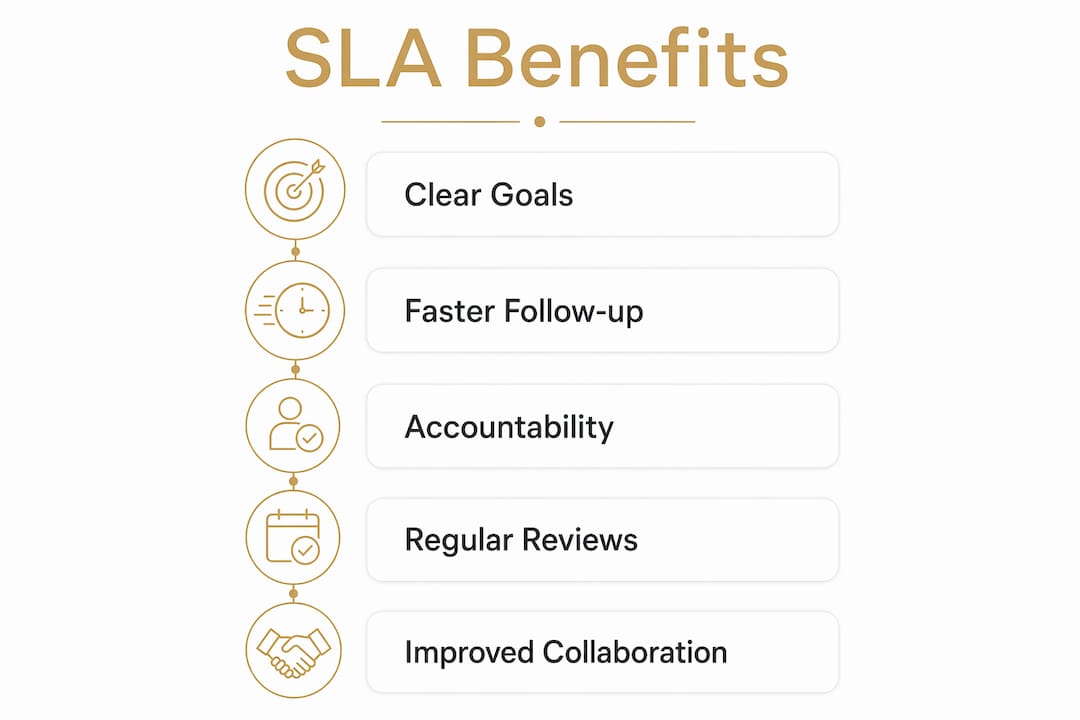
SLAs must be living documents with defined escalation triggers, not one-time contracts filed and forgotten. Treat them the same way you treat a product roadmap: review, revise, and republish regularly.
How does technology support sales and marketing integration?
Disconnected data is the silent killer of B2B sales partnerships. When the CRM and the marketing automation platform do not talk to each other, sales reps work from stale data and marketing optimizes for metrics that do not reflect pipeline reality. That disconnect is one of the primary sources of friction between the two teams.
The technology stack for aligned teams needs four layers:
CRM. The system of record for all prospect and customer interactions. Every lead, deal stage, and activity lives here.
Marketing automation platform. Tracks content engagement, email behavior, and campaign attribution. Must push data into the CRM in real time.
Lead enrichment tool. Appends firmographic and technographic data to inbound leads so sales has context before the first call.
Unified reporting layer. A shared dashboard both teams review together, showing MQL volume, conversion rates, pipeline velocity, and revenue attribution.
Bi-directional data flow between the CRM and marketing platform creates a single source of truth. Sales reps can see which content a prospect engaged with before the call. Marketing can see which leads converted to revenue and work backward to identify the highest-value campaigns.
AI-driven lead scoring adds another layer of precision. Instead of manually reviewing every inbound lead, scoring models rank prospects by fit and intent. Behavior-triggered alerts notify sales when a target account visits the pricing page or downloads a case study. That context turns cold outreach into warm conversations.
Technology layer | Primary function | Alignment benefit |
|---|---|---|
CRM | Records all sales activity | Shared pipeline visibility |
Marketing automation | Tracks content and campaign behavior | Real-time lead context for sales |
Lead enrichment | Appends firmographic data | Faster, better-informed qualification |
Unified reporting | Measures shared KPIs | Joint accountability and faster decisions |
How do regular feedback loops sustain sales and marketing alignment?
Communication structure is what separates teams that stay aligned from teams that drift apart after the first quarter. A single kickoff meeting does not sustain alignment. A repeating system of structured touchpoints does.
The most effective format is the bi-weekly “Smarketing” meeting. These meetings focus on three things: pipeline health, lead quality feedback, and messaging alignment. Sales reports on which objections came up most in recent calls. Marketing reports on which content is generating the most qualified engagement. Both teams leave with specific actions.
Beyond the meeting cadence, the feedback loop needs two more elements:
Sales listening to marketing content. Sales reps should review new campaigns, emails, and ads before they go live. They know which messages resonate in real conversations. That knowledge should shape what marketing publishes.
Marketing attending sales calls. Even one call per month gives marketers direct exposure to buyer language, objections, and decision-making dynamics. That exposure produces better content and more accurate ICP updates.
Joint content creation is the output of a healthy feedback loop. When sales shares the top five objections from the last month, marketing can build case studies, comparison pages, and FAQ content that addresses those objections directly. The result is sales enablement material that actually gets used.
Pro Tip: Create a shared Slack channel or Teams channel where sales reps can drop real buyer quotes and objections in real time. Marketing can mine that channel weekly for content ideas and messaging updates.
The cultural shift this requires is real. Sales teams often see marketing as a support function. Marketing teams often see sales as the people who ignore their leads. The goal is a “we vs. the problem” mindset, where both teams measure success by the same revenue number.
What are the most common alignment obstacles and how do you fix them?
Misalignment rarely has a single cause. It usually results from three overlapping problems that reinforce each other.
The first is poor communication, which 42% of B2B teams identify as the biggest obstacle. Without a structured cadence, both teams default to their own priorities and metrics. The fix is the meeting structure and shared dashboards described above.
The second is conflicting incentives. Marketing is often measured on MQL volume. Sales is measured on closed revenue. Those two metrics can pull in opposite directions: marketing sends high volumes of low-quality leads to hit its number, while sales ignores them to focus on deals already in the pipeline. The fix is to add shared revenue metrics to both teams’ scorecards. When marketing is measured on pipeline contribution and sales is measured on MQL follow-up rate, incentives align.
The third is unclear accountability. When a deal falls through, both teams point at each other. The fix is documented sales plays. Companies with formally documented sales plays are twice as likely to succeed compared to those relying on ad-hoc rep activity. A sales play ties a specific trigger (a competitor mention, a pricing page visit, an inbound demo request) to a specific sequence of actions, owned by a specific person, with a measurable outcome.
A Revenue Operations (RevOps) function accelerates all three fixes. RevOps sits between sales and marketing, owns the shared data infrastructure, and enforces the SLA. Not every company needs a dedicated RevOps team, but every aligned company needs someone playing that role. Without it, the system depends on goodwill, and goodwill does not scale.
Key Takeaways
Aligning sales and marketing in B2B requires a shared ICP, a formal SLA, integrated technology, and a repeating communication structure, all measured by joint revenue metrics.
Point | Details |
|---|---|
Shared ICP is foundational | Both teams must own and update the ICP together to prevent targeting conflicting buyer personas. |
SLAs create real accountability | Define lead criteria, follow-up speed (24 hours), and review cadence in writing to enforce shared standards. |
Integrated tech removes friction | Bi-directional CRM and marketing platform data gives both teams the same real-time view of the pipeline. |
Feedback loops sustain alignment | Bi-weekly Smarketing meetings and joint content creation keep messaging and lead quality on track. |
Shared revenue metrics fix incentives | Measuring both teams on pipeline contribution eliminates the volume-vs.-value conflict. |
Why alignment is a system, not an event
I have watched B2B teams run alignment workshops, agree on an ICP, shake hands, and drift back to their old patterns within six weeks. The problem is not commitment. The problem is that they treated alignment as a project with a finish line instead of an operating system with no end date.
The teams that stay aligned treat their SLA the way a product team treats a sprint contract. They review it weekly, update it when data changes, and escalate when someone misses a commitment. That discipline feels bureaucratic until you see the pipeline numbers. Then it feels like the only way to run a business.
The insight that changed how I think about this comes from buyer psychology. Discrepancies between what marketing promises and what sales delivers create a certainty gap that kills deals. Buyers do not just evaluate your product. They evaluate whether your company is coherent. When the marketing email says one thing and the sales call says another, the buyer’s confidence drops, even if both messages are technically accurate.
Alignment is not just an internal efficiency play. It is a signal to the market that your company knows what it is doing. That signal closes deals. Building your go-to-market approach as a company-wide operating system, rather than a series of disconnected campaigns and calls, is the only version of alignment that compounds over time.
— Mieke
Flockleads and the case for engineered lead flow
Alignment frameworks only work when the leads entering the pipeline are consistent and qualified from the start. Flockleads builds engineered lead flow for B2B service companies, delivering leads directly to your website with the volume and quality needed to support the SLA commitments your teams have agreed on.

When lead flow is predictable, your SLA targets become achievable. When leads carry behavioral and firmographic context, sales follow-up becomes faster and more relevant. Flockleads integrates with the reporting and qualification processes your teams already use, so both sides of the revenue equation work from the same data. If your alignment work keeps stalling because lead quality is inconsistent, the lead generation process itself is worth examining first.
Frequently asked questions
What does it mean to align sales and marketing in B2B?
Sales and marketing alignment means both teams share the same ICP, lead definitions, KPIs, and accountability for revenue. It replaces separate scorecards with a single, joint measure of pipeline performance.
How do SLAs improve B2B marketing alignment?
An SLA defines lead acceptance criteria, follow-up speed (within 24 business hours), and a weekly review cadence. It converts informal agreements into measurable commitments that both teams are held to.
Why do sales and marketing teams lose alignment over time?
Conflicting incentives, poor communication, and disconnected data are the three main causes. Marketing measured on volume and sales measured on revenue will naturally diverge without shared metrics and structured touchpoints.
What technology do aligned B2B teams need?
Aligned teams need a CRM, a marketing automation platform with bi-directional data sync, a lead enrichment tool, and a unified reporting dashboard. All four layers must feed the same data to both teams in real time.
How often should sales and marketing meet to stay aligned?
Bi-weekly Smarketing meetings are the recommended minimum. Weekly data reviews of shared dashboards should run alongside those meetings to catch conversion drops before they become pipeline problems.
NEED A CLEARER PLAN?
Let’s turn your next move into momentum.
Talk to us →