THE SHORT ANSWER
A B2B content marketing funnel is a stage-specific content system designed to attract, qualify, and convert buyers into sales-ready leads. Most B2B teams treat content as a publishing exercise. The ones that win treat it as a pipeline engineering problem.
A B2B content marketing funnel is a stage-specific content system designed to attract, qualify, and convert buyers into sales-ready leads. Most B2B teams treat content as a publishing exercise. The ones that win treat it as a pipeline engineering problem. To build a B2B content marketing funnel that actually moves revenue, you need the right foundation, stage-matched content, a distribution system, and metrics that connect content to closed deals.
What do you need before you build a B2B content marketing funnel?
The most common reason B2B funnels fail is not bad content. It is a missing foundation. Before you write a single word, three things must be in place: a clear picture of your buyer, an honest audit of what you already have, and defined conversion goals.
Audience research and buyer personas
Effective B2B content planning starts by understanding decision pressure, meaning the internal politics and evidence needs that drive a buyer’s decision, rather than focusing on keyword volume alone. A VP of Operations and a CFO evaluating the same product need completely different content. The VP wants proof of implementation speed. The CFO wants ROI data and risk reduction. Build personas around those pressures, not job titles.

Content audit and goal setting
Audit your existing content for funnel stage fit, not just traffic. A blog post that ranks well but attracts students instead of buyers is a liability, not an asset. Set conversion goals with specific criteria: what makes a lead marketing-qualified, and what signals push it to sales-qualified. Without those definitions agreed upon by both marketing and sales, your funnel has no exit ramp.
Technology stack
Tool category | Purpose | Example use case |
|---|---|---|
Marketing automation | Lead nurturing and scoring | Trigger email sequences based on page visits |
CRM | Pipeline tracking and handoff | Log MQL-to-SQL transitions with timestamps |
Intent data platform | Behavioral signal capture | Flag pricing page visits as buying signals |
SEO and analytics | Content performance tracking | Measure visitor-to-lead conversion by page |
A CRM and marketing automation platform are the minimum viable stack. Intent data tools become critical once you are ready to move beyond demographic scoring and start tracking real buying behavior.
How do you create content for each stage of the funnel?
Stage-appropriate content is the core mechanic of any B2B content strategy. The wrong content at the wrong stage either repels buyers or wastes your budget on people who are not ready to buy.
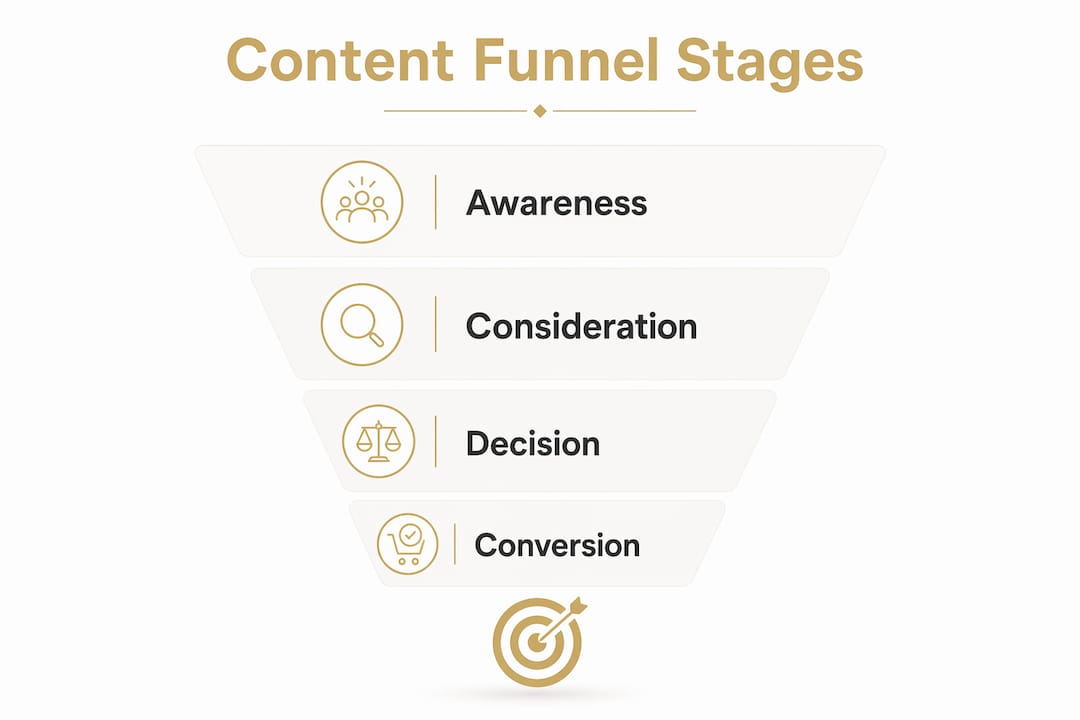
Top-of-funnel content (TOFU)
TOFU content generates awareness among buyers who do not yet know they have a problem you solve. SEO blog posts, podcasts, and research reports drive 44.6% of B2B revenue from organic search, more than any other channel. That number makes a strong case for investing in long-form educational content before anything else. Focus on answering the questions your buyers type into Google at 7 a.m. before they have a vendor in mind.
Middle-of-funnel content (MOFU)
MOFU content nurtures leads who know their problem and are evaluating solutions. Webinars with Q&A, case studies, and ROI calculators build solution preference and influence lead qualification. These formats work because they require active engagement. A buyer who downloads your ROI calculator and fills it out with their own numbers is not browsing. They are buying.
Bottom-of-funnel content (BOFU)
BOFU content removes the final objections standing between a qualified lead and a signed contract. Free trials, demo pages, testimonials near CTAs, and transparent pricing reduce friction and improve conversion rates. A/B testing your BOFU copy is not optional at this stage. Small wording changes on a demo request page can shift conversion rates by meaningful margins.
Pro Tip: Match content format to buyer intent, not just funnel stage. A buyer who just visited your pricing page for the third time does not need another educational blog post. They need a case study from a company that looks exactly like them.
Content type | Funnel stage | Primary goal |
|---|---|---|
SEO blog post | TOFU | Attract organic traffic |
Industry research report | TOFU | Build authority and capture emails |
Webinar with Q&A | MOFU | Nurture and qualify interest |
ROI calculator | MOFU | Demonstrate value, capture intent |
Case study | MOFU/BOFU | Build preference and reduce risk |
Demo page | BOFU | Convert qualified leads |
Transparent pricing page | BOFU | Remove friction, trigger decision |
How should you distribute your B2B content to reach the right buyers?
Creating great content and publishing it to your blog is not a distribution strategy. Treating content distribution as equally important as creation, with a 50/50 resource split and repeatable operational workflows, is what separates high-performing funnels from content graveyards.
The most effective distribution channels for B2B content are:
Personalized email sequences. Segment by persona and funnel stage. A cold prospect gets your best TOFU piece. A lead who attended your webinar gets a case study the next day.
LinkedIn posts from executives. Native LinkedIn content from a company’s leadership consistently outperforms brand page posts. A founder sharing a data insight from your research report reaches buyers that paid ads cannot.
Outbound sales referencing content. Train your sales reps to open conversations with content, not pitches. “I thought this ROI calculator might be useful given what you mentioned” is a warmer opener than any cold script.
Paid amplification for proven content. Do not pay to promote content that has not already earned organic engagement. Amplify what already works.
Content summaries for sales enablement. Give reps one-page summaries of your best MOFU content. They will use it. They will not read the full white paper.
Repurposing is the multiplier. A single 2,000-word research report becomes a LinkedIn post series, an email sequence, a webinar outline, and a sales one-pager. Each format reaches a different buyer at a different moment.
Pro Tip: Build distribution as a repeatable system, not a one-off task. Create a distribution checklist for every content asset you publish. Assign ownership. Set deadlines. Treat it like a product launch, not an afterthought.
How do you measure and optimize your content funnel performance?
The metrics that matter in a B2B content funnel are not page views or social shares. Content influence on pipeline is best measured by content-assisted MQLs, influenced deals, and time-to-close reduction. Those numbers connect your content program directly to revenue.
The four metrics every B2B content team should track are:
Visitor-to-lead conversion rate. The average B2B team converts 2.3% of visitors to leads at the top of the funnel. If you are below that, your TOFU content or your lead capture mechanics need work.
MQL-to-SQL conversion rate. Average teams convert 13–15% of MQLs to SQLs. Top teams reach 39–40% by adding behavioral intent signals to their scoring models. That gap is not a small improvement. It is a threefold difference in pipeline output.
Content-assisted MQLs. Track which content pieces appear in the path of leads that eventually become SQLs. That tells you what to produce more of.
Time-to-close reduction. Content that educates buyers before sales conversations shortens deal cycles. Measure it.
The most critical funnel leak happens between MQL and SQL. Adding behavioral signals like pricing page visits to your lead scoring model can triple MQL-to-SQL conversion rates by identifying true purchase intent beyond demographics alone. Speed also matters at this stage. Following up with leads within 5 minutes makes sales 21 times more likely to qualify them than waiting 30 minutes. That is not a marginal improvement. It is a structural advantage.
Key Takeaways
A B2B content marketing funnel converts more leads when it combines stage-matched content, behavioral intent scoring, and a distribution system treated as an operational function, not a campaign activity.
Point | Details |
|---|---|
Foundation before content | Define buyer personas by decision pressure and set MQL/SQL criteria before creating any content. |
Stage-matched content | TOFU builds awareness, MOFU builds preference, BOFU removes objections. Use the right format for each. |
Distribution is half the job | Allocate equal time and budget to distributing content as to creating it, using repeatable workflows. |
Behavioral scoring triples SQLs | Adding intent signals like pricing page visits to lead scoring lifts MQL-to-SQL rates from 13% to 39–40%. |
Speed closes the gap | Following up within 5 minutes of a lead inquiry makes qualification 21 times more likely than waiting 30 minutes. |
What I have learned from building B2B content funnels that actually work
The biggest mistake I see B2B marketing teams make is treating MQL definitions as a marketing problem. They are not. They are a sales and marketing alignment problem. When marketing defines an MQL without sales input, you get a funnel that produces volume but no pipeline. The fix is a shared scoring rubric, agreed upon in writing, reviewed quarterly.
Behavioral data changed how I think about lead qualification entirely. Demographic scoring tells you who someone is. Behavioral scoring tells you what they are doing right now. A CFO who visits your pricing page three times in a week is a completely different lead than a CFO who downloaded a white paper six months ago. Treating them the same is a waste of your sales team’s time.
Distribution is the discipline most content teams skip. They publish and pray. The teams that build real pipeline treat distribution like a production line. Every asset gets a distribution plan before it gets written. That shift alone changes the ROI of a content program faster than any editorial improvement.
One more thing: audit your content for funnel stage fit every six months. Most B2B content libraries are 80% TOFU and 20% everything else. That ratio produces traffic and almost no pipeline. Rebalance toward MOFU and BOFU, and your conversion rates will follow.
— Mieke
How Flockleads fits into your B2B lead generation funnel
Building a content funnel is only half the equation. The other half is making sure the leads your content generates actually reach your sales team in a qualified, timely state.
Flockleads is built for B2B service businesses that need a predictable flow of qualified leads to their website. The platform is designed to capture, score, and route leads so that your content investment translates into pipeline, not just traffic. If you are ready to connect your content funnel to a lead flow system that works, see how it works and find out what engineered lead flow looks like in practice.
Frequently asked questions
What is a B2B content marketing funnel?
A B2B content marketing funnel is a stage-specific content system that moves buyers from awareness to sales-qualified status through targeted content at each decision stage. It connects marketing content directly to pipeline generation.
What is the average MQL-to-SQL conversion rate in B2B?
Average B2B teams convert 13–15% of MQLs to SQLs. Top-performing teams reach 39–40% by incorporating behavioral intent signals like pricing page visits into their lead scoring models.
How does behavioral intent scoring improve B2B lead qualification?
Behavioral intent scoring adds signals like page visit patterns and content engagement to demographic data, which can triple MQL-to-SQL conversion rates by identifying buyers who are actively evaluating a purchase.
How much of my budget should go to content distribution?
A 50/50 split between content creation and distribution is the standard recommended by experienced B2B content strategists. Distribution treated as an operational function, not an afterthought, is what drives funnel velocity.
How quickly should sales follow up with inbound leads?
Sales teams should follow up within 5 minutes of an inbound inquiry. Responding within that window makes qualification 21 times more likely than waiting 30 minutes, according to 2026 funnel performance data.
NEED A CLEARER PLAN?
Let’s turn your next move into momentum.
Talk to us →