THE SHORT ANSWER
Outsourced lead generation is the practice of hiring an external provider to identify, contact, and qualify sales prospects on your behalf. Done right, it produces a steady flow of sales-ready opportunities that align with your internal process and CRM. Done poorly, it generates activity reports nobody trusts and leads your sales team ignores.
Outsourced lead generation is the practice of hiring an external provider to identify, contact, and qualify sales prospects on your behalf. Done right, it produces a steady flow of sales-ready opportunities that align with your internal process and CRM. Done poorly, it generates activity reports nobody trusts and leads your sales team ignores. The difference comes down to three things: clear qualification criteria, tight CRM integration, and structured feedback loops. This guide gives B2B marketing managers the operational framework to outsource lead generation effectively and measure real business outcomes.
What do you need before outsourcing lead generation?
The single biggest reason outsourced programs underperform is that companies hand off the work before they are ready internally. No external provider can compensate for a vague Ideal Customer Profile (ICP) or a sales team that cannot agree on what a qualified lead looks like.
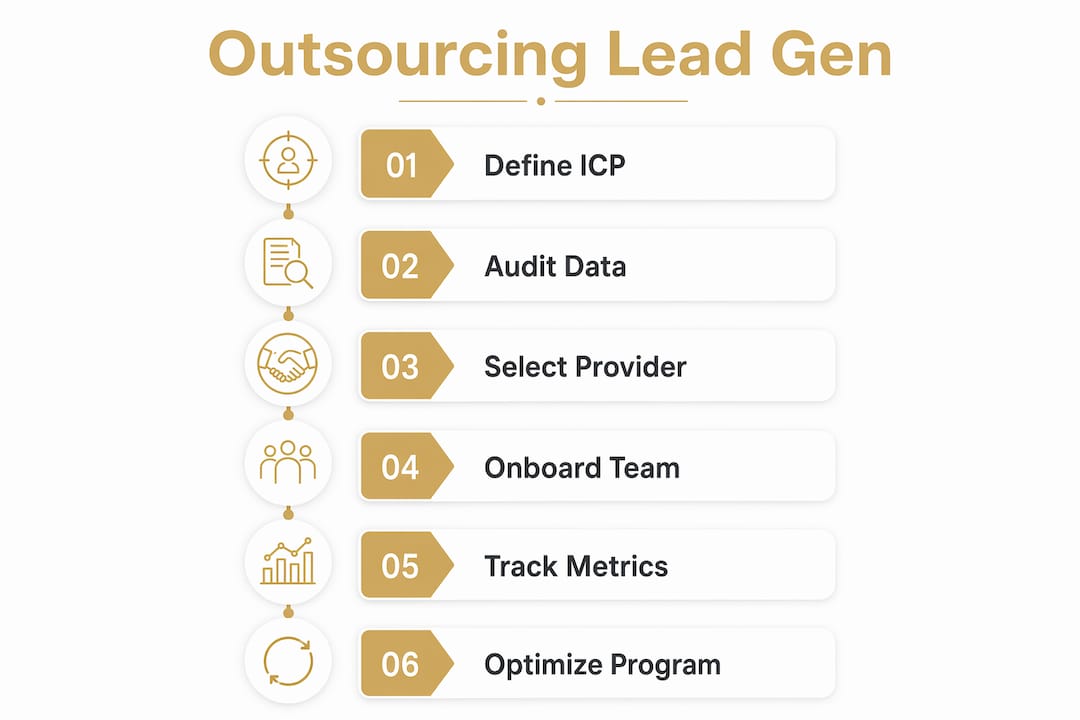
Before you sign a contract, lock down these four assets:
Ideal Customer Profile (ICP): Define firmographics (industry, company size, revenue), technographics (tools they use), and behavioral signals (recent funding, hiring patterns). A software company targeting mid-market logistics firms, for example, should specify fleet size and current TMS vendor, not just “logistics.”
Lead qualification criteria: Document exactly what makes a lead sales-ready. Criteria like BANT (Budget, Authority, Need, Timeline) or MEDDIC give your provider a concrete checklist. Sharing detailed ICP context and objection-handling notes measurably improves outreach quality.
CRM readiness: Set up source labeling, campaign identifiers, and ownership rules before the first lead arrives. Disconnected data systems turn lead generation management into a political dispute rather than a process.
Internal alignment: Your sales leadership, marketing team, and revenue operations contact must agree on objectives and measurement before the agency starts work. Misaligned expectations at the top cascade into every handoff.
Pro Tip: Run a short internal audit before onboarding. Pull your last 90 days of closed-won deals and identify the three firmographic traits they share. That pattern is your ICP starting point.
How to onboard and manage your outsourced provider

Onboarding is where most programs either build a foundation or create problems they spend months fixing. Treat it as a structured knowledge transfer, not a kickoff call.
Follow these steps in order:
Share full sales context. Give your provider your buyer personas, common objections, competitive positioning, and recent win/loss stories. Generic outreach fails because it lacks the specificity that earns a response from a busy decision-maker.
Set a communication cadence. Weekly syncs between your marketing manager, sales lead, and agency account manager are the minimum. Weekly feedback loops between sales and the agency are what separate programs that improve from programs that plateau.
Define the handoff process. Specify exactly how a qualified lead gets transferred: CRM entry format, notification method, response time expectation, and who owns follow-up. Ambiguity here causes leads to go cold.
Establish reason codes for rejected leads. Every lead your sales team declines should carry a coded reason: wrong seniority, wrong industry, no budget, already a customer. These codes are the feedback mechanism that lets the agency refine targeting week over week.
Agree on a trial period. The first 90 days of an outsourced engagement should focus on perfecting the handoff process, not hitting volume targets. Pressure for numbers before the process is stable produces low-quality leads at scale.
Pro Tip: Create a shared Slack channel or project management thread where sales reps can flag lead quality issues in real time. Waiting for a weekly meeting to surface problems costs you days of wasted outreach.
What metrics and tools should you track?
Tracking the wrong metrics is one of the most common ways outsourced programs lose credibility with leadership. Volume metrics like “leads delivered” tell you almost nothing about business impact.
The metrics that matter fall into two categories.
Lead journey metrics
Track every stage from first touch to pipeline entry. This means recording initial contact, acceptance by sales, disqualification reason, no-show rate for scheduled meetings, and pipeline progression after handoff. Multi-channel campaigns across email, LinkedIn, and phone generate multiple data points per prospect, giving you a clearer picture of what messaging works at each stage.
Financial metrics
Cost per qualified opportunity and revenue influenced by outsourced leads are the metrics that expose real program performance. Cost per lead is a vanity metric. A lead that costs $40 but never converts is more expensive than a lead that costs $200 and closes into a $50,000 contract.
Your CRM setup directly determines whether you can track any of this. Source labeling and campaign identifiers must be in place from day one. Without them, attribution becomes guesswork, and guesswork becomes conflict between your marketing team and sales team.
What are the most common outsourcing mistakes?
The mistakes that kill outsourced lead generation programs are predictable. Most of them share a root cause: prioritizing activity over fit.
Buying volume instead of quality. Focusing on outreach volume instead of buyer fit leads to wasted budget and low conversion rates. An agency that sends 10,000 emails a month but books meetings with the wrong personas is generating noise, not pipeline.
Ignoring rejected lead data. Every declined lead contains targeting intelligence. Ignoring rejection reason codes means repeating the same mistakes and paying for them repeatedly.
Skipping the feedback loop. Programs that skip ongoing sales-to-agency feedback optimize for operational metrics instead of business outcomes. The agency hits its activity targets while your pipeline stays flat.
Misaligned leadership expectations. Executives who expect pipeline contribution in week four of a new program create pressure that forces shortcuts. Shortcuts produce leads that look good in a report and fail in a sales call.
“When CRM data and agency lead data live in separate systems, attribution stops being a measurement problem and becomes a management problem. Sales blames marketing, marketing blames the agency, and nobody fixes the process.”
The fix for all of these mistakes is the same: build the process before you build the volume. A tight qualification framework and a functioning feedback loop produce better results at lower cost than any increase in outreach activity.
How do you scale an outsourced lead generation program?
Scaling works when the foundation is stable. Scaling before that point amplifies problems rather than results.
Stabilize lead quality first. Track your sales acceptance rate for 60 days. When it holds steady above your agreed threshold, the targeting and messaging are working. That is the signal to increase outreach volume.
Use reason codes to refine before you expand. Rejection data and no-show patterns tell you which audience segments are underperforming. Fix those segments before adding new ones.
Consider a hybrid model. High-volume prospecting outsourced, relationship nurturing kept in-house is a common and effective structure. Your internal team handles accounts already in conversation while the agency fills the top of the funnel.
Plan for insourcing milestones. Once your ICP is validated and your messaging is documented in a repeatable playbook, you have the option to bring prospecting in-house. Many companies reach this point after 12–18 months of outsourced operation and use the agency’s work as the template.
The goal of scaling is not to do more of the same. It is to do more of what works, informed by data from what did not.
Key Takeaways
Outsourcing lead generation effectively requires a documented ICP, CRM readiness, and structured feedback loops before any outreach begins.
Point | Details |
|---|---|
Prepare before you outsource | Define your ICP, qualification criteria, and CRM setup before signing with any provider. |
Treat the first 90 days as a trial | Focus on handoff quality and process stability, not lead volume, during the initial engagement. |
Track financial metrics, not just activity | Measure cost per qualified opportunity and revenue influence, not leads delivered. |
Use rejection data as intelligence | Require reason codes for every declined lead to refine targeting and messaging continuously. |
Scale only after quality stabilizes | Increase outreach volume only when your sales acceptance rate holds steady over 60 days. |
The 90-day rule nobody talks about enough
Most marketing managers I have worked with start an outsourced lead generation engagement with the same instinct: get leads fast. That instinct is understandable. It is also the thing most likely to sink the program.
The first 90 days are not about volume. They are about learning whether your ICP is accurate, whether your messaging resonates, and whether your handoff process actually works under real conditions. Every rejected lead and every no-show in that period is data. Treated as failure, that data gets buried. Treated as intelligence, it becomes the foundation for a program that scales.
The other thing I have seen consistently is that transparency between the agency and the internal team is the variable that separates good programs from great ones. Agencies that hide underperformance to protect the relationship make the problem worse. Marketing managers who sugarcoat rejection data to protect their budget make it worse too. Blunt, weekly communication about what is working and what is not is the only thing that produces real improvement.
The companies that get the most from outsourced lead generation are not the ones with the biggest budgets. They are the ones that treat the agency as an extension of their sales process, share real context, and use every data point to get sharper. That is a discipline, not a vendor selection.
— Mieke
Flockleads: qualified leads delivered to your pipeline
Flockleads generates qualified leads for B2B service businesses and delivers them directly to your website and CRM. The focus is on lead quality and handoff precision, not raw volume.
If you are ready to build a lead generation program with clear qualification criteria and measurable pipeline impact, Flockleads is built for that. The service covers prospecting, qualification, and managed lead flow for service businesses that need a reliable top-of-funnel without building the infrastructure internally. You can review the program structure and engagement conditions before committing. For marketing managers who want results they can report with confidence, Flockleads is the place to start.
Frequently asked questions
What does it mean to outsource lead generation effectively?
Outsourcing lead generation effectively means using an external provider to deliver qualified sales opportunities that match your ICP and integrate cleanly with your CRM and sales process. Effectiveness is measured by cost per qualified opportunity and revenue influenced, not leads delivered.
How long before an outsourced lead generation program produces results?
Most programs require 60–90 days to stabilize lead quality before volume targets make sense. The first 90 days should focus on refining the handoff process and qualification criteria, not hitting pipeline numbers.
What is the most important metric for outsourced lead generation?
Cost per qualified opportunity is the most important metric because it connects lead generation activity directly to revenue potential. Volume metrics like cost per lead do not account for whether leads actually convert.
Why do outsourced lead generation programs fail?
The most common causes are vague ICP definitions, disconnected CRM systems that create attribution conflicts, and the absence of structured feedback loops between sales and the agency. Without these foundations, programs optimize for activity rather than outcomes.
Should you insource lead generation after outsourcing?
Insourcing makes sense once your ICP is validated and your messaging is documented in a repeatable playbook, typically after 12–18 months of outsourced operation. A hybrid model, where prospecting stays outsourced and nurturing moves in-house, is often the most practical transition.
NEED A CLEARER PLAN?
Let’s turn your next move into momentum.
Talk to us →