THE SHORT ANSWER
Lead nurturing is the systematic process of engaging prospective B2B buyers with personalized, relevant content and outreach at optimal times to move them progressively toward a purchase decision. Most B2B leads require 5 to 12 touchpoints before they reach purchase readiness. That number alone explains why a single email or one sales call rarely closes a deal.
Lead nurturing is the systematic process of engaging prospective B2B buyers with personalized, relevant content and outreach at optimal times to move them progressively toward a purchase decision. Most B2B leads require 5 to 12 touchpoints before they reach purchase readiness. That number alone explains why a single email or one sales call rarely closes a deal. Modern nurturing programs run across multiple channels, including email, LinkedIn, personalized video, and direct voice outreach, typically spanning 30–60 days with 6–10 structured touches per lead.
What are the essential components of the lead nurturing process?
Effective lead nurturing rests on four pillars: content relevance, timing, channel selection, and segmentation. Strip out any one of these and the whole program loses traction. A well-built nurture program maps every piece of content to a specific buyer stage: awareness, consideration, or decision.
Mapping content to buyer stages
Awareness-stage content educates without selling. Think industry reports, how-to guides, and problem-framing articles that help a prospect understand their challenge. Consideration-stage content introduces solutions and builds credibility through case studies, comparison frameworks, and webinars. Decision-stage content closes the gap with demos, pricing walkthroughs, and testimonials. Pushing decision-stage content at a prospect who just entered your funnel is one of the most damaging mistakes a B2B marketer can make. It signals tone-deafness and accelerates unsubscribes.

Multi-channel coordination
Email alone is not a nurturing program. A coordinated approach combines email sequences with LinkedIn connection requests and content shares, personalized video messages at key moments, and occasional direct phone or voice outreach when intent signals spike. Each channel serves a different purpose. Email delivers structured content at scale. LinkedIn builds social proof and visibility. Video creates a human connection that text cannot replicate. Voice outreach signals genuine interest at the right moment.
Pro Tip: Map each channel to a specific role in your sequence before you build it. If you cannot explain why a channel is in the mix, cut it.
Timing: triggered vs. calendar-based sequences
High-performing nurture sequences use behavior-triggered timing rather than fixed calendar drips. A calendar drip sends email three on day seven regardless of what the prospect did. A triggered sequence sends email three when the prospect visits your pricing page for the second time. The difference in relevance is significant. Triggered sequences respect where the buyer actually is, not where your calendar assumes they should be.
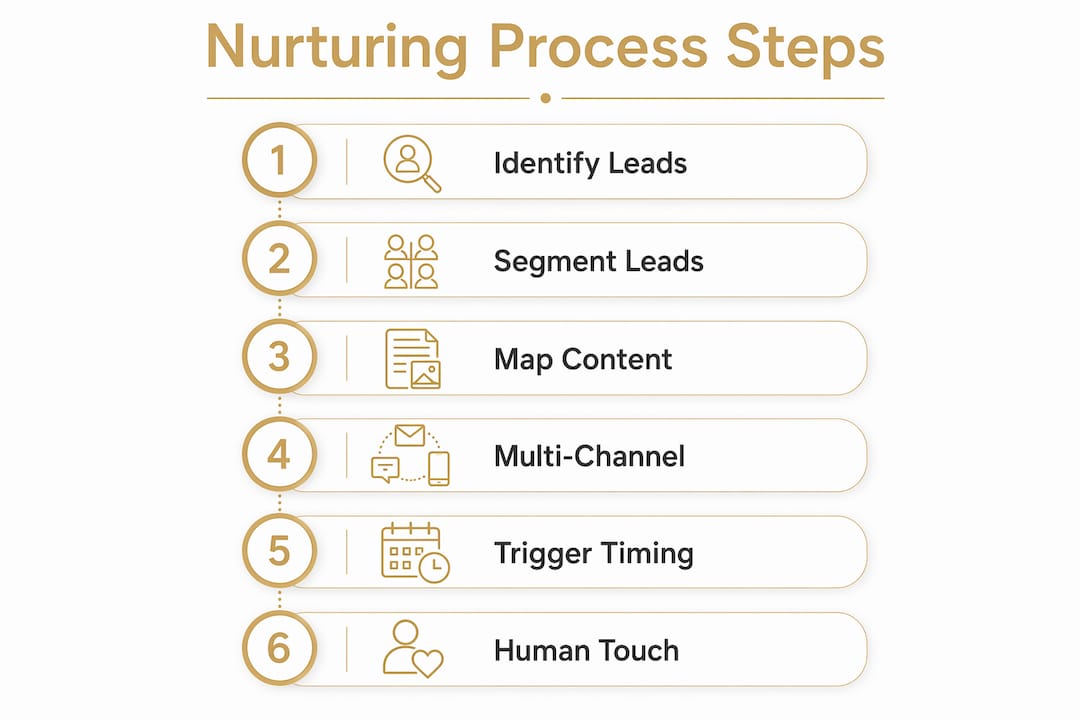
How does behavior-driven lead nurturing improve conversion outcomes?
Behavioral signals are the most reliable indicators of buyer intent. Page visits, resource downloads, repeated content engagement, and role changes all tell you something meaningful about where a prospect stands. The lead nurturing process explained through a behavioral lens looks very different from a traditional drip model.
Conversion rates rise to 3–8% when human sales outreach combines with automation at high-intent moments, compared to just 0.5–2% for automation-only programs. That gap represents a significant revenue difference at any pipeline volume.
The implication is direct: automation handles volume and consistency, but humans close the gap at critical moments. A prospect who downloads your pricing guide and then visits your case studies page within 48 hours is showing clear intent. That moment calls for a personal email or a phone call from a sales rep, not the next automated email in a drip sequence.
Common mistakes that kill behavioral nurturing
Forcing leads through a rigid linear funnel ignores real-time signals and increases unsubscribe rates. Over-emailing is the most common version of this mistake. Sending three emails in five days to a prospect who has not opened the first two does not increase engagement. It trains them to ignore you. The fix is simple: pause the sequence when engagement drops, trigger a re-engagement message after a defined silence window, and route persistently unengaged leads to a low-frequency long-term nurture track.
Top-performing B2B programs integrate automated content delivery with timely human outreach triggered by intent signals such as repeated pricing page visits or demo requests. This is not a luxury reserved for enterprise sales teams. Even a two-person sales operation can set up basic intent alerts and respond personally when a prospect crosses a defined threshold.
Responding within five minutes of a high-intent signal dramatically improves engagement. The 5-minute response rule is one of the most cited and least practiced principles in B2B lead management.
What does a practical lead nurturing sequence look like?
B2B nurture sequences typically span 30–60 days with 6–10 touches distributed across email, LinkedIn, and video. The structure below reflects a 30-day sequence built for a B2B service company targeting mid-market buyers.
Day | Channel | Content type | Stage |
|---|---|---|---|
Day 1 | Welcome + educational resource | Awareness | |
Day 3 | Connection request + brief note | Awareness | |
Day 7 | Industry insight or how-to guide | Awareness | |
Day 10 | Video email | Personalized intro from sales rep | Consideration |
Day 14 | Case study or customer story | Consideration | |
Day 18 | Relevant content share or comment | Consideration | |
Day 22 | Objection-handling content | Consideration | |
Day 26 | Soft CTA: demo invite or consultation | Decision | |
Day 30 | Phone/email | Direct outreach from sales rep | Decision |
A well-structured content mix across this sequence follows a rough split: 60% educational content, 25% social proof, and 15% objection-handling emails. That ratio keeps the sequence from feeling like a sales pitch while still moving the prospect toward a decision.
Post-sequence strategy
After the primary sequence ends, split your leads into two groups based on engagement.
Engaged leads who opened multiple emails, clicked links, or visited key pages move directly to a sales-qualified handoff. A rep reaches out personally within 24 hours.
Unengaged leads enter a long-term nurture track with one email per month. This track focuses entirely on educational content with no CTAs until a behavioral signal reactivates them.
Partially engaged leads who opened some emails but never clicked receive a re-engagement sequence of two to three messages with a direct question: “Is this still relevant to you?”
Pro Tip: Never delete unengaged leads after a sequence ends. Long-term nurture tracks regularly produce conversions 90–180 days after the initial sequence closes.
Why does lead segmentation determine nurturing success?
Segmentation is the difference between a nurture program that feels relevant and one that feels like spam. Behavioral segmentation can increase lead-to-opportunity conversion 3–5x compared to demographic-only approaches. Sending the same content to a CFO evaluating budget and a marketing manager researching tools is a waste of both their time and yours.
Effective segmentation uses four data layers:
Buyer stage: Where is this lead in their decision process based on content consumed and pages visited?
Behavioral signals: What actions have they taken? Downloads, page visits, email clicks, and video views all indicate intent level.
Company profile: Industry, company size, and revenue band determine which case studies and proof points are most relevant.
Intent signals: Repeated visits to pricing or product pages, attendance at webinars, and direct questions via chat or email all indicate high purchase intent.
Lead scoring combines these signals with profile fit to prioritize which leads receive human outreach and which stay in automated tracks. A lead with a strong company profile but low engagement stays in nurture. A lead with moderate profile fit but high behavioral engagement gets a personal call. That routing logic is what separates a well-run B2B program from a generic email blast.
AI and real-time data enrichment improve segmentation by updating lead profiles as behavior changes. A prospect who ignored your first three emails but then downloaded a detailed technical guide has shifted. A static segmentation model misses that shift. A dynamic model catches it and adjusts the next touch automatically.
Key takeaways
Effective lead nurturing combines behavioral triggers, multi-channel sequencing, and human intervention at intent signals to consistently outperform single-channel automated programs.
Point | Details |
|---|---|
Multi-touch sequences win | B2B leads need 5–12 touchpoints across 30–60 days before they are ready to buy. |
Behavior beats calendar | Triggered sequences based on prospect actions outperform fixed-schedule drips every time. |
Human outreach at intent signals | Conversion rates reach 3–8% when sales reps engage at high-intent moments alongside automation. |
Segment by behavior, not just demographics | Behavioral segmentation increases lead-to-opportunity conversion 3–5x over demographic-only models. |
Post-sequence routing matters | Splitting leads into engaged, unengaged, and partial tracks after a sequence ends protects pipeline and long-term revenue. |
What linear drip models get wrong in 2026
Most B2B marketers I have worked with built their first nurture program as a linear drip: email one on day one, email two on day four, email three on day eight. It feels organized. It is easy to build. And it consistently underperforms.
The problem is that buyers do not move in a straight line. A prospect might ignore your first four emails, then suddenly download three resources in a single afternoon after a budget conversation with their CFO. A linear drip has no way to respond to that shift. It just keeps sending email five on day twelve, completely blind to what just happened.
The programs I have seen produce the best results treat the sequence as a starting point, not a fixed track. They use behavioral signals to accelerate, pause, or redirect the nurture path in real time. They also treat human outreach as a core part of the program, not an afterthought. The marketers who resist this because it “doesn’t scale” are usually the ones watching their conversion rates stagnate at 1%.
The other mistake I see constantly is ignoring the post-sequence period. Most programs end after 30 days and declare a lead dead if they didn’t convert. Some of the highest-value B2B deals I have observed closed six months after the initial sequence ended, because someone stayed in a low-frequency long-term track and re-engaged when their situation changed.
Build for the long game. Buyers move on their timeline, not yours.
— Mieke
How Flockleads supports multi-channel lead nurturing
B2B marketers who want to put these principles into practice need a system that handles both the automation and the human handoff without losing track of either.
Flockleads builds engineered lead flow for B2B service companies, combining multi-channel outreach, behavior-based segmentation, and intent-triggered routing into a single coordinated program. Leads that arrive through your website get placed into structured nurture sequences that adapt based on real engagement, not guesswork. When a prospect crosses a high-intent threshold, Flockleads routes them to your sales team at exactly the right moment. You can see how it works and decide whether it fits your current pipeline setup.
Frequently asked questions
What is lead nurturing in B2B marketing?
Lead nurturing is the process of building relationships with prospective buyers through personalized, relevant content and outreach across multiple channels over time. The goal is to move leads progressively toward a purchase decision by staying relevant at each stage of their journey.
How many touchpoints does B2B lead nurturing require?
Most B2B leads require 5–12 touchpoints before they are ready to buy. Effective nurture programs deliver these touches across 30–60 days using email, LinkedIn, video, and direct outreach.
What is the difference between a drip campaign and lead nurturing?
A drip campaign sends pre-scheduled emails on a fixed calendar regardless of prospect behavior. Lead nurturing adapts to behavioral signals, adjusting timing, content, and channel based on what the prospect actually does.
Why do conversion rates improve with human outreach in nurturing?
Automation handles volume and consistency, but human outreach at high-intent moments closes the gap. Conversion rates reach 3–8% when sales reps engage alongside automation, compared to 0.5–2% for fully automated programs.
How does lead scoring fit into a nurturing strategy?
Lead scoring assigns values to engagement signals and profile fit to determine which leads receive personal sales outreach and which remain in automated tracks. It prevents sales teams from wasting time on low-intent leads while ensuring high-intent prospects get immediate human attention.
NEED A CLEARER PLAN?
Let’s turn your next move into momentum.
Talk to us →