THE SHORT ANSWER
For B2B service firms that want predictable appointment flow, outsourced SDR teams and managed paid-ad specialists are the most reliable alternatives to Leads at Scale. The market has over 70 providers competing for this budget, which makes picking by brand name alone a losing strategy.
For B2B service firms that want predictable appointment flow, outsourced SDR teams and managed paid-ad specialists are the most reliable alternatives to Leads at Scale. The market has over 70 providers competing for this budget, which makes picking by brand name alone a losing strategy. What actually separates a good fit from a costly mistake is category alignment: knowing whether you need human-powered outbound, performance-based paid acquisition, or a hybrid before you talk to any vendor.
Here is a fast shortlist by category:
Outsourced SDR teams (CIENCE, Belkins, memoryBlue): best for companies that need a full top-of-funnel team without hiring in-house
Appointment-setting specialists (Callbox, Martal Group, Operatix): best for firms that want booked meetings, not raw leads
Performance-based paid ads (KlientBoost, Lean Labs): best for teams with a working offer that needs volume from paid channels
Inbound content + SEO (Lean Labs): best for longer sales cycles where organic authority matters
Done-for-you lead flow (Flockleads): best for service businesses that want leads delivered directly to their website without managing an SDR team or an ad account
Quick pick: If you want qualified leads flowing to your website without building an outbound team or running ads yourself, Flockleads is the lowest-friction path. For companies that need a full SDR bench and structured outreach, Belkins or CIENCE are the strongest vetted options. Every recommendation here is grounded in third-party reviews (G2, Clutch), published case studies, and pricing transparency signals.
What do the best Leadsatscale.com alternatives actually look like side by side?
The fragmented market means buyers face both agency and software options with wildly different service models. Category-level comparisons cut through that noise faster than any vendor list.
Category | Best for / Ideal buyer | Primary services | Pricing model | Typical contract / time-to-results | Industries served | Proof & trust signals |
|---|---|---|---|---|---|---|
Outsourced SDR teams | Companies replacing or augmenting an in-house BDR function | Cold outreach, email sequencing, LinkedIn prospecting, SDR-as-a-service | Monthly retainer | 3–6 month contracts; 45–60 days to first SQLs | SaaS, tech, professional services | G2 reviews, case studies with SQL counts |
Appointment-setting specialists | Firms that want booked calendar slots, not raw contact lists | Multi-channel outreach, appointment booking, lead qualification | Retainer or per-appointment | 3–12 month contracts; 30–45 days to first appointments | Healthcare, finance, logistics, IT | Clutch ratings, average monthly meetings published |
Performance-based paid ads | Teams with a proven offer needing scalable inbound volume | Google Ads, LinkedIn Ads, paid social, landing page optimization | Percentage of ad spend or retainer | Month-to-month to 3 months; 2–4 weeks to first leads | E-commerce, SaaS, B2B services | ROAS case studies, conversion lift data |
Inbound content + SEO | Longer sales cycles; brand-building alongside lead gen | Content strategy, SEO, demand generation | Retainer | 6–12 month contracts; 3–6 months to measurable lift | Professional services, SaaS, healthcare | Organic traffic growth metrics, published case studies |
Done-for-you lead flow | Service businesses wanting leads to their website without managing channels | Engineered lead flow, paid-to-lead workflows, website lead delivery | Retainer | Onboarding in 30–60 days; steady-state leads within 60 days | B2B service businesses | Published process, operational terms, blog case content |
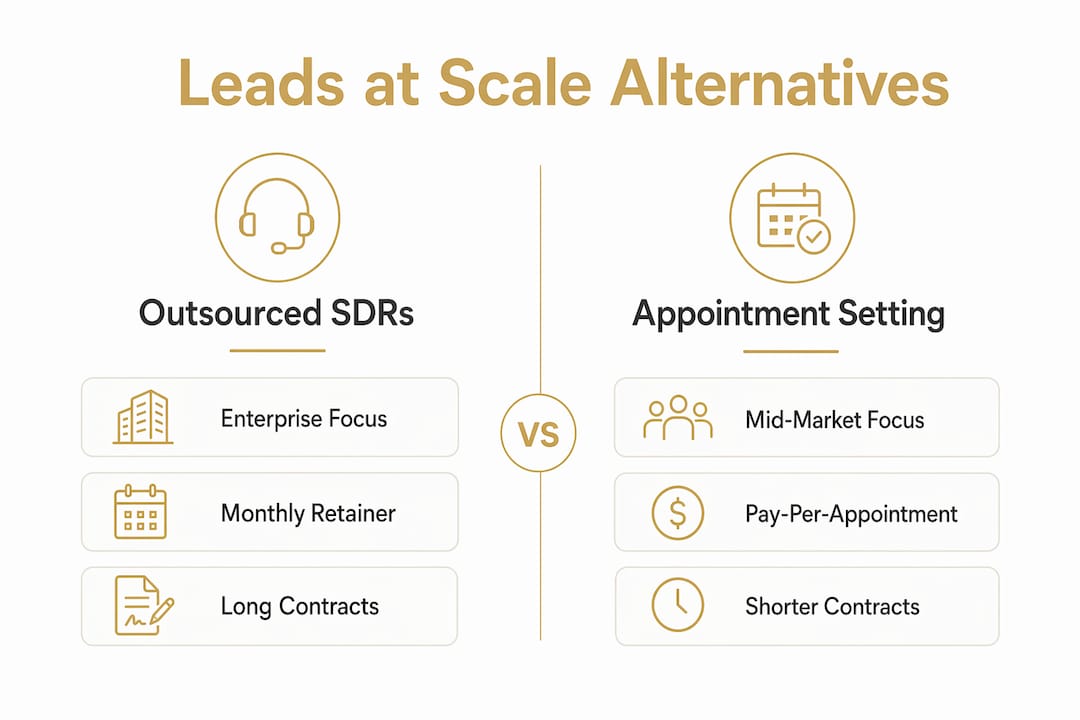
How to read this table: “Time-to-results” means time to your first qualified lead or booked meeting, not time to campaign launch. Pricing models vary by vendor within each category. Trust signals listed are the types to look for, not guarantees every vendor in the category provides them.
Key dimensions that most influence which category fits your situation:
Control vs. delegation: SDR teams give you more visibility into outreach activity; done-for-you lead flow delegates the whole channel
Speed: Paid-ad specialists typically deliver leads faster than inbound SEO; SDR teams fall in the middle
Cost floor: Performance-based paid ads require a separate ad budget on top of agency fees; retainer-only models have a more predictable total cost
Profiles of the top alternatives and what you actually get
The agency review landscape for lead-gen firms shows a wide range of service models. Here is what each category delivers day-to-day, and where the trade-offs land.

Outsourced SDR teams: CIENCE, Belkins, memoryBlue, Pearl Lemon Leads
These firms embed a dedicated outbound function into your sales process. You get prospecting, sequencing, and qualification handled by a team that reports to your pipeline metrics. Belkins and CIENCE both publish case studies on G2 showing SQL counts and conversion lifts. memoryBlue focuses heavily on tech and SaaS, with reps who often come from the industry they prospect into. Pearl Lemon Leads operates across the US and UK with a smaller team footprint, which suits companies that want a more hands-on relationship.
Pros:
Full top-of-funnel coverage without a hiring cycle
Transparent activity reporting (calls, emails, LinkedIn touches)
Replaceable reps if performance lags (check SLA for this)
Cons:
Ramp time of 45–60 days before reliable weekly meetings
Requires your team to handle discovery and close; they hand off, not close
US availability: All four operate across the US. CIENCE and Belkins have the broadest enterprise client bases.
Appointment-setting specialists: Callbox, Martal Group, Operatix, Salesbread
Callbox and Martal Group run multi-channel outreach (email, phone, LinkedIn, sometimes direct mail) with the explicit deliverable of booked meetings on your calendar. Operatix focuses on the tech sector and has a strong track record with European-headquartered firms expanding into the US market. Salesbread specializes in LinkedIn-first outbound and publishes per-campaign appointment rates. The key differentiator here is that you pay for outcomes (meetings), not just activity.
Pros:
Deliverable is a booked meeting, not a contact list
Multi-channel reach covers prospects who ignore email
Martal Group and Callbox both have published Clutch ratings
Cons:
Per-appointment pricing can spike costs if your close rate is low
Quality of “booked” meetings varies; always define qualification criteria in writing before signing
US availability: All four serve the US market. Operatix has a stronger European footprint but operates US campaigns.
Performance-based paid ads: KlientBoost, Lean Labs

KlientBoost runs paid search and paid social with a performance-first model, publishing conversion case studies across SaaS and B2B services. Lean Labs blends paid acquisition with inbound content, making it a fit for companies that want both channels working together. The appeal of this category is speed: a well-structured paid campaign can deliver leads within two to four weeks of launch, faster than any outbound SDR ramp.
Pros:
Fastest path to first lead when the offer and landing page are solid
Transparent cost-per-lead metrics from day one
Lean Labs’ hybrid model builds long-term organic value alongside paid
Cons:
Ad spend is a separate budget line on top of agency fees
Performance drops sharply if creative or targeting goes stale; requires ongoing optimization
US availability: Both operate primarily in the US market.
Inbound content + SEO: Lean Labs, Cleverly (LinkedIn content)
Lean Labs handles full-funnel inbound for B2B companies with longer sales cycles. Cleverly focuses specifically on LinkedIn content and organic outreach, which suits professional services firms where decision-makers live on that platform. Neither delivers leads in week one, but both build compounding pipeline value that outbound alone cannot.
Pros:
Organic leads carry lower cost-per-acquisition over a 12-month horizon
Content assets serve sales enablement beyond just lead gen
Cons:
3–6 months before measurable traffic and lead lift
Requires consistent content investment; pausing kills momentum
Pro Tip: Before signing with any inbound provider, ask for a 90-day content calendar sample and a traffic-to-lead conversion benchmark from a comparable client. Vague “we’ll build authority” promises without a conversion target are a red flag.
How do you choose the right alternative for your business?
Buyers consistently rate time-to-first-qualified-lead and transparent replacement policies as the most important selection criteria when switching lead-gen vendors. Here is a practical framework to apply that before you sign anything.
Top evaluation criteria
Time-to-first-lead: Ask for the median days from contract signature to first qualified lead, not from campaign launch
Replacement policy: If a booked meeting is a no-show or disqualified, what is the vendor’s policy? Get it in writing
CRM integration: Confirm the vendor can push leads directly into your CRM (Salesforce, HubSpot, Pipedrive) with mapped fields
Industry experience: Ask for two references from companies in your vertical, not just your company size
Pricing transparency: If pricing is not on the website, ask for a written range before the first call ends
Vendor QA script: questions to ask on discovery calls
What is your median time from contract signature to first qualified lead for a company like ours?
Walk me through your onboarding process: what do you need from us, and what is the week-one deliverable?
What does your replacement or credit policy look like for disqualified or no-show meetings?
Can you share a sample reporting dashboard from a current client in our industry?
What CRM integrations do you support, and can we get a data export at any point in the contract?
What is the minimum contract length, and what are the cancellation terms?
Who is our day-to-day contact, and what is the escalation path if performance misses targets?
Red flags to watch for
No published references or case studies with specific metrics (SQL counts, conversion rates)
Opaque pricing with no written range before a proposal
No replacement or credit policy for disqualified leads
Contract text under two pages with no SLA section
Promises of results in under two weeks for outbound campaigns
Trust signals worth prioritizing
Case studies that name the client, the channel, and a specific metric (not just “we increased leads”)
G2 or Clutch ratings with more than 20 reviews
Explicit SLA windows in the contract (e.g., replacement within 5 business days)
Sample reporting dashboards shared before signing, not after
What pricing models and timelines should you expect?
Hidden costs like list acquisition, lead validation, and creative production frequently push pilots over initial budgets. Build TCO questions into your vendor QA from the start.
Pricing model | Typical low | Typical median | Typical high | Notes |
|---|---|---|---|---|
Monthly retainer (SDR team) | $3,000/mo | $6,000–$8,000/mo | $15,000+/mo | Excludes list and tool costs |
Per-appointment | $150/appt | $300–$500/appt | $800+/appt | Quality definition matters |
Performance / % of ad spend | 10% of spend | 15–20% of spend | 25%+ of spend | Ad budget is separate |
Retainer (inbound/SEO) | $2,500/mo | $5,000–$7,000/mo | $12,000+/mo | 6–12 month commitment typical; earliest measurable results generally seen in 3–6 months |
Done-for-you lead flow | Varies by scope | Contact vendor | Contact vendor | Flockleads: contact for current pricing |
Ranges are category-level estimates based on publicly available vendor pricing signals and industry listings. Individual vendor quotes will vary.
Typical timeline milestones
Onboarding: 1–3 weeks for paid ads; 3–4 weeks for SDR teams; 4–6 weeks for inbound
Pilot period: Most vendors recommend a 60–90 day pilot before evaluating steady-state performance
Time-to-first-qualified-lead: 2–4 weeks for paid ads; 30–60 days for SDR and appointment-setting; 3–6 months for inbound and SEO
Ramp to steady-state: 60–90 days for outbound; 3–6 months for inbound
Common hidden costs and TCO factors
List acquisition: Prospect list purchases or data enrichment tools (ZoomInfo, Apollo) often sit outside the retainer
Lead validation: Some vendors charge separately to verify contact data before outreach
Creative production: Ad copy, landing pages, and email templates may be billed as setup fees
Minimum contract penalties: Early termination clauses can equal 2–3 months of remaining fees
CRM setup and integration: Custom field mapping and workflow builds are sometimes billed hourly
Pro Tip: Negotiate a 60-day pilot with a defined exit clause before committing to a full-year contract. Require that the pilot includes a CRM data export and a sample dashboard so you can validate lead routing and quality independently, not just through the vendor’s own reporting.
How were these categories and signals selected?
Raw aggregator lists of alternatives are noisy by design: they surface popularity, not fit. The categories and signals in this article were selected using a consistent set of criteria applied across all options.
Selection criteria applied:
Published case studies with at least one specific metric (SQL count, conversion rate, cost-per-lead)
Third-party review presence on G2 or Clutch with a meaningful review count
Pricing transparency: at least a model description (retainer, per-lead, performance) publicly available
US market availability confirmed through vendor website or published client list
Client-type fit: the vendor’s stated ideal client matches the B2B service firm profile
Data sources used:
G2 product pages for Leads at Scale, Callbox, CIENCE, Belkins, Martal Group, Operatix, and memoryBlue
Clutch agency profiles for appointment-setting and SDR categories
Vendor websites for pricing model descriptions and case study access
Industry aggregator listings for market-map context
Limitations: Pricing ranges are category-level estimates, not vendor-specific quotes. Time-to-results figures are medians drawn from published case studies and vendor claims; individual results depend on offer quality, ICP clarity, and market conditions. Where vendor-specific data was unavailable, category-level patterns from the research were used.
How Flockleads maps to buyers looking for Leads at Scale alternatives
Most of the categories above require you to manage something: an SDR team’s activity, an ad account’s creative, or a content calendar’s cadence. Flockleads takes a different position.
Flockleads is built for service businesses that want leads delivered directly to their website without owning the channel that generates them. The model is engineered lead flow: Flockleads handles the paid-to-lead workflow end-to-end, so the client receives qualified leads without running an ad account or managing outbound reps.
What that means in practice:
Leads arrive at your website, not in a spreadsheet or a shared inbox
The paid traffic to lead engine is built and managed by Flockleads, not handed off to your team after setup
Onboarding runs on a 30–60 day window before steady-state lead flow begins
Operational terms and service scope are published on the general conditions page, which is a transparency signal most competitors do not offer
For buyers who have already evaluated SDR teams and found the management overhead too high, or who have run paid ads in-house and found the optimization cycle too demanding, Flockleads fits as a lower-friction alternative. The Flock Blog also publishes ongoing tactical guidance on lead-gen performance, which gives buyers a way to assess the team’s thinking before committing.
Key Takeaways
The most reliable path to replacing Leads at Scale is matching your operational capacity to the right category: outsourced SDR for pipeline volume, appointment-setting for booked meetings, paid ads for speed, and done-for-you lead flow for service businesses that want results without managing the channel.
Point | Details |
|---|---|
Category fit beats brand name | Match your operational capacity to the right service model before evaluating individual vendors. |
Time-to-first-lead varies by model | Paid ads deliver leads in 2–4 weeks; SDR and appointment-setting typically take 30–60 days to first qualified lead. Inbound and SEO models require 3–6 months to measurable results. |
Hidden costs inflate pilots | List acquisition, validation, and creative fees often sit outside the retainer; build TCO questions into your QA script. |
Require a 60-day pilot | Negotiate an exit clause and demand a CRM data export during the pilot to validate lead quality independently. |
Flockleads for service businesses | Flockleads delivers leads directly to your website via an engineered lead flow model, removing channel management from your plate. |
What most buyers get wrong when switching lead-gen vendors
The conventional advice is to compare vendors on price and review count. That gets buyers into trouble more often than it helps them.
The real mistake is skipping the operational fit question. A vendor with 200 G2 reviews and a polished deck can still be wrong for your business if their onboarding assumes you have a dedicated sales ops person, a clean CRM, and a defined ICP document ready on day one. Most B2B service firms do not have all three. When that mismatch surfaces two months into a six-month contract, the vendor blames the client’s readiness and the client blames the vendor’s delivery. Both are usually right.
The second mistake is treating the pilot as a formality. A 60-day pilot is only useful if you define success criteria before it starts: a specific number of qualified leads, a source-to-SQL conversion rate, or a cost-per-meeting target. Without a pre-agreed benchmark, vendors can reframe any result as progress. Require raw data access, not just a dashboard. Dashboards can hide lead rejection rules and filtering logic that inflate reported performance.
One practice worth building into every vendor evaluation: ask for a CRM mapping trial during onboarding. Have the vendor push five to ten test leads into your actual CRM with all fields mapped before the contract goes live. If they cannot do that cleanly in the pilot, they will not do it cleanly at scale.
Flockleads delivers leads to your website without the overhead
If the alternatives above feel like trading one management burden for another, Flockleads is worth a direct look. The model is straightforward: Flockleads builds and runs the lead flow engine for your service business, and qualified leads arrive at your website. No SDR team to supervise, no ad account to optimize, no content calendar to maintain.
The engineered lead flow approach is designed specifically for B2B service businesses that need consistent pipeline without the overhead of running a full marketing function. Onboarding runs in 30–60 days, and the operational terms are published publicly so you know what you are buying before you sign. See how it works or review past projects to assess fit before reaching out.
Useful sources and further reading
Top 10 Leads at Scale Alternatives & Competitors in 2026 — G2’s competitor listing for Leads at Scale; useful for review counts and category mapping across named vendors.
leadsatscale.com alternatives | Top 70 similar sites — SiteLike aggregator showing the breadth of the market; useful as a market-map reference, not a vetted shortlist.
leadsatscale.com competitors | SitePrice — Traffic and valuation estimates for competing sites; confirms market fragmentation.
Leads at Scale Review | AgencyReview — Agency review listing with service-type catalog and proof signals; useful for understanding what buyers report about the category.
What Is the Highest Paid Lead Generation? | Legal Brand Marketing — Industry-level analysis of which verticals pay most for leads; supports pricing and vertical-focus sections.
Flock | Engineered Lead Flow for Service Businesses — Flockleads’ primary landing page; the starting point for buyers evaluating the done-for-you lead flow model.
Flock Blog — Ongoing tactical content on lead-gen performance and paid-to-lead workflows.
Marketing Agency Bookkeeping Services | TrueMeasure Accounting — Relevant to TCO and hidden cost planning for agencies and their clients.
G2 product review pages for Callbox, CIENCE, Belkins, Martal Group, Operatix, and memoryBlue — primary source for third-party review counts and ratings cited throughout.
Note: This article is general information for B2B buyers evaluating lead-gen vendors. Pricing ranges are category-level estimates; confirm current pricing and contract terms directly with each vendor before making a purchase decision.
Frequently asked questions
What is the best lead generation website for B2B companies?
The best option depends on your sales model. For booked meetings, Callbox and Belkins are consistently top-rated on G2. For done-for-you lead flow to your website, Flockleads is built specifically for B2B service businesses.
Can ChatGPT do lead generation?
ChatGPT can assist with prospecting research, email copy, and ICP definition, but it cannot replace a managed lead-gen service. It has no outreach capability, no CRM integration, and no mechanism to deliver qualified leads to your pipeline.
How much should you pay for lead generation?
Monthly retainers for outsourced SDR teams typically vary depending on scope. Per-appointment pricing varies widely depending on quality definition and other factors. Always account for list acquisition and setup fees, which often sit outside the base retainer.
What industry pays the most for leads?
Legal, finance and insurance, medical/healthcare, and real estate are the highest-value lead verticals. Vendors serving these industries typically charge premium rates to reflect the higher revenue-per-client potential for buyers in those sectors.
How long does it take to see results from a new lead-gen vendor?
Paid-ad specialists can deliver first leads within 2–4 weeks. Outsourced SDR teams and appointment-setting firms typically take 30–60 days to deliver the first qualified lead. Inbound content and SEO providers usually require 3–6 months before you see measurable pipeline lift.
NEED A CLEARER PLAN?
Let’s turn your next move into momentum.
Talk to us →