THE SHORT ANSWER
Start with Sponsored Content paired with Lead Gen Forms, layer on tight job title and seniority targeting, and connect everything to your CRM before you spend a dollar. LinkedIn ads for B2B work best when the deal size or lifetime value justifies a premium-priced channel — this isn’t the place for $200 sales.
Start with Sponsored Content paired with Lead Gen Forms, layer on tight job title and seniority targeting, and connect everything to your CRM before you spend a dollar. LinkedIn ads for B2B work best when the deal size or lifetime value justifies a premium-priced channel — this isn’t the place for $200 sales. If your average customer is worth $5,000 or more, or you’re running account-based marketing against a defined list, this approach converts audience precision into qualified pipeline faster than almost any other paid channel.
TL;DR:
Campaigns targeting high-value deals of $5,000 or more, with account-based marketing and the right audience size, convert faster on LinkedIn than other paid channels.
Before launching, ensure your company page and advocates are active, your ICP and account list are defined, and CRM is integrated; creative assets and optimized Lead Gen Forms are also necessary.
Sponsored Content with Lead Gen Forms remains the most effective format, with short videos and employee boost ads providing the best mix of engagement and trust.
Audience size should be at least 50,000 to 300,000 for feed placements, and 15,000 to 50,000 for message ads, with exclusions for employees, existing customers, or “open to work” profiles.
A realistic monthly ad spend of $3,000 to $5,000 is required during testing, with bid strategies shifting from manual CPC to automated after 30 to 50 conversions for optimal results.
Pre-Launch Checklist for a B2B LinkedIn Campaign
Before you touch Campaign Manager, get these five things in order. Skipping any one of them is the fastest way to burn through a test budget without learning anything useful.
Company Page and advocates ready. Your Company Page needs recent activity, and you should have at least one or two named employees willing to post as Thought Leaders. Ads boosting a real person’s post routinely outperform ads run from the brand page alone.
ICP and account list defined. Write down your ideal customer profile in specific terms: industry, company size band, job titles, seniority. If you’re doing account-based marketing, build the target account list now, not after launch.
CRM connected. Wire up your CRM before the first impression serves. Retrofitting attribution after a campaign has already spent $2,000 means you’ve lost the ability to measure it properly.
Objective and budget locked. Decide upfront: Lead Gen Forms or website conversions. Set a realistic test budget rather than a token one.
Creative assets built. Have a short video, at least one static image variant, and one document asset (a one-pager or short guide) ready before launch.
Also draft your Lead Gen Form questions now. Three to five fields, including one qualifying question, is the sweet spot — more than that and completion rates drop.
Which LinkedIn Ad Formats Work Best for B2B Lead Gen?
Four formats do the heavy lifting for B2B lead generation, and each solves a different part of the funnel.
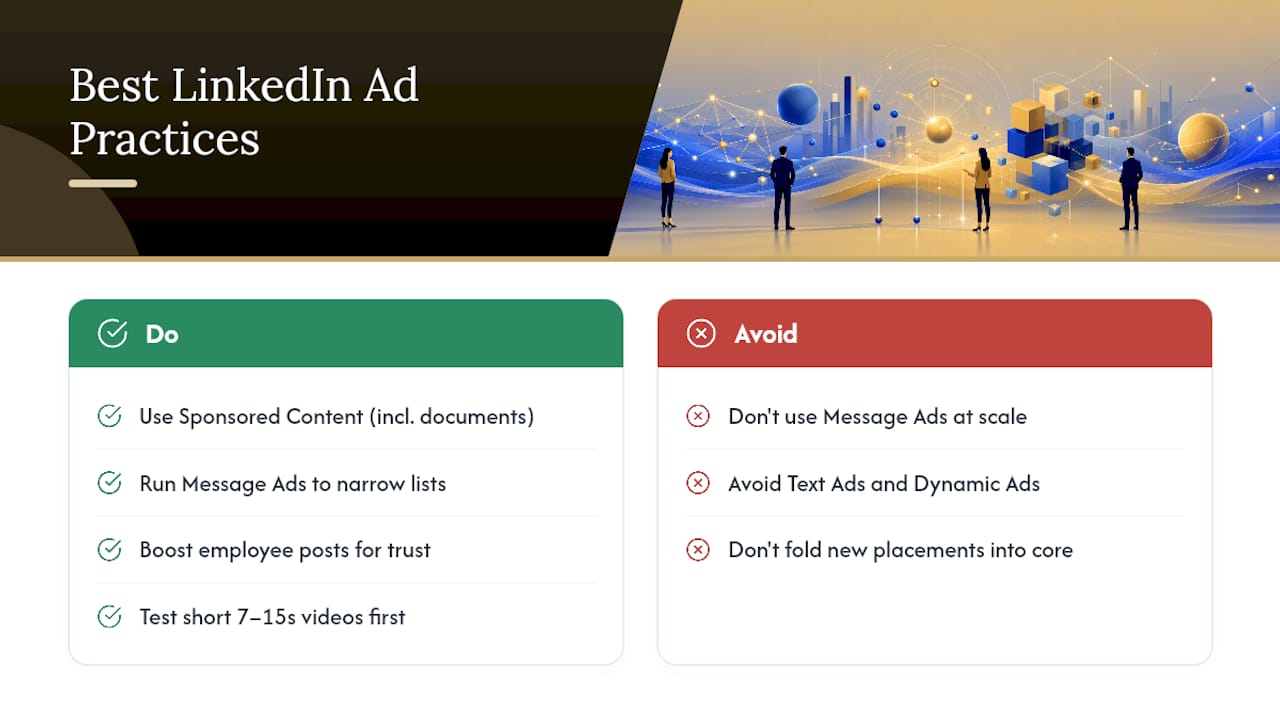
Sponsored Content (single image, carousel, video, or document) is your workhorse. Document ads in particular work well for mid-funnel content like buyer’s guides, because they let a prospect flip through a PDF without leaving LinkedIn.
Message Ads and Conversation Ads land in the inbox rather than the feed. They’re built for tight, high-intent invites, think webinar registrations or demo bookings, sent to a narrow, well-qualified audience. Don’t use them for broad awareness; the format performs poorly at scale, and can feel intrusive if the audience is too wide.
Thought Leader Ads let you boost an individual employee’s organic post as a sponsored placement. Boosted employee content often lowers CPCs and raises trust compared to the same message run from the company page, because it reads as a person’s opinion rather than a brand’s pitch.
For direct lead generation, skip Text Ads and Dynamic Ads. Both have their place in a broader brand campaign, but neither delivers the volume or targeting precision that Lead Gen Forms and Message Ads offer for B2B.
Pro Tip: Test short-form video (7 to 15 seconds) as your first creative variant against a static image. It’s one of the fastest formats for surfacing which message resonates before you commit budget to a longer asset.
New placements worth testing in 2026 are short-form vertical video and connected TV inventory. Treat both as a small, separate test budget rather than folding them into your core campaign until you have a read on performance.
How Do You Build B2B Audiences That Convert on LinkedIn?
Audience construction is where most B2B campaigns win or lose before the first click. The core combination is job title plus seniority plus company size. Stack industry or skills on top only when your product genuinely serves a narrow vertical. Add too many layers at once and you’ll shrink the audience below a size Campaign Manager can serve efficiently.
Matched Audiences give you three distinct tools:
Account lists for account-based marketing, matched against your target company list.
Contact lists uploaded from your CRM, useful for nurture or upsell campaigns to known contacts.
Website retargeting, which re-engages visitors who didn’t convert on their first visit.
Audience size matters more than most marketers assume. For feed placements like Sponsored Content, aim for 50,000 to 300,000 people. Go narrower and you’ll exhaust the audience within days, driving up frequency and CPMs. For Message Ads or tight ABM lists, 15,000 to 50,000 is the workable range, since these formats depend on relevance more than reach.
LinkedIn’s scale gives you room to work with: Statista’s quarterly member counts show the platform has grown steadily, which means even a niche B2B vertical usually clears the minimum audience threshold if you’re willing to combine two or three adjacent job titles.
Three exclusions belong in every B2B campaign: your own employees, existing customers already in your CRM, and anyone flagged “open to work” if you’re selling something other than recruiting services. As the campaign accumulates data, watch frequency and conversion signals. If cost per lead climbs while frequency rises, broaden the audience. If lead quality drops while volume stays high, tighten it.
How Much Should You Spend on LinkedIn Ads for B2B?
Budget conversations on LinkedIn need a reset from what marketers expect coming from Meta or Google. A realistic test budget runs $3,000 to $5,000 per month, and that’s not a marketing number, it’s a statistical one: you need enough spend to accumulate the click and conversion volume Campaign Manager’s algorithm requires to optimize delivery.
Treat these as directional. A campaign targeting VPs at enterprise accounts will sit at the high end of every row; a campaign targeting mid-market managers will land lower.
On bidding strategy:
Start with manual CPC during the learning phase so you control cost while the algorithm gathers signal.
Shift to automated or CPM bidding once you have 30 to 50 conversions and stable delivery.
Watch for bid shading. If your manual bid sits well above the suggested range, Campaign Manager will often under deliver, so nudge it down incrementally rather than in large jumps.
Choose daily budgets for ongoing campaigns you want to pace evenly, and lifetime budgets for time-bound offers like a webinar registration window. Qualified Lead Optimization, which lets you feed first-party “qualified lead” events back into the platform, has shown early efficiency gains for accounts that wire it up correctly, because the algorithm starts optimizing toward leads your sales team actually wants, not just form fills.
Creative and Messaging That Produce Higher-Quality Leads
The strongest B2B ad copy on LinkedIn leads with a role-specific benefit stated in one sentence, followed by a single clear call to action. Don’t stack three CTAs into one ad; it splits intent and confuses the click.
A few rules that consistently separate high-performing creative from the rest:
Open with the outcome, not the feature: “Cut vendor onboarding from six weeks to six days” beats “Our platform streamlines vendor management.”
Use short video (7 to 15 seconds) for top-of-funnel awareness and document ads for mid-funnel qualification, when a prospect is ready to actually read something.
Run Thought Leader Ads alongside company-page creative. The tonal contrast, a person’s voice next to a brand’s, often reduces CPC and increases the sense that a real human is behind the message.
Personalize headlines by seniority. A director-level prospect and a C-suite prospect respond to different framing even when the offer is identical.
Pro Tip: Build a simple testing matrix: three creative formats (video, static, document) across two headline angles (efficiency vs. risk reduction). Six combinations is enough to find a clear winner without spreading your budget too thin.
Deciding between a landing page and a Lead Gen Form comes down to what you’re willing to trade. Lead Gen Forms auto-populate LinkedIn profile data, so completion rates run 6% to 13%, well above what most external landing pages achieve. The tradeoff is qualification: without custom questions, you’ll get volume that includes people who clicked without real intent. Add one or two qualifying questions (“What’s your team size?” or “What’s your timeline?”) to filter before the lead ever reaches sales.
Measurement: Which KPIs Actually Matter for LinkedIn B2B Campaigns
Cost per lead is the metric everyone watches and the one that misleads the most people. A campaign with a low CPL and a terrible sales acceptance rate is worse than a campaign with double the CPL and leads that close.
The KPIs that actually predict revenue:
CPL, useful for budget planning but never in isolation.
SQL rate, the percentage of leads sales accepts as sales-qualified. A rate under 15% signals a targeting or qualification problem, not a creative one.
Pipeline velocity, how fast a LinkedIn-sourced lead moves through your stages compared to leads from other channels.
Closed-won attribution, tied back to the original campaign and ad.
None of this works without proper tracking of where each lead actually came from. Set up UTM parameters on every ad, install LinkedIn’s Insight Tag site-wide, and where your sales cycle runs long, use offline conversion uploads to feed closed-won data back into Campaign Manager weeks or months after the original click. Without that loop, you’re optimizing toward form fills instead of revenue.
Report weekly during the first month of any campaign, then shift to a biweekly cadence once delivery stabilizes. Cross-channel attribution deserves its own discipline too. If a prospect saw a LinkedIn ad, then converted from a Google search two weeks later, a single-touch model will credit the wrong channel entirely.
A Testing Framework to Prioritize in 2026
Run these tests in order, not all at once. Splitting budget across five experiments simultaneously means none of them reach statistical stability.
Lead Gen Forms vs. website conversion. Run both for two to three weeks with equal budget, then compare SQL rate, not just raw lead count.
Thought Leader Ads vs. company-page creative. Same message, two delivery voices, same audience.
Short video vs. static image. Measure completion rate and cost per lead, not just click-through rate.
Ad duplication for scaling winners. Once a variant wins, duplicate it into a new campaign rather than editing the original, so you preserve the learning data on the winner.
Qualified Lead Optimization setup. Map your CRM’s “qualified” status to a conversion event in Campaign Manager, then give it at least three to four weeks and 50-plus qualified events before judging results.
Give every test two to three weeks minimum before making a call, and don’t trust a result built on fewer than 20 to 30 conversions. Judge quality signals, SQL rate and pipeline velocity, over raw volume every time the two disagree.
Flockleads’ Approach to Managed B2B LinkedIn Campaigns
Running this playbook well takes real operational weight: ICP definition, weekly bid adjustments, creative refreshes, and a CRM integration that actually holds up over months. Flockleads builds B2B lead generation campaigns around exactly that structure, starting with ICP-first targeting, qualifying every lead before it reaches a client’s inbox, and connecting delivery directly to the client’s CRM so sales sees leads the moment they convert.
The managed approach adds the most value in three specific spots:
Weekly optimization cycles that catch a creative fatigue or audience saturation issue before it drains a month’s budget.
Lead qualification logic tuned to a client’s actual sales process, not a generic form.
Reporting that ties spend to SQL rate and pipeline, not just cost per click.
For B2B teams weighing managed LinkedIn advertising against building the muscle in-house, the honest answer depends on whether marketing has the weekly bandwidth to run this level of optimization. Most lean teams don’t, and that gap is exactly where a managed service earns its cost.
When LinkedIn Ads Are the Right Move, and When They Aren’t
LinkedIn earns its premium price when three things are true: you have a defined ICP, your average deal is worth enough to absorb a $50 to $150 cost per lead, and you’re running something close to account-based marketing rather than a scattershot campaign. Under those conditions, the targeting precision LinkedIn offers pays for itself.
It’s the wrong channel when deal value is low, when there’s no nurture sequence waiting to catch the leads it generates, or when the total test budget is under $1,000 a month. Spread that thin, you won’t reach the volume needed to learn anything before the budget runs out.
The strongest B2B programs rarely run LinkedIn alone. Google Search catches high-intent buyers already looking for a solution, Meta can fill top-of-funnel awareness at a lower cost for categories with a broader audience, and LinkedIn does what neither does well: reaching a specific title at a specific company before that person has started searching at all. Used together, the channels cover the funnel LinkedIn alone can’t.
— Mieke
Get Managed LinkedIn Lead Generation Without the In-House Overhead
Running LinkedIn ads well means weekly bid checks, creative rotation, and a CRM pipeline that never breaks, work most lean marketing teams don’t have hours for. Flockleads runs that entire loop for you: ICP-first targeting, qualified Lead Gen Forms, CRM integration, and weekly optimization, so leads arrive ready for sales instead of sitting in a spreadsheet.
Hiring an agency makes sense once your deal value justifies the spend but your team lacks the bandwidth to manage bids, creative testing, and CRM mapping every week. Running it in-house makes more sense only if someone owns LinkedIn full-time. If you’re not there yet, see how Flockleads’ managed approach compares to running campaigns solo and where the two paths diverge on cost and control.
Start with a free audit of your current setup, or lack of one, and get a clear picture of what a managed LinkedIn program could deliver for your B2B lead generation goals. Request your audit today and see the targeting plan before you commit a dollar of ad spend.
Sources
For platform mechanics, consult LinkedIn’s own campaign documentation on campaign types and account limits. For testing priorities, see Search Engine Land’s 2026 test list. For benchmark figures and Lead Gen Form conversion data, see FYI Digital’s B2B guide and Neal Schaffer’s LinkedIn ads guide.
Frequently asked questions
What Is the Best LinkedIn Ad Format for B2B Lead Gen?
Sponsored Content paired with Lead Gen Forms is the most reliable starting point, since it combines feed visibility with a low-friction, high-completion conversion form.
How Much Should a B2B Company Budget for LinkedIn Ads?
Plan for $3,000 to $5,000 a month during the testing phase; that range gives Campaign Manager’s algorithm enough conversion volume to optimize delivery within two to three weeks.
What SQL Rate Should I Expect From LinkedIn Leads?
An SQL rate below 15% usually points to a targeting or qualification issue rather than a creative problem, so treat it as a diagnostic, not just a scorecard.
Should I Run LinkedIn Ads Myself or Hire a Managed Service?
Run it yourself if someone owns the weekly optimization cycle full-time; hire a managed provider like Flockleads if your team lacks the bandwidth for bid management, creative testing, and CRM integration every week.
NEED A CLEARER PLAN?
Let’s turn your next move into momentum.
Talk to us →