THE SHORT ANSWER
LinkedIn advertising typically runs $5–$12 per click, $30–$60 per thousand impressions, and $60–$175 per qualified lead, according to Hootsuite’s 2026 benchmarks . Those ranges are wide on purpose: LinkedIn pricing is auction-based, and your actual cost depends on who you’re targeting, what you’re bidding on, and how well your creative performs. The number that matters most isn’t your CPC.
LinkedIn advertising typically runs $5–$12 per click, $30–$60 per thousand impressions, and $60–$175 per qualified lead, according to Hootsuite’s 2026 benchmarks. Those ranges are wide on purpose: LinkedIn pricing is auction-based, and your actual cost depends on who you’re targeting, what you’re bidding on, and how well your creative performs. The number that matters most isn’t your CPC. It’s your cost per qualified pipeline opportunity.
Quick planning benchmarks for 2026:
CPC: $5–$12 (Sponsored Content feed ads, typical B2B targeting)
CPM: $30–$60 (impression-based campaigns, brand awareness)
CPL via Lead Gen Forms: $60–$175 depending on industry and role seniority
Message Ads cost-per-send: roughly $0.20–$1.00 per send
For a first test, plan a minimum of $25/day in LinkedIn Campaign Manager, with $2,500–$3,000/month as a realistic starting budget to exit the platform’s learning phase. LinkedIn Sponsored Content feed ads are the most common entry point. LinkedIn Conversation and Message Ads work better for direct outreach to warm audiences. Flockleads runs managed LinkedIn campaigns across all these formats for B2B companies that want leads delivered without building the infrastructure themselves.
Key Takeaways
LinkedIn advertising costs can vary widely due to industry, audience, and creative quality; a key metric to evaluate success is the cost per qualified pipeline opportunity rather than just raw cost per lead.
Point | Details |
|---|---|
Core cost ranges | LinkedIn CPC runs $5–$12, CPM $30–$60, and CPL $60–$175 for most B2B campaigns. |
Minimum test budget | Budget at least $2,500/month ($75–$100/day) to exit the learning phase within 4–6 weeks. |
Bidding strategy | Start on maximum delivery, then switch to cost cap once you have 15–20 conversions per campaign. |
Measure what matters | Track cost per qualified pipeline opportunity via CRM, not just raw CPL from Campaign Manager. |
Flockleads option | Flockleads manages LinkedIn campaigns with built-in forecasting, weekly optimization, and CRM-connected lead delivery for B2B companies. |
What do LinkedIn ads actually cost? Benchmarks by format
Metric definitions matter here before you read any table. CPC (cost per click) is what you pay each time someone clicks your ad. CPM (cost per thousand impressions) is what you pay for visibility. CPL (cost per lead) is what you pay per form submission or lead captured. CPV (cost per video view) applies to video campaigns billed on a view basis.
Webtools’ mid-2026 dataset puts the platform-wide average CPC at $6.50 and average CPM at $36. Those are medians across all industries and objectives, which means your number will almost certainly differ.
Message Ads are billed per send, with costs influenced heavily by recipient engagement rates; effective cost per click equivalents can vary widely depending on open and click-through performance.
Expect costs at the high end when targeting C-suite roles in Financial Services or Technology. Broad recruiting campaigns targeting mid-level professionals in large industries tend to land closer to the floor. Treat every published benchmark as a directional range, not a guarantee. Auction dynamics shift weekly.
How LinkedIn billing and the ad auction work
LinkedIn’s pricing is a second-price auction: you set a bid, but you typically pay just above what the next-highest bidder offered, not your full maximum. Your actual clearing price also reflects a relevance multiplier. High-engagement creative effectively lowers your cost; low-engagement creative raises it, because LinkedIn deprioritizes ads that don’t hold attention.
Billable events by objective:
Impressions (CPM): charged per 1,000 ad views; used for brand awareness objectives
Clicks (CPC): charged per click on your ad; used for website visits, lead gen
Sends (Message Ads): charged per message delivered, regardless of open or click
Video views (CPV): charged per qualifying view (typically 2+ seconds); used for video view objectives
LinkedIn offers three bidding options, each suited to a different stage of campaign maturity:
Maximum delivery (automated): LinkedIn spends your budget to get the most results. Good for new campaigns with no historical data, but Zapier’s analysis warns this can waste budget fast when audience targeting is too broad.
Cost cap: You set a target cost per result. LinkedIn tries to stay at or below it. Better for campaigns with some conversion history.
Manual bidding: You set the exact bid. Gives the most control but requires active management and a clear sense of what a result is worth.
Pro Tip: Start new campaigns on maximum delivery for the first two to three weeks to collect conversion data. Once you have 15–20 conversions per campaign, switch to cost cap to stabilize your CPL without sacrificing delivery volume.
All of these settings live inside LinkedIn Campaign Manager, which also shows your billed events and spend history in real time.
What drives LinkedIn ads cost up or down?
Four levers move your auction price more than anything else.
Audience size and competition. Targeting fewer than 20,000 members pushes CPC up sharply because you’re competing for a scarce pool. Adlibrary’s 2026 data confirms that audience size strongly correlates with auction competition. A campaign targeting “VP of Engineering at Series B SaaS companies in the US” might reach 8,000 people. Everyone else targeting that same profile is bidding against you for the same impressions.
Industry and role seniority. Technology, SaaS, and Financial Services consistently produce the highest CPCs on the platform. Senior titles (VP, Director, C-suite) command a premium because they’re the most sought-after audience in B2B.
Creative relevance. LinkedIn’s relevance diagnostics penalize low-engagement ads by raising their effective auction price. An ad with a weak hook that gets scrolled past repeatedly will cost more per click than a well-tested creative that earns genuine engagement. This isn’t just a quality score in theory. It shows up in your actual spend.
Seasonality. Q4 (October through December) drives up CPMs across the board as budgets flush and advertisers compete for year-end pipeline. January and August tend to be softer. If you’re planning a first test, February through May or September are often more cost-efficient entry points.
How to estimate clicks, leads, and CPL from your budget
The core formula is straightforward:
Budget ÷ CPC = estimated clicks
Clicks × landing page conversion rate = leads
Leads × qualified rate = pipeline opportunities
Here’s a worked example using a $2,500 monthly test budget and a $7.50 average CPC (close to the Webtools median):
$2,500 ÷ $7.50 = 333 clicks
If your budget is tight, native forms are the faster path to leads.
On minimums: LinkedIn’s platform minimum is $10/day, but Zapier’s guidance and practitioner consensus both point to $25–$100/day as the realistic floor for stable delivery. Below $25/day, the learning phase drags on and CPCs fluctuate wildly. For reliable campaign optimization, a budget that allows for steady data collection over several weeks is generally recommended to help the algorithm stabilize performance, though exact amounts vary by campaign.
Pro Tip: Run your first campaign for at least four weeks before drawing conclusions. LinkedIn’s learning phase typically needs 15–20 conversions per campaign to exit. Cutting a campaign at day 10 because CPL looks high is one of the most common and costly mistakes on the platform.
Benchmarks by industry and campaign objective
Industry context changes the math significantly. A $120 CPL that looks expensive in isolation is actually below average for Financial Services, where Hootsuite’s 2026 data places typical CPLs toward the higher end of the $60–$175 range.
Objective-level ramp times:
Lead generation campaigns: expect 4–6 weeks to exit learning phase and reach stable CPL
Brand awareness (CPM): stabilizes faster, usually 2–3 weeks, but downstream pipeline impact takes longer to measure
Recruiting campaigns: often the fastest to stabilize due to larger audience pools and higher click intent
A few rules of thumb for reading your own benchmarks:
If your CPL is more than 2x the industry median, check creative first, then audience size.
If your CPC is high but CTR is low, the problem is almost always the ad hook, not the bid.
If your CPL is low but pipeline quality is poor, your targeting is too broad or your lead form isn’t qualifying well enough.
Tactics to lower cost-per-result and improve ROI
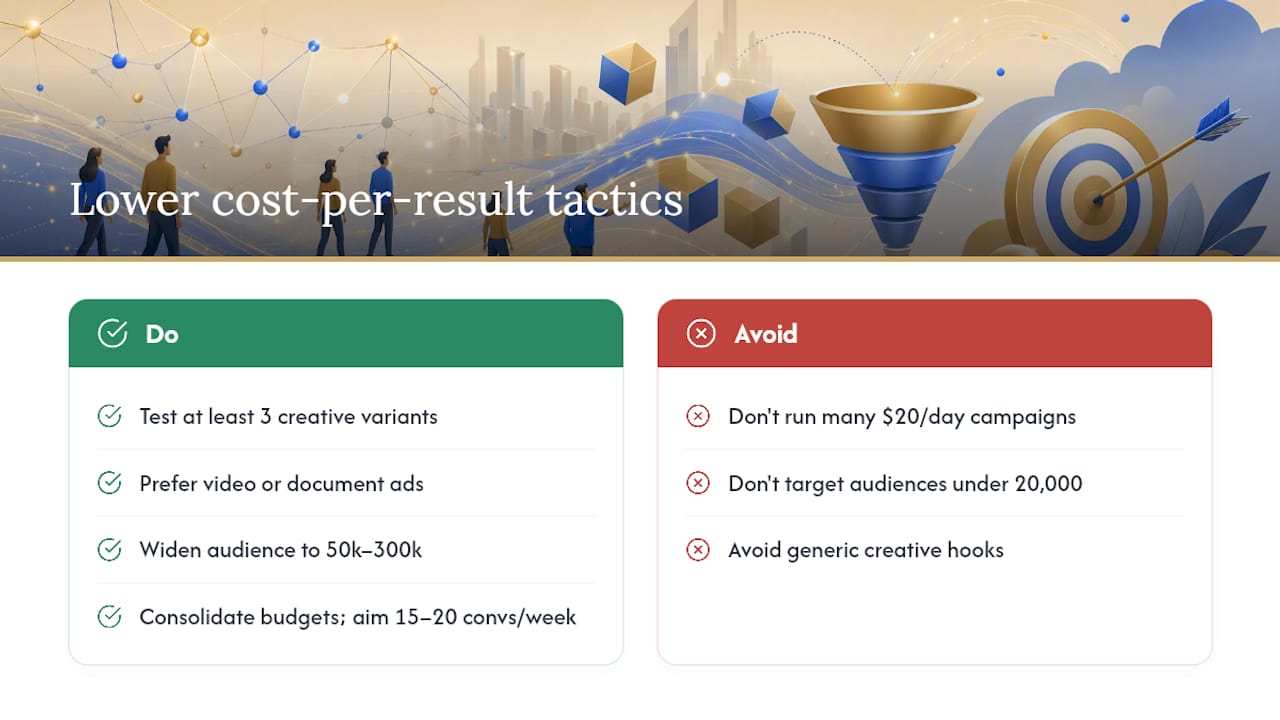
The fastest CPL reduction usually comes from creative, not bidding. Test at least three creative variants per campaign: one direct offer, one insight-led hook, and one social-proof angle. Video and document ads often outperform single images in feed because they generate more dwell time, which improves relevance scores.
On audience strategy: if your CPC is spiking, the first fix is usually widening the audience. Adlibrary’s data shows audiences under 20,000 members consistently produce higher CPCs. Aim for 50,000–300,000 for most B2B campaigns. Layer account-based targeting (uploading a matched company list) on top of a broader role-based audience to get precision without scarcity pricing.
For bidding: consolidate small campaigns rather than running five separate ones with $20/day each. The platform needs 15–20 conversions per campaign per week to stabilize delivery, per Adlibrary’s practitioner guidance. Five campaigns at $20/day will all stay in learning phase indefinitely. One campaign at $100/day exits it in two to three weeks.
On measurement: stop optimizing for raw CPL. The metric that actually predicts revenue is cost per qualified pipeline opportunity. Connect LinkedIn Campaign Manager to your CRM (Salesforce, HubSpot, or similar) and track which leads progress to MQL, SQL, and closed deals.
Pro Tip: Generic creative is the fastest way to raise your CPC. LinkedIn’s relevance diagnostics penalize ads that look like every other ad in the feed. Specific, opinionated hooks (“Why your outbound sequence isn’t booking meetings”) consistently outperform generic benefit statements (“Grow your pipeline with LinkedIn ads”) because they earn the scroll-stop that drives engagement scores down.
LinkedIn vs. Google and Meta: cost trade-offs for B2B goals
LinkedIn costs more per click than Google Search or Meta. That’s not a flaw. It’s the price of verified professional audience data. The question is whether the downstream quality justifies the premium.
Metric | Google Search | Meta (Facebook/Instagram) | |
|---|---|---|---|
Typical CPC | $6–$12 | $2–$8 | $0.50–$3.00 |
Typical CPM | $30–$60 | $2–$10 | $5–$20 |
Typical CPL (B2B) | $60–$175 | $40–$150 | $30–$100 |
Targeting specificity | Very high (job title, company, seniority) | Intent-based (keyword) | Interest/behavioral |
Ramp time | 4–6 weeks | 2–4 weeks | 2–4 weeks |
Primary B2B use case | Account-level targeting, senior roles | Demand capture | Awareness, retargeting |
Relative cost | Highest | Medium | Lowest |
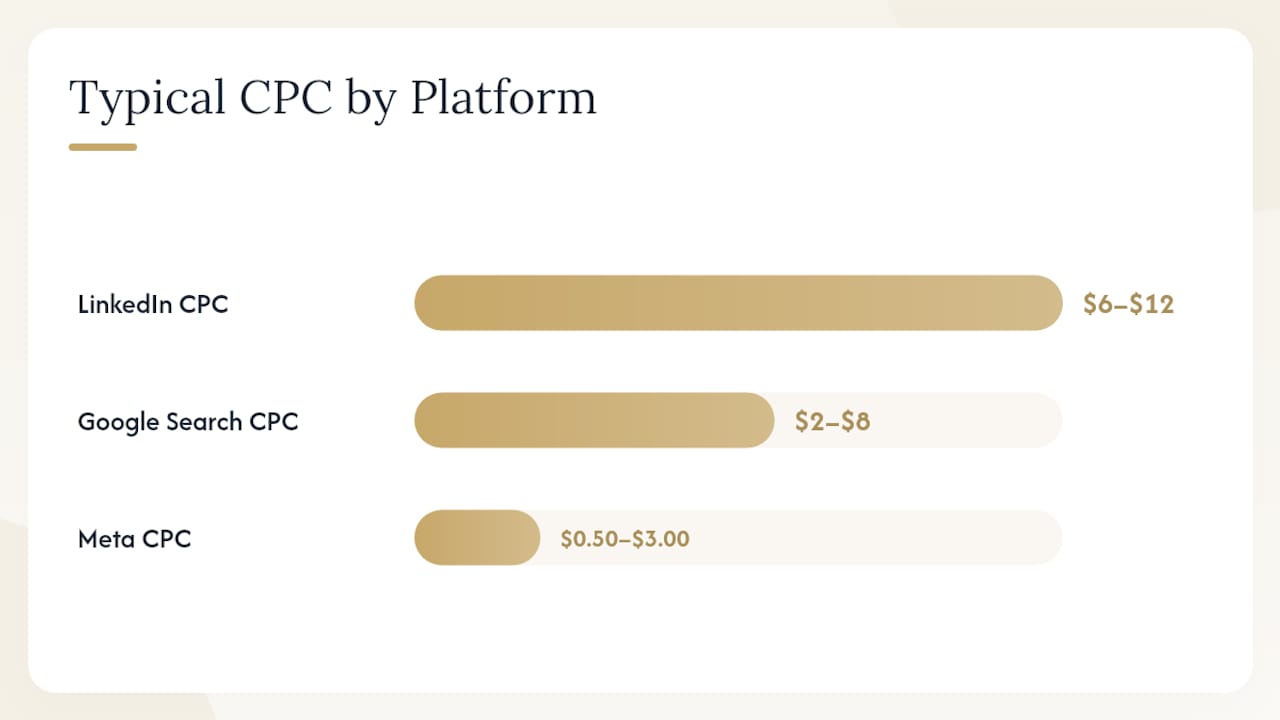
LinkedIn wins when you need to reach a specific job title at a specific company size in a specific industry. No other platform matches that precision. For more detail on Meta ad costs and timelines or Google Search ad performance, Flockleads has published benchmarks for both.
When LinkedIn is the right choice:
Your buyer is a senior decision-maker (VP, Director, C-suite) and you need to reach them by role, not by keyword
You’re running account-based marketing and need to target specific companies
Your deal size is large enough that a $150 CPL is a rounding error on customer lifetime value
When Google or Meta may outperform LinkedIn:
You need to capture in-market demand (someone actively searching for your solution)
Your budget is under $1,500/month and you need volume to test messaging
Your audience is broad enough that Meta’s interest targeting reaches them efficiently
For a broader comparison of LinkedIn vs. other ad channels for B2B lead generation, the trade-offs go deeper than CPC alone. See also this practical overview of using LinkedIn to promote your business for context on getting started.
How Flockleads approaches LinkedIn ad budgeting and forecasting
Flockleads uses a four-step forecasting process before recommending a LinkedIn budget to any B2B client.
Step 1: Baseline benchmark selection. Pull the relevant industry CPC and CPL range from current benchmark data (using sources like Webtools and Hootsuite). Anchor to the median, not the floor.
Step 2: Audience-competition adjustment. Estimate audience size in Campaign Manager.
Here’s what that looks like for a typical mid-market SaaS client:
Conservative assumptions, but they give a client a concrete number to hold the campaign accountable to. The forecast isn’t a guarantee. It’s a baseline that gets revised after week four of live data.
Pro Tip: In the first four weeks of a new LinkedIn campaign, measure three things only: CTR (creative health), CPL (bidding efficiency), and lead-to-MQL rate (targeting quality). Everything else is noise until you have enough data to act on it.
Key proofs that make this methodology credible: Flockleads runs LinkedIn campaigns across multiple B2B verticals, uses CRM integration to track leads from click to close, and publishes cost-per-lead benchmarks by industry for clients to reference. The forecast above is built on the same benchmark data cited throughout this article.
For a deeper look at why cost per lead and cost per acquisition measure different things and which one to manage, Flockleads has a dedicated breakdown.
When should you run LinkedIn ads vs. hire a managed provider?
Running LinkedIn campaigns in-house gives you control and transparency. You see every bid, every creative test, every audience segment. The trade-off is time and ramp speed. Getting from first campaign to stable, predictable CPL typically takes 6–10 weeks of active management: creative iteration, audience refinement, bid adjustments, and CRM attribution setup.
A few decision criteria worth being honest about:
Monthly budget under $2,000: DIY is probably fine. The learning phase will be slow, but the cost of a managed service may not be justified at this scale.
Monthly budget $3,000–$10,000: This is where managed services start to pay for themselves. The difference between a well-optimized campaign and a poorly structured one at this spend level is often $50–$80 CPL.
No in-house LinkedIn expertise: Expect to spend 3–4 months learning the platform before campaigns perform consistently. That’s not a criticism; it’s just the reality of a platform with a steeper learning curve than Meta.
Need for predictable lead flow now: A managed provider with existing campaign infrastructure and benchmark data can compress the ramp time significantly.
The honest answer is that LinkedIn’s auction rewards experience. Advertisers who know how to structure campaigns, exit the learning phase efficiently, and connect spend to pipeline outcomes consistently outperform those who don’t, regardless of budget. For small B2B businesses evaluating LinkedIn, the platform is genuinely worth it when deal size is high enough to absorb the CPL.
Flockleads delivers predictable B2B leads from LinkedIn without the ramp-up guesswork
Most B2B companies waste their first three months on LinkedIn figuring out what experienced campaign managers already know: which audience sizes avoid CPC spikes, which creative formats exit the learning phase fastest, and how to connect lead volume to actual pipeline value.
Flockleads runs managed LinkedIn campaigns built around the forecasting methodology described above: baseline benchmarks, audience-competition adjustments, creative testing cycles, and CRM-connected pipeline tracking. You get qualified leads delivered to your website, weekly optimization, and reporting tied to downstream revenue, not just form fills. No long-term lock-in. No agency retainer. If you’re planning B2B lead generation spend and want a faster path to stable CPL, see how Flockleads works.
Sources
The figures and recommendations in this article draw from the following sources. Treat all benchmarks as directional ranges and validate them with a 4–6 week pilot campaign in your own industry.
Run a pilot before committing to a full monthly budget. Four weeks of live data will tell you more about your actual CPL than any benchmark table.
Frequently asked questions
What does LinkedIn advertising typically cost per click?
LinkedIn CPC typically runs $5–$12 for most B2B campaigns, with a platform-wide average around $6.50 based on Webtools’ mid-2026 dataset. Targeting senior roles in competitive industries like Technology or Financial Services pushes costs toward the higher end.
Are LinkedIn ads worth it for B2B lead generation?
Yes, when deal size is large enough to absorb a $60–$175 CPL. LinkedIn’s value comes from verified professional targeting by job title, seniority, and company, which produces higher-quality pipeline than most other paid channels at comparable CPL.
What is the minimum budget to run LinkedIn ads effectively?
LinkedIn’s platform minimum is $10/day, but $25–$100/day is the practical floor for stable delivery. A $2,500/month budget over 30 days gives the algorithm enough data to exit the learning phase and produce reliable CPL figures.
How does LinkedIn ad cost compare to Google or Meta?
LinkedIn CPC ($6–$12) is higher than Google Search ($2–$8) and significantly higher than Meta ($0.50–$3.00). The premium reflects audience precision: LinkedIn lets you target by exact job title and company size, which Google and Meta cannot match for B2B.
What is the 5-3-2 rule on LinkedIn?
The 5-3-2 rule is a content mix guideline for organic LinkedIn posting: five pieces of curated content from others, three original posts, and two personal updates per ten posts. It applies to organic strategy, not paid LinkedIn advertising.
NEED A CLEARER PLAN?
Let’s turn your next move into momentum.
Talk to us →