THE SHORT ANSWER
Marketing automation is software that handles repetitive marketing tasks, such as sending follow-up emails, scoring leads, and tracking prospect behavior, without anyone on your team lifting a finger each time. For small B2B businesses, that matters because speed and consistency in follow-up are often the difference between a closed deal and a lost one.
What marketing automation actually does for B2B lead generation
Marketing automation is software that handles repetitive marketing tasks, such as sending follow-up emails, scoring leads, and tracking prospect behavior, without anyone on your team lifting a finger each time. For small B2B businesses, that matters because speed and consistency in follow-up are often the difference between a closed deal and a lost one.
The core components most relevant to B2B lead generation:
Lead capture: Forms, landing pages, and chatbots that pull prospects into your system automatically
Segmentation: Grouping contacts by industry, behavior, or stage so messaging stays relevant
Lead nurturing workflows: Automated email sequences that move prospects through the funnel over days or weeks
Lead scoring: Ranking contacts by engagement so your sales team focuses on the hottest prospects first
Automated follow-ups: Triggered emails or SMS after a form fill, demo request, or content download
Tools like ActiveCampaign, HubSpot, and Brevo are the most widely adopted platforms at the small business level, each covering these functions at different price points and complexity levels. The real payoff is scale: a two-person marketing team can manage hundreds of active leads simultaneously without hiring.
Key benefits that make automation worth the investment
Time savings are the most obvious win. Automating lead scoring, email sequences, and CRM data updates can recover hours every week that currently go to manual tasks.
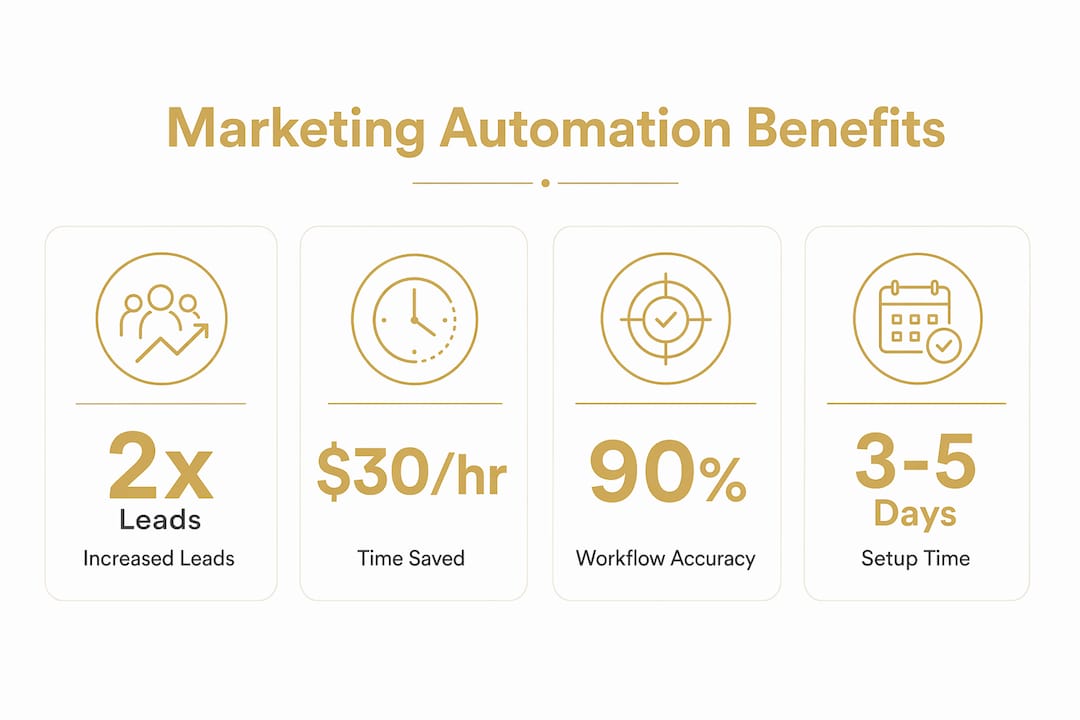
The less obvious benefit is lead quality. Quality lead nurturing sequences can generate significantly more qualified leads than ad-hoc follow-up strategies. That gap exists because automation enforces consistency: every lead gets the right message at the right time, not just when someone remembers to send it.
Other concrete advantages for small B2B teams:
Personalized messaging at scale: Behavior-based triggers send relevant content based on what a prospect actually clicked or downloaded
CRM alignment: When marketing automation connects to your CRM, sales reps see the full picture of a lead’s activity before they make a call
Cost efficiency: Reducing manual labor in marketing lowers cost per lead and improves overall ROI
Faster response times: Automated follow-ups reach a new lead within minutes, not hours, which directly affects conversion rates
Common pitfalls that sink marketing automation projects
Here is the number that should give any small business owner pause: 42–54% of marketing automation initiatives in small businesses fail to generate expected revenue due to process, data, and team misalignment issues. The causes are almost never the software itself.
The most common failure points:
Automating broken processes: Automating a broken process multiplies the chaos rather than fixing it. If your follow-up sequence is unclear before automation, it will be unclear at scale.
Data rot: Outdated or inaccurate contact data degrades deliverability and ruins segmentation. Lists decay faster than most teams realize.
Marketing and sales misalignment: Automation generates leads; if sales ignores them or follows up inconsistently, the system fails regardless of the software.
Choosing by feature count: Buying the platform with the most features almost always means paying for tools your team will never use.
Underestimating maintenance: Workflows need ongoing monitoring, debugging, and retuning. Ignoring maintenance leads to failing sequences that quietly damage your sender reputation.
Hidden cost escalation: Pricing often grows fast as your contact list expands. Budget for that before you commit.
How to choose the right marketing automation software
Start by mapping your existing marketing process before you open a single demo. Mapping your customer journey first uncovers process gaps that no software can fix on its own. Know which tasks consume the most time, where leads currently fall through, and what your sales team actually needs from marketing.
Then match the tool to those specific needs:
ActiveCampaign is the strongest choice for B2B teams that need advanced workflow logic, behavior-based segmentation, and CRM integration without moving into enterprise pricing.
HubSpot fits businesses that want marketing, CRM, sales pipeline, and reporting inside one connected platform. The free tier is genuinely useful; the paid tiers scale up significantly.
Brevo is the most affordable entry point, especially if your contact list is large. Its pricing is based on email sends rather than contact count, which makes it significantly cheaper at scale compared to per-contact tools.
For a broader look at how these platforms compare against each other, HubSpot alternatives for small business is worth reviewing before you finalize a decision.
Selection criteria checklist:
Does it integrate with your existing CRM and website?
Can your team realistically maintain it without a dedicated specialist?
What does pricing look like at three times your current contact list size?
Does it offer a free trial long enough to build one real workflow?
Pro Tip: Model your pricing at triple your current list size before committing to any platform. Costs that look manageable at 1,000 contacts can become painful at 5,000.
Best practices for generating leads with marketing automation
Start with one workflow, not ten. Successful automation begins with a single measurable workflow built on clean data. Welcome sequences are the right first choice: welcome emails have much higher open rates than standard campaigns.
Practical best practices for B2B lead generation:
Welcome sequences first: Every new lead should receive a structured, multi-step welcome series that introduces your value and sets expectations
Data hygiene on a schedule: Scrub your list quarterly. Remove bounced addresses, re-engage dormant contacts, and update job titles and company data
Keep humans in the loop for high-value moments: Automated sequences work for nurturing; a real person should handle demo requests, pricing conversations, and any complaint
Track what matters: Open rates are a starting point, not the goal. Monitor reply rates, demo bookings, and pipeline value generated from automated sequences
Scale gradually: Add new workflows only after the existing ones are performing consistently
Pro Tip: Audit every active workflow every 90 days. Platforms update, contacts change jobs, and offers go stale. A workflow that worked in Q1 may be quietly underperforming by Q3.
How automation connects with your existing systems
Isolated software creates more work, not less. Integration across marketing, CRM, sales, and other tools is what separates a functional automation system from a collection of disconnected apps that require manual data copying between them.

For B2B businesses, the critical integrations are:
CRM connection: When a lead completes a form or clicks a specific email link, that activity should appear automatically in your CRM with no manual entry. ActiveCampaign and HubSpot both handle this natively. If you use a separate CRM like Salesforce or Pipedrive, verify native integration before purchasing.
Email platform sync: If your marketing automation tool is separate from your email service provider, use a connector like Zapier to keep lists and tags synchronized. Mismatched data between platforms is one of the fastest ways to send the wrong message to the wrong person.
Social media and ad platforms: Most mid-tier automation platforms connect to Meta Ads and LinkedIn Campaign Manager, allowing you to sync custom audiences directly from your contact segments. This means a lead who opens three emails but hasn’t booked a call can automatically enter a LinkedIn retargeting audience. For a deeper look at social media tools for small businesses, there are solid options that pair well with your automation stack.
What small B2B businesses actually see in practice
A B2B consulting firm with a two-person marketing team uses ActiveCampaign to run a five-email nurture sequence triggered by a whitepaper download. The sequence runs for 14 days, ends with a soft call-to-action for a 30-minute discovery call, and requires zero manual effort after setup. The team reviews performance monthly and adjusts subject lines based on open rate data.
A small SaaS company uses HubSpot’s free CRM alongside its marketing hub to track every lead from first form fill through to closed deal. Sales reps see the full email engagement history before they call, which shortens discovery conversations and improves close rates.
These examples share a common structure: one clear goal, one defined workflow, clean data, and a human review cycle. Neither team automated everything at once.
Cost and ROI: what to realistically expect
Entry-level tools start at $0–$29/month. ActiveCampaign’s small business plans begin around $29/month; HubSpot’s Marketing Hub Starter is priced similarly. Brevo offers a free tier and paid plans based on send volume rather than contact count.
According to SBA research, small businesses using marketing automation generate 2–3x more leads per marketing dollar than those running manual campaigns. The average business recovers its software cost within 2–3 months when the first automated follow-up sequence is properly configured.
The hidden costs to budget for: content creation to feed the sequences, initial workflow setup time (1–2 weeks for a basic ActiveCampaign build), and ongoing maintenance. Factor those in before calculating ROI.
Training and change management for small teams
The platform is rarely the problem. The team’s willingness and ability to maintain it consistently is. The best automation software is the one your team will actually use, not the one with the longest feature list.
For small teams adopting automation for the first time:
Assign one person as the system owner responsible for monitoring and updates
Start with vendor onboarding resources: HubSpot Academy and ActiveCampaign’s training library are both free and genuinely useful
Run a 30-day pilot on a single workflow before rolling out additional automations
Hold a monthly 30-minute review where marketing and sales discuss what the automation is producing and what needs adjustment
Change resistance usually comes from sales teams who feel automation depersonalizes their leads. Addressing that early, by showing them the engagement data automation surfaces, tends to resolve it faster than any policy mandate.
If you want a done-for-you approach to lead generation on autopilot, Flockleads builds engineered lead flows for B2B service businesses that connect directly to your website and existing systems.
Ready to stop chasing leads manually? Flockleads builds automated lead generation systems for B2B service businesses in the U.S. that run without a dedicated marketing team.
Key Takeaways
Marketing automation works for small B2B businesses when it starts with clean data, a single defined workflow, and a team committed to maintaining it consistently.
Point | Details |
|---|---|
Start with one workflow | Build and validate one automation before adding complexity. |
Welcome emails perform the best | Welcome sequences have much higher open rates than standard campaigns. |
Failure rate is high | 42–54% of marketing automation initiatives in small businesses fail to generate expected revenue due to process, data, and team misalignment issues. |
Price scales with list size | Model costs at triple your current contact count before committing to any platform. |
Integration is non-negotiable | Isolated tools create manual work; connect automation to your CRM and email platform from day one. |
Frequently asked questions
What is marketing automation for small business?
Marketing automation uses software to handle repetitive marketing tasks, such as email sequences, lead scoring, and follow-ups, automatically. For small B2B businesses, it means more leads get consistent attention without adding headcount.
Which tool is best: ActiveCampaign, HubSpot, or Brevo?
ActiveCampaign is the strongest overall choice for B2B workflow depth, HubSpot is best if you want CRM and marketing in one ecosystem, and Brevo is the most affordable option for businesses with large contact lists.
How long does it take to see results from marketing automation?
Basic email sequences can go live within a few days; more complex automations take 1–2 weeks to configure properly. Most businesses recover their software cost within 2–3 months when the first follow-up sequence is correctly set up.
What causes marketing automation to fail?
The most common causes are automating poorly defined processes, low data quality, and misalignment between marketing and sales teams. Choosing software based on feature count rather than actual business fit is also a frequent mistake.
How much does marketing automation software cost for a small business?
Entry-level plans start at $0–$29/month for tools like Brevo and HubSpot Starter. Costs rise as contact lists grow, so model pricing at triple your current list size before committing to a platform.
NEED A CLEARER PLAN?
Let’s turn your next move into momentum.
Talk to us →