THE SHORT ANSWER
Multichannel lead generation is the practice of coordinating outreach across multiple independent platforms simultaneously to attract, engage, and convert B2B prospects. You run LinkedIn ads, email nurture sequences, Google Search campaigns, and events at the same time, each optimized for its own platform, while keeping your core message consistent.
Multichannel lead generation is the practice of coordinating outreach across multiple independent platforms simultaneously to attract, engage, and convert B2B prospects. You run LinkedIn ads, email nurture sequences, Google Search campaigns, and events at the same time, each optimized for its own platform, while keeping your core message consistent. The result is a lead engine that does not collapse when one channel underperforms.
The data behind this is hard to ignore. Businesses using three or more channels see significantly higher purchase rates than those relying on a single channel. That gap exists because buyers rarely convert after one touchpoint. They see your LinkedIn post, search your brand name on Google, read a case study, and then respond to an email. Each channel plays a different role in that sequence.
Key benefits of a multichannel approach:
Broader reach: Your audience is fragmented across platforms. Meeting them where they already spend time increases exposure without requiring them to find you first.
Improved engagement: Multiple touchpoints build familiarity and trust before a sales conversation begins.
Reduced risk: Dependence on a single channel leaves you exposed to algorithm changes, rising costs, and platform disruptions.
Better lead quality: Different channels attract prospects at different funnel stages, giving you a more complete picture of buyer intent.
What channels actually drive B2B leads?
Not every channel deserves a spot in your mix. The right selection depends on where your buyers spend time, what stage of the funnel you are targeting, and what your team can execute consistently.
Digital channels:
LinkedIn: The highest-intent B2B platform. Effective for both paid lead generation and organic thought leadership. Average cost per click tends to be relatively high, but the audience quality justifies it for most B2B offers.
Email: The only channel you fully own. Algorithms cannot deplatform a list you built. Works best for nurturing, retention, and converting warm prospects who already know you.
Google Search Ads: Captures high-intent buyers who are actively searching for a solution. Fast to launch, measurable, and direct.
Paid social (Facebook, Instagram, TikTok): Better for awareness and remarketing than direct lead capture in B2B. Useful for reaching decision-makers outside of work hours.
Content and SEO: Slower to build (typically 3–6 months before meaningful traffic), but compounds over time. A blog post published today can drive qualified leads for years.
Traditional and hybrid channels:
Events and trade shows: Face-to-face trust is hard to replicate digitally. Events compress the qualification process because you can have a real conversation in minutes.
Cold calling and outbound phone: Still effective when paired with strong targeting. Works best as a follow-up channel rather than a cold first touch.
Webinars: High-intent leads self-select by registering. A well-run webinar can generate more qualified pipeline in 90 minutes than a month of display ads.
Channel selection criteria: Match each channel to your audience’s behavior, your funnel stage, your content production capacity, and your budget. A B2B SaaS company targeting enterprise buyers will weight LinkedIn and events heavily. A local service business might find Google Search and email more than sufficient.

Why multichannel strategies produce better business results
The business case for multichannel lead generation goes beyond reach. It changes the economics of your entire pipeline.
Single-channel dependency is a structural risk. When Facebook changes its algorithm or Google raises CPMs, a business running all its lead generation through one platform has no fallback. Diversification is not just a growth tactic. It is basic risk management.
287% higher purchase rates. That is the lift businesses see when they coordinate three or more marketing channels versus relying on one. The gap widens further with five or more coordinated channels.
Customer retention also improves when buyers interact with a brand across multiple channels. The repeated exposure builds familiarity, and familiarity builds trust. A prospect who has read your content, seen your LinkedIn posts, and attended one of your webinars arrives at a sales call already half-convinced.
Inbound and outbound each play a distinct role in this picture. Inbound harvests existing demand cheaply. Outbound creates new demand but costs more per lead. Running both on a unified layer produces a more resilient pipeline than either approach alone.
The deeper advantage is data. When you run multiple channels, you collect behavioral signals from multiple sources. You learn which content topics drive the most qualified leads, which channels attract buyers who close fastest, and where in the journey prospects tend to drop off. That intelligence compounds over time.

How to build a multichannel lead generation strategy step by step
A multichannel strategy fails when it is just multiple campaigns running in parallel with no coordination. Here is how to build one that actually works.
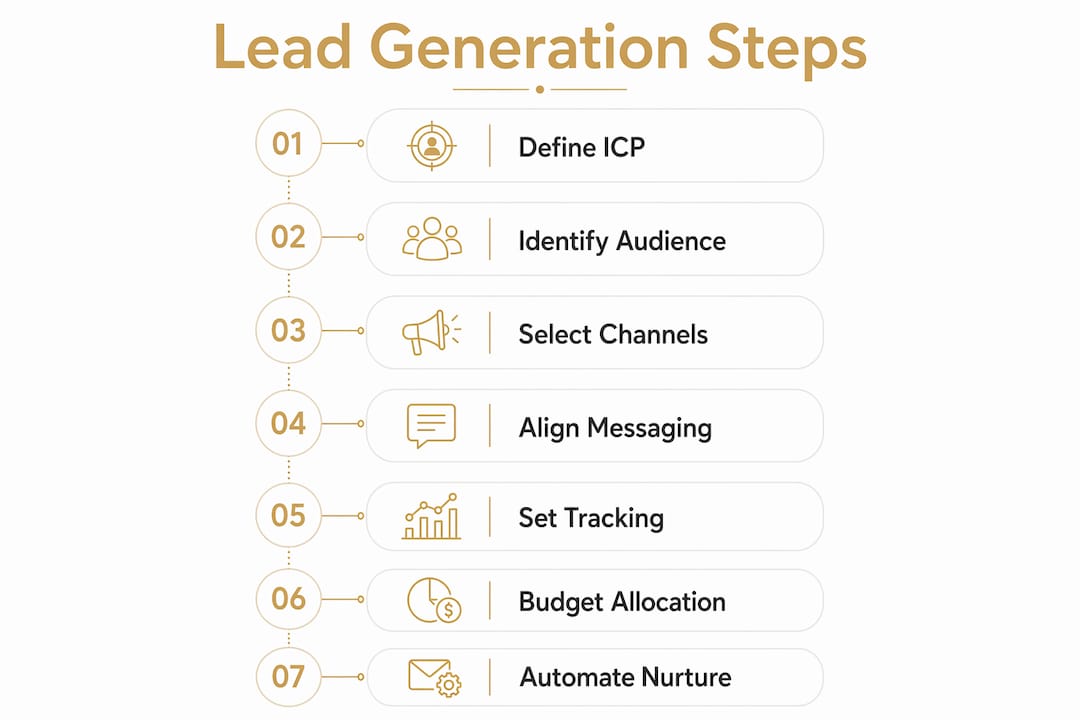
Step 1: Define your ideal customer profile with precision. Start from your closed-won customers. Which accounts bought fast, stayed, and expanded? What did they have in common beyond obvious firmographics? Build your targeting filters from those patterns, not from generic industry categories.
Step 2: Identify where your audience is active. Use platform demographic data, customer surveys, and your own analytics. Do not assume. A B2B buyer who spends 8 hours a day on LinkedIn may never open a cold email.
Step 3: Select 2–3 core channels and go deep before expanding. For budgets under $50,000 per month, the strongest guidance is to master two to three channels before adding more. Below $10,000 per month, limit yourself to two to three channels. Scaling to five or six channels only makes sense with a larger budget and dedicated team per channel.
Step 4: Align messaging across channels. Your core value proposition must stay consistent even as the creative execution adapts to each platform. A LinkedIn carousel and a cold email can look completely different and still carry the same message. Message conflict across channels causes brand confusion and pushes prospects out of the sales process.
Step 5: Set up tracking before you launch. UTM parameters, CRM integration, and a unified reporting dashboard are not optional extras. Without them, you cannot tell which channels drive revenue and which just look busy.
Step 6: Allocate budget using the 70/20/10 framework. Put 70% on proven channels, 20% on channels you are actively scaling, and 10% on experiments. Review performance monthly and reallocate based on return on ad spend (ROAS), customer acquisition cost (CAC), and conversion data.
Step 7: Automate follow-up and nurture sequences. Marketing automation has been shown to generate more leads and achieve higher conversion rates than manual campaigns. Automation ensures that a prospect’s behavior on one channel can trigger a relevant response on another without anyone manually monitoring it.
Pro Tip: The single most common messaging mistake is treating channel adaptation as an excuse to change your core offer. Your LinkedIn ad and your email sequence can use different formats, different tones, and different visuals. But if a prospect sees a “free audit” offer on LinkedIn and a “book a demo” offer in your email the same week, they will wonder if they are talking to the same company. Lock the offer. Adapt the wrapper.
Channel-specific best practices that actually move the needle
Generic advice about “being consistent” does not help you run a better LinkedIn campaign. Here is what works at the channel level.
LinkedIn:
Lead with professional credibility, not product features. Decision-makers on LinkedIn respond to insight, not pitches.
Use LinkedIn for B2B outreach with a clear named offer rather than a vague “let’s connect” message.
Thought leadership posts that share a specific opinion or counterintuitive finding consistently outperform promotional content.
Retarget website visitors and video viewers with a more direct offer once they have shown intent.
Email:
Give proof before you ask. Share a case study, a data point, or a useful insight before requesting a meeting.
Segment your list by behavior and intent. A prospect who downloaded a whitepaper last week should not receive the same email as someone who signed up six months ago and never engaged.
Behavior-triggered sends, such as follow-ups after a demo no-show or a content re-engagement sequence, catch prospects at peak intent.
Google Search Ads:
Focus on high-intent keywords where buyers are actively looking for a solution, not just researching a problem.
Set negative keyword lists aggressively to avoid wasting budget on irrelevant clicks.
Match your ad copy to your landing page headline exactly. Mismatches between ad promise and page delivery kill conversion rates.
Events and trade shows:
Qualify leads during the event, not after. Ask the right questions in conversation so your follow-up is specific and relevant.
Follow up within 24 hours while the conversation is still fresh. A generic “great to meet you” email two weeks later accomplishes nothing.
Use events to accelerate deals already in your pipeline, not just to generate new names.
How to measure and optimize your multichannel campaigns
Measurement is where most multichannel programs fall apart. Each platform reports its own numbers using different attribution windows and different definitions of “conversion.” Without a unified view, you end up making budget decisions based on incomplete data.
Key metrics to track:
Metric | What it tells you | Where to track it |
|---|---|---|
Blended ROAS | Total revenue divided by total ad spend across all channels | Unified dashboard |
CAC by channel | Which channels acquire customers most efficiently | CRM with UTM data |
Qualified lead rate | What share of leads meet your ICP criteria | CRM |
Pipeline velocity | How fast deals move from lead to close | CRM |
Assisted conversion rate | Which channels appear in the path before a final conversion | Multi-touch attribution |
Attribution matters more than most teams realize. Last-click attribution systematically undervalues awareness channels like content and social while over-crediting bottom-of-funnel converters like paid search. Multi-touch attribution distributes credit across all touchpoints along the buyer journey, giving you a more accurate picture of what is actually driving revenue.
Measurement best practices:
Use UTM parameters consistently across every channel so your CRM can track the full conversion path.
Run incrementality tests by turning channels on and off in geographic tests to measure true lift, not just attributed conversions.
Set channel-specific goals. An awareness channel should be measured on reach and assisted conversions, not direct ROAS.
Build a unified data layer that connects customer behavior across every channel. Without it, you cannot accurately attribute conversions or personalize cross-channel sequences.
Review leading indicators (pipeline created, engagement rates) weekly and lagging indicators (revenue, CAC) monthly.
How to align channels so prospects experience one conversation
The difference between multichannel presence and a multichannel strategy is coordination. Running LinkedIn ads, email campaigns, and Google Search simultaneously is not a strategy if each channel operates in isolation with no shared data and no awareness of what the others are doing.
A prospect who sees your LinkedIn ad, visits your website, and then receives an email that ignores everything they just did will feel like they are talking to three different companies. That friction slows deals and erodes trust.
The fix is a shared record. Every channel should read from and write to the same CRM record for each contact. When a prospect downloads a guide, that event should update their record and trigger a relevant follow-up on whichever channel they are most likely to engage with next. This is what separates cross-channel coordination from parallel campaigns.
Account-based marketing (ABM) is the most sophisticated version of this. ABM coordinates personalized outreach across every available channel for a defined list of target accounts, creating a situation where key decision-makers encounter relevant messaging on LinkedIn, in their inbox, through paid display, and in content their colleagues share. B2B organizations with aligned sales and marketing in a coordinated multichannel program show 36% higher customer retention rates than those with disconnected sales and marketing motion.
The practical starting point is simpler than ABM. Map which channels can pass events to your CRM, agree on a shared definition of a qualified lead, and set routing rules so no channel works in isolation. That coordination is where the prospect experience shifts from feeling like five separate conversations to feeling like one.
Which tools support a multichannel lead generation program?
Technology does not make a multichannel strategy work. Process and execution do. That said, the right tools remove friction and make coordination possible at scale.
CRM (Customer Relationship Management): The foundation. Salesforce and HubSpot CRM are the most common choices in B2B. Every lead, regardless of source, should land in the CRM with its origin channel tagged.
Marketing automation: Platforms like HubSpot Marketing Hub, Marketo, or ActiveCampaign enable behavior-triggered sequences across email and other channels. This is where the 80% more leads and 77% higher conversion rates from automation become real, because the system responds to prospect behavior faster than any human team can.
Unified reporting dashboard: Tools like Google Analytics 4, combined with a data connector, pull channel performance into one view. Without this, you are logging into five different platforms and trying to reconcile numbers that use different attribution windows.
LinkedIn-specific tools: For B2B teams investing heavily in LinkedIn, LinkedIn content and outreach work best when coordinated. LinkedIn Sales Navigator helps with targeting and outreach sequencing.
UTM tracking and tag management: Google Tag Manager paired with consistent UTM parameters across every campaign is the minimum viable tracking setup. Inconsistent tracking produces unreliable attribution data, which makes every budget decision a guess.
AI-powered lead scoring: Predictive scoring tools analyze behavioral signals across channels to identify which prospects are most likely to convert. This lets sales teams prioritize their time on the accounts most worth pursuing rather than working a flat list.
The tool selection principle: start with what you can sustain and actually use. A simple CRM plus email automation plus Google Analytics 4 is enough to run a coordinated two-channel program. Add tools only when you have outgrown what you have, not because a vendor demo looked impressive.
What a successful multichannel B2B campaign looks like in practice
Abstract strategy is easier to understand with a concrete example. Consider how a B2B software company might build a multichannel lead generation program from scratch.
The company starts with two channels: LinkedIn paid ads targeting mid-market operations directors, and an email nurture sequence for inbound leads from their website. Every LinkedIn lead lands in the CRM tagged with the campaign source. Every website visitor who downloads a guide enters the email sequence. The two channels share the same core offer and the same case study as proof.
After 90 days, the data shows that LinkedIn leads take longer to close but have a higher average contract value. Email leads close faster but at a lower price point. That insight changes the budget allocation: more LinkedIn spend for enterprise deals, more email investment for mid-market velocity.
In month four, the company adds Google Search Ads targeting high-intent keywords. The search ads capture buyers who are already looking for a solution, which shortens the sales cycle further. The CRM now shows three-channel conversion paths, and the team can see that prospects who touch all three channels before a sales call close at a higher rate than those who touch only one.
This is the compounding effect of a coordinated approach. Each channel informs the others, and the data from one channel improves the targeting and messaging of the rest. The Flockleads approach to engineered lead flow is built on exactly this kind of coordinated, data-connected channel architecture.
Common pitfalls in multichannel lead generation and how to avoid them
Most multichannel programs fail for predictable reasons. Knowing them in advance is most of the defense.
Pro Tip: Speed of follow-up is the most underestimated variable in B2B lead generation. Firms that contact leads within one hour are roughly seven times more likely to have a meaningful conversation than those that wait longer. Most teams take hours or days. Fix your follow-up speed before you add a new channel.
Common mistakes to avoid:
Channel sprawl: Adding channels before you have the budget, team, or infrastructure to run them well. Below $10,000 per month, two to three channels is the ceiling. Adding more spreads resources too thin and produces mediocre results everywhere.
Message conflict: Running different offers or value propositions on different channels simultaneously. Prospects notice the inconsistency and it creates doubt. Lock your core message and adapt only the format.
Confusing presence with strategy: Being active on five channels is not a multichannel strategy if those channels share no data, no goals, and no attribution model. Presence without coordination is just expensive noise.
Measuring the wrong things: Tracking activity metrics like posts published or emails sent instead of outcomes like qualified leads generated and pipeline created. Activity metrics feel productive. Outcome metrics tell you whether the program is working.
Abandoning too early: Most multichannel programs need 3–6 months to show meaningful results. Cutting channels after six weeks because the numbers are not there yet is the most common failure mode.
Over-investing in tools before fixing process: No platform solves a broken follow-up process or unclear messaging. Start with simple tools and upgrade when you have genuinely outgrown them.
The 70/20/10 budget rule is a practical approach to guard against channel sprawl: roughly two-thirds to proven channels, some to scaling channels, and a smaller portion to experiments. Review monthly. When a channel hits diminishing returns, that is the signal to reallocate, not to spend more on the same channel hoping for a different result.
Key Takeaways
Multichannel lead generation works because coordinated presence across three or more channels produces dramatically higher purchase rates than any single channel can achieve alone.
Point | Details |
|---|---|
Start narrow, then expand | Master a few core channels before adding more; at smaller budgets, focusing on fewer channels improves results. |
Message consistency is non-negotiable | Keep the same core offer across all channels; adapt format, not the value proposition. |
Automation multiplies output | Marketing automation can significantly increase lead generation and conversion rates compared to manual campaigns. |
Attribution drives budget decisions | Multi-touch attribution reveals which channels actually drive revenue, not just last-click conversions. |
Follow-up speed changes outcomes | Contacting leads quickly after they express interest greatly increases the likelihood of a meaningful conversation. |
Frequently asked questions
What is multichannel lead generation?
Multichannel lead generation is the practice of attracting and capturing B2B prospects across multiple platforms simultaneously, such as LinkedIn, email, Google Search, and events, while maintaining a consistent core message across all of them.
What are the disadvantages of a multichannel approach?
The main risks are channel sprawl, message inconsistency, and attribution complexity. Running too many channels without sufficient budget or team capacity dilutes execution quality across all of them, and without a unified data layer, you cannot accurately measure which channels drive revenue.
What is the difference between multichannel and omnichannel marketing?
Multichannel marketing uses multiple independent channels with coordinated messaging but separate metrics and data. Omnichannel marketing goes further by fully integrating those channels through shared real-time data, creating a personalized experience that adapts based on a customer’s behavior across every touchpoint.
What are the four main marketing channels for B2B lead generation?
The four most commonly used B2B lead generation channels are email, LinkedIn, Google Search Ads, and content or SEO. Events and outbound phone round out most mature B2B programs, with channel selection ultimately depending on audience behavior, funnel stage, and budget.
How long does it take to see results from a multichannel strategy?
Most multichannel programs take 3–6 months to show meaningful business results. Early signals like pipeline activity and engagement rates typically appear within the first month, but revenue impact usually becomes visible by month three or four.
NEED A CLEARER PLAN?
Let’s turn your next move into momentum.
Talk to us →