THE SHORT ANSWER
Pay per lead marketing works well for contractor teams with a narrow ideal customer profile and a sales team that can close what it’s given. Before signing anything, run a 30-day pilot with a written service level agreement, insist on held-meeting billing wherever the supplier will agree to it, and reject any deal without a replacement policy for bad leads.
Pay per lead marketing works well for contractor teams with a narrow ideal customer profile and a sales team that can close what it’s given. Before signing anything, run a 30-day pilot with a written service level agreement, insist on held-meeting billing wherever the supplier will agree to it, and reject any deal without a replacement policy for bad leads. Some suppliers offer exclusive, GDPR-compliant leads and a free audit as a lower-risk way to start.
TL;DR:
Contractors with a high close rate above 20 to 25 percent benefit most from pay per lead models, especially in defined service areas.
Pricing for qualified, exclusive leads can range from $30 to over $1,500 depending on lead quality, exclusivity, and seniority.
A solid SLA must clearly define billable actions, data fields, geographic limits, and lead replacement policies to prevent disputes.
Running a structured 30-day pilot with fixed filters, CRM tagging, and predefined thresholds ensures reliable evaluation of lead quality before full commitment.
Speed of follow-up within five minutes significantly improves lead conversion chances, emphasizing the importance of automated, rapid response sequences.
FlockleadsGet Exclusive Leads Without A RetainerFlock Leads qualifies each enquiry and passes it to one contractor, with agreed quality criteria and replacement for unsuitable leads.Visit Flock Leads
What is pay per lead marketing and how does it work?
Pay per lead (PPL) is a commercial model where you pay only when a supplier delivers a lead that meets criteria you agreed in advance, rather than paying for clicks, impressions, or a flat monthly fee regardless of output. The billable unit varies by contract: some suppliers charge on a form fill, others only on a booked meeting or a sales-qualified lead (SQL) that has passed a human qualification call.
The workflow behind most PPL suppliers looks the same regardless of vertical. Traffic gets generated through paid channels, a qualification step filters out tyre-kickers, the lead gets delivered to your CRM or inbox, and you have a defined window to accept or reject it against the agreed criteria. That acceptance window is where most disputes happen, which is why the contract terms matter more than the price per lead.
PPL shifts risk in a way pay per click (PPC) and retainer models don’t. With PPC, you pay for traffic whether or not it converts. With a retainer, you pay for the agency’s time and effort, win or lose. With PPL, the supplier only gets paid on an outcome you defined, which is closer to pay per acquisition than to traditional media buying. That’s also why PPL pricing per unit tends to run higher than raw cost per click. You’re paying for the guarantee, not just the traffic.
Suppliers typically source PPL volume through:
Google Search and Google Local Services ads targeting high-intent queries
Meta (Facebook and Instagram) campaigns aimed at homeowners or facility managers
LinkedIn campaigns for B2B and commercial trade work
Email or affiliate partnerships, less common but still used for volume top-ups
Our own breakdown of how lead generation actually works for contractors goes deeper into channel mix and realistic timelines if you want the fuller picture before comparing suppliers.
Who should use pay per lead, and when should you avoid it?
Three buyer profiles tend to get real value from PPL. Recognising which one you are, if any, saves you from a costly trial.
Contractors with a tight ICP and strong closers. If your close rate on qualified leads is already above 20 to 25%, PPL lets you buy volume without building an internal media team. Roofers, solar installers, and HVAC firms with a defined service radius fit this profile well.
Firms testing a new region or service line. PPL gives you a fast read on demand without the ramp-up time of an owned SEO or paid media programme. You can test heat pump demand in a new postcode area for a month rather than a quarter.
Teams that need short-term pipeline fill. A gap between a departing salesperson and their replacement, or a seasonal dip, is a legitimate reason to buy leads on a per-unit basis rather than commit to a retainer. Industry guidance from LaunchLeads frames hybrid retainer-plus-success-fee models as the safer long-term structure, with pure PPL working best for exactly these shorter, sharper needs.
If it’s higher, negotiate the price down or walk away.
What does pay per lead pricing actually look like?
Pricing varies enormously by deliverable, vertical, and exclusivity, which is exactly why so many contractors get burned comparing quotes that aren’t measuring the same thing. SyncGTM’s 2026 guide to pay per lead puts low-intent form fills at roughly $30 to $100, rising to $1,500 or more for a fully qualified SQL in a competitive vertical.
Exclusivity and persona seniority both push price upward. A lead sold to you alone typically costs more than one resold to two or three competing installers, because the supplier is giving up volume to protect your close rate. A lead qualified against a homeowner with a confirmed budget and a signed decision-maker costs more than one from a general enquiry form, for the same reason a booked meeting costs more than a form fill.
Three numbers to anchor your negotiation: your target cost of acquisition, your historical close rate on comparable leads, and the ceiling of 5 to 15% of ACV that SyncGTM’s benchmarking treats as the sustainable range for lead cost against deal value. Walk into any pricing conversation with those three figures written down, and you’ll spot an inflated quote immediately. For a country-by-country breakdown, our cost per lead benchmarks by industry and country page carries more granular figures than a single global range can offer.
How do you write an SLA that avoids lead-quality disputes?
A price per lead means nothing without a written definition of what counts as a lead. FoundryCRO’s benchmarking research flags the absence of a proper SLA as one of the most common technical pitfalls in PPL relationships, and it’s an easy one to fix before you sign.
Your SLA should specify:
The exact billable action (form fill, held meeting, or SQL) with no ambiguity about what triggers payment
Mandatory data fields (name, verified phone, email, postcode, project type, timeline)
Geographic filters matching your actual service area, not a wider radius the supplier finds convenient
An exclusivity window stating how long the lead is yours alone before it can be resold
Replacement or credit rules for leads that fail your criteria, with a clear claims deadline
On the operational side, insist on duplicate detection, phone and email validation before delivery, and a defined no-show policy for booked meetings that never turn up. LeadDistro’s guide to pay per lead recommends exactly this kind of verification layer as standard practice, not an optional extra.
Pro Tip: Negotiate a replacement or credit window of 7 to 10 business days for rejected leads, and ask to bill on cost per held meeting rather than cost per booked meeting. A booked meeting that never happens still costs you money if the contract only tracks bookings.
Our detailed page on negotiating lead quality criteria with a supplier walks through sample clause wording if you want a starting template rather than drafting from scratch.
How do you run a 30-day pilot before committing?
A pilot only tells you anything useful if it’s structured properly. Loose, informal trials produce loose, informal data, which is how contractors end up locked into poor suppliers for months.
Fix the ICP filters before the pilot starts. Agree postcode radius, project type, and budget threshold in writing, identical to what you’d want in a full contract.
Tag every lead in your CRM the moment it lands. Source, cost, acceptance status, and outcome all need to be tracked from day one, not reconstructed later from memory.
Decide upfront whether you’re billing on held or booked meetings. This single decision changes the real cost per outcome more than almost any other contract term.
Request sample proof before volume ramps up. A handful of anonymised past leads from the same vertical tells you more about quality than any sales pitch.
Set acceptance thresholds in advance: a show rate above 70%, a held-to-opportunity rate above 25%, and a time-to-opportunity under two weeks are reasonable starting benchmarks for most trades.
Apply a scale, renegotiate, or stop rule at day 30. If thresholds are hit, scale volume. If they’re close, renegotiate price or criteria. If they’re missed badly, stop and move on.
Leadyra’s comparison of pay-per-lead against subscription lead generation makes the same point: a narrow pilot with identical filters across suppliers is the only fair way to compare vendors apples-to-apples.
Why does lead speed determine whether pay per lead pays off?
Buying a qualified lead is only half the job. What happens in the first few minutes after delivery often decides whether it becomes revenue or wasted spend. Practitioners in trade sales automation report that near-instant, automated follow-up materially improves the chance of converting a contractor enquiry into a booked job, based on evidence from Intyb’s sales automation work.
Fast follow-up matters most in trades because the buyer is often comparing three or four quotes within the same day.
A workable sequence looks like this:
An automated WhatsApp or SMS message fires within 60 seconds of lead delivery, confirming receipt
A phone call attempt follows within 5 minutes, tagged in the CRM whether answered or not
The lead is routed to the next available account executive, with a hard SLA between marketing and sales on response time
Build this once and it runs on every lead, whether it came from a PPL supplier or your own campaigns.
What KPIs should you demand from a pay-per-lead supplier?
Judging a supplier fairly means tracking outcomes, not just lead volume. The metrics that matter most:
Cost per held meeting, not cost per booked meeting, since no-shows shouldn’t count as delivered value
Held-to-opportunity percentage, showing how many meetings actually progress to a real sales opportunity
Close rate on leads from that specific source, tracked separately from your other channels
Time to opportunity, measuring how long it takes a lead to become a qualified deal in your pipeline
Implied cost of acquisition payback, calculated against your average deal value and margin
Ask for a weekly or fortnightly reporting cadence showing these figures broken out by source and campaign, not a single blended number. When comparing two suppliers, normalise both on the same billable unit (held meetings, for instance) before judging which one is cheaper. A supplier quoting a lower cost per form fill can easily be more expensive per actual sale.
What legal and compliance rules apply to bought leads?
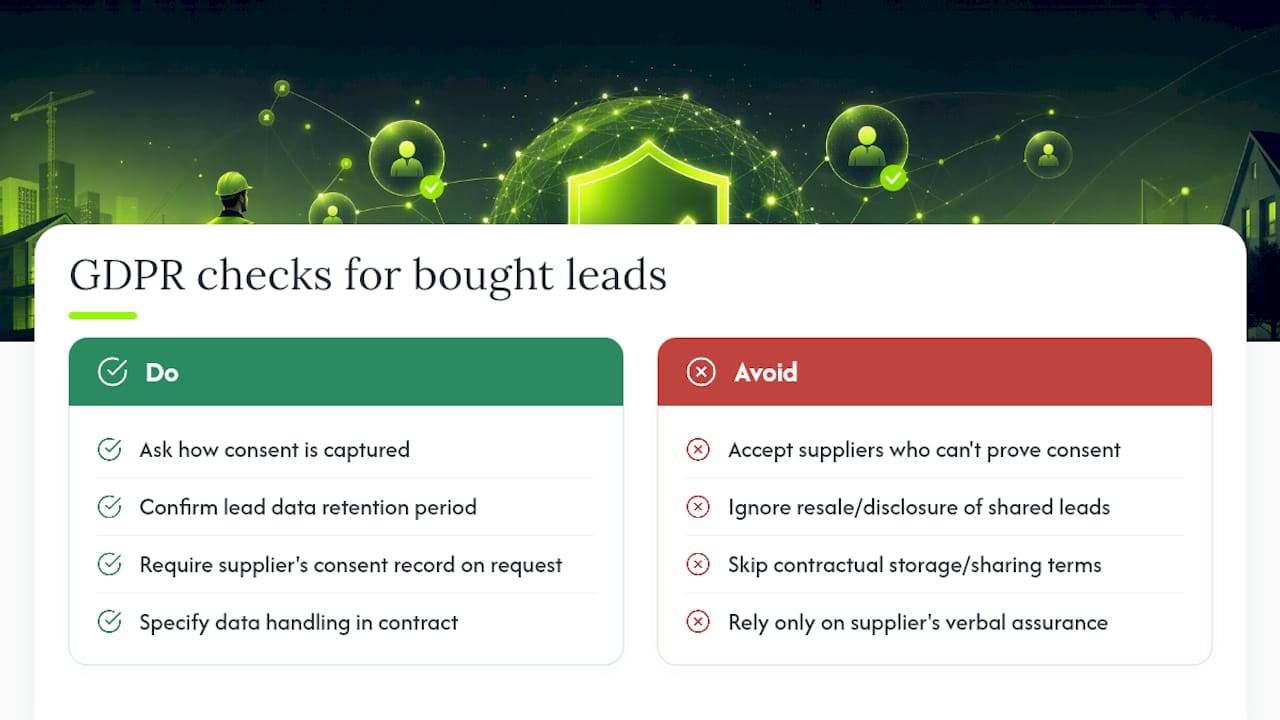
Every lead you buy for use in Belgium, the Netherlands, Germany, France, or Ireland falls under the EU’s General Data Protection Regulation (GDPR), regardless of which country the supplier is based in. That means the person behind the lead must have given clear, informed consent to be contacted by a business for the specific purpose stated, and the supplier must be able to prove that consent if asked.
Before signing with any PPL supplier, ask how consent is captured, how long lead data is retained, and whether the supplier can produce a consent record for a specific lead on request. A supplier that can’t answer this clearly is a compliance risk you’d be inheriting, not just a quality risk.
Contracts should also specify data handling terms: where the data is stored, whether it’s shared with any third party beyond you, and what happens to unconverted lead data after a defined period. If the supplier resells the same lead to competitors (a shared, non-exclusive lead), that resale itself needs to be disclosed to the consumer at the point of consent under GDPR’s purpose-limitation principle. This is one of the clearer arguments for exclusive leads over shared ones: fewer parties handling the same personal data means a simpler, more defensible compliance position.
Keep your own records too. If a lead later disputes being contacted, you’ll want your own log of consent, source, and contact history, not just the supplier’s assurance that everything was above board.
How do you connect bought leads to your CRM for proper attribution?
A lead that isn’t tracked from delivery to outcome is a lead you can’t judge fairly, and it’s also a lead your sales team can quietly ignore without anyone noticing. Every PPL lead should land directly in your CRM through an API or webhook integration, tagged automatically with source, cost, campaign, and delivery timestamp.
Manual entry is where attribution breaks down. A lead forwarded by email and typed into the CRM an hour later loses its timestamp accuracy, and it’s far more likely to get missed entirely during a busy week. Automated delivery also means you can build the fast-follow-up sequence described earlier without a person having to manually trigger it each time.
Attribution matters most when you’re running more than one channel simultaneously. If a lead first appeared on a Google form, then engaged with a retargeting ad, then finally converted through a PPL supplier’s booked-meeting flow, first-touch and last-touch attribution will give you two very different answers about which channel deserves credit. Most CRM platforms let you set a defined attribution model (first-touch, last-touch, or a weighted split) rather than defaulting to whichever touch happened last, which is worth configuring properly before you start comparing supplier performance rather than after.
What happens after the lead lands: nurturing and conversion?
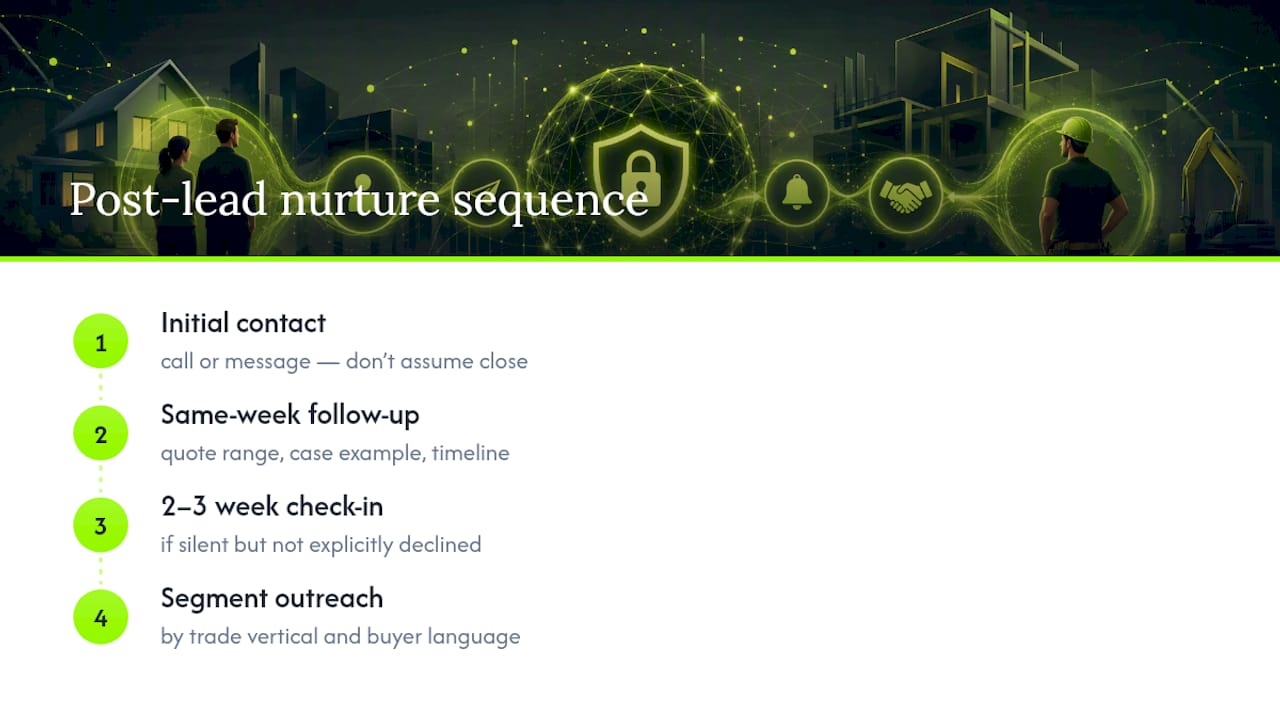
Not every accepted lead converts on the first contact, and treating a PPL lead as a one-shot opportunity wastes money you’ve already spent qualifying it. A structured nurture sequence, not just a single follow-up call, is what separates suppliers that look expensive from ones that are actually cheap per sale.
Build a sequence that assumes the first contact doesn’t close: an initial call or message, a same-week follow-up with more specific project detail (a quote range, a case example, a timeline), and a check-in at two to three weeks if the lead has gone quiet without saying no, following examples in our step-by-step guide for solopreneurs. Segmenting this outreach by trade vertical and using the buyer’s own language, rather than generic marketing copy, produced markedly better results in one documented campaign: a case study from a solar and heat pump outbound campaign in Germany generated 112 sales-qualified leads across three months once outreach was split into vertical-specific batches with native trade vocabulary.
The same principle applies after a lead is delivered, not just during acquisition. A heat pump enquiry and a window replacement enquiry shouldn’t get the same follow-up script. Our guide on the right follow-up sequence for a home improvement lead breaks this down by project type if you want a starting structure rather than building one from nothing.
Does lead exclusivity change the price you should expect to pay?
Exclusivity is the single biggest lever on price in any pay-per-lead contract. A shared lead sold to two or three competing contractors costs less per unit because the supplier spreads its acquisition cost across multiple buyers, but your close rate drops sharply because you’re now racing rivals to the same homeowner’s phone.
An exclusive lead, sold to you alone, costs more upfront but tends to close at a meaningfully higher rate, since you’re not competing on speed alone against three other quotes landing in the same inbox. When comparing two quotes at different price points, the fairer comparison isn’t cost per lead, it’s cost per sale, which folds in the close rate difference between shared and exclusive traffic.
Exclusivity should also shape supplier selection, not just pricing. A supplier who resells the same enquiry to your direct competitors down the street has a business model that depends on you never finding out how many other contractors got the same lead. Ask directly, in writing, whether leads are sold once or multiple times, and get the answer into the contract rather than taking it on trust.
Flock Leads’ perspective: minimum standards and red flags
We recommend treating a written SLA, a GDPR-compliant consent process, and a sample proof request as non-negotiable minimums before paying for a single lead, not nice-to-haves you get around to later. Watch for three red flags: suppliers who won’t put lead definitions in writing, suppliers who resist a paid trial period, and suppliers who can’t explain their consent capture process in one clear sentence. Contractors who skip these checks tend to discover the gaps only after the invoice arrives.
— Flock Leads
How Flock Leads runs exclusive lead generation for trade firms
The suppliers and pitfalls covered above apply to any PPL relationship, whichever agency you choose. One supplier was built specifically for that decision: they run and manage campaigns across Google, Meta, LinkedIn, and TikTok, qualify every enquiry before it reaches clients, and pass each lead to a single contractor rather than reselling it multiple times.
That exclusivity is the core difference between what we offer and the shared-lead marketplaces this article has spent several sections warning you about. Engagements run under EU rules, GDPR included, with pricing in euros and lead quality criteria agreed before payment, backed by a replacement policy for leads that don’t meet them. It is created by Hummingbirds, a Belgian marketing agency rated 5.0 from 32 Google reviews.
A typical starting path is a free audit of current lead flow and website conversion, followed by a trial period, then an ongoing plan once the results prove themselves. If you’re weighing up whether to build owned sourcing or work with an agency at all, our comparison of pay per lead against retainer and commission models is a useful next read. When you’re ready to see how quickly a qualified lead should be handled once it lands, our guide on qualifying a home improvement lead in five minutes is the practical starting point, and it’s the same standard we hold our own delivery to.
Sources
Frequently asked questions
What is a good cost per lead in marketing?
A good cost per lead sits at 5 to 15% of your average contract value, according to SyncGTM’s 2026 benchmarking; anything above that range starts eroding margin faster than most contractors expect.
What is the 3-3-3 rule in marketing?
Definitions of the 3-3-3 rule vary across marketing sources and there’s no single agreed version, so treat any specific claim about it with caution rather than as an established industry standard.
What is the 5-minute rule for leads?
The 5-minute rule holds that contacting a new lead within 5 minutes of enquiry dramatically increases the odds of converting them, a principle supported by trade sales automation practice showing near-instant follow-up materially improves conversion, per Intyb.
Is pay per lead better than a retainer for contractors?
It depends on your goal: PPL suits short-term pipeline fill and market testing, while a retainer or hybrid model suits contractors wanting a longer-term strategy alongside steady lead flow, as outlined in LaunchLeads’ pricing models guide.
How do I know if a pay-per-lead supplier is trustworthy?
Check for a written SLA defining the billable action, a stated replacement or credit policy, clear GDPR consent practices, and a willingness to provide sample leads or a paid trial before you commit to volume.
Does Flock Leads offer exclusive leads or shared leads?
One supplier delivers exclusive leads to a single contractor per enquiry, never reselling the same lead to competitors, with lead quality criteria and a replacement policy agreed before the campaign starts.
NEED A CLEARER PLAN?
Let’s turn your next move into momentum.
Talk to us →