THE SHORT ANSWER
You can scale a B2B business without cold calling by building an inbound engine — content, paid ads, LinkedIn, and partner referrals — combined with AI-driven qualification that routes warm leads directly into a short sales playbook. The result: higher close rates and a pipeline you can actually forecast.
You can scale a B2B business without cold calling by building an inbound engine — content, paid ads, LinkedIn, and partner referrals — combined with AI-driven qualification that routes warm leads directly into a short sales playbook. The result: higher close rates and a pipeline you can actually forecast.
Start here, today:
Audit your current lead sources in HubSpot or your existing CRM (takes 30 minutes).
Pick one quick-ramp channel (Google Ads or LinkedIn) and one compounding channel (SEO or referral program) to run in parallel.
Book a free audit with Flockleads to get a channel map built for your specific offer.
According to The Founder Drop, a functioning inbound pre-sell system takes roughly four weeks to build and compounds from there. The rest of this guide covers the three components: the right channels, a conversion funnel, and the automation layer that ties them together.
Pro Tip: Don’t try to launch five channels at once. Pick two, measure them for 30 days, then decide what to add.
Key Takeaways
Scaling a B2B business without cold calling requires two channels running in parallel, a five-stage inbound funnel, and automated qualification that routes leads to your calendar before they go cold.
Point | Details |
|---|---|
Pick two channels | Run one quick-ramp channel (Google Ads or LinkedIn) alongside one compounding channel (SEO or referrals). |
Build the five-stage funnel | Discover, pre-sell, qualify, consult, and close — each stage needs one KPI and one owner. |
Automate qualification | Use Zapier and HubSpot to score and route leads within 15 minutes of a form fill. |
Measure at 30-day gates | Judge each channel on CAC vs. LTV/3 after 30 days and — before scaling or cutting. |
Flockleads as managed option | Flockleads delivers qualified B2B leads via managed campaigns with a free audit as the starting point. |
What channels actually replace cold calling for B2B growth?
The fastest way to prioritize is to match each channel to your buyer type and your patience for ramp time. Transactional buyers (clear problem, short sales cycle) respond well to Google Ads and paid directories. Advisory buyers (complex problem, longer evaluation) need content, LinkedIn, and webinars to build trust first.
McKinsey’s research on growth outperformance shows top performers combine core-channel maximization with adjacent moves rather than spreading thin across everything. That’s the same logic here: pick one quick-ramp channel to generate leads now, and one compounding channel to build equity over 90 days.
Channel selection rules:
If your sales cycle is under 30 days, start with Google Search ads.
If your deal size is above $5,000, LinkedIn and webinars outperform paid directories.
Content that spotlights customers drives outsized organic reach. One SaaS founder reached 300 paying customers with zero paid acquisition by making content about his users, not about himself.
Use Zapier to automate lead handoffs from any channel into HubSpot so no inbound lead sits uncontacted for more than 15 minutes.
For a deeper look at how AI search affects channel planning, note that the SEO calculus has shifted in 2026 and is worth understanding before you commit budget.
How do you build a funnel that closes without cold calls?
The funnel has five stages. Each one has a single job.
Discover — the prospect finds you via search, LinkedIn, or a referral. KPI: impressions and click-through rate.
Pre-sell — they consume content (case study, webinar replay, LinkedIn post) that answers their core objection before a call. KPI: content engagement rate and time on page.
Qualify — they fill out a form or book a call. KPI: qualified lead rate (target: 40%+ of form fills).
Consult — a 20–30 minute discovery call. KPI: show rate (target: 70%+) and demo-to-proposal rate.
Close — proposal sent, contract signed. KPI: close rate and average deal size.
Salesforce reports that for SMBs, 80% of buyers say experience matters as much as the product itself. That means the pre-sell stage is where most deals are won or lost before your sales team ever speaks to a prospect.
Sales playbook for inbound leads:
Send a confirmation email within 5 minutes of a form fill (automated via HubSpot).
Include one relevant case study or short video in the confirmation.
Ask three qualification questions on the booking form: budget range, timeline, and primary pain point.
Set a 24-hour SLA for a human follow-up if the prospect doesn’t book immediately.
Use Calendly or HubSpot Meetings for instant self-scheduling to protect show rates.
How do automation and AI replace manual follow-up outreach?
The automation stack doesn’t need to be complex. A four-step flow covers most B2B scenarios:
Lead fills out a form or clicks an ad.
Zapier fires the lead into HubSpot, tags it by source and intent signal, and triggers a nurture sequence.
A lightweight AI classifier scores the lead based on company size, job title, and form answers.
High-score leads route to a calendar booking link; low-score leads enter a 5-email drip sequence.
BCG’s guidance for CEOs recommends treating AI adoption programmatically, with governance and stress-testing, rather than bolting on tools ad hoc. The same principle applies here: define your scoring rules first, then automate them.
Nurture sequence structure (replaces cold follow-up):
Email 1 (day 0): Confirmation + one case study.
Email 2 (day 3): Short educational piece addressing the top objection.
Email 3 (day 7): Social proof or client result.
Email 4 (day 14): Direct ask to book a call.
SMS reminder (day 1 before booked call): reduces no-shows by a meaningful margin.
To track whether AI assistants are surfacing your business in search results, Flockleads has a guide on AI search visibility worth bookmarking.
Pro Tip: Before training a full AI scoring model, A/B test a simple rule-based score (e.g., “title contains ‘Director’ or above AND budget above $2,000 = high intent”) for 30 days. It catches 80% of what a complex model would catch, with zero training time.
How do referral and partner programs make others sell for you?
Warm introductions close at a far higher rate than any cold channel. The goal is to build a system where partners send you qualified prospects regularly, not occasionally.
Partner recruitment checklist:
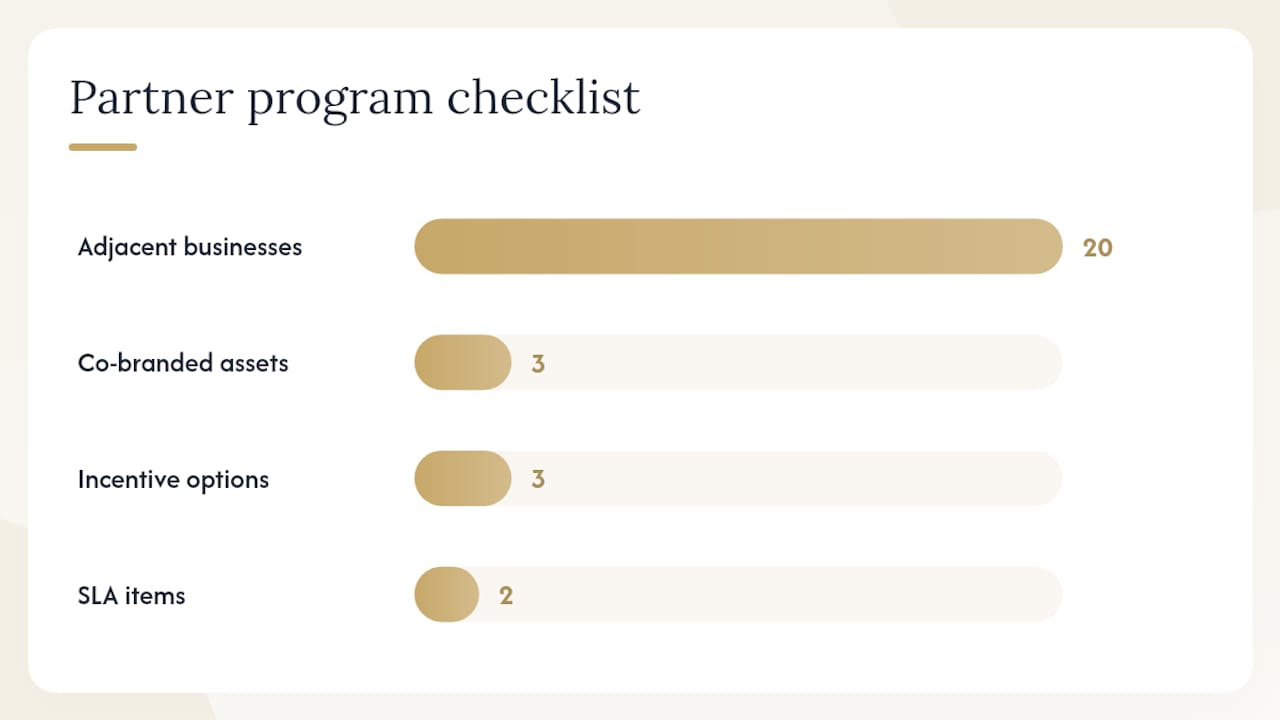
List 20 adjacent businesses that serve your exact buyer but don’t compete with you.
Approach each with a media offer first: invite them to co-host a webinar or appear on a podcast episode. Leonid Bugaev’s framework shows that media offers convert far better than cold partnership pitches because they give the other party a reputationally safe reason to say yes.
Run one joint activity (webinar, LinkedIn Live, co-authored article) before proposing a formal referral arrangement.
Agree on an incentive structure: a fixed referral fee per closed deal, a revenue-share pilot, or reciprocal content promotion.
Provide co-branded assets: a one-page overview of your offer, a short email template for introductions, and a booking link.
Set a communication SLA: monthly check-in, quarterly performance review.
Incentive structures by fit:
Fixed referral fee: works best when deal sizes are predictable and the partner wants simplicity.
Revenue share: better for longer-term partnerships where the partner stays involved post-sale.
Content co-creation: lowest barrier to entry; builds trust before money changes hands.
For video-based partner content, short-form video assets shared by partners consistently outperform static posts in B2B LinkedIn feeds.
What KPIs and testing cadence should you track?
Core KPIs to monitor weekly:
Lead velocity (new qualified leads per week)
Qualified lead rate (% of all leads that meet your ICP)
Show rate (% of booked calls that attend)
Close rate by channel
Customer acquisition cost (CAC) by channel
LTV:CAC ratio (target: 3:1 or above)
BDA’s growth architecture recommends allocating resources across three time horizons: short-term experiments (quick-ramp channels), medium-term compounding plays (SEO, partnerships), and long-term capability building (brand, community). A practical budget split for most B2B businesses: 60% to proven channels, 30% to active experiments, 10% to early-stage bets.
Governance: weekly dashboard review (15 minutes), monthly channel review (60 minutes), and a hard decision gate at 90 days where any channel that hasn’t hit its CAC threshold gets paused or restructured.
Your 30–60–90 day plan to replace cold calling
Days 1–30 (foundation):
Audit existing lead sources and set baseline KPIs in HubSpot.
Launch one paid channel (Google Ads or LinkedIn) with a tight ICP targeting brief.
Build the five-stage funnel: landing page, booking form with qualification questions, confirmation email, and one nurture sequence.
Identify 10 potential referral partners and send five media offers.
Expected outcome: first inbound leads within 2–3 weeks; partner conversations started.
Days 31–60 (optimize):
Review CAC and qualified lead rate by channel; cut underperformers.
Add a second nurture email based on the most common objection from discovery calls.
Activate two to three referral partners with co-branded assets.
Begin publishing one SEO-focused content piece per week.
Expected outcome: show rate above 60%; at least one partner sending referrals.
Days 61–90 (scale):
Double budget on the channel with the lowest CAC.
Launch a joint webinar with one partner.
Run the first A/B test on landing page copy.
Review LTV:CAC ratio and set a 90-day decision gate on each channel.
Expected outcome: predictable weekly lead flow; first closed deals from inbound.
HBS Online’s framework on value-stick thinking applies directly here: at each phase, ask whether the channel is genuinely increasing willingness-to-pay or just generating volume. Volume without quality burns budget fast.
When should you hire a managed lead-generation partner?
Keep it in-house when you have a marketing owner with 10+ hours per week, a clear ICP, and a CRM already set up. Outsource when any of these apply:
No internal bandwidth to manage campaigns and optimize weekly.
You need leads within 30 days, not 90.
You want to test three to four channels simultaneously without building the infrastructure yourself.
Your current CAC is unknown because tracking isn’t in place.
What a managed partner delivers:
Initial audit of your offer, ICP, and current funnel gaps.
Campaign setup across Meta, LinkedIn, Google, and/or TikTok with qualifying lead forms.
CRM integration and instant lead delivery (under 15 minutes from form fill to CRM).
Weekly optimization and monthly reporting.
For a detailed look at how B2B lead generation differs from consumer approaches, the qualification criteria and funnel structure are meaningfully different and worth understanding before you brief any partner.
The case for inbound over outbound is stronger than most owners realize
Most B2B owners who resist dropping cold calling aren’t attached to the tactic itself. They’re attached to the feeling of control it gives: you pick up the phone, you make something happen. Inbound feels passive by comparison, which is exactly why it gets deprioritized.
That instinct is wrong, and the data is clear. McKinsey’s analysis of long-term growth outperformers shows that firms activating the full organization around a defined growth system — not heroic individual effort — consistently outperform those relying on outbound hustle. Cold calling scales with headcount. An inbound system scales with content and code.
The other thing most playbooks miss: the partner channel is the fastest path to warm leads, and almost nobody builds it deliberately. A single well-structured referral relationship with an adjacent business can outperform a $5,000/month Google Ads campaign in lead quality, even if it takes six weeks to activate. The barrier isn’t effort. It’s that most owners never make the first media offer.
Flockleads runs the inbound engine for you
If you’ve read this far and the bottleneck is time, not knowledge, that’s exactly the gap Flockleads fills. Rather than spending 60–90 days building and testing a lead system yourself, Flockleads delivers qualified B2B leads directly to your website through managed campaigns across Google, LinkedIn, Meta, and TikTok, with qualifying lead forms, CRM integration, and weekly optimization included.
The process starts with a free audit of your current funnel and offer. From there, Flockleads builds and launches your campaigns, handles the creative and targeting, and routes leads into your sales process within minutes of a form fill. No long-term lock-in on the first engagement. Reporting is weekly, so you always know what’s working.
Start with a free audit at Flockleads and get a channel map built for your specific business within days.
Sources
Frequently asked questions
How long does it take to replace cold calling with inbound leads?
A basic inbound system can generate its first leads within two to four weeks, according to The Founder Drop’s documented build sequence. A fully compounding pipeline, where SEO and referrals contribute consistently, typically takes 90 days.
Which inbound channel works fastest for B2B?
Google Search ads and LinkedIn campaigns are the fastest to generate qualified leads, usually within two to four weeks of launch. SEO and referral programs take longer but produce higher-quality leads at lower CAC over time.
What KPIs should I track when scaling without cold calling?
Track lead velocity, qualified lead rate, show rate, close rate by channel, and CAC versus LTV. A 3:1 LTV:CAC ratio is a standard threshold before scaling a channel’s budget.
When does it make sense to outsource lead generation to a partner like Flockleads?
Outsource when you lack internal bandwidth for weekly campaign optimization, need leads within 30 days, or want to test multiple channels simultaneously without building the infrastructure yourself.
Do I need a CRM before I start?
Yes. HubSpot’s free tier is sufficient to capture, tag, and route inbound leads at the start. Without a CRM, leads from paid channels will arrive and go cold before anyone follows up.
NEED A CLEARER PLAN?
Let’s turn your next move into momentum.
Talk to us →