THE SHORT ANSWER
SEO lead generation is defined as the practice of attracting potential buyers through organic search and converting them into qualified leads through targeted content, landing pages, and lead capture mechanisms. The role of SEO in lead generation goes far beyond rankings. It creates a repeatable pipeline of intent-driven visitors who are already looking for what you sell.
SEO lead generation is defined as the practice of attracting potential buyers through organic search and converting them into qualified leads through targeted content, landing pages, and lead capture mechanisms. The role of SEO in lead generation goes far beyond rankings. It creates a repeatable pipeline of intent-driven visitors who are already looking for what you sell. For B2B marketers and business owners, that distinction matters. Paid ads stop the moment your budget runs out. SEO compounds over time, building credibility and reducing your cost per lead with every passing month. Flockleads is built on exactly this principle: engineered lead flow that turns organic visibility into a predictable revenue channel.
What key SEO strategies directly impact lead generation success?
SEO lead generation is the process of using SEO tactics to attract potential customers via organic search and converting them through lead capture methods like forms and demos. The strategies that move the needle most are not generic. They target buyer intent at every stage of the funnel.
Keyword research aligned to buyer intent
Keyword research is the foundation of effective lead generation with SEO. Generic keywords attract browsers. Buyer-intent keywords attract prospects. A B2B software company targeting “enterprise project management software pricing” will generate far more qualified leads than one ranking for “what is project management.” Tools like Google Search Console and Google Keyword Planner surface the exact phrases your buyers type when they are ready to act.

On-page SEO and landing page optimization
Landing pages focused on specific keywords with clear calls to action improve visitor-to-lead conversion rates. Every landing page should carry one primary keyword, one value proposition, and one lead capture form. Cluttered pages with multiple offers dilute both SEO signals and conversion rates. Keep the page focused and the form short.
Content creation for informational and transactional intent
High-quality, relevant content builds trust and authority, which boosts SEO rankings and lead conversion potential. Content pillars that interlink related topics improve topical authority and organic visibility over time. A B2B company selling logistics software, for example, can build a content cluster around “supply chain optimization,” “freight cost reduction,” and “warehouse management,” each piece feeding traffic toward a central service page with a lead form.
Technical SEO as a lead generation foundation
Technical SEO fundamentals like mobile optimization, fast load times, and crawlability directly impact visibility and user retention. Technical issues prevent proper indexing and result in lost traffic and lead opportunities. A site that loads in under three seconds on mobile retains far more visitors than one that takes six. Google’s Core Web Vitals are the benchmark here. Pass them, and you protect the traffic your content earns.
Pro Tip: Run a crawl audit using Google Search Console at least once per quarter. Fix broken internal links, resolve duplicate title tags, and submit an updated sitemap. These fixes take hours but protect months of content investment.
How does SEO integrate with the sales funnel to nurture leads?
SEO does not operate in isolation from your sales funnel. It feeds every stage, from first awareness to the moment a prospect fills out a contact form. Understanding where each piece of content fits determines how well your SEO investment converts.
Top of funnel: awareness content. Blog posts, guides, and thought leadership articles target informational search intent. A buyer searching “how to reduce B2B customer churn” is early in their research. Your content earns their attention and plants your brand in their consideration set.
Middle of funnel: comparison and solution content. Prospects searching “best CRM for mid-market B2B” are evaluating options. Pages that compare approaches, explain methodologies, or present case studies capture this intent. These pages should include a lead magnet or gated asset to move visitors into your nurturing sequence.
Bottom of funnel: transactional pages. Service pages, pricing pages, and demo request pages target buyers ready to act. SEO-optimized landing pages that combine specific keywords with clear calls to action convert organic traffic into marketing-qualified leads at the highest rate.
Micro-yes strategy for progressive engagement. The micro-yes strategy involves engaging visitors with small-value asks before requesting high-friction contact information. Offering a downloadable checklist, a free audit, or a newsletter subscription before asking for a demo request reduces visitor drop-off significantly. Each small commitment builds trust and moves the prospect closer to conversion.
Remarketing to organic visitors. Organic visitors who do not convert on the first visit are not lost. Pixel-based remarketing through Google Ads or LinkedIn Campaign Manager lets you re-engage them with targeted content. SEO brings them in. Remarketing brings them back.
Trusted websites achieve higher organic engagement and better conversion rates. That trust is built through consistent content quality, clear site structure, and a frictionless user experience across every funnel stage.
What metrics and KPIs demonstrate the impact of SEO on lead generation?
Measuring SEO’s impact on lead generation requires tracking the right signals, not just rankings. Rankings tell you where you appear. Conversion data tells you whether that appearance generates revenue.
KPI | What it measures | Why it matters for leads |
|---|---|---|
Organic traffic volume | Total sessions from unpaid search | Baseline for lead opportunity |
Organic traffic quality | Bounce rate, time on page, pages per session | Signals whether visitors match your buyer profile |
Keyword rankings | Position for buyer-intent terms | Predicts future lead volume from organic search |
Lead form conversion rate | Percentage of visitors who submit a form | Direct measure of SEO-to-lead efficiency |
Lead acquisition cost | Cost per lead from organic vs. paid channels | Demonstrates SEO’s long-term financial advantage |
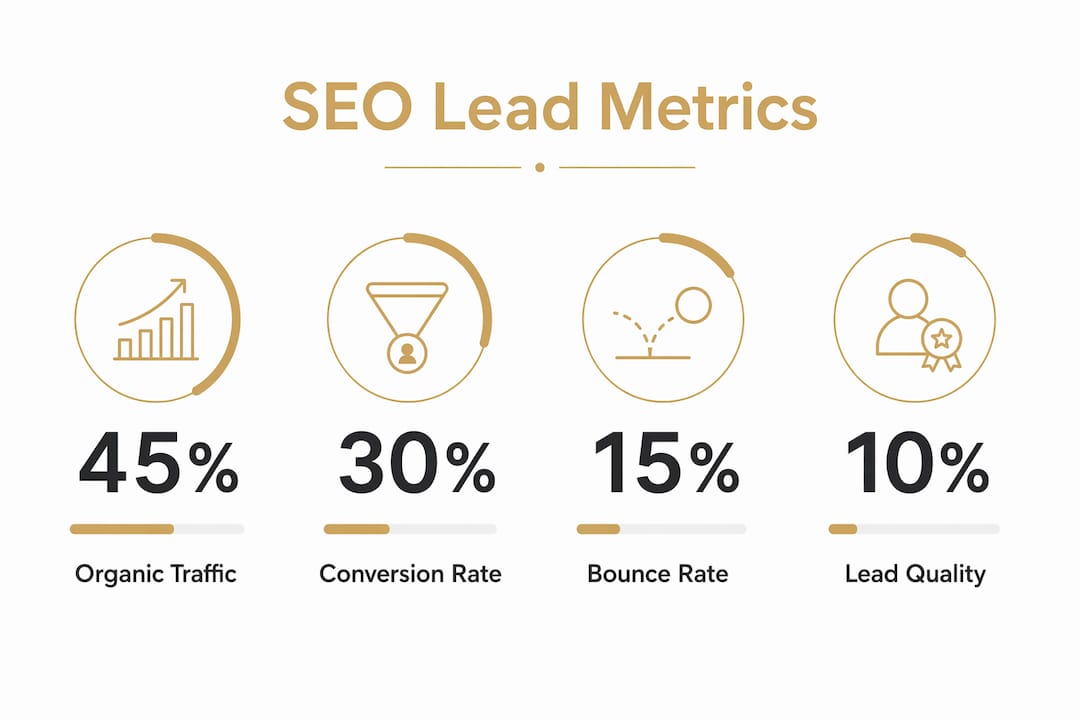
SEO lead generation metrics include organic traffic quality, keyword ranking, bounce rate, conversion rates on lead forms, and lead acquisition cost compared to paid ads. Tracking these KPIs helps marketers refine their approach continuously. The most telling metric for B2B teams is lead acquisition cost. Consistent SEO efforts build long-term credibility through organic search presence, reducing lead acquisition costs over time. Paid channels deliver volume immediately but at a fixed cost per click. SEO delivers compounding returns as your content library grows and your domain authority increases.
Bounce rate and time on page reveal whether your content matches search intent. A page with a 90% bounce rate and 20 seconds of average time on page is not serving its audience. Rewrite the opening, add a relevant internal link, and include a clear next step. Small copy changes on high-traffic pages can shift conversion rates meaningfully.
What common pitfalls should marketers avoid in SEO lead generation?
SEO lead generation fails most often not because of algorithm changes but because of avoidable execution errors. Knowing the pitfalls protects your investment.
Ignoring search intent. Ranking for the wrong keywords drives traffic that never converts. A page optimized for “what is inbound marketing” will attract students and curious readers, not buyers. Map every page to a specific buyer stage before you write a single word.
Aggressive lead capture that damages UX. Overly aggressive lead capture forms harm user experience and deter leads. Pop-ups that fire within two seconds of page load, forms that require ten fields, and interstitials that block content all increase bounce rates and reduce time on page. Both signals hurt your rankings.
Neglecting technical SEO fundamentals. A beautifully written blog post that Google cannot crawl generates zero leads. Broken canonical tags, slow server response times, and unoptimized images are invisible to most marketers but visible to every search engine crawler.
Lack of content authority. Thin content that covers a topic superficially ranks poorly and converts worse. Google’s Helpful Content system rewards depth, specificity, and demonstrated expertise. Write for the reader who needs a real answer, not for the crawler that counts keywords.
Failing to optimize for mobile. Mobile traffic accounts for a majority of B2B research sessions, particularly in early funnel stages. A site that renders poorly on a smartphone loses leads before they ever see your offer.
Pro Tip: Test your lead capture forms on mobile before publishing any new landing page. Fill out the form yourself on three different devices. If the process feels slow or clunky, your prospects will abandon it.
Key takeaways
SEO drives B2B lead generation by attracting intent-driven organic traffic and converting it through targeted content, optimized landing pages, and progressive engagement strategies.
Point | Details |
|---|---|
Buyer-intent keywords | Target phrases that signal purchase readiness, not just general curiosity. |
Funnel-aligned content | Match each content type to a specific funnel stage to move prospects toward conversion. |
Micro-yes engagement | Use low-friction offers like downloads before requesting demo or contact information. |
Measure the right KPIs | Track lead form conversion rate and acquisition cost, not just keyword rankings. |
Technical SEO protects leads | Fix crawlability, speed, and mobile rendering to prevent losing traffic you already earned. |
Where conventional SEO wisdom gets B2B teams into trouble
Most SEO advice treats lead generation as a traffic problem. Get more visitors, get more leads. That logic breaks down fast in B2B, where a single qualified lead is worth more than a thousand unqualified page views.
I have worked with B2B teams that ranked on page one for high-volume keywords and still saw their pipelines stall. The traffic was real. The intent was wrong. They were attracting researchers, not buyers. The fix was not more content. It was a complete rethink of which keywords they were targeting and what the landing page asked visitors to do next.
The other mistake I see constantly is treating SEO and sales as separate functions. Your sales team knows exactly what questions prospects ask before they buy. Those questions are keywords. When marketing and sales share that intelligence, content strategy gets sharper and lead quality improves. The engineered lead flow model works precisely because it treats SEO as a system, not a tactic.
Measurement discipline separates the teams that win with SEO from those that spin their wheels. Track lead acquisition cost from organic search every quarter. If it is falling, your SEO is compounding. If it is flat or rising, something in the funnel is broken and you need to find it before you publish another piece of content.
— Mieke
How Flockleads turns SEO traffic into a consistent lead pipeline
SEO brings the right visitors to your website. Converting them into qualified leads requires a system built around that traffic, not bolted onto it after the fact.

Flockleads builds engineered lead flow for B2B service businesses by combining SEO-driven traffic acquisition with lead capture and nurturing frameworks that match how your buyers actually research and decide. The approach is direct: attract intent-driven visitors through organic search, engage them with content that matches their stage in the buying process, and capture their information through forms and offers that reduce friction. B2B marketers and business owners who want a predictable pipeline, not a traffic report, can see exactly how the system works at Flockleads.
Frequently asked questions
What is SEO lead generation?
SEO lead generation is the practice of attracting potential buyers through organic search and converting them into leads through content, landing pages, and lead capture forms. It targets intent-driven keywords so the visitors who arrive are already looking for what you offer.
How does SEO drive lead generation differently than paid ads?
SEO builds compounding organic visibility over time, reducing lead acquisition cost as your content library and domain authority grow. Paid ads deliver immediate traffic but stop generating leads the moment your budget runs out.
What is the micro-yes strategy in SEO lead generation?
The micro-yes strategy engages visitors with low-friction offers like downloadable content or newsletters before requesting high-commitment contact information. This progressive approach reduces drop-off and increases the number of visitors who ultimately share their details.
Which KPIs best measure SEO’s impact on lead generation?
The most direct KPIs are lead form conversion rate, organic traffic quality, and lead acquisition cost compared to paid channels. Keyword rankings matter, but they are a leading indicator, not a measure of actual lead volume.
How does technical SEO affect lead generation?
Technical SEO issues like slow load times, poor mobile rendering, and crawl errors prevent your content from being indexed and seen. A technically sound site protects the traffic your content earns and keeps visitors on the page long enough to convert.
NEED A CLEARER PLAN?
Let’s turn your next move into momentum.
Talk to us →