THE SHORT ANSWER
B2B lead generation is defined as the process of identifying and attracting potential business buyers into a sales pipeline. The five primary types are inbound, outbound, content-led, referral/partner-led, and account-based marketing (ABM). Each method carries distinct cost and conversion profiles: inbound averages $35–$80 per lead with a 14.6% close rate, while outbound runs $150–$250 per lead
B2B lead generation is defined as the process of identifying and attracting potential business buyers into a sales pipeline. The five primary types are inbound, outbound, content-led, referral/partner-led, and account-based marketing (ABM). Each method carries distinct cost and conversion profiles: inbound averages $35–$80 per lead with a 14.6% close rate, while outbound runs $150–$250 per lead with a 1.7% close rate. ABM produces deals 2.4 times larger than standard methods. Choosing the right mix of these channels is the single most important decision a B2B marketer makes when building a pipeline.
1. What are the types of B2B lead generation?
The five core types of B2B lead generation each serve a different stage of buyer intent and a different business goal. Inbound and content-led methods attract buyers who are already searching. Outbound and ABM go after buyers who are not yet looking. Referral and partner-led generation sits in the middle, converting warm relationships into qualified pipeline.
No single method wins across every scenario. A startup with a small budget favors inbound. An enterprise sales team targeting Fortune 500 accounts runs ABM. A professional services firm with a strong client base builds a referral program. The right channel depends on your average deal size, sales cycle length, and available resources.

2. Inbound lead generation: attracting buyers who are already searching
Inbound lead generation attracts prospects through SEO, content marketing, and organic discovery rather than direct outreach. Buyers find you through blog posts, search results, LinkedIn content, or industry directories. The 14.6% close rate for inbound leads is nearly nine times higher than outbound. That gap exists because inbound buyers arrive with intent already established.
The cost advantage compounds over time. A blog post written today generates leads for years. A cold email campaign stops the moment you stop paying. Inbound builds an asset; outbound rents attention.
Key inbound tactics include:
SEO-optimized blog content targeting buyer search queries at every funnel stage
Organic social media on LinkedIn, where B2B decision-makers actively research vendors
Free tools or calculators that capture contact details in exchange for genuine utility
Podcast appearances and guest articles that build authority in niche markets
Pro Tip: Apply lead scoring to inbound traffic from day one. Assign point values to page visits, content downloads, and return visits. Leads that cross a defined score threshold go directly to sales, cutting qualification time in half.
3. How outbound lead generation works and its advantages
Outbound lead generation means proactively contacting prospects who have not yet expressed interest. Cold calls, cold email sequences, LinkedIn outreach, and paid advertising all fall under this category. The median cost per lead runs $150–$250, which is significantly higher than inbound. The tradeoff is speed and targeting precision.
Outbound lets you define exactly who you want to reach. You can filter by industry, company size, job title, revenue, and geography before sending a single message. That specificity makes outbound the fastest path to a first conversation with a named account.
Common outbound methods include:
Cold email sequences with personalized first lines based on company news or LinkedIn activity
LinkedIn Sales Navigator outreach targeting decision-makers by title and company size
Targeted paid ads on LinkedIn or Google that reach specific job functions
Cold calling with a tight script focused on a single pain point per call
The biggest outbound prospecting mistake is sending generic messages to large lists. Personalization at scale, using data signals like funding rounds or job changes, consistently outperforms volume-only approaches.
Pro Tip: Cap outbound spend at 40% of your total lead generation budget. Reinvest the rest into inbound assets that compound. Outbound fills the pipeline fast; inbound keeps it full without ongoing spend.
4. Content-led lead generation: building authority and capturing mid-funnel leads
Content-led lead generation uses gated and ungated assets to attract buyers who are actively researching solutions. Ebooks, webinars, research reports, and case studies all qualify. The buyer downloads a resource, exchanges contact details, and enters the pipeline with a clear intent signal already attached to their record.
Content-led leads are better qualified than cold outbound contacts because they self-select based on topic relevance. A prospect who downloads a guide on enterprise contract management is telling you exactly where they are in the buying process. That context makes follow-up conversations more productive from the first touchpoint.
Effective content-led tactics include:
Gated research reports that provide original data unavailable elsewhere
Webinars and virtual events that combine education with live Q&A for deeper engagement
Case studies that demonstrate measurable outcomes for buyers in the same industry
Email nurture sequences triggered by content downloads to move leads toward a sales conversation
Content Type | Buyer Stage | Primary Goal |
|---|---|---|
Blog posts | Awareness | Drive organic traffic |
Ebooks and guides | Consideration | Capture contact details |
Webinars | Consideration | Build trust and qualify intent |
Case studies | Decision | Accelerate deal closure |
Research reports | All stages | Establish authority |
Pro Tip: Repurpose every major content asset across at least three formats. A research report becomes a webinar, a blog series, and a LinkedIn carousel. One production investment generates leads across multiple channels simultaneously.
5. Referral and partner-led lead generation as a high-trust method
Referral and partner-led generation produces the lowest median cost per lead at $89 and the highest conversion rates of any lead generation type. The reason is simple: trust transfers. A referred prospect arrives with a third-party endorsement already in place, which compresses the sales cycle significantly.
Partner-led generation extends this logic to formal channel relationships. Technology integrations, agency partnerships, and co-selling arrangements all create structured referral flows. The mechanics differ from informal referrals, but the trust transfer principle is identical.
Building a referral program that actually produces pipeline requires:
Defined incentive structures that reward partners for qualified introductions, not just referrals
Clear qualification criteria so partners know exactly what a good lead looks like before they make an introduction
Regular partner enablement including updated pitch materials, case studies, and competitive positioning
Formal tracking so every referred lead is attributed and the partner receives credit
Integrating referral tracking into a B2B CRM system is non-negotiable for programs at scale. Without CRM attribution, you cannot measure which partners generate the most revenue, and you cannot allocate incentives fairly.
6. Account-based marketing (ABM): targeting high-value accounts for larger deals
ABM is defined as a B2B strategy that treats individual accounts as markets of one, building personalized campaigns for specific companies rather than broad audience segments. It inverts traditional lead generation logic. Instead of casting a wide net and filtering, ABM starts with a named list of target accounts and builds everything around them.
The cost is higher. ABM carries a median CPL of $241, the highest of any lead generation type. The return justifies the investment for enterprise sales teams: ABM deals average 2.4 times larger than deals sourced through other methods. That math works clearly when your average contract value exceeds $50,000.
Core ABM tactics include:
Personalized landing pages built for each target account, referencing their specific industry challenges
Direct outreach to multiple stakeholders within the same account to build consensus before a formal pitch
Account-specific content such as custom ROI calculators or tailored case studies
Coordinated sales and marketing plays where both teams work from the same account plan and timeline
The most common ABM failure is running it as a marketing-only program. ABM requires sales and marketing to share the same account list, the same messaging, and the same definition of what a successful engagement looks like. Without that alignment, personalized campaigns reach the right companies with the wrong follow-up.
Pro Tip: Start ABM with a pilot list of 10–20 accounts before scaling. Measure engagement depth, not just lead volume. Accounts that consume three or more personalized touches within 30 days are significantly more likely to convert to pipeline.
Combining at least three lead generation channels produces 18.96% higher engagement and a 9.5% annual revenue uplift compared to single-channel approaches. The top-performing B2B companies run inbound alongside outbound and layer in ABM or partner-led channels as they grow.
Key takeaways
The most effective B2B lead generation programs combine inbound, outbound, and at least one high-trust channel such as referrals or ABM, because each method addresses a different buyer behavior and budget reality.
Point | Details |
|---|---|
Inbound outperforms outbound on close rate | Inbound closes at 14.6% vs. 1.7% for outbound, making it the higher-quality volume channel. |
Referrals deliver the lowest cost per lead | At a $89 median CPL, referral programs outperform every other channel on cost efficiency. |
ABM produces the largest deals | ABM yields deals 2.4 times larger, making it the right choice for enterprise sales teams. |
Multi-channel beats single-channel | Running three or more channels together produces 18.96% higher engagement and 9.5% revenue uplift. |
KPI alignment determines program success | Tracking CAC, CLTV, and deal size rather than vanity metrics keeps lead generation tied to revenue. |
What I’ve learned about lead generation that most articles won’t tell you
Most B2B marketing teams treat lead generation as a volume problem. They chase more leads, more channels, more campaigns. The real problem is almost always a qualification and handoff problem.
I’ve seen teams generate thousands of leads per month and still miss revenue targets. The issue is never the top of the funnel. It’s the gap between marketing and sales, where leads sit uncontacted for days, get passed without context, or get pursued without a clear definition of what “qualified” actually means. Frameworks like BANT exist precisely because undefined SQL criteria waste more pipeline than any channel inefficiency.
The second thing most articles skip is the compounding cost of scattered data. Fragmented relationship management across sales and marketing kills deals before they reach qualification. A prospect who spoke to a sales rep six months ago should not receive a cold outreach email today. That happens constantly in organizations without a centralized CRM, and it destroys credibility with exactly the accounts you most want to win.
My honest recommendation is to align your KPIs with revenue outcomes before you spend another dollar on lead generation. Customer acquisition cost, customer lifetime value, and average deal size tell you whether your program is working. Follower counts and open rates do not. Fix the measurement first, then scale the channels.
— Mieke
How Flockleads fits into your lead generation program
B2B lead generation produces results only when leads actually reach your website and enter a pipeline you can track.
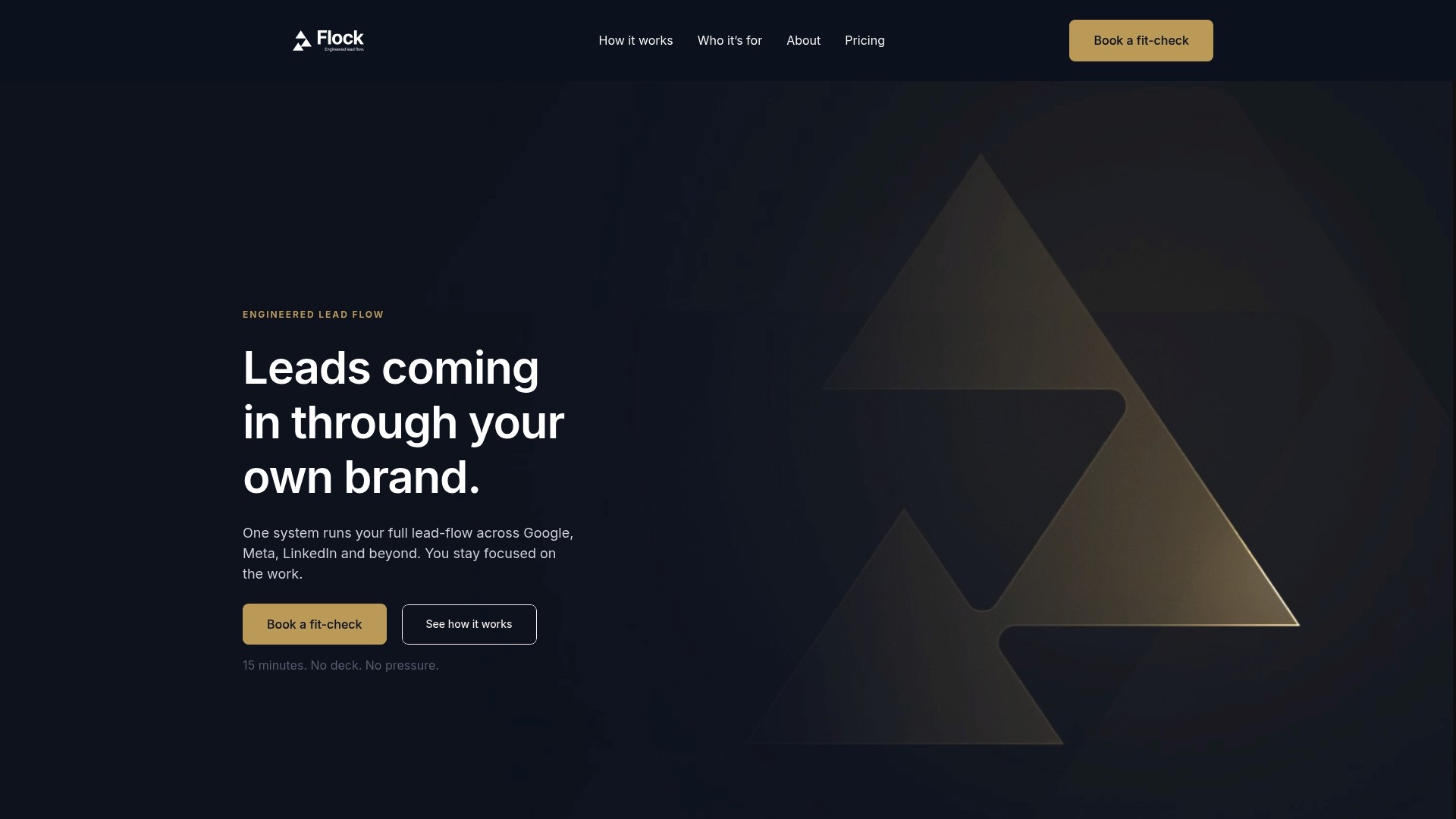
Flockleads builds engineered lead flow for B2B service businesses, connecting inbound traffic, outbound campaigns, and partner-led referrals into a single, trackable pipeline. The platform captures leads at the point of intent and routes them directly to your sales team with full context attached. You can also review active lead flow projects to see how other B2B teams have structured their acquisition programs. If your current setup loses leads between channels or between teams, Flockleads closes that gap.
Frequently asked questions
What is B2B lead generation?
B2B lead generation is the process of identifying and attracting potential business buyers into a sales pipeline. It includes inbound, outbound, content-led, referral, and ABM methods.
Which type of B2B lead generation has the highest close rate?
Inbound lead generation closes at 14.6%, the highest of any lead generation type. That rate reflects the intent advantage of buyers who find you through organic search or content.
How do you set B2B lead generation KPIs?
Align KPIs with revenue outcomes such as customer acquisition cost, customer lifetime value, and average deal size. Vanity metrics like social media engagement do not indicate pipeline health.
What is a CRM system in B2B sales?
A B2B CRM system centralizes customer data, automates lead qualification, and supports collaboration across sales and marketing teams. It prevents the scattered data and follow-up gaps that kill deals before qualification.
What makes ABM different from standard lead generation?
ABM targets named accounts with personalized campaigns rather than broad audiences. It produces deals 2.4 times larger than other methods, at a higher cost per lead, making it best suited for enterprise sales teams.
NEED A CLEARER PLAN?
Let’s turn your next move into momentum.
Talk to us →