THE SHORT ANSWER
The most effective types of business visibility strategies fall into eight groups: owned content and SEO, paid search and social, organic social and creator partnerships, earned media and PR, events and experiential, referrals and partnerships, local listings, and AI/AEO optimization. No single channel wins alone.
The most effective types of business visibility strategies fall into eight groups: owned content and SEO, paid search and social, organic social and creator partnerships, earned media and PR, events and experiential, referrals and partnerships, local listings, and AI/AEO optimization. No single channel wins alone. The mix you prioritize depends on whether you are building awareness from scratch or capturing demand that already exists.
Strategy types at a glance:
Owned content and SEO
Paid search (SEM/PPC) and paid social
Organic social and creator/influencer partnerships
Earned media, PR, and thought leadership
Events and experiential marketing
Referral programs and co-marketing partnerships
Local listings and directory visibility
AI/AEO and entity optimization
One-line verdict: Early-stage businesses should lead with paid search and organic social for speed, then layer in SEO and PR for compounding returns. Established businesses chasing new markets should prioritize thought leadership, AEO, and referral systems.
What “business visibility” actually means (and how it differs from brand awareness)
Business visibility and brand awareness are related but not the same thing. Brand awareness asks whether people recognize your name. Visibility asks whether your business appears when a buyer is actively looking, whether that search happens on Google, in an AI answer engine, on LinkedIn, in a directory, or through a peer recommendation.
Visibility lives in specific channels. It is measurable. Brand awareness is largely attitudinal and harder to tie to a pipeline. That distinction matters for how you allocate budget and what you track.
A modern visibility strategy must cover AI answers, social search, community platforms, and traditional search together. Treating visibility as a Google-only problem leaves you invisible in the places where buyers increasingly start their research.
Dimension | Brand awareness | Business visibility |
|---|---|---|
Core question | Do people know who you are? | Can buyers find you when they search? |
Where it lives | Memory, associations, creative reach | Search results, AI answers, directories, social feeds |
Primary measurement | Surveys, brand lift studies, recall | Impressions, share of search, AI citations, directory rankings |
Channel scope | Broadcast, social, PR | Owned, earned, paid, social, local, AI/AEO |
Time horizon | Long-term brand building | Both immediate (paid) and compounding (SEO, PR) |
Scope for this guide: owned channels, earned media, paid advertising, social, local listings, and AI/AEO optimization. Deep legal or regulatory discussion is out of scope.
The main types of business visibility strategies, organized by channel
AI search draws on owned, earned, social, and paid content, which means a connected cross-channel approach is no longer optional. The nine strategy types below cover the full range. Each one includes a short definition, who it suits best, and a concrete starter tactic.
1. Owned content and SEO
Content marketing — blogs, long-form guides, video, and topic hubs — is the foundation most B2B visibility programs are built on. SEO captures buyers during problem-aware research phases, when they are searching for answers before they know which vendor to call. That traffic compounds: a well-optimized article published today can generate qualified visits three years from now.
Publish for problem-aware search and stack third-party proof to win buyer shortlists. For B2B, that means writing concise answer blocks around the questions your buyers type before they know your name, then supporting those answers with case study snippets or quantified results.
Best for: Businesses with a 6–12 month runway and a content resource. Strong for B2B, SaaS, and professional services.
Starter tactic: Map your top five buyer questions, write a dedicated answer page for each, and interlink them into a topic cluster. Check whether SEO and content are worth the investment for your specific lead generation goals before committing the resource.
2. Paid search (SEM/PPC)
Paid search puts your business in front of buyers at the exact moment they are searching for what you sell. It is the fastest visibility channel available. Paid search and PPC act as accelerators to organic visibility and work best when coordinated with SEO and content rather than run in isolation.
Best for: Businesses that need leads now, have a defined offer, and can track conversions. Works across B2B and B2C.
Starter tactic: Start with exact-match and phrase-match keywords around your core service. Review Google Search ads ramp times and costs before setting budget expectations.
3. Paid social advertising
Paid social (Meta, LinkedIn, TikTok) reaches buyers who are not actively searching but match your ideal customer profile. LinkedIn is the dominant channel for B2B; Meta and TikTok work well for B2C and some B2B categories with visual or educational content. Online advertising spans a large and growing range of formats, so matching the format to the platform’s native behavior matters more than budget size.
Best for: Awareness campaigns, retargeting warm audiences, and B2B account-based targeting on LinkedIn.
Starter tactic: Run a LinkedIn Sponsored Content campaign targeting job titles in your ICP. Use a lead magnet (checklist, benchmark report) rather than a direct sales pitch.
4. Organic social and creator partnerships
Organic social builds a consistent presence in the feeds of buyers and referral sources. It rarely drives direct conversions at scale, but it keeps your brand visible during the long consideration cycles common in B2B. Creator and influencer partnerships extend that reach to audiences you do not own. Influencer and creator marketing is widely adopted and effective for expanding reach and trust when budgets allow.
Best for: Businesses with a clear point of view and a content-comfortable team. Particularly strong for B2C and B2B companies targeting younger buyer segments.
Starter tactic: Post three times per week on the one platform where your buyers actually spend time. For B2B, LinkedIn short-form posts from a founder or senior practitioner outperform company-page content by a wide margin.
5. Earned media, PR, and thought leadership
Earned media means coverage you did not pay for: press mentions, podcast appearances, contributed articles, analyst citations, and award inclusions. Thought leadership — original research, strong opinions, and public expertise — is the fuel. It transfers credibility faster than domain-building alone because a third party is vouching for you.
For B2B, a single placement in a trade publication your buyers read can do more for pipeline than months of social posting. Original research earns citations from other publishers, which builds both SEO authority and AI citation likelihood.
Best for: Businesses with a genuine point of view and a 3–6 month PR runway. High-value for professional services, SaaS, and B2B companies targeting enterprise buyers.
Starter tactic: Pitch one contributed article per month to a publication your buyers read. Repurpose the piece into LinkedIn posts, a blog summary, and a short video clip.
6. Events and experiential marketing
Events, whether in-person conferences, hosted roundtables, or virtual webinars, create concentrated visibility with a defined audience. They also generate content (recordings, summaries, quotes) that extends the visibility window well past the event date.
Best for: Businesses selling high-consideration products or services where trust and relationship matter. Particularly effective for B2B companies targeting mid-market and enterprise buyers.
Starter tactic: Host a 45-minute virtual roundtable for 10–15 prospects and customers on a topic they genuinely care about. Record it, publish a summary, and use the attendee list for follow-up outreach.
7. Referral programs and co-marketing partnerships
Word-of-mouth is the highest-trust visibility channel, but it is not passive. Structured referral programs and co-marketing partnerships with complementary businesses turn organic recommendations into a repeatable system. Referrals versus paid leads is a real strategic choice: referrals convert at higher rates but are harder to scale predictably.
Best for: Businesses with satisfied customers and a clear incentive structure. Strong for service businesses, agencies, and B2B companies with long customer relationships.
Starter tactic: Identify three to five complementary businesses that serve your buyer but do not compete with you. Propose a mutual referral arrangement with a simple tracking mechanism.
8. Local listings and directory visibility
For place-based businesses, local listings are non-negotiable. Google Business Profile, Yelp, industry-specific directories, and review platforms determine whether your business appears in local search results and, increasingly, in AI-generated local recommendations. Consistent NAP data (name, address, phone number) across all listings is the baseline requirement.
Local signals, directories, and recent reviews help brands appear in AI-curated answers for place-based queries. A business with 50 recent reviews and consistent listings will outrank a competitor with better service but a neglected profile.
Best for: Any business with a physical location or a defined service area. Critical for contractors, healthcare providers, restaurants, and professional services firms.
Starter tactic: Claim and fully complete your Google Business Profile, then audit your top five directory listings for NAP consistency. See how directories and listings feed lead generation for a practical next step.
9. AI/AEO and entity optimization
Answer Engine Optimization (AEO) is the practice of structuring content so that AI systems like ChatGPT, Perplexity, and Google’s AI Overviews cite your brand in their answers. AEO and GEO are necessary for AI citation: content needs explicit definitions, FAQ schema, and verifiable data to be machine-readable.
Entity recognition and consistent external profiles materially increase AI citation likelihood. That means maintaining consistent brand descriptions across Google Business Profile, LinkedIn, Crunchbase, and wherever else your brand appears publicly. To AI systems, visibility equals entity recognition signals. A brand that is described consistently across 20 authoritative sources is far more likely to be cited than one that appears only on its own website.
Best for: Every business, but especially those in competitive B2B categories where buyers use AI tools for vendor research.
Starter tactic: Add FAQ schema to your top five pages, write explicit one-sentence definitions of your core services, and audit your brand description across your top external profiles for consistency. For lead generation companies specifically, AI search visibility tactics deserve their own dedicated review.
How to pick the right visibility mix for your business
The right mix depends on four variables: your business objective, your buyer’s channel habits, your available resources, and your tolerance for time-to-results.
Start with the objective. Awareness and demand capture require different channels. If buyers do not know your category exists, paid social and content marketing build the mental model. If buyers are actively searching for what you sell, paid search and SEO capture that demand directly.
Then ask these four questions:
Where do your buyers actually search? (Google, LinkedIn, industry directories, AI tools, or peer communities?)
What is your realistic monthly budget, and can you sustain it for at least 90 days?
Do you have the internal skills to execute, or do you need a managed provider? (See in-house marketer vs. agency vs. buying leads for a clear breakdown.)
How quickly do you need results, and what is your measurement capability?
Sequencing matters. PR and LinkedIn can deliver early momentum within weeks. SEO and thought leadership compound over months. Paid search fills the gap in between. A practical sequence for most B2B businesses: launch paid search and LinkedIn ads in month one for immediate visibility, publish two to three SEO-optimized content pieces per month from month two onward, and begin a PR and AEO program from month three. For digital marketing strategies that cover channel sequencing in more depth, that resource is worth bookmarking.
How to measure visibility: the KPIs that actually matter
A significant share of searches end without a click, indicating the need for new visibility metrics beyond clicks., which means click-based metrics alone miss most of your visibility. You need leading indicators that capture whether buyers are discovering your brand during research, not just whether they convert at the end.
Track leading indicators like branded search share and AI-citation frequency rather than relying solely on last-click conversions.
KPI | Why it matters | Signal source | Reporting cadence |
|---|---|---|---|
Organic impressions (problem-aware queries) | Shows whether content is surfacing during buyer research | Google Search Console | Weekly |
Branded search volume | Measures whether awareness efforts are driving direct intent | Google Search Console, SEMrush | Monthly |
AI citation frequency | Tracks how often your brand appears in AI-generated answers | Manual checks, Perplexity, ChatGPT | Monthly |
Share of search (vs. competitors) | Relative visibility benchmark across your category | SEMrush, Ahrefs | Monthly |
Third-party mentions and backlinks | Proxy for earned credibility and PR effectiveness | Ahrefs, Google Alerts | Monthly |
Review count and average rating | Local and AI discoverability signal | Google Business Profile, Yelp | Monthly |
Paid impressions and click-through rate | Measures paid reach and ad relevance | Google Ads, LinkedIn Campaign Manager | Weekly |
Pipeline influenced by visibility channels | Ties visibility to revenue outcomes | CRM (HubSpot, Salesforce) | Monthly |
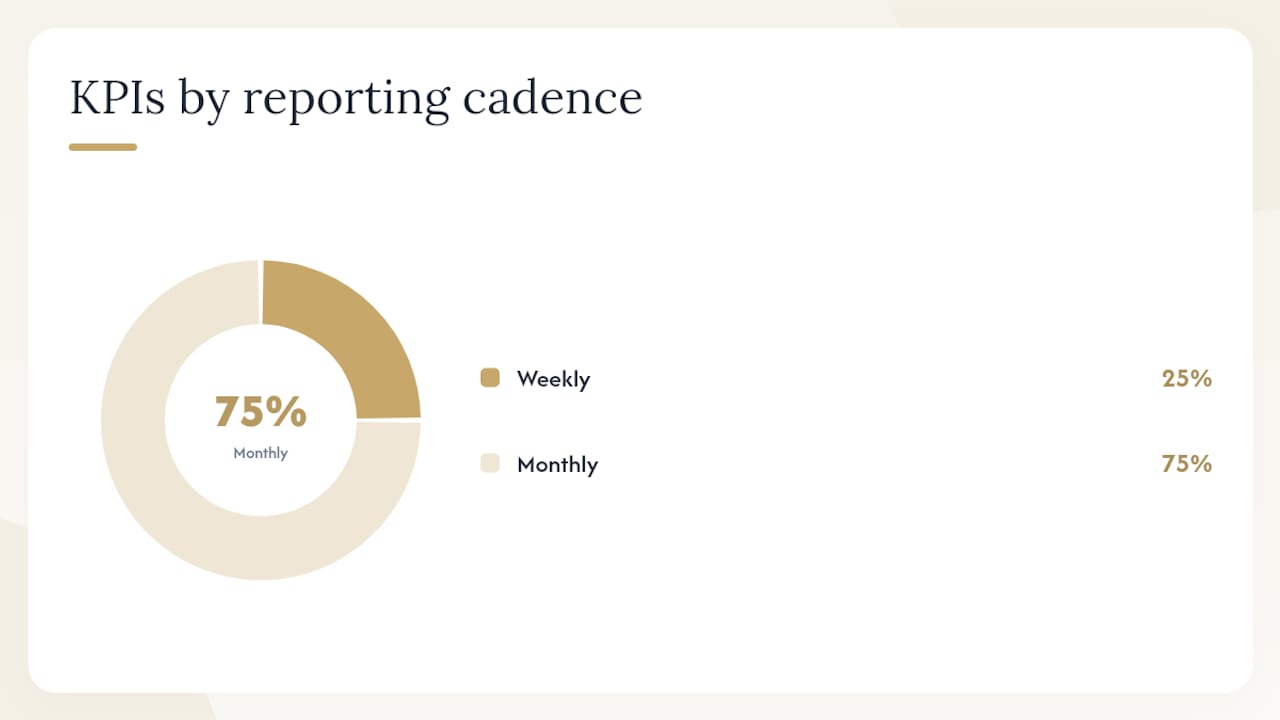
Reporting skeleton: Weekly, review paid impressions, CTR, and organic impressions for anomalies. Monthly, report branded search trend, AI citation checks, third-party mentions, and pipeline influenced. Quarterly, review share of search against two or three competitors and adjust channel mix accordingly.
Realistic ramp times and cost ranges by strategy type
Setting honest expectations prevents budget misalignment. Here is what each major strategy type typically requires in time and money.
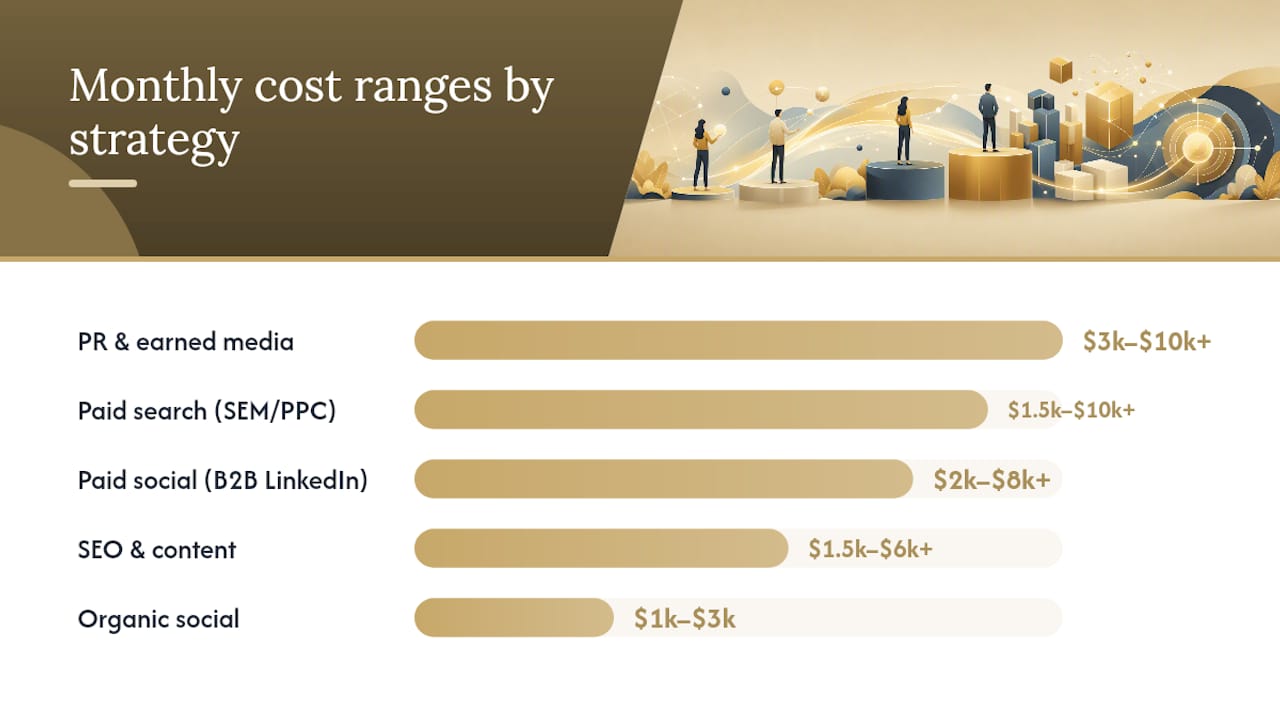
Paid search (SEM/PPC)
Ramp time: 2–4 weeks to meaningful data; 6–8 weeks to optimization
Cost range: $1,500–$10,000+/month (ad spend plus management); highly variable by industry and keyword competition
Paid social (LinkedIn, Meta, TikTok)
Ramp time: 1–3 weeks for initial results; 4–6 weeks for audience learning
Cost range: $2,000–$8,000+/month for B2B LinkedIn; lower for Meta awareness campaigns
Organic social
Ramp time: 3–6 months to build consistent engagement
Cost range: Near-zero for DIY; $1,000–$3,000/month for managed content creation
SEO and content marketing
Ramp time: 4–12 months for meaningful organic traffic growth
Cost range: $1,500–$6,000+/month for managed SEO; lower for in-house execution
PR and earned media
Ramp time: 6–12 weeks for first placements; 6+ months for consistent coverage
Cost range: $3,000–$10,000+/month for a retained PR agency; lower for DIY outreach
Events and webinars
Ramp time: 4–8 weeks to plan and promote a virtual event
Cost range: $500–$5,000 for a virtual roundtable; $10,000+ for in-person
Referral programs
Ramp time: 4–8 weeks to set up; results depend on customer base size
Cost range: Low setup cost; incentive cost varies by deal size
Local listings and directories
Ramp time: 2–4 weeks for initial setup; 1–3 months for ranking improvement
Cost range: Mostly free (Google Business Profile); $100–$500/month for premium directory listings
AI/AEO optimization
Ramp time: 2–4 weeks for technical implementation; 2–3 months to see citation improvement
Cost range: Largely time investment; $500–$2,000/month if outsourced
Planning note: Sequence paid channels first for speed, then layer in SEO and PR for compounding returns. Treat paid as the accelerator while organic and earned build the foundation.
From visibility to leads: how Flockleads approaches this for B2B
Visibility without a conversion path is just awareness spending. For B2B companies, the goal is to appear where buyers research, earn enough trust to make the shortlist, and then capture that intent through a clear next step.
The practical sequence Flockleads recommends for B2B clients:
Audit your current positioning — Where do you appear today when a buyer searches your core problem? Check Google, LinkedIn, and two or three AI tools. The gaps are your priority list.
Pro Tip: When you publish a new piece of content, immediately check whether it answers a question that appears in Google’s “People Also Ask” box for your target query. If it does, add FAQ schema to that page. AI systems frequently pull from FAQ-structured content when generating answers.
For B2B specifically, publishing concise problem-aware answer blocks with forwardable proof points accelerates inclusion in buyer shortlists. A two-paragraph case study snippet with a specific result outperforms a five-page PDF that buyers never open.
Key Takeaways
A cross-channel visibility strategy, combining owned content, paid media, earned PR, and AI/AEO optimization, consistently outperforms any single-channel approach for B2B businesses building durable pipeline.
Point | Details |
|---|---|
Start with two channels | Pilot one fast channel (paid search) and one compounding channel (SEO or PR) for 90 days before expanding. |
Measure leading indicators | Track branded search volume, organic impressions, and AI citation frequency, not just last-click conversions. |
Claim your entity profiles | Complete Google Business Profile, LinkedIn, and Crunchbase with consistent brand descriptions to improve AI citation rates. |
Sequence for speed and compounding | Launch paid search in month one, add SEO content from month two, and begin PR and AEO from month three. |
Flockleads for managed B2B visibility | Flockleads runs paid, SEO, and AEO campaigns for B2B companies, delivering qualified leads with weekly optimization and CRM integration. |
Why single-channel wins rarely hold up over time
Most businesses that see early traction on one channel make the same mistake: they double down on it and neglect everything else. Paid search delivers leads until costs rise or a competitor outbids you. Organic social builds an audience until an algorithm change cuts reach. SEO compounds beautifully until a core update reshuffles rankings.
The businesses that sustain visibility over years are the ones that treat channels as mutually reinforcing. A PR placement earns a backlink that strengthens SEO. That SEO ranking surfaces the brand in AI answers. The AI citation drives branded search. The branded search feeds a retargeting audience for paid social. None of those outcomes happen from a single channel in isolation.
The compounding case is clearest in B2B. A company that publishes original research, earns three trade press mentions, and structures that content for AI citation will outpace a paid-only competitor within 12 months, often at lower cost per lead. Paid media is most efficient when it amplifies content that already performs organically, not when it substitutes for it. That is the core argument for sequencing channels rather than choosing between them.
Flockleads delivers the visibility work, not just the advice
Most B2B companies know they need a cross-channel visibility program. The gap is execution: the time, the technical setup, the weekly optimization, and the measurement discipline to make it work. That is the gap Flockleads fills.
Flockleads runs managed, measurable lead delivery for B2B companies using paid search (Google, Meta, LinkedIn, TikTok), SEO, and AEO, with qualifying lead forms, CRM integration, and weekly campaign optimization built in. You get qualified leads delivered to your pipeline without building the infrastructure yourself.
The practical signal that a managed service makes sense: you have tried one or two channels, results are inconsistent, and you do not have the bandwidth to run weekly optimization across multiple platforms. At that point, the cost of a managed program is typically lower than the cost of the leads you are losing to slower execution.
If you are unsure whether your current visibility setup is leaving pipeline on the table, start with a free audit. Flockleads will map your current search and AI visibility gaps and show you where the fastest wins are. Understand how B2B lead generation differs from consumer lead generation before you decide on a channel mix, then get a free audit at Flockleads to see exactly where your visibility stands today.
Useful sources and further reading
These are the primary sources behind the recommendations in this guide, organized by the follow-up task they are most useful for.
Brand Visibility Strategy: How to Get Found Across Google, AI, and Social in 2026 — HubSpot
How to build brand visibility in AI search | SEMrush
How Cross-Channel Strategies Drive Brand Visibility in AI Results | VML
Market Visibility Strategies: 10 Ways to Get Found First
Guide to types of marketing strategies, techniques and tactics explained | AMA
Enhance Online Visibility: SEO & PPC Tactics
Frequently asked questions
What are the main types of business visibility strategies?
The eight core types are: owned content and SEO, paid search (SEM/PPC), paid social, organic social and creator partnerships, earned media and PR, events and experiential, referral programs and partnerships, and AI/AEO optimization. Most businesses need a mix of at least three to build durable visibility.
What are the four types of visibility in marketing?
A common framework groups visibility into owned (your website, content, profiles), earned (press, reviews, word-of-mouth), paid (ads, sponsorships), and social (organic and creator-driven reach). These four categories map to the channels where buyers discover and evaluate businesses.
How do I choose the right visibility strategy for my business?
Start with your business objective (awareness vs. demand capture), then identify where your buyers actually search. Match fast channels like paid search to immediate needs, and layer in compounding channels like SEO and PR for long-term returns. Budget and internal skills determine whether you execute in-house or use a managed provider.
How long does it take for visibility strategies to show results?
Paid search and paid social show initial data within 2–4 weeks. SEO and content marketing typically take 4–12 months for meaningful organic traffic. PR placements usually appear within 6–12 weeks of outreach. AI/AEO improvements can show up in citation checks within 2–3 months of technical implementation.
What KPIs should I track for business visibility?
Track organic impressions on problem-aware queries, branded search volume, AI citation frequency, share of search versus competitors, third-party mentions, and review count. These leading indicators capture whether buyers are discovering your brand during research, not just whether they convert at the final step.
NEED A CLEARER PLAN?
Let’s turn your next move into momentum.
Talk to us →