THE SHORT ANSWER
Every type of paid advertising falls into one of ten buckets: search, paid social, display, video/CTV, shopping and retail media, retargeting, native and sponsored content, influencer and affiliate, audio and email sponsorships, and programmatic buying through demand-side platforms. Search wins for high-intent buyers already looking to purchase.
Every type of paid advertising falls into one of ten buckets: search, paid social, display, video/CTV, shopping and retail media, retargeting, native and sponsored content, influencer and affiliate, audio and email sponsorships, and programmatic buying through demand-side platforms. Search wins for high-intent buyers already looking to purchase. Social wins for building awareness and targeting by job title, interest, or behavior. Display and video build brand recognition at scale. Shopping and retail media move product for ecommerce sellers. Retargeting recovers the visitors who almost converted and left.
Search (Google Ads, Microsoft Advertising): appears in search results; priced per click; best for buyers ready to act now.
Paid social (Meta, LinkedIn, TikTok): appears in feeds and stories; priced per click or per thousand impressions; best for audience targeting and awareness.
Display/video (GDN, YouTube, CTV): appears across websites, apps, and streaming; priced per thousand impressions; best for reach and brand recall.
Shopping/retail media (Google Shopping, Amazon Ads): appears in product listings; priced per click or on commission; best for direct product sales.
Retargeting (DSPs, GDN): appears wherever the network places it; priced per click or impression; best for recovering warm leads.
Native/sponsored content, influencer/affiliate, audio/podcast, email sponsorships: appear inside publisher content or feeds; priced per placement or per action; best for niche trust-building.
Pro Tip: Pick one primary goal per campaign before you pick a channel. Trying to drive awareness and closed sales with the same ad usually produces mediocre numbers on both fronts.
Key Takeaways
Matching each paid-ad type to a specific funnel stage, and backing it with clean first-party conversion tracking, determines returns more than any single platform choice.
Point | Details |
|---|---|
Search captures existing demand | Use Google Ads or Microsoft Advertising when buyers are actively searching for your solution. |
Social builds targeted audiences | Meta, LinkedIn, and TikTok let you target by interest, job title, or behavior rather than intent. |
Shopping needs clean feeds | Product feed quality directly determines return on ad spend for shopping and retail media ads. |
Measurement requires a hybrid approach | Combine first-party CRM data, server-side tracking, and platform attribution since cookies alone fall short. |
Flockleads manages the full mix | Flockleads runs Google, Meta, LinkedIn, and TikTok campaigns with CRM integration and weekly optimization for B2B lead generation. |
What Are the Different Types of Paid Advertising Options?
Paid advertising, sometimes called paid media, is any placement where a business pays a publisher or platform to show its message to a specific audience, rather than earning that visibility for free. The system runs on three types of players: the advertiser (you), the publisher or ad network (Google, Meta, a news site), and increasingly a matchmaking layer of demand-side and supply-side platforms that connect the two at scale. Most paid placements are sold one of two ways: a direct buy, where you negotiate a fixed price with a publisher, or an auction, where an algorithm picks the winning ad in real time based on bid amount plus relevance signals like expected click-through rate and ad and site quality.
Auctions are why two advertisers targeting the same keyword can pay wildly different prices. A more relevant ad with a stronger landing page often beats a higher bid from a competitor with weaker creative.
Pricing models track directly to the goal you’re chasing:
CPC (cost-per-click): you pay only when someone clicks. Best for traffic and lead generation.
CPM (cost-per-thousand-impressions): you pay for exposure regardless of clicks. Best for awareness.
CPA (cost-per-action): you pay when a defined action happens, like a signup. Best for performance-focused budgets.
CPL (cost-per-lead): a CPA variant common in B2B and services.
Flat sponsorship or commission: fixed fee or a cut of resulting sales, common in native and affiliate placements.
One distinction trips up a lot of marketers new to paid media: a view-through conversion counts someone who saw your ad and later converted without clicking, while a click conversion requires the click itself. Platforms report both, and conflating the two inflates your apparent return.
Which Paid Ad Types Should You Use for Each Goal?
This is the part most guides skip past too quickly: the format matters less than matching it to where the buyer stands in their decision. A well-targeted display ad shown to someone who has never heard of you will underperform a mediocre search ad shown to someone actively typing your exact problem into Google.
Search advertising
Search ads (Google Ads, Microsoft Advertising) show up above or beside organic results when someone types a query. They’re the closest thing paid media has to a sure bet, because you’re reaching people who told the search engine exactly what they want. Pricing runs on CPC, typically ranging from a few dollars for low-competition local terms to higher amounts per click in crowded B2B and legal categories. Creative needs are light: headlines, descriptions, and a landing page that matches the promise. Ramp time is fast, often producing usable data within one to two weeks, though Microsoft Advertising frequently delivers lower CPCs than Google for the same keywords because of lighter competition. Our own breakdown of Google Search ads for lead generation covers realistic cost ranges by industry.

Pro Tip: Search converts best when someone is already looking. If nobody searches for what you sell yet, you need awareness ads first, not more search budget.
Paid social
Meta (Facebook and Instagram), LinkedIn, and TikTok let you target by demographic, interest, job title, or behavior rather than by keyword intent. Meta pricing typically runs on CPC or CPM and rewards frequent creative refreshes since ad fatigue sets in fast among the same audience. LinkedIn costs considerably more per click than Meta, often $6 to $12, but its professional targeting makes it one of the few platforms where B2B advertisers can reliably reach by job function and company size. TikTok rewards native-feeling video over polished commercials and needs a faster creative testing cadence than any other channel. Ramp time for social sits around two to four weeks, mostly spent letting the algorithm learn who converts. Detailed cost and timeline expectations for two of these platforms live in our Meta ads for lead generation and LinkedIn ads for lead generation breakdowns.
Display and the Google Display Network
Display ads are the banner and image placements that follow you around the internet, served through networks like the Google Display Network across millions of partner sites. They’re priced almost always on CPM and exist to build recognition rather than drive immediate clicks. Click-through rates on display are low by design; the value shows up in brand recall and in supporting other channels. Creative requirements are heavier than search: you need multiple sizes and formats, and stale creative tanks performance within a couple of weeks. Display works best as a supporting layer under a search or social campaign, not as a standalone lead source for most businesses.
Video, YouTube, CTV, and OTT
Video ads on YouTube, and increasingly on connected TV (CTV) and over-the-top (OTT) streaming services, combine the reach of display with the persuasive power of storytelling. YouTube runs primarily on CPV (cost-per-view) or CPM, and skippable pre-roll ads only charge you when someone watches a meaningful portion. CTV and OTT buys, often run through programmatic platforms, tend to carry higher CPMs than YouTube but land in front of an audience that has largely tuned out traditional TV ads. Production is the real barrier here: a script, voiceover, and edited footage take longer to produce than a static image, which pushes typical ramp time to four to six weeks including creative development. Our YouTube and video ads for lead generation page covers realistic budgets by format.
Shopping and retail media
Shopping ads (Google Shopping) and marketplace ads (Amazon Ads, and similar formats on Walmart and other retailers) show the product image, price, and seller directly in the results, skipping the click-then-browse step entirely. These formats run almost exclusively on CPC or a commission structure, and they are unforgiving of bad data. Ecommerce sellers with clean, complete product feeds see strong returns, while sellers with inconsistent titles, missing attributes, or uncompetitive pricing see the return on ad spend collapse almost immediately. If you sell physical products online, this is usually the highest-priority channel to get right before spending heavily elsewhere. A partner resource on ecommerce SEO covers the product page and feed fundamentals that make shopping ads perform.
Retargeting and remarketing
Retargeting shows ads specifically to people who already visited your site or app but didn’t convert, using pixel data to follow them across the Google Display Network, social platforms, or dedicated demand-side platforms like AdRoll and Criteo. It’s typically the cheapest, highest-converting paid format you’ll run, because you’re reaching warm prospects instead of cold strangers. Pricing runs on CPC or CPM, and creative needs are modest: a handful of ad variations covering different stages of interest usually covers it. The catch is volume. If your site doesn’t get enough traffic, your retargeting pool stays too small to matter.
Native and sponsored content
Native ads blend into the surrounding content on news sites and content recommendation networks, styled to match the editorial format around them. They typically run on a flat sponsorship fee or CPC through content recommendation networks, and they work best for brand storytelling or thought leadership rather than direct response. The format demands genuinely useful content; a thinly disguised sales pitch performs worse than an honest ad because readers expect native placements to deliver something informative.
Influencer and affiliate marketing
Influencer partnerships and affiliate programs pay based on results, typically a flat fee per post, a commission on resulting sales, or a hybrid of both. This category rewards patience and relationship management more than campaign optimization skills, since performance depends heavily on the influencer’s actual audience trust rather than your targeting settings. It’s a strong fit for consumer brands with a visual product; it’s rarely the right first move for B2B companies selling complex services.
Audio, podcast, and email newsletter sponsorships
Podcast ads and newsletter sponsorships place your message inside content a specific audience already trusts and pays attention to. Podcast advertising runs on flat sponsorship rates tied to downloads, and measurement leans on publisher-reported numbers or lift studies rather than clean click tracking, since most listeners can’t click a link mid-episode. Newsletter sponsorships work similarly and can perform very well for niche B2B audiences when the publication’s subscriber base lines up closely with your buyer profile, though inventory is limited and pricing varies widely by publisher size.
Mobile in-app and app install ads
App install campaigns run inside other apps and mobile games, typically priced on CPI (cost-per-install) or CPA once a user completes a specific in-app action. They demand video or interactive creative built for a vertical, thumb-scrolling audience, and they matter almost exclusively to businesses with a mobile app to promote.
Programmatic buying through DSPs
Demand-side platforms like The Trade Desk and Google’s DV360 let you buy display, video, audio, and CTV inventory across thousands of publishers through a single interface, layering your own audience data on top. Programmatic buying delivers scale and sophisticated targeting that manual channel-by-channel buying can’t match, but it demands clean audience data and disciplined setup. Get the targeting wrong and you’ll burn budget across low-quality inventory faster than on any single-platform channel.
Start with the goal, not the channel: awareness, consideration, lead generation, sales, or app installs each point toward different formats.
Check your creative capacity honestly. Video-heavy channels like TikTok and YouTube fail fast without a real production pipeline.
Confirm the data foundation exists: a product feed for shopping, a pixel for retargeting, a CRM connection for lead ads.
Pilot one channel at a time rather than splitting a small budget six ways.
Emerging formats worth watching without betting the budget on yet: AI-generated creative variations that let platforms test dozens of ad versions automatically, and early interactive or AR-based ad units on social platforms. Both are promising, but treat them as a small test slice of spend, not a primary channel, until measurement standards catch up.
How Do You Measure Paid Ad Performance?
Six metrics cover almost every paid campaign: click-through rate (CTR) for ad relevance, cost-per-click (CPC) for efficiency, cost-per-action (CPA) and cost-per-lead (CPL) for down-funnel performance, return on ad spend (ROAS) for revenue-focused campaigns, and conversion rate for landing page effectiveness. View-through conversions round out the picture for awareness-heavy formats like display and video, where a click was never the point.
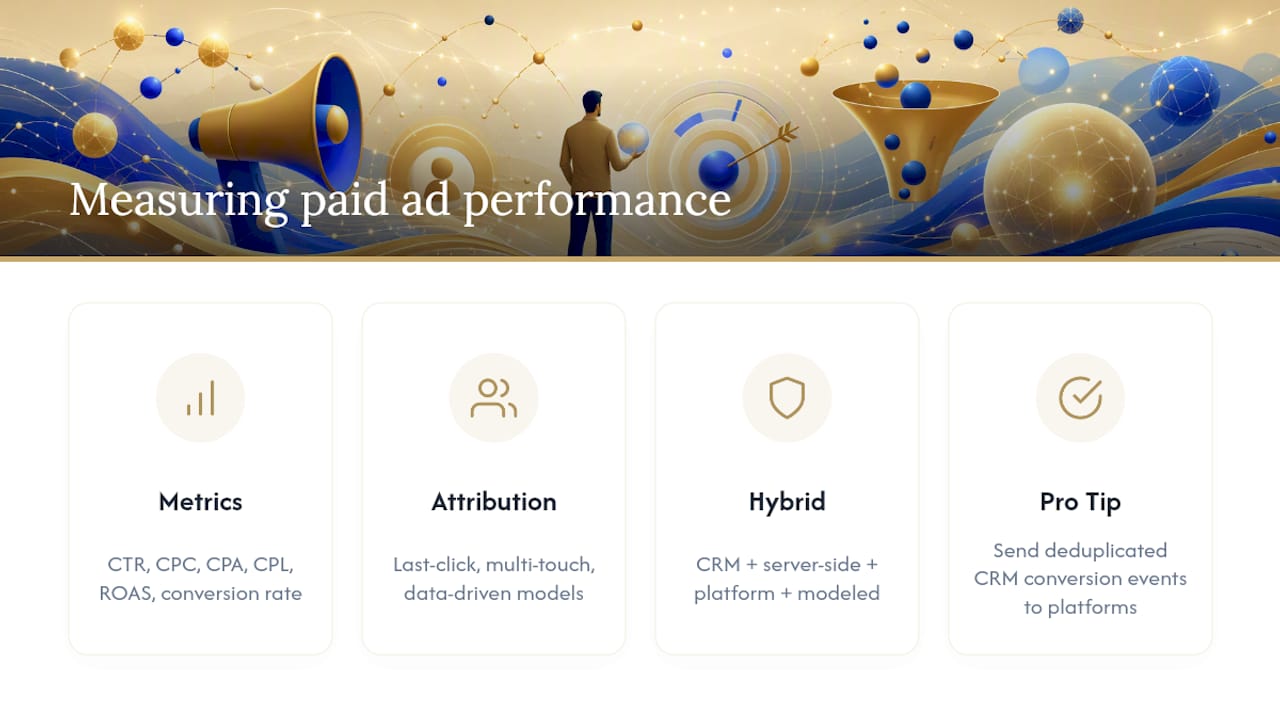
Attribution is where things get genuinely complicated. Last-click attribution gives all the credit to the final touchpoint before conversion, which undervalues the display or social ad that started the journey. Data-driven and multi-touch models split credit more realistically across the path, but every platform’s built-in attribution report tends to favor itself, since Meta counts conversions Google also claims, and neither fully sees the other’s contribution.
The practical fix most marketers land on is hybrid measurement: combining first-party conversion data from your own CRM, server-side tracking that doesn’t depend on browser cookies, platform-reported attribution, and modeled conversions to fill remaining gaps. Privacy changes have made cookie-based tracking alone unreliable, pushing this hybrid approach from “nice to have” to standard practice across most competitive industries. A deeper look at cookieless measurement from Rdyrct’s privacy-first analytics guide walks through the technical setup.
Pro Tip: Before you scale any channel, make sure your CRM fires a clean, deduplicated conversion event back to the ad platform. Messy conversion data is the single most common reason “the numbers don’t match” between your CRM and your ad dashboard.
What Does a Paid Ad Budget and Timeline Actually Look Like?
Budgets should shift shape as a campaign matures. Early spend is a test budget, built to answer “does this channel work for us,” not to hit a return target. Once you find a combination of audience and creative that converts, you move to a scale budget that pushes that winning formula harder. Sustained performance spend comes last, once you’ve got enough historical data to forecast returns confidently.
A common starting split by funnel stage: roughly 20% awareness, 30% consideration, and 50% conversion focused, though B2B companies with longer sales cycles often shift more weight toward consideration since a single lead form rarely closes a five-figure deal on the first touch.
Rough ramp expectations by channel:
Search: 4 to 12 weeks to stabilize, since the algorithm needs volume to learn which searches convert.
Social: 2 to 6 weeks per creative test, with faster cycles on TikTok than LinkedIn.
Video/CTV: 4 to 8 weeks, mostly eaten by creative production.
Shopping: 2 to 4 weeks once the feed is clean, faster than most channels since intent is already high.
Programmatic: 8 to 12 weeks to optimize across the full inventory pool.
Watch for two red flags that mean stop and rework, not push harder: a high CPC paired with a low conversion rate usually points to a landing page problem, not a bidding problem, and a high CPA on a well-targeted audience usually means the offer itself isn’t compelling enough. Throwing more budget at either issue just burns cash faster.
Pro Tip: Don’t judge a new channel on week one numbers. Give it the full ramp window above before deciding whether it works for your business.
How Do You Choose the Right Paid Ad Mix?
Run through this sequence before committing real budget to any channel:
Define one primary goal for the campaign: awareness, leads, or sales.
Map whether your audience shows intent (search) or shares interests and traits (social).
Confirm creative production capacity matches the channel’s format demands.
Set a test budget and a fixed testing window before judging results.
Verify conversion tracking and attribution are actually working, not just installed.
Choose one channel or one clear experiment at a time rather than launching five at once.
A simple goal-to-channel matrix: chasing immediate demand points to search or shopping; building brand awareness points to display or video; growing a targeted audience points to social; recovering lost visitors points to retargeting.
Before spending a dollar, answer these:
Do you have a working product feed if you’re selling physical goods?
Is a first-party conversion event (form fill, purchase, signup) firing cleanly to your CRM?
Can you produce new creative on a two to four week cadence?
Does your landing page actually match what the ad promises?
Do you know your average customer value, so you can judge whether a CPA is sane?
Is someone available to check performance weekly, not just at month’s end?
Red flags that mean pause before scaling: no conversion tracking installed, a landing page that loads slowly or buries the offer, or a targeting setup that doesn’t match the creative message. A startup-focused channel priority framework from Asha Frazier offers a useful model for sequencing early-stage spend if you’re building this from scratch.
What’s Different About Paid Advertising for B2B Lead Generation?
B2B paid advertising runs on a longer clock than consumer advertising. Sales cycles stretch from weeks to months, so a single click rarely closes a deal. That reshapes priorities: lead quality matters more than lead volume, and nurture sequences matter more than one-shot conversion pages. LinkedIn’s professional targeting, Meta’s custom audience lists built from CRM data, and Google Search’s intent capture are the three channels that consistently perform for B2B, in roughly that order of targeting precision.
Pricing in B2B typically shows up as cost-per-lead through a form fill, or cost-per-qualified-lead once you factor in sales team feedback on which leads were worth pursuing. Account-based advertising, which targets specific named companies rather than a broad demographic, has become common among B2B teams selling higher-value contracts.
The lever that moves the needle most in our experience running these campaigns: tight CRM integration that feeds qualification data back into the ad platform. When a platform knows which leads actually became customers, not just which leads filled out a form, it optimizes toward quality instead of raw volume, and cost-per-qualified-lead usually drops within a few optimization cycles.
Pro Tip: If your sales team isn’t tagging lead quality in your CRM, fix that before you fix your ad targeting. The algorithm can only optimize toward signals you actually give it.
Why Clean Measurement Matters More Than Channel Choice
The businesses that get the most out of paid advertising aren’t necessarily picking the fanciest channels. They’re the ones with clean conversion tracking and a weekly rhythm of small adjustments rather than big, infrequent overhauls. A campaign that gets checked and tweaked every week consistently outperforms one that gets set up once and left alone for a quarter, even when the underlying channel choice is identical. Hybrid measurement, first-party data plus platform reporting plus a real CRM feedback loop, isn’t optional anymore for anyone serious about knowing what’s actually working.
Let Flockleads Handle Your Paid Ad Mix
Flockleads is the alternative to piecing together a DIY paid-ad stack channel by channel: instead of learning six platforms and guessing at budget splits, you get managed campaigns across Google, Meta, LinkedIn, and TikTok, with qualifying lead forms and CRM integration built in from day one.
The weekly optimization cadence covered above isn’t a nice idea here, it’s how every account gets run, with reporting that shows which leads actually turned into customers, not just which ads got clicked. Pricing runs as a monthly subscription after a free initial audit, and most B2B accounts see stabilized lead flow within the four to eight week range typical of the channels involved. If you’re weighing whether to run this yourself or hand it to a team that already knows the differences between B2B and B2C lead generation, start with that free audit and see what a managed mix would look like for your business.
Sources
Frequently asked questions
What are the main types of paid advertising?
The core categories are search, paid social, display, video/CTV, shopping and retail media, retargeting, native and sponsored content, influencer and affiliate, audio and email sponsorships, and programmatic buying through demand-side platforms.
What are some common examples of paid advertising?
Google Search ads, Meta and Instagram feed ads, LinkedIn sponsored content, YouTube pre-roll video, Amazon Shopping ads, and display banners through the Google Display Network are all everyday examples.
What are the four main types of advertising in a simple framework?
A common simplified breakdown groups paid ads into search, display, social, and video, though a fuller catalogue also includes shopping, retargeting, and programmatic formats as distinct categories.
How is B2B paid advertising different from B2C?
B2B campaigns favor lead quality over volume, run on longer sales cycles, and lean on platforms like LinkedIn and Google Search that support professional targeting and intent capture, as covered in Flockleads’s B2B versus B2C comparison.
How long does it take to see results from paid advertising?
Search campaigns typically stabilize in 4 to 12 weeks, social creative tests show signal in 2 to 6 weeks, and programmatic campaigns need 8 to 12 weeks to optimize across their full inventory pool.
NEED A CLEARER PLAN?
Let’s turn your next move into momentum.
Talk to us →