THE SHORT ANSWER
Yes, social media can reliably generate paying clients for small service businesses — but only when you pair proof-of-expertise content with targeted outreach and a simple capture funnel. The fastest path to your first inbound lead is not posting more; it is posting smarter on one platform while messaging five qualified prospects a day.
Yes, social media can reliably generate paying clients for small service businesses — but only when you pair proof-of-expertise content with targeted outreach and a simple capture funnel. The fastest path to your first inbound lead is not posting more; it is posting smarter on one platform while messaging five qualified prospects a day.
Three things to do first:
Optimize your profile on one platform (LinkedIn for B2B, Instagram for visual services) so it reads as a client-facing landing page, not a résumé. State who you help and what outcome you deliver in the headline.
Publish three posts per week that rotate between a practical tip, a client result, and a belief-challenging insight. Do this for 90 days straight.
Send five personalized DMs per day to prospects who posted recently and show clear buying signals.
Realistic timeline: it typically takes 3–6 months of consistent LinkedIn posting and daily outreach to reach a reliable inbound lead flow, at which point most focused service businesses generate 2–5 inbound leads per month. Flockleads builds this exact system for service businesses that want it done for them.
Which social platforms should you actually focus on?
The right platform is the one where your ideal client already looks for help — not the one with the most users. Spreading effort across five channels is one of the fastest ways to burn out and see zero results.
Platform quick reference for service businesses:
LinkedIn: Best for B2B coaches, consultants, agencies, and professional services. Buyers are actively searching for vendors, and founder profiles generate significantly more engagement than company pages. Start here if your client is a business owner or decision-maker.
Instagram: Best for visual services (design, photography, fitness, beauty, interior design) and consumer-facing brands. Strong for building trust through behind-the-scenes content and before/after results.
YouTube: Best for complex services where education drives trust (financial planning, legal, software, coaching). A 10-minute tutorial positions you as the obvious expert before a prospect ever contacts you.
Facebook/Meta: Best for local service businesses and community-driven offers. Facebook Groups remain underrated for niche service providers who can answer questions and demonstrate expertise.
X (formerly Twitter): Best for tech, SaaS, and media niches. Effective for thought leadership when your buyers are active there, but declining for most service verticals.
TikTok: Best for consumer-facing services targeting audiences under 40. Growing for B2C, but conversion to paid clients is slower than LinkedIn for most professional services.
The one-line rule: Pick the platform where your ideal client already asks questions and where professional credibility signals are visible (titles, case studies, testimonials).
Pro Tip: Before committing to a platform, run a 15-minute audit. Search three problems your ideal client faces on each platform. Check the engagement quality on the top posts — are the comments from buyers or just other service providers? If you see prospects asking questions and vendors answering, that is a live buying signal. That is your platform.

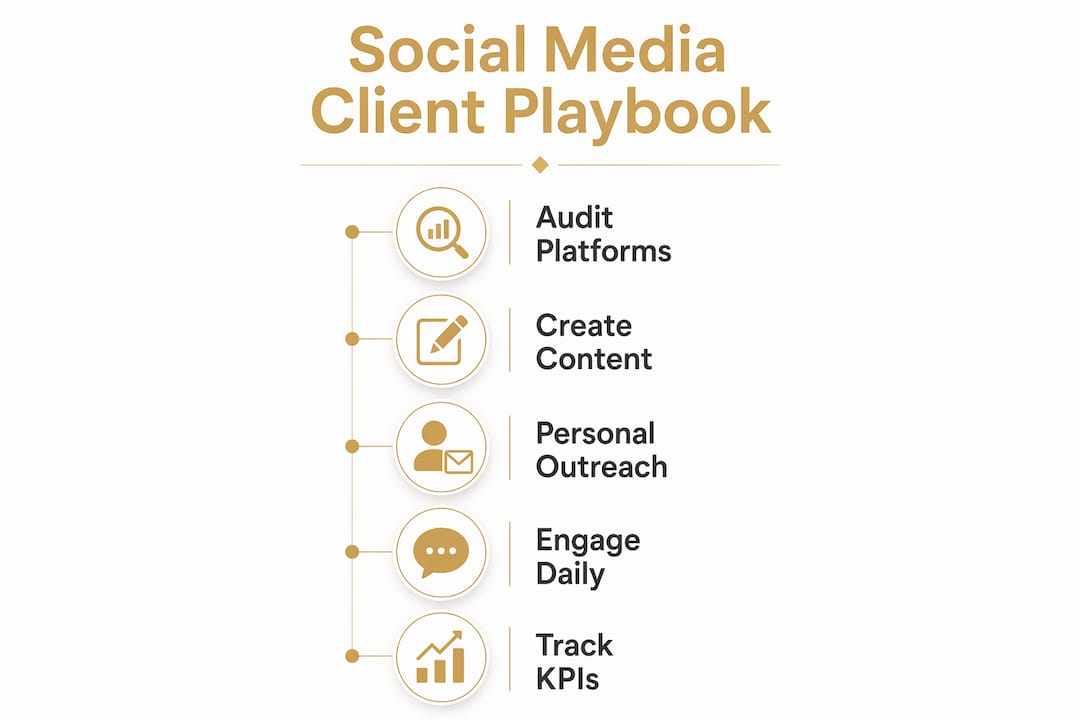
A repeatable weekly content and outreach plan you can start today
The biggest mistake solo professionals make is treating content and outreach as separate activities. They are one system. Content warms the market; outreach creates the conversation. Here is a practical weekly schedule built around three posts per week and daily DM activity.
The weekly schedule
Monday — Framework post (teach something) Share a process, checklist, or framework your ideal client can use immediately. Keep it specific to your niche. End with a soft CTA: “Drop a comment if you want the full version.”

Wednesday — Story/result post (show proof) Describe a client outcome or a before/after scenario without naming the client if needed. Concrete numbers beat vague claims every time. “Helped a 3-person agency go from 2 inbound leads/month to 11 in 90 days” is a post that stops the scroll.
Friday — Contrarian or insight post (challenge a belief) Pick one thing your ideal client believes that is slowing them down and push back on it. These posts generate the most comments and shares, which expands your reach to new prospects.
Daily (Monday–Friday) — Outreach Message five prospects who posted recently and show engagement signals. Not a pitch. A genuine, specific reply to something they said.
Copy-ready templates
DM opener (personalized): Comment reply (when someone engages with your post): Short caption CTA (end of any post):
Repurposing one idea into three assets
Write the LinkedIn post first (the core idea in 200–300 words).
Pull the single best sentence as a standalone quote graphic for Instagram Stories.
Record a 60-second voice note or video expanding on the idea for a Reel or YouTube Short.
Pro Tip: Batch your content on Sunday. Write all three posts in one 45-minute session, schedule them with a tool like Buffer or Later, then spend your daily 20 minutes purely on outreach. Separating creation from distribution cuts the mental load in half.
How do you turn social conversations into paying clients?
Likes and comments are not clients. The conversion happens in the conversation, and most small business owners skip the middle steps entirely. Here is the full path from post to paid engagement.
The five-step conversion path
Post generates a comment or reaction. Someone engages with your framework or story post.
You reply with a question, not a pitch. Ask something that reveals their situation: “Are you dealing with this right now, or more of a future concern?”
Move to DM when interest is clear. “I don’t want to clog your notifications — mind if I send you something useful in DMs?”
Qualify before you pitch. Three questions that protect your time:
“What does your current process look like for [the problem you solve]?”
“What’s the biggest bottleneck you’re running into?”
“Is this something you’re actively trying to fix, or more exploratory right now?”
Book the call with low friction. “Based on what you’ve shared, I think there’s a real fit here. I have 20 minutes Thursday or Friday — want to jump on a quick call and I’ll show you exactly how I’d approach your situation?”
What qualifies a lead
A qualified lead answers yes to at least two of these: they have the problem you solve, they are actively trying to fix it, and they have the authority (or budget) to make a decision. Anyone who says “maybe someday” is not a lead yet — move them to a nurture sequence and focus your energy on the active ones.
Treating social channels as searchable prospect databases rather than broadcast platforms is what separates teams that consistently fill their pipeline from those that post into the void. Content warms the market; outreach creates the opportunity.
A content series of roughly 10 related assets feeding a lead magnet or landing page capture keeps prospects engaged before you ever ask for a purchase. This is far more effective than pointing a cold follower straight to a sales page.
When should you run paid ads, and how do you test them cheaply?
Paid ads are an amplifier, not a foundation. Running ads before your organic messaging is validated is one of the most common ways small businesses waste money on social media.
Run ads only when:
You have at least 8–10 weeks of organic posting data showing which content types generate DM inquiries.
Your profile converts visitors to followers or DM conversations at a measurable rate.
You have a specific offer (lead magnet, free audit, discovery call) with a clear landing page.
How to run a small exploratory test:
Start with $10–$20 per day for 7–10 days. The goal is not sales — it is data. You want to evaluate which ad creative and audience targeting generate efficient cost per lead before scaling.
Budget level | Daily spend | Goal | Success signal |
|---|---|---|---|
Exploratory | Low daily spend | Validate creative + audience | Aim for cost-effective lead generation |
Growth | Moderate daily spend | Scale a proven lead magnet | Aim for stable lead generation |
Scale | Higher daily spend | Fill pipeline predictably | Monitor cost and conversion rates closely |
Amplification order:
Boost your two or three highest-performing organic posts to a lookalike audience.
Test a lead-gen form (LinkedIn Lead Gen Forms or Meta Instant Forms) with a free resource offer.
Only then test a direct landing page with a paid discovery call CTA.
Layering channels — warm referrals, organic content, and paid amplification in that order — consistently outperforms any single-channel approach. Paid is the last layer, not the first. For a deeper look at integrating paid campaigns with a validated organic offer, the Flockleads guide on turning paid traffic into a steadier lead engine walks through the exact sequencing.
What KPIs should you track, and how long until you see steady leads?
Most small business owners either track nothing or track vanity metrics like follower count. Neither tells you whether your social activity is generating revenue. Here are the five numbers that actually matter.
KPI | What it measures | How to calculate |
|---|---|---|
Profile visits | Awareness and content reach | Native analytics on each platform |
DM inquiries | Outreach and content conversion | Count new DMs from prospects per week |
Qualified calls booked | Pipeline quality | Calls where prospect meets 2+ qualification criteria |
Lead-to-call conversion | DM effectiveness | Qualified calls ÷ total DM conversations |
Cost per lead (if running ads) | Paid efficiency | Total ad spend ÷ number of qualified leads |
Minimal weekly dashboard: Every Friday, log five numbers in a spreadsheet: profile visits, new DM conversations, qualified calls booked, calls converted to proposals, and proposals accepted. That is your entire dashboard. Add a “source” column to every new lead so you know whether it came from a post, a DM, a referral, or an ad.
Realistic timeline:
Weeks 0–6: Setup and testing. Optimize your profile, establish your posting rhythm, and send your first outreach messages. Expect low response rates while you refine targeting and messaging.
Months 3–6: Reliable inbound begins. Consistent LinkedIn posting combined with daily outreach produces 2–5 inbound leads per month for most focused service businesses.
Months 6–12: Compound growth. Your content library builds authority, referrals start arriving from early clients, and your outreach response rate improves as your profile gains credibility.
Common mistakes that kill social media client generation (and fast fixes)
Most social media efforts fail not because the platform is wrong, but because of a handful of repeatable errors. Here are the ones that show up most often.
Mistake: Posting without a defined niche Fix: Write your profile headline as “[What you do] for [specific type of client] who want [specific outcome].” Every post should speak to that one person. Vague positioning attracts no one.
Mistake: Broadcasting instead of conversing Fix: For every post you publish, spend 20 minutes commenting on five other posts in your niche. Genuine, specific replies in comments build trust faster than any broadcast offer. The conversation matters more than the caption.
Mistake: Sending generic outreach Generic connection requests convert under 10%; a single sentence referencing a prospect’s recent post can lift reply rates to 30–40%. Always reference something specific: their recent post, a hiring signal, or a comment they left on someone else’s content.
Mistake: Scaling outreach before the message is working Fix: Scale volume only after three things are stable — your targeting, your messaging, and your profile conversion. Sending 50 DMs a day with a broken message just burns your reputation faster.
Mistake: Ignoring follow-up Fix: If a prospect does not reply to your first DM, follow up once after five days with a different angle — share a relevant piece of content rather than repeating the original ask. After two attempts, move on. Automation tools like Expandi or Dripify can handle follow-up sequences, but keep the tone human. Every automated message should read as if you wrote it manually.
Pro Tip: On legal and ethical outreach: always respect platform terms of service, never scrape contact data without consent, and honor opt-out requests immediately. In the U.S., the CAN-SPAM Act and platform-specific community standards govern commercial messaging — a single spam complaint can get your account restricted. Keep outreach volume reasonable (under 25 new DMs per day on LinkedIn) and personalize every message.
What does the research actually say about social media client acquisition?
The evidence behind this playbook is not anecdotal. Several consistent findings from practitioner research support the specific tactics above.
What the data supports:
3–5 LinkedIn posts per week combined with targeted daily outreach produces reliable inbound leads for B2B coaches and consultants, with a 3–6 month ramp to steady flow.
Personal founder profiles generate roughly 8× the engagement of company pages for B2B content, making personal branding the higher-ROI investment for solo professionals.
Referrals rank highest in early-stage ROI, followed by content marketing (especially LinkedIn for B2B) and partnerships. Cold outreach and paid ads rank lower in early-stage return.
A practical outreach filter — messaging only prospects who posted recently, show engagement signals, and can actually make a buying decision — can lift DM response rates from single digits to 25–40% on filtered campaigns.
For deeper technical guidance on the content vs. outreach tradeoff on LinkedIn, this B2B LinkedIn analysis breaks down which approach drives more leads at each stage of growth.
The one-line implication: Start with LinkedIn, post three times a week, and message five filtered prospects daily. Everything else — paid ads, multiple platforms, automation — comes after that system is producing conversations.
Key Takeaways
Consistent proof-of-expertise content on LinkedIn combined with daily personalized outreach is one of the most reliable ways to generate steady inbound leads over a few months for small service businesses.
Point | Details |
|---|---|
Platform priority | Start with LinkedIn for B2B; pick the platform where your ideal client already asks questions. |
Posting cadence | Three posts per week rotating between a practical tip, a client result, and a contrarian insight. |
Outreach filter | Message only prospects who posted recently and show buying signals; filtered campaigns reach 25–40% reply rates. |
Timeline expectation | Expect 0–6 weeks of setup, then 3–6 months to reliable inbound of 2–5 leads per month. |
Flockleads option | Flockleads builds engineered lead flow for service businesses that want this system done for them. |
What I would actually do this week if I were starting from zero
Most social media advice tells you to “be consistent” and “add value.” That is not a plan. Here is what a focused first week actually looks like.
Action 1: Rewrite your profile headline (30 minutes). Your headline should state who you help and what outcome you deliver. “Marketing consultant” tells a prospect nothing. “I help B2B SaaS founders add qualified pipeline through LinkedIn content” tells them everything. Do this before you post a single piece of content.
Action 2: Publish three targeted posts (2 hours, batched on Sunday). Write a framework post, a client result post, and a contrarian take. Schedule them for Monday, Wednesday, and Friday. Do not wait until they are perfect — a specific, slightly rough post outperforms a polished generic one every time.
Action 3: Run outreach to 10 filtered prospects (1 hour across the week). Use LinkedIn’s search to find people who match your ideal client profile and posted in the last seven days. Send each one a personalized DM that references their specific post. Aim for two replies in the first week. That is a realistic target, not a stretch goal.
Prioritized action list:
Profile rewrite — 30 minutes today. This is the highest-leverage single action because every piece of outreach and every post drives traffic back to it.
Batch three posts — 2 hours Sunday. Scheduling in advance removes the daily decision fatigue that kills consistency.
10 personalized DMs — 10–15 minutes per day, Monday through Friday. Two genuine conversations this week is a better outcome than 50 generic messages.
The compounding effect of this system is real. Week one feels slow. By month three, inbound inquiries start arriving without you initiating every conversation.
Prefer to outsource? Here is what a lead flow engagement looks like
If you have validated your offer but do not want to manage the content calendar, outreach sequences, and platform optimization yourself, a done-for-you lead flow service is worth evaluating.
Flockleads builds engineered lead flow for B2B service businesses — handling the targeting, outreach sequencing, and pipeline delivery so leads arrive at your website without you managing the daily mechanics. The concrete difference from a traditional agency: Flockleads focuses on qualified leads delivered to your pipeline, not on follower counts or impressions. That distinction matters when you are paying for outcomes, not activity.
Before you hire any vendor, ask these five questions:
“What specific outcomes do you guarantee, and over what timeframe?” (Leads per month, qualified calls booked — not impressions.)
“How do you test and iterate messaging before scaling?” (Any credible vendor runs small tests before committing budget.)
“What does your reporting look like, and how often do I see it?” (Weekly dashboards beat monthly PDFs.)
“How does your system integrate with my CRM or booking tool?” (Leads that do not land in your workflow are leads you will lose.)
“Can you share a reference from a client in a similar service category?” (Proof of work in your niche beats generic case studies.)
See how Flockleads works and review current project scopes to evaluate whether the model fits your situation. If it does, the next step is a short discovery call to map your ideal client profile to a targeting strategy.
Useful sources and further reading
These resources go deeper on the specific tactics covered in this article.
Social Media for Coaches and Consultants: How to Get Clients in 2026 — Monolit Blog: The most detailed practitioner breakdown of the LinkedIn posting cadence and 3–6 month timeline for service businesses. Start here for platform-specific depth.
How to Find Clients on Social Media: A Founder’s Guide — DMpro Blog: Covers the outreach-as-targeting-problem framing and the practical filter for identifying high-response prospects. Essential reading before you write your first DM.
How to Find Freelance Clients on Social Media (2026) — Monolit Blog: Focused on solo professionals and freelancers; strong on personalization tactics and reply-rate data.
How To Get Coaching Clients From Social Media Without Running A Single Ad — Molly Mahoney: Practical content-mix guidance for organic-only client acquisition. Useful if you are not ready to run ads.
LinkedIn Content vs. LinkedIn Outreach: Which Drives More B2B Leads — Resonate: A direct comparison of content-driven inbound versus outreach-driven acquisition on LinkedIn, with stage-specific recommendations.
How To Find Social Media Marketing Agency Clients (2026) — Postplanify: Covers channel layering, referral systems, and the ROI ranking of acquisition channels. Useful for agencies and multi-service businesses.
Flockleads Blog: Case studies and playbooks on LinkedIn marketing, outreach systems, and paid traffic integration for service businesses.
Turning Paid Traffic Into a Steadier Lead Engine — Flockleads: Specific guidance on when and how to layer paid campaigns onto a validated organic system.
Frequently asked questions
How long does it take to get clients from social media?
With consistent LinkedIn posting (three times per week) and daily personalized outreach, focused service businesses typically reach a reliable inbound flow of 2–5 leads per month after 3–6 months. The first 6 weeks are setup and testing; steady results usually start to appear around the third month.
Which social platform is best for client generation?
LinkedIn is the highest-ROI platform for B2B client acquisition, particularly for coaches, consultants, and agencies targeting business owners or decision-makers. Instagram works better for visual services and consumer-facing offers.
How many posts per week do you need to generate clients?
Regular posting on one primary platform can help build authority and generate inbound interest. Posting more without a matching outreach effort rarely produces better results.
What should a cold DM say to attract clients?
Reference something specific from the prospect’s recent activity, ask one question about their current situation, and make it easy to reply. Generic pitches tend to have low conversion rates; personalized messages that reference a specific post typically achieve higher reply rates.
When should a small business start running paid social ads?
Only after 8–10 weeks of organic data showing which content generates DM inquiries and your profile converts visitors at a measurable rate. Paid ads amplify a working system; they cannot fix a broken one.
NEED A CLEARER PLAN?
Let’s turn your next move into momentum.
Talk to us →