THE SHORT ANSWER
A UTM naming convention is an enforced taxonomy that governs how you fill in the five UTM parameters, so every marketer types the same values the same way. The single rule that fixes most broken reports: lowercase only, one separator, and a controlled vocabulary for source and medium. Get that right and you stop the fragmentation that scatters one campaign across a dozen rows in GA4.
A UTM naming convention is an enforced taxonomy that governs how you fill in the five UTM parameters, so every marketer types the same values the same way. The single rule that fixes most broken reports: lowercase only, one separator, and a controlled vocabulary for source and medium. Get that right and you stop the fragmentation that scatters one campaign across a dozen rows in GA4.
TL;DR:
Consistent, lowercase UTM parameters with fixed source and medium vocabulary prevent report fragmentation caused by case sensitivity.
Using a hybrid naming model with a positional structure for campaign names and short, fixed source and medium values balances readability and scalability.
Enforcing a strict UTM convention through a simple document, dropdown tools, and automated checks ensures ongoing data integrity and reduces human error.
Regular audits of GA4 data for inconsistent capitalization and unexpected source or medium values are essential to maintain accurate attribution over time.
Implementing a phased rollout over 90 days, with documentation, training, and ongoing governance, helps embed UTM best practices across marketing teams.
What Are UTM Naming Conventions and Which Parameters Matter?
Google Analytics tracks five UTM parameters, but only three of them are load-bearing for attribution. Everything else is a refinement.
utm_source identifies where the traffic came from (google, facebook, newsletter).
utm_medium identifies the channel type (cpc, social, email, referral).
utm_campaign identifies the specific initiative (spring-sale, product-launch).
utm_content distinguishes between variants inside the same ad or email, useful for A/B testing two creatives or two calls to action.
utm_term tracks paid search keywords, mostly relevant if you still run manual keyword-level campaigns.
Most guides recommend starting with just three parameters, utm_source, utm_medium, and utm_campaign, and adding utm_content or utm_term only when a specific test or keyword actually needs it. That minimalism matters more than it sounds. Every extra field is another place someone can type “Facebook” instead of “facebook.”
Two related fields sit outside this system and cause confusion when people mix them up. utm_id links a UTM string to a specific campaign ID inside Google Ads or Campaign Manager, and Google’s own gclid parameter gets appended automatically to Google Ads clicks regardless of what UTMs you add. Don’t try to replace either with a manual UTM value.
Keep anything that isn’t strictly channel and campaign identity out of your UTMs entirely. Budget, target audience, creative agency, approval status: that metadata belongs in your CRM or ad platform, not stuffed into utm_content as a workaround. A UTM string that tries to carry seven pieces of information becomes unreadable and, worse, inconsistent, because nobody remembers the order after the third campaign.
Why Does Inconsistent UTM Tagging Break Your Reports?
Case sensitivity is the quiet killer here. GA4 treats Facebook, facebook, and FACEBOOK as three distinct source values, and that mismatch is one of the most common causes of report fragmentation practitioners run into. Nobody decides to break their own reports. It happens because one person on the team capitalizes proper nouns out of habit, and GA4 has no idea “Facebook” and “facebook” are the same platform.
Picture a paid social campaign that ran for six months. Three different team members touched the link builder over that stretch. By month six, your acquisition report shows six separate rows for what should be one row: facebook, Facebook, FB, fb-ads, facebook_ads, and facebook-paid. Total spend and total leads for that channel look artificially low in every single row, because the real numbers are split six ways. Whoever reviews that report concludes paid social underperforms and cuts the budget, based on a data problem, not a performance problem.
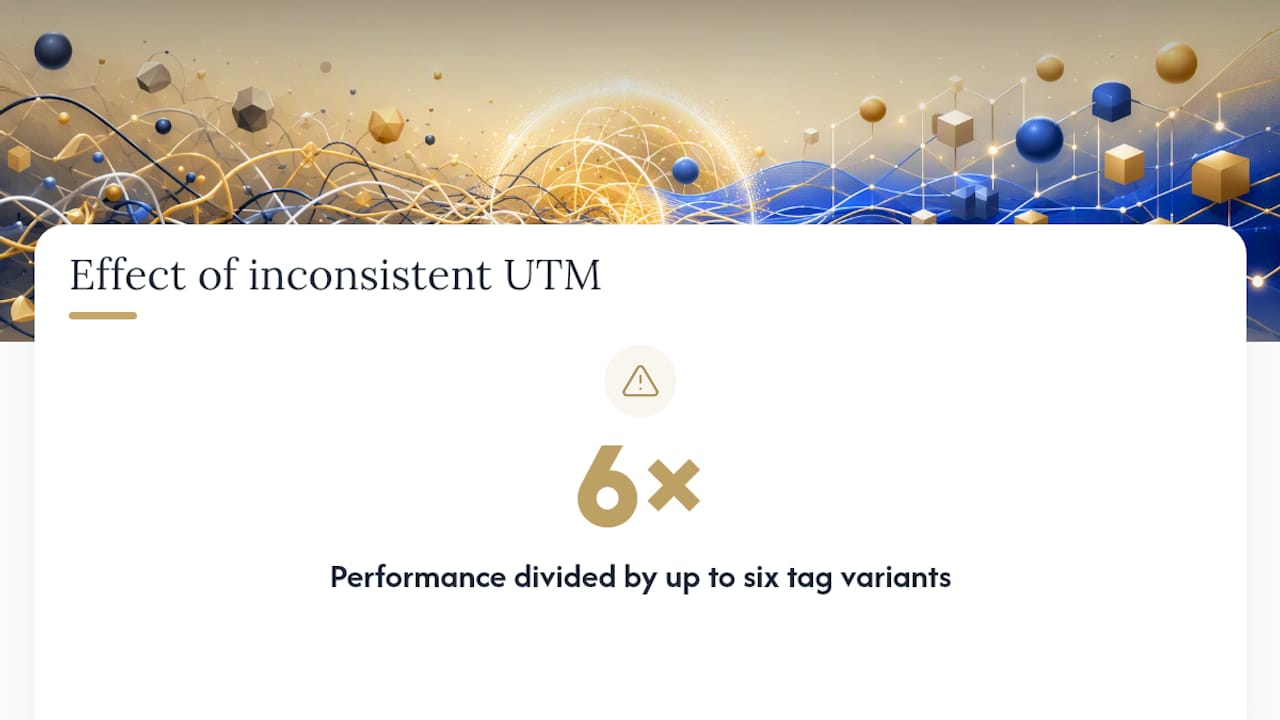
The fragmentation math: a single campaign tagged inconsistently across six variants doesn’t just create six rows. It silently divides your true channel performance by up to six, making a winning channel look like a loser in every dashboard that rolls up by source.
A naming convention is the cheapest fix available for this problem. It costs nothing to implement beyond a shared document and some discipline, and it prevents the exact failure mode that makes leadership distrust the analytics team’s numbers.
Which UTM Naming Model Should Your Team Use?
Three models dominate how teams structure their UTM values, and each one trades readability against scale differently. Picking the wrong one for your team’s size is how conventions collapse within a quarter.
The cryptic model uses short, compact codes: sp26-ig-carousel instead of a fully spelled-out description. It’s fast to type and keeps URLs short, which matters if you’re pasting links into character-limited social captions. The tradeoff is that nobody outside the team who built the taxonomy can read it. Six months later, even the person who wrote it might not remember what sp26 stood for.
The positional model fixes a strict field order and length for every campaign name, something like [team]-[quarter]-[channel]-[variant], each segment a set number of characters. This is the model that plays best with data warehouses, because a fixed field order makes parsing campaign names in BigQuery or Snowflake mechanical instead of guesswork. The drawback shows up the moment your campaign structure evolves and a five-segment name doesn’t fit the six-segment pattern you now need.
The key-value model spells out labels inside the value itself, like campaign=spring-launch_channel=email. It’s the most self-documenting option; anyone can read a report and know exactly what ran. It’s also the most verbose, and verbosity in UTM strings means more room for typos, mismatched capitalization, and inconsistent labeling between team members.
For most marketing teams, a hybrid wins. Use a loose positional structure for campaign names (period, product, offer, in that order) but keep source and medium values short, plain, and drawn from a fixed list rather than free-typed. You get the parsing benefits of positional structure without the rigidity of a strict character-count system, and you avoid the illegibility of pure cryptic codes.
Model | Best for | Main risk |
|---|---|---|
Cryptic | Small teams, high campaign volume | Unreadable to anyone outside the builder |
Positional | Teams reporting into a data warehouse | Breaks when campaign structure changes |
Key-value | Cross-functional teams, low tagging volume | Verbose, more room for typos |
The Non-Negotiable Rules for Naming UTM Tags
Every UTM convention that survives contact with a real marketing team, across multiple channels and multiple hands on the keyboard, follows the same handful of rules. Skip one of these and fragmentation creeps back within weeks.
Lowercase everything, always. This is the single highest-leverage rule because GA4’s case sensitivity means “Newsletter” and “newsletter” report as two different sources. Enforce it with a link builder that auto-lowercases input, or a spreadsheet formula that converts everything before publishing.
Pick one separator and never mix it. Choose hyphens or underscores, not both. Spaces get URL-encoded as %20 and turn readable values into gibberish the moment someone pastes the link into a browser bar.
Build a controlled vocabulary for source and medium. Nobody free-types these two fields. They come from a fixed dropdown list your team agrees on once and revisits quarterly.
Map every utm_medium value to a GA4 Default Channel Grouping. If a medium value doesn’t match what GA4 expects, that traffic lands in “Unassigned” instead of the channel it actually belongs to, which is arguably worse than mislabeling it.
Keep values short and descriptive, never generic.
spring26-promobeatscampaign1. A value should tell a human what ran without requiring a lookup table.Never tag internal links with UTMs. Internal links should rely on event tracking, not UTM parameters, because a UTM on an internal link overwrites the visitor’s original acquisition source the moment they click it. If someone arrives from a paid social ad and then clicks an internally UTM-tagged banner on your homepage, GA4 now credits that banner instead of the ad that actually drove them there.
Compare these side by side:
Bad:
Spring Sale 2026!(spaces, capitalization, punctuation)Good:
spring26-saleBad:
FB_Ads(mixed case, inconsistent separator across campaigns)Good:
facebookas source,paid-socialas mediumBad:
emailused interchangeably withnewsletterande-blastfor the same channelGood: one approved value,
email, used every single time
Pro Tip: Run a find-and-replace audit on your last 90 days of campaign data before you write a single rule. You’ll usually find the exact fragmentation patterns your team creates by habit, which tells you which values need the strictest enforcement first.
For channel-specific examples of how source and medium actually get tagged in practice, campaigns like Meta ads for window and door companies or Google Search ads for lead generation show how the same convention holds up across very different platforms.
How Do You Govern and Enforce a UTM Taxonomy?
A convention document that lives in a forgotten Google Doc doesn’t govern anything. It gets read once and ignored by the third campaign. Real governance needs an owner, a tool, and a checkpoint that catches mistakes before they publish, not after.
Start with a one-page convention document, not a wiki, not a slide deck. List the five parameters, the approved values for source and medium, the separator you chose, and one worked example per channel. Multiple practitioner guides converge on this exact format because anything longer gets skimmed rather than followed. Assign a single owner, whether that’s a person or a small analytics team, who approves new source or medium values before they enter the system.
From there, tooling does the enforcement a document can’t:
A shared spreadsheet template with data validation dropdowns for source and medium removes free-typing entirely, since the cell simply won’t accept an unlisted value.
A UTM builder tool, whether homegrown or a service like Cult Media’s UTM tracking templates, generates the final URL from dropdown selections instead of manual concatenation.
Programmatic link generation, where campaign management software builds UTM strings from a database of approved values, removes human typing from the equation entirely once you’re running dozens of campaigns a month.
Automated validation checks confirm required fields are present, capitalization is correct, and the destination URL actually resolves before a link goes live in an ad platform.
The most overlooked check in that list is redirect survival. Advanced teams crawl the final landing page after a redirect chain to confirm the UTM parameters actually survived, because some link shorteners and redirect services strip query parameters without warning. A perfectly tagged link that loses its UTM string three redirects later shows up in GA4 as direct traffic, and you’ll never know why unless you check.
Pro Tip: If you use a link shortener anywhere in your funnel, test one campaign link end to end before your launch, not after. Paste the shortened URL into a browser, follow it to the final landing page, and check the address bar for your UTM string. This takes ninety seconds and catches a failure mode that otherwise hides for months.
What Campaign-Naming Patterns Actually Work?
Two patterns cover the overwhelming majority of campaign types, and both are built to survive parsing in a spreadsheet or a warehouse later.
The first is {period}-{product}-{offer}, best for straightforward promotional campaigns: q2-insulation-freeaudit or spring26-solar-discount. The second is {year}-{quarter}-{program}-{tactic}, better suited to larger organizations running multiple concurrent programs: 2026-q2-leadgen-retargeting.

The choice between a relative period marker like q2 and an exact date like 2026-04-15 isn’t arbitrary. Recurring campaigns should use relative markers, because a campaign called q2-promo is instantly reusable next year without renaming logic. Reserve exact ISO dates for genuine one-offs where the specific date is the point, a product launch tied to a single day, or a webinar with a fixed registration deadline.
Here’s how the same campaign looks across channels, all sharing one utm_campaign value so they roll up together in reporting:
Notice what stays fixed and what changes: utm_campaign never varies, because that’s what lets you see total performance for the initiative across every channel in one rollup. utm_source and utm_medium change per channel, drawn from your controlled vocabulary. utm_content is where creative testing lives, distinguishing the carousel ad from the single-image version running the exact same offer.
For platform-specific naming examples, LinkedIn campaigns and small-budget search tests, like the kind broken down in BidSurvivor’s look at what $200 buys on Google Ads, both illustrate how the same utm_campaign value can anchor wildly different channel-level tactics without losing the ability to compare them.
How Do You Audit and Enforce UTMs Over Time?
A convention that isn’t checked decays. New hires free-type values out of habit, agencies build their own links without seeing your dropdown list, and six months later you’re back to fragmented reports.
Run a weekly GA4 acquisition check. Scan the source/medium report for anything that shouldn’t exist: capitalized variants, unfamiliar mediums, or a spike in “Unassigned” traffic that signals a medium value GA4 doesn’t recognize.
Schedule a monthly automated audit. Whoever owns the taxonomy pulls a report of every unique utm_source and utm_medium combination used that month and flags anything outside the approved list.
Reconcile historical fragmentation only where the data supports it. If your raw event logs are exported to a warehouse, you can apply normalization scripts to merge known variants like
fbandfacebookinto a single value. Without a raw export, this kind of retroactive fix is often not feasible, so it’s usually smarter to fix forward and accept the old data as-is.Validate before launch, verify after. Check the link against your convention rules before it goes into an ad platform, then check GA4 twenty-four hours after launch to confirm it’s reporting under the expected source and medium.
Case mismatches remain the most frequently cited cause of UTM fragmentation across practitioner guides, which is exactly why the audit step focused on capitalization deserves a recurring slot on someone’s calendar, not a one-time cleanup.
How Do You Roll Out a UTM Convention in 90 Days?
Treat this as a phased rollout, not a one-day policy announcement that everyone forgets by Friday.
Days 1 to 30: audit and prioritize. Pull every UTM combination used in the last quarter, identify the worst fragmentation (usually your highest-volume paid channel), and fix that first.
Days 31 to 60: document and tool up. Write the one-page convention, build the spreadsheet template with dropdown validation, and pick or build a link generator everyone will actually use.
Days 61 to 90: train, launch, and set cadence. Walk the team through the new system with real examples, launch it on all new campaigns, and set the recurring audit calendar with a named owner and a clear process for requesting new source or medium values.
Ongoing: govern, don’t just launch. Define who approves new values, how often the list gets reviewed, and when an old, unused value gets retired from the dropdown entirely.
Publisher Perspective: What Actually Gets UTM Conventions to Stick
The organizational blocker is never a lack of rules. It’s that rules live in documents nobody reopens after week one. What actually holds up is putting the convention inside the tool people already use, a dropdown in the link builder, not a rule in a doc they have to remember. Automation beats policy every time, because it removes the choice to do it wrong. And someone has to actually own the audit calendar. Ownership without a visible cadence is just a title.
— Mieke
If keeping a UTM taxonomy clean across every campaign, platform, and hire feels like more governance than your team wants to own, that’s a legitimate reason to look at a managed alternative. Flockleads runs lead generation campaigns across Meta, LinkedIn, Google, and TikTok with tracking and reporting built in from the start, so you get qualified leads delivered with attribution intact instead of a taxonomy to maintain yourself. If you’re weighing whether to keep building and tagging campaigns in-house or hand that operational load to a team that already does it at scale, comparing a lead generation agency against a lead marketplace is a useful place to start.
Sources
Frequently asked questions
What Are the 5 UTM Parameters?
The five are utm_source, utm_medium, utm_campaign, utm_content, and utm_term. Most teams only need the first three, source, medium, and campaign, for reliable attribution, adding content and term only when testing creative or tracking paid search keywords.
What Are Examples of Good UTM Naming Conventions?
A solid pattern looks like utm_source=facebook, utm_medium=paid-social, utm_campaign=q2-solar-promo, all lowercase with hyphens as the only separator. The campaign name stays consistent across every channel running the same initiative, while source and medium change to reflect the specific platform.
What Are the Most Common UTM Mistakes?
Mixed capitalization is the most common one, since GA4 treats “Facebook” and “facebook” as separate sources. Close behind: mixing hyphens and underscores in the same taxonomy, free-typing source or medium instead of using a fixed list, and tagging internal links, which overwrites the visitor’s real acquisition source.
How Should You Structure a UTM Campaign Name?
Use a consistent, ordered pattern like {period}-{product}-{offer}, for example q2-solar-promo, and keep that same order across every campaign so it parses cleanly in a spreadsheet or data warehouse later. Use relative period markers like q2 for recurring campaigns and reserve exact dates for genuine one-off events.
Should utm_medium Match GA4’s Default Channel Groupings?
Yes. If your utm_medium value doesn’t match what GA4 expects, that traffic gets classified as “Unassigned” instead of landing in the correct channel group, which hides real performance data behind a label nobody checks regularly.
NEED A CLEARER PLAN?
Let’s turn your next move into momentum.
Talk to us →