THE SHORT ANSWER
A B2B conversion funnel is defined as the structured path a business prospect follows from first discovering your brand to becoming a paying customer. Unlike B2C funnels, the B2B version involves longer sales cycles, multiple decision-makers, and distinct stages that demand different marketing and sales tactics at each phase.
A B2B conversion funnel is defined as the structured path a business prospect follows from first discovering your brand to becoming a paying customer. Unlike B2C funnels, the B2B version involves longer sales cycles, multiple decision-makers, and distinct stages that demand different marketing and sales tactics at each phase. Understanding this funnel is the foundation of any serious B2B lead generation strategy. Flockleads works with service businesses every day to map and improve exactly this process, and the patterns are consistent: companies that define their funnel stages clearly close more deals, faster.
What is the B2B conversion funnel and its core stages?
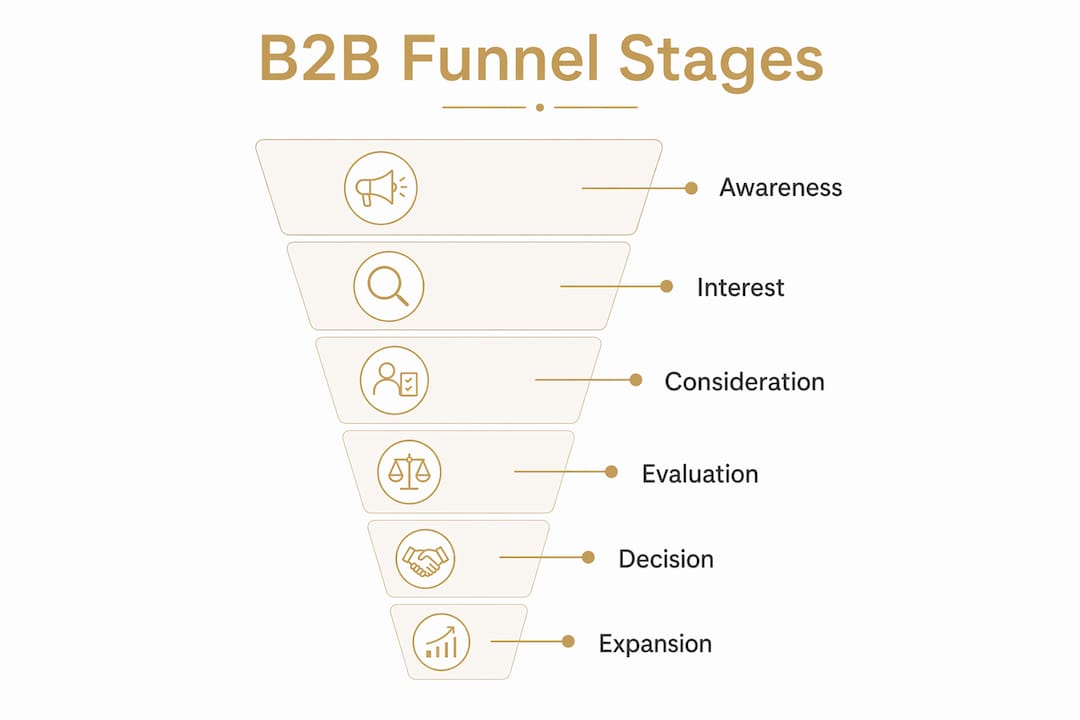
The B2B conversion funnel organizes the buyer’s journey into stages, with the prospect pool narrowing at each phase as buyers move closer to a purchase decision. Typical B2B funnel stages include Awareness, Interest, Consideration, Evaluation, Decision, and Expansion. Each stage reflects a distinct buyer mindset and requires a different response from your marketing and sales teams.
Top of funnel: awareness and interest
Awareness is where prospects first encounter your brand, usually through search, social content, paid ads, or referrals. At this stage, buyers are not ready to talk to sales. They are researching a problem. The right content here is educational: blog posts, industry reports, and short-form video that answers the questions they are already asking.

Interest follows when a prospect engages more deliberately, perhaps downloading a guide or signing up for a newsletter. This signals they recognize the problem and are actively looking for solutions. Marketing automation and lead scoring tools help identify these signals so your team can prioritize follow-up.
Middle of funnel: consideration and evaluation
Consideration is where the buyer compares options. They are reading case studies, attending webinars, and requesting demos. Most effective B2B funnels have 5–7 stages that match distinct buyer mindsets, and the middle stages are where most deals are won or lost. Your content must address specific objections and prove measurable value.
Evaluation is the most sales-intensive stage. Procurement teams run vendor assessments, finance reviews pricing, and legal checks contracts. Sales reps need to be responsive, specific, and ready to customize proposals.
Bottom of funnel: decision and expansion
Decision is the purchase moment, but it rarely involves just one person. After the deal closes, expansion covers upsells, renewals, and referrals. Retention-focused content and customer success programs keep accounts active and growing.
Pro Tip: Map a specific content asset to each funnel stage before you build your next campaign. A mismatch between content depth and buyer readiness is the most common reason qualified leads go cold.
How does the B2B funnel differ from the sales pipeline?
B2B marketers often confuse the conversion funnel with the sales pipeline. They are related but not the same. The B2B marketing funnel tracks the buyer’s end-to-end journey across both marketing and sales touchpoints. The sales pipeline tracks what the sales team does internally: calls made, proposals sent, deals staged.
The practical difference matters for measurement. Funnel metrics tell you where buyers drop off and why. Pipeline metrics tell you where your sales reps are spending time. You need both views to diagnose problems accurately.
Dimension | B2B conversion funnel | Sales pipeline |
|---|---|---|
Perspective | Buyer-focused | Seller-focused |
Scope | Marketing and sales combined | Sales team activities only |
Key metrics | Stage conversion rates, drop-off points | Deal velocity, win rate, pipeline value |
Primary use | Diagnosing buyer behavior | Forecasting revenue |
Managed by | Marketing and sales together | Sales team and CRM |
A company with a healthy pipeline but a leaky funnel will keep losing leads before they ever reach a sales rep. Fixing the funnel first makes every pipeline dollar work harder.
What unique challenges define the B2B conversion funnel?
The B2B funnel is structurally more complex than its B2C counterpart. B2B sales cycles typically span 3–12 months and involve an average buying committee of 8–13 decision-makers. That combination of time and stakeholder count creates friction at every stage.
The buying committee challenge is the one most teams underestimate. B2B buying committees include procurement, finance, operations, and executives, each with different priorities and success criteria. A message that resonates with a VP of Operations may actively alienate a CFO focused on cost reduction. You need content and conversations tailored to each role.
The non-linear journey compounds the problem. Modern B2B buyer journeys are iterative, with prospects looping back to earlier stages or pausing entirely when internal priorities shift. A prospect who attended your demo last quarter may re-enter the funnel at the Consideration stage six months later with a new budget cycle.
Three practical approaches address these challenges directly:
Multi-stakeholder content: Create separate content tracks for economic buyers, technical evaluators, and end users. A one-size pitch fails all three.
Long-cycle nurturing: Use email sequences and retargeting to stay visible during the months when a prospect is not actively evaluating. Deals often go to the vendor who stayed present.
CRM integration: Tag prospects by funnel stage and buying committee role so sales reps always know the full context before a call.
Pro Tip: Build a “champion kit” for the internal advocate at each target account. Give them the data, case studies, and ROI calculations they need to sell your solution internally. Your champion does more selling than your reps ever will.
How do you optimize a B2B conversion funnel to increase conversions?
Funnel optimization starts with measurement. Successful B2B funnel optimization requires mapping funnel stages, tracking stage-specific conversion rates, and aligning marketing and sales around clear qualification criteria. Without that baseline, you are guessing at where to fix things.
B2B SaaS conversion benchmarks give a useful reference point: visitor-to-lead runs around 1.4%, lead-to-MQL around 40%, MQL-to-SQL around 38%, SQL-to-opportunity around 44%, and opportunity-to-customer around 30–40%. These numbers show where the real attrition happens. Most B2B funnels lose the majority of potential revenue between visitor and MQL, not between SQL and close.
Here is a practical optimization sequence:
Define stage exit criteria. A lead should not advance to MQL without meeting specific behavioral or demographic thresholds. Vague definitions create inflated pipeline numbers and wasted sales time.
Audit your content gaps. Map every piece of content to a funnel stage. Most B2B companies are over-indexed on awareness content and thin on Evaluation-stage assets like ROI calculators and competitive comparison guides.
Measure drop-off at each transition. If your MQL-to-SQL rate is well below 38%, the problem is likely lead quality or a misaligned handoff process between marketing and sales.
Align sales and marketing on lead definitions. The MQL and SQL definitions must be agreed upon by both teams and reviewed quarterly. Misaligned definitions are the single most common cause of funnel inefficiency.
Test messaging by stakeholder role. Run A/B tests on email subject lines and landing page copy segmented by job title. Role-specific messaging consistently outperforms generic copy in B2B contexts.
The goal is not a perfect funnel on day one. The goal is a funnel you can measure, so you can improve it systematically over time.
Key Takeaways
A well-defined B2B conversion funnel, built around buyer mindset stages and multi-stakeholder dynamics, is the clearest path to predictable revenue growth.
Point | Details |
|---|---|
Define funnel stages clearly | Map 5–7 stages tied to buyer mindset, not just sales activities. |
Separate funnel from pipeline | Use the funnel for buyer behavior insights and the pipeline for sales forecasting. |
Address the buying committee | Create tailored content for each decision-maker role to accelerate consensus. |
Track stage-specific conversion rates | Benchmark against industry data to find and fix your biggest drop-off points. |
Design for non-linear journeys | Build nurturing sequences that re-engage prospects who pause or loop back. |
Why most B2B funnels fail before they even start
Most B2B teams I have worked with build their funnel backward. They start with the sales pipeline, label the stages, and call it a funnel. The result is a seller-centric model that tracks what reps do, not what buyers need. That gap is where deals die.
The insight that changed how I think about this: the funnel is not a sales tool. It is a buyer behavior model that sales and marketing both serve. When you treat it that way, the whole system shifts. Marketing stops handing off “leads” and starts handing off context. Sales stops pitching and starts advising.
The non-linear reality of B2B buying is the other piece most teams ignore. A prospect who goes quiet is not lost. They are often mid-committee, waiting for budget approval, or dealing with a competing internal priority. The teams that win are the ones who stay present and useful during that silence, not the ones who mark the lead as dead after 30 days.
The future of B2B funnel strategy is less about the funnel shape and more about the data layer underneath it. Companies that connect CRM data, intent signals, and content engagement into a single view of each account will outperform those running disconnected tools. That integration is not optional anymore. It is the baseline for competing in complex B2B sales.
— Mieke
How Flockleads supports B2B lead flow and funnel performance
Building a funnel is one thing. Filling it with qualified prospects is another. Flockleads is built specifically for service-based B2B businesses that need a consistent, measurable flow of leads arriving at their website.
Flockleads maps your lead generation funnel to your specific buyer journey, so every stage has the right volume of prospects moving through it. The platform connects lead flow directly to your conversion goals, giving you visibility into where leads come from and how they progress. If you want to see how this works for your business type, Flockleads shows exactly which service businesses benefit most from engineered lead flow.
Frequently asked questions
What is a B2B conversion funnel?
A B2B conversion funnel is the structured sequence of stages a business prospect moves through, from first awareness of your brand to becoming a paying customer. Each stage requires distinct marketing and sales tactics aligned to the buyer’s mindset at that point.
How many stages does a B2B sales funnel have?
Most effective B2B funnels have 5–7 stages, typically covering Awareness, Interest, Consideration, Evaluation, Decision, and Expansion. The exact number depends on your sales cycle complexity and buying committee size.
What is a typical B2B conversion rate?
B2B SaaS benchmarks show visitor-to-lead conversion around 1.4%, with MQL-to-SQL rates near 38% and opportunity-to-customer rates between 30–40%. These vary significantly by industry and deal size.
How long does a B2B sales cycle take?
B2B sales cycles typically run 3–12 months, depending on deal complexity and the number of stakeholders involved. Larger buying committees and higher contract values extend the cycle further.
What is the difference between a funnel and a pipeline?
The funnel tracks the buyer’s journey across all marketing and sales touchpoints. The pipeline tracks the sales team’s internal deal activities. Both are necessary, but they answer different questions about where revenue is being won or lost.
NEED A CLEARER PLAN?
Let’s turn your next move into momentum.
Talk to us →