THE SHORT ANSWER
A business website funnel is a deliberately engineered path on your site that limits choices and guides qualified B2B prospects toward one conversion goal: a lead form, demo request, or trial signup. Unlike a general website, every page, headline, and button in a funnel serves a single purpose.
A business website funnel is a deliberately engineered path on your site that limits choices and guides qualified B2B prospects toward one conversion goal: a lead form, demo request, or trial signup. Unlike a general website, every page, headline, and button in a funnel serves a single purpose. The payoff for B2B owners is twofold: higher lead quality because only motivated prospects complete the steps, and full visibility into exactly where people drop off so you can fix the right problem.
Funnels also connect your paid ad spend directly to your CRM. A prospect clicks a LinkedIn ad, lands on a focused page, fills out a qualifying form, and lands in your pipeline within minutes. That closed loop is what separates a funnel from a brochure site.
What a B2B website funnel delivers:
Qualified leads routed directly to your CRM, not a generic inbox
Clear drop-off data so you know which step is costing you conversions
A measurable cost-per-lead tied to specific campaigns and ad creative
How does a funnel differ from a regular website?
A standard website is an information storefront. It answers “who are you?” and lets visitors wander. A funnel is an engineered path with one destination. That distinction shapes everything from the navigation (funnels often remove it entirely) to the measurement model.
“Funnels intentionally limit choices to guide visitors toward a specific conversion goal — they are a buyer-centric conversation, not an information archive.” — TechTarget
Here is what that looks like in practice. A B2B buyer clicks a Google ad for “commercial HVAC maintenance contracts.” On a generic site, they land on a homepage with eight navigation links, a blog, and a contact page buried in the footer. On a funnel, they land on a page with one headline matching the ad, three bullet points on the service, and a form asking for company size and zip code. The generic site might get a 1–2% contact rate. The funnel, because it removes friction and matches intent, routinely outperforms that.
As Salesforce explains, a sales funnel tracks the customer journey from awareness to action and highlights exactly where prospects drop off. That diagnostic capability alone makes it worth building.
What components does every B2B funnel need?
No funnel works without all of these in place:
Targeted landing page: One offer, one audience, no navigation links pulling visitors away
Single CTA: One action per page — “Request a Demo,” “Get Your Free Audit,” not both
Lead form with qualification fields: Company size, industry, budget range, or timeline — fields that let your sales team prioritize before they pick up the phone
Thank-you/confirmation page: Confirms receipt, sets expectations, and can offer a secondary conversion (book a call, download a resource)
CRM integration: Leads route automatically to HubSpot, Salesforce, or your CRM of choice with source data attached
Email nurture sequence: A 3–5 email cadence that keeps warm leads engaged while your team follows up
GA4 tracking and UTM structure: Every ad click tagged, every form submission recorded as a GA4 conversion event
Ad creative: Matched in message and visual style to the landing page so the experience feels continuous
A common tech stack for a mid-market B2B company: Unbounce or Webflow for landing pages, HubSpot for CRM and email, GA4 for analytics, and Meta or LinkedIn for paid traffic. When budget is tight, prioritize the landing page and CRM integration first. Tracking and nurture can be layered in after you have your first leads flowing.
Pro Tip: Match your ad headline to your landing page headline word-for-word. This single change, called message match, is one of the fastest ways to lift conversion rates without touching anything else.

What happens at each funnel stage for B2B buyers?
The three stages — TOFU (top of funnel), MOFU (middle), and BOFU (bottom) — each require a different offer and a different measure of success.
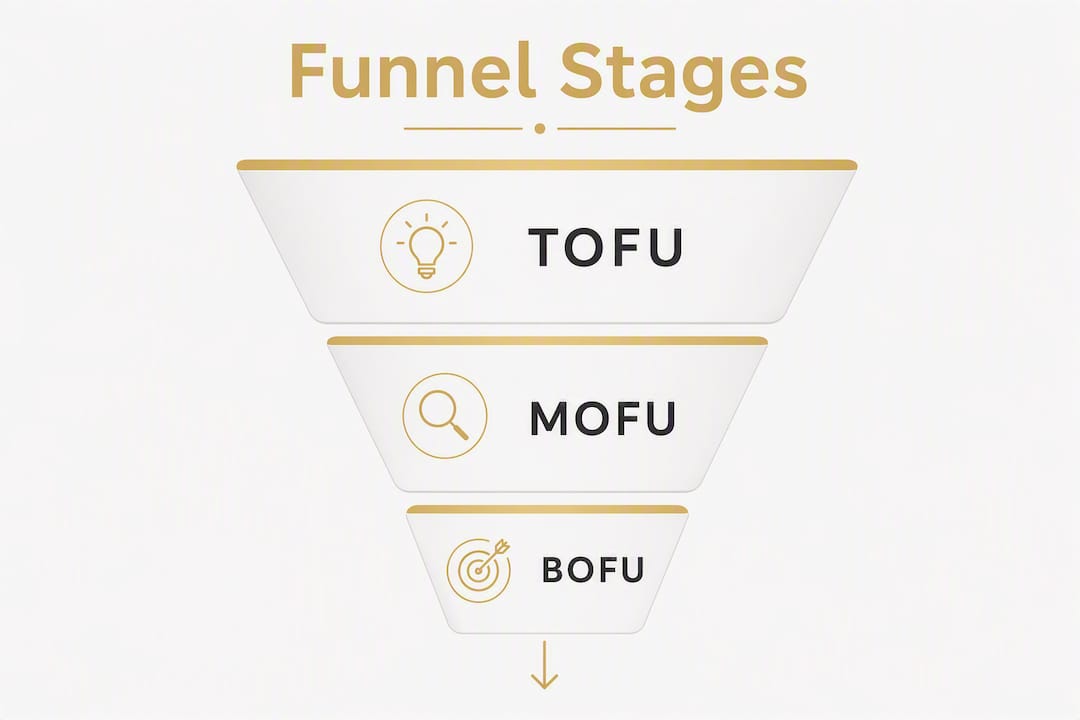
HubSpot’s research shows that most website visitors are not ready to buy on a first visit. That makes TOFU the stage where you trade value for contact information, not where you pitch.
TOFU (awareness): The buyer has a problem but no vendor in mind. Your job is to earn their email. Offers that work: a whitepaper on industry benchmarks, a free audit, or a short diagnostic tool. Conversion goal: form fill.
MOFU (consideration): The buyer is evaluating options. They need proof that your approach works. Offers: a product demo, a case study, or an ROI calculator. Conversion goal: demo booked or sales call scheduled. This is also where nurture sequences matter most — B2B buying cycles can often run several months, and a weekly email cadence keeps you visible without requiring your sales team to manually follow up with every lead.
BOFU (decision): The buyer is comparing vendors and needs a reason to choose you. Offers: a free trial, a proposal, or a limited-time incentive. Conversion goal: signed contract or trial activation.
Retargeting ads on Meta and LinkedIn are the mechanical link between stages. A visitor who downloaded your whitepaper but did not book a demo gets served a case study ad. That ad sends them back into the MOFU page, not your homepage.
Which metrics actually tell you if your funnel is working?
Behavior tracking and analytics are what separate a high-performing funnel from a static site. Here are the KPIs that drive decisions:
KPI | Why it matters | How to measure it |
|---|---|---|
Landing page conversion rate | Shows whether your offer and copy are resonating | GA4 conversion events, Unbounce analytics |
Form completion rate | Reveals friction in your lead capture step | GA4 form interaction events |
Cost-per-lead (CPL) | Ties ad spend to lead volume | Ad platform + CRM data |
MQL-to-SQL rate | Measures lead quality, not just quantity | CRM pipeline stages |
Drop-off by step | Pinpoints the exact page losing prospects | GA4 funnel exploration report |
Time-to-first-contact | Affects close rates — faster is better | CRM timestamp fields |
Pro Tip: Set up UTM parameters on every ad link before you launch. Without them, GA4 cannot tell you which campaign, ad set, or creative produced each lead — and you will optimize blind. Use lead source attribution to connect every closed deal back to its originating campaign.
How do you build a B2B funnel from scratch?
Follow these steps in order. Skipping ahead to design before you have mapped the buyer journey is the most common reason funnels underperform.
Map the buyer journey. Define who the buyer is, what problem they have at each stage, and what question they need answered before they move forward.
Define your offer. One offer per funnel. A free audit, a demo, a report — pick one and build around it.
Design the landing page. One headline, one sub-headline, three to five benefit bullets, a form, and nothing else. Remove navigation.
Build the lead form. Include 3–5 qualification fields. More than several fields typically reduces completions without improving quality.
Integrate your CRM. Map every form field to a CRM property. Set up instant lead notification for your sales team.
Install tracking. GA4 events for page view, form start, form submit, and thank-you page. Add UTM parameters to every ad URL.
Launch ads. Start with one channel and one audience. LinkedIn works well for B2B titles; Google captures active searchers.
Monitor and iterate. Review weekly for the first 60 days. Look at drop-off by step and CPL before changing creative.
For A/B testing, start with the landing page headline. It has the highest leverage of any single element. Test a feature statement against a benefit statement (“24/7 HVAC Maintenance” vs. “Never Lose a Tenant to a Broken System”). Run each variant for at least 200 visitors before calling a winner.
What does a B2B funnel cost and how long until you see leads?
Most B2B companies see their first usable leads within a few weeks of launch, assuming the landing page, form, and ad campaigns are live from day one. The build phase is usually the bottleneck, not the ad platform.
Approach | Build time | Setup cost | Monthly cost | Best for |
|---|---|---|---|---|
DIY | Several weeks | Moderate setup cost | Moderate monthly ad spend | Teams with in-house design and CRM skills |
Agency | Few weeks | Higher setup cost | Higher monthly retainer and ad spend | Companies wanting custom creative and strategy |
Managed service | Short build time | Low or included setup cost | Subscription plus ad spend | B2B owners who want leads without managing campaigns |
Timeline phases: build and QA (weeks 1–2), initial data collection (weeks 3–6), first optimization cycle (weeks 7–10). Expect CPL to drop meaningfully after the first optimization cycle once you have enough data to cut underperforming ad sets.
What mistakes kill B2B funnels before they start?
Most funnel failures trace back to a short list of fixable problems:
No nurture sequence: A lead who does not hear from you within 24 hours is 10 times less likely to convert. Set up at least a 3-email automated sequence before you launch.
Weak qualification fields: Asking only for name and email fills your CRM with unqualified contacts. Add company size or budget range to filter out poor fits early.
No tracking: Without GA4 events and UTM tags, you cannot tell which ad produced which lead. Fix this before spending a dollar on ads.
Long forms: Every field above five reduces completions. Start with the minimum needed to qualify, then add fields after you have volume.
Ad-to-landing mismatch: If your ad says “Free HVAC Audit” and your landing page talks about maintenance contracts, visitors leave. Match the message exactly.
For a quick A/B test with fast results, reduce your form from seven fields to four and measure the change in completion rate over two weeks. Improving landing page conversion is often the fastest lever available before touching ad spend.
When tracking breaks at the server level (form submissions not firing, CRM not receiving source data), that is the point to bring in a technical resource. Client-side GA4 tags miss a meaningful share of conversions due to ad blockers; server-side event tracking closes that gap.
How Flockleads applies this to generate qualified B2B leads
Flockleads builds and manages the full funnel stack for B2B companies: ad campaigns across Meta, LinkedIn, Google, and TikTok; qualifying lead forms mapped to your CRM; and weekly optimization cycles based on live performance data. The model is designed so you receive leads, not a project to manage.
“Capturing a lead is only the first step. The funnel has to keep working after the form submit — through nurture, qualification, and CRM routing — or the ad spend is wasted.” — HubSpot
A typical Flockleads engagement for a B2B service company looks like this: sector-specific ad creative launches in week one, a qualifying form filters by company size and geography, and leads arrive in the client’s CRM within minutes of submission. The in-house team handles sales calls. Flockleads handles everything upstream.
What an in-house team would need to replicate this: a landing page builder, a CRM, an ad account manager, a copywriter for ongoing creative, a tracking setup, and a weekly analytics review. That is a part-time role at minimum.
For more on how B2B lead generation differs from consumer campaigns, and why the funnel architecture needs to reflect that, the Flockleads resource library covers the mechanics in detail.
Key Takeaways
A B2B website funnel works when it combines a single clear offer, a qualifying form, CRM integration, and tracked ad campaigns into one measurable system.
Point | Details |
|---|---|
Funnel vs. website | A funnel limits choices and engineers one conversion path; a website is an information resource. |
Core components | You need a landing page, single CTA, qualifying form, CRM integration, nurture sequence, and GA4 tracking. |
Stage-matched offers | TOFU earns the email; MOFU books the demo; BOFU closes the contract. |
Measure what matters | Track CPL, drop-off by step, and MQL-to-SQL rate before optimizing creative. |
Flockleads | Flockleads manages the full funnel stack — ads, forms, CRM routing, and weekly optimization — so B2B owners receive qualified leads without running the campaigns themselves. |
Why most B2B owners underestimate what a funnel actually requires
The conventional wisdom is that a funnel is a landing page with a form. Build it, run some ads, and leads appear. That framing is why so many B2B owners spend $3,000 on a landing page and wonder why nothing comes in.
The part that gets skipped is the middle. MOFU is where B2B deals are actually won or lost. A prospect who downloaded your whitepaper in January and never heard from you again did not become a customer. They became a competitor’s customer. The nurture sequence, the retargeting ads, the follow-up email cadence — these are not optional extras. They are the funnel.
The other thing most articles do not say plainly: funnels are measurement tools, not persuasion machines. You cannot force a prospect through a funnel. What you can do is remove every obstacle between their interest and your form, then use the data to find the next obstacle. That iterative process, done weekly, is what compounds into a reliable lead engine over 90 days.
Flockleads builds the funnel so you can focus on closing
Most B2B owners know they need a funnel. The gap is execution: the ad accounts, the qualifying forms, the CRM mapping, the weekly data review. Flockleads handles that entire system under a monthly subscription, with no agency retainer and no long-term lock-in.
You get qualified leads delivered directly to your CRM, sourced from campaigns across LinkedIn, Meta, Google, and TikTok, with every lead traceable to the ad that produced it. The first step is a free audit of your current setup — what is working, where leads are leaking, and what a funnel built for your sector would look like. Start with a free audit at Flockleads and see what a managed lead engine looks like for your business.
Useful sources
Salesforce: What Is a Sales Funnel? — Authoritative definition and stage breakdown with CRM context
HubSpot: What Is a Sales Funnel? — Covers nurture sequences, MOFU strategy, and modern funnel models
TechTarget: Sales Funnel Definition — Clear explanation of funnel intent and architecture vs. a standard website
Crazy Egg: Website Conversion Funnel — Practical guide to diagnosing drop-off and improving conversion rates
Google Analytics 4 (GA4) Documentation — Setup reference for funnel tracking, events, and conversion reporting
Flockleads: B2B Lead Generation Resources — Sector-specific funnel strategy, paid traffic guides, and lead generation playbooks
Frequently asked questions
What is a business website funnel in simple terms?
A business website funnel is a structured path on your site that guides visitors toward one specific action, such as filling out a lead form or booking a demo, while filtering out unqualified prospects along the way.
How is a funnel different from a regular website?
A regular website shares information and lets visitors browse freely. A funnel removes navigation, limits choices, and focuses every element on a single conversion goal, which is why funnels consistently outperform general websites for lead generation.
How long does it take to get leads from a B2B funnel?
Most B2B companies see their first usable leads within a few weeks of launch, assuming the landing page, form, and ad campaigns are live from day one.
Which metrics should I track first in a new funnel?
Start with landing page conversion rate, form completion rate, and cost-per-lead. These three numbers tell you whether your offer is resonating, where friction exists, and what each lead is actually costing you.
Can Flockleads build and manage a B2B funnel for my business?
Yes. Flockleads manages the full funnel system, including ad campaigns, qualifying forms, CRM integration, and weekly optimization, delivering qualified leads directly to your pipeline under a monthly subscription model.
NEED A CLEARER PLAN?
Let’s turn your next move into momentum.
Talk to us →