THE SHORT ANSWER
A lead generation funnel is the systematic framework businesses use to attract, engage, and convert anonymous visitors into qualified leads. Unlike a general sales funnel, which tracks the full buyer journey to purchase, a lead generation funnel focuses specifically on the earlier stages: capturing interest and producing prospects your sales team can actually work with.
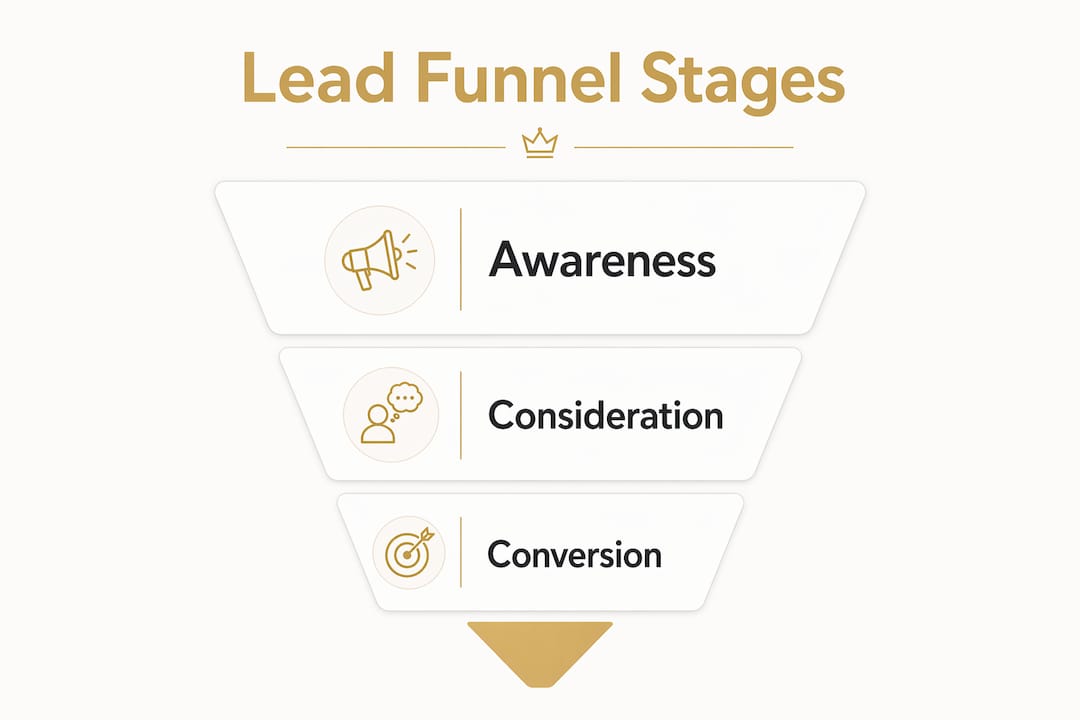
A lead generation funnel is the systematic framework businesses use to attract, engage, and convert anonymous visitors into qualified leads. Unlike a general sales funnel, which tracks the full buyer journey to purchase, a lead generation funnel focuses specifically on the earlier stages: capturing interest and producing prospects your sales team can actually work with. The three core phases are awareness, evaluation, and conversion to lead. Every B2B company running paid ads, publishing content, or working with an agency is operating inside this structure, whether they know it or not.
What is a lead generation funnel and how does it work?
A lead generation funnel is a structured process that moves prospects from first contact to a point where they are ready to talk to sales. The word “funnel” reflects a simple reality: many people enter at the top, fewer reach the middle, and fewer still convert at the bottom. That narrowing is not a failure. It is the system working correctly, filtering out poor fits and surfacing genuine prospects.
The funnel sits inside the broader concept of a sales funnel, but it stops before the purchase decision. Its job is to hand a qualified lead to your sales team, not to close the deal. This distinction matters because the content, channels, and metrics you use at each stage are completely different from those used in late-stage selling.

Content alignment with each funnel stage is what separates high-performing funnels from ones that generate volume but no revenue. A prospect reading a blog post for the first time needs something different from a prospect who has already downloaded your pricing guide. Treating both the same way is the most common funnel mistake.
What are the main stages of a lead generation funnel?
Top of funnel: building awareness
The top of funnel (TOFU) is where prospects first encounter your brand. The goal here is visibility, not conversion. Educational blog posts, LinkedIn content, YouTube videos, and paid display ads all serve this stage. You are answering questions your ideal customer is already asking, before they know your company exists.
Organic SEO is the most cost-effective TOFU channel over time. A well-ranked article keeps generating traffic for years without additional spend. Paid advertising on Google or LinkedIn delivers faster results but stops the moment your budget does.
Middle of funnel: earning consideration
The middle of funnel (MOFU) is where interest becomes intent. Prospects here have a problem they are actively trying to solve. They compare options, read case studies, and look for proof that your solution works. Webinars, comparison guides, email sequences, and gated white papers all perform well at this stage.
This is also where lead qualification begins. Asking the right questions through forms, chatbots, or discovery calls helps you separate serious buyers from casual browsers. Wasting sales time on unqualified leads is expensive, and MOFU is where you prevent it.
Pro Tip: Gate your best MOFU content behind a short form that asks for company size and role. You will collect fewer submissions but far better leads.
Bottom of funnel: converting to a lead
The bottom of funnel (BOFU) is where a prospect takes a direct action: booking a demo, requesting a quote, or filling out a contact form. The friction here must be minimal. Long forms, slow pages, and unclear calls to action all kill conversions at the final step.
Friction removal tactics at the BOFU stage include single-field forms, social proof near the CTA, and clear statements of what happens after submission. Prospects at this stage have already decided they want help. Your job is to make it easy for them to ask for it.
How do lead generation agencies fit into funnel management?
Lead generation agencies extend internal sales and marketing teams by managing prospecting, multi-channel outreach, and lead qualification to deliver meeting-ready leads. For most B2B companies, building this infrastructure in-house takes months and requires specialized skills that are hard to hire for. An agency brings that infrastructure on day one.
A well-run agency handles the following:
Ideal customer profile (ICP) development. The agency defines exactly who you are targeting based on industry, company size, role, and buying signals.
Multi-channel outreach. Email sequences, LinkedIn prospecting, and cold calling run in parallel to maximize contact rates.
Lead qualification. Agencies apply BANT criteria (budget, authority, needs, and timeline) to filter out poor fits before a lead ever reaches your sales team.
CRM enrichment. Qualified leads arrive with context: company data, conversation history, and intent signals already attached.
Reporting and iteration. Agencies track response rates, conversion rates, and meeting show rates to refine outreach continuously.
The result is a sales team that spends its time closing, not prospecting. That shift alone can dramatically improve revenue per sales rep.
Pro Tip: When evaluating a lead generation agency, ask specifically how they define a “qualified lead” before signing anything. Vague definitions produce volume without value.
Lead generation specialists within these agencies balance research, outreach crafting, and analytics to keep campaigns performing. The best ones treat every campaign as a live experiment, adjusting messaging based on reply rates and meeting conversion data week over week.
What are the best strategies for an effective lead funnel?
Balancing paid and organic channels
Paid channels like Google and LinkedIn ads offer immediate traffic and testing speed, while organic SEO provides sustainable compound traffic benefits. The right mix depends on your timeline and budget. If you need leads in 30 days, paid advertising gets you there. If you are building for 18 months from now, organic content is the better investment.
The mistake most B2B marketers make is treating paid and organic as competing priorities. They work best together. Paid ads test which messages resonate fastest. Organic content then scales the winners without ongoing ad spend. Running both in parallel is how you generate leads through paid advertising while building a traffic base that does not disappear when your budget does.
Automation and nurturing sequences
High-performing funnels use automation for nurturing sequences that send the right content at the right time, improving engagement and conversion. A prospect who downloads a white paper but does not book a call is not lost. An automated email sequence over the next two weeks can bring them back.
Effective nurturing sequences share three traits:
They reference the specific action the prospect took (the download, the page visit, the webinar attendance).
They deliver value in each email before asking for anything.
They escalate the ask gradually, moving from content to conversation to demo request.
Generic drip campaigns that ignore prospect behavior produce low open rates and high unsubscribes. Behavioral triggers are what separate nurturing that converts from nurturing that annoys.
Speed as a conversion factor
Speed in lead follow-up is not a nice-to-have. Contacting leads within five minutes makes them 21 times more likely to qualify than contact after 30 minutes. That number comes from a Harvard Business Review study, and it holds up in practice. The prospect’s intent is highest the moment they submit a form. Every minute of delay lets that intent cool.
Automation handles the first touch instantly: a confirmation email, a calendar link, or a chatbot response. Human follow-up within the same business hour closes the gap between automation and genuine conversation.
What metrics reveal how well your funnel is performing?
Funnel performance is measured at each stage transition, not just at the final conversion. A funnel that converts 3% of visitors to leads looks identical from the outside whether it is losing people at TOFU, MOFU, or BOFU. Stage-by-stage data tells you exactly where to fix it.
The metrics that matter most:
TOFU conversion rate: the percentage of visitors who take any engagement action (click, scroll depth, time on page).
MOFU conversion rate: the percentage of engaged visitors who submit a form or enter a nurture sequence.
BOFU conversion rate: the percentage of nurtured prospects who request a demo or direct contact.
Lead qualification rate: the percentage of submitted leads that meet your ICP and BANT criteria.
Response time: measured in minutes from form submission to first human contact.
Pro Tip: If your MOFU conversion rate is strong but your BOFU rate is weak, the problem is almost always friction at the conversion step, not the quality of your leads. Simplify the form and sharpen the CTA before changing anything else.
Using data to refine outreach messages is equally important. Low email open rates signal a subject line problem. Low reply rates signal a message relevance problem. Low meeting show rates signal a qualification problem. Each metric points to a specific fix, which is why tracking all of them separately matters.
Key Takeaways
A lead generation funnel converts anonymous visitors into qualified leads through three structured stages: awareness, consideration, and conversion, each requiring distinct content, channels, and metrics.
Point | Details |
|---|---|
Three-stage structure | Every funnel moves prospects through awareness, evaluation, and conversion to lead. |
Content must match the stage | Educational content works at TOFU; proof and comparison content works at MOFU; friction removal works at BOFU. |
Speed determines qualification | Contacting leads within five minutes makes them 21 times more likely to qualify. |
Agencies accelerate results | Lead generation agencies apply ICP targeting, BANT qualification, and multi-channel outreach to deliver sales-ready leads. |
Paid and organic work together | Paid ads test messaging fast; organic SEO compounds that learning into sustainable traffic. |
What I have learned about funnels that most guides skip
Most funnel advice focuses on structure. The three stages, the content types, the metrics. All of that is correct and worth knowing. But after working with B2B companies across multiple industries, the pattern I see most often is not a structural problem. It is a sequencing problem.
Companies build awareness content and conversion assets, then wonder why leads do not convert. The MOFU layer is missing entirely. There is nothing to catch the prospect who is interested but not yet ready. They arrive, they look around, and they leave. No nurture sequence follows them. No comparison guide answers their objection. The funnel has a top and a bottom with a gap in the middle.
The second pattern I see constantly is treating lead volume as the primary success metric. Volume is easy to generate. Qualified volume is hard. An agency or internal team that optimizes for form submissions without applying BANT criteria will fill your CRM with contacts your sales team cannot close. That is not a lead generation win. It is a pipeline illusion.
My honest advice: build the MOFU layer first. Map the three to five objections your best customers had before they bought, then create one piece of content that addresses each one. That content becomes your middle funnel. Everything else connects to it.
— Mieke
How Flockleads builds lead flow that actually reaches your pipeline
Most B2B companies have a funnel in theory. What they lack is consistent, qualified traffic moving through it. Flockleads is built specifically to solve that problem for service businesses.
Flockleads manages multi-channel outreach, ICP targeting, and lead qualification so your sales team receives prospects who are ready to talk, not just curious. The engineered lead flow model means every lead that reaches you has been filtered against your ideal customer profile and confirmed for intent. You get a predictable pipeline instead of random inbound spikes. If you want to see how the process works from outreach to qualified meeting, the full process breakdown is worth reviewing.
Frequently asked questions
What is a lead generation funnel in simple terms?
A lead generation funnel is a structured process that moves potential customers from first awareness of your brand to the point where they are ready to speak with sales. It typically includes three stages: awareness, consideration, and conversion.
What is the difference between a lead funnel and a sales funnel?
A lead generation funnel ends when a prospect becomes a qualified lead. A sales funnel begins at that point and continues through the purchase decision. The two connect but serve different goals.
What is organic lead generation?
Organic lead generation attracts prospects through unpaid channels such as SEO, content marketing, and social media. It builds traffic over time without ongoing ad spend, making it a cost-effective long-term strategy.
What is paid lead generation?
Paid lead generation uses advertising spend on platforms like Google or LinkedIn to drive immediate traffic and leads. It delivers faster results than organic methods but requires continuous budget to maintain volume.
How does a lead generation agency help with funnel management?
A lead generation agency manages prospecting, outreach, and qualification on behalf of your business. It delivers meeting-ready leads by applying ICP targeting and BANT criteria, freeing your sales team to focus on closing.
NEED A CLEARER PLAN?
Let’s turn your next move into momentum.
Talk to us →