THE SHORT ANSWER
A marketing qualified lead (MQL) is a prospect who fits your ideal customer profile and has shown enough engagement or intent to be worth nurturing, but isn’t yet ready for a direct sales conversation. Think of it as a filter: not everyone who fills out a form or downloads a guide belongs in your sales pipeline. An MQL has cleared a meaningful bar.
A marketing qualified lead (MQL) is a prospect who fits your ideal customer profile and has shown enough engagement or intent to be worth nurturing, but isn’t yet ready for a direct sales conversation. Think of it as a filter: not everyone who fills out a form or downloads a guide belongs in your sales pipeline. An MQL has cleared a meaningful bar.
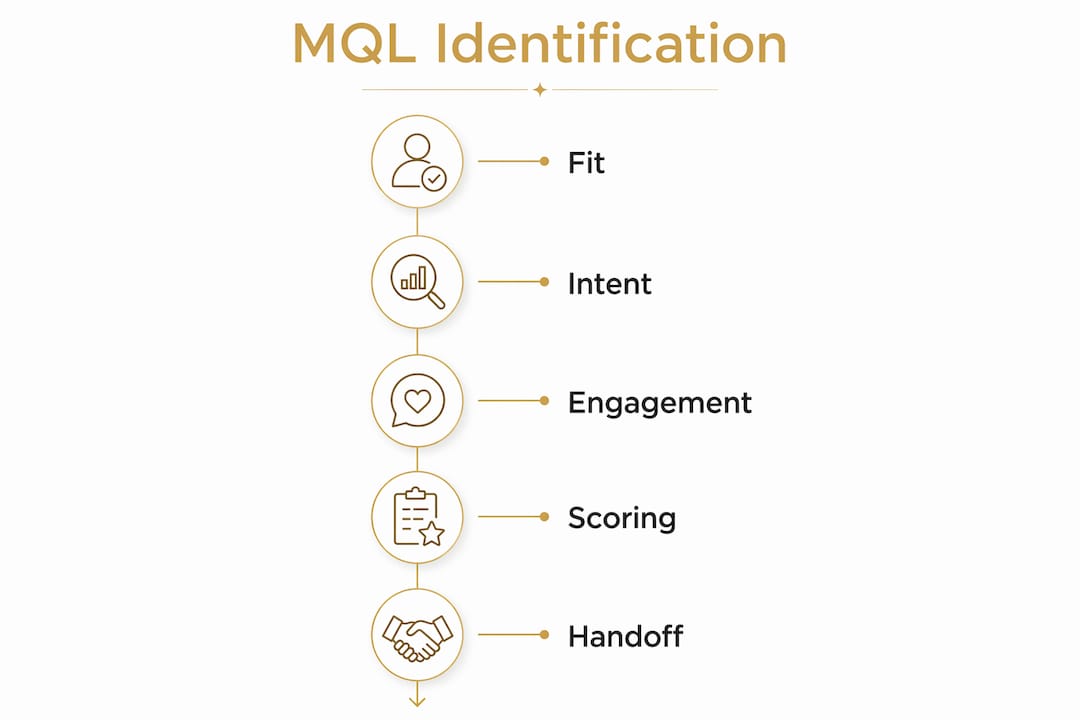
The core signals that make a lead an MQL:
Fit: matches your ICP (industry, company size, job title, geography)
Engagement: took a meaningful action (webinar attendance, repeat site visits, content downloads)
Intent: visited high-signal pages (pricing, demo request, case studies)
Score: crossed a defined point threshold in your lead scoring model
MQLs are marketing-owned. They need nurture before sales touches them. Routing them too early is one of the most common ways B2B teams burn sales capacity on leads that were never ready.
Why a shared MQL definition matters for revenue
A vague MQL definition doesn’t just cause confusion. It costs money. When marketing and sales disagree on what qualifies as an MQL, sales reps spend time on low-probability leads, pipeline forecasts become unreliable, and marketing optimizes for volume instead of quality.
A clear, shared definition fixes several problems at once:
Reduces wasted sales effort by routing only higher-probability leads to the sales team
Improves MQL-to-SQL conversion rates because the leads entering the pipeline are better matched to what sales can close
Creates a predictable pipeline that marketing can influence through campaign and content decisions
Makes optimization easier since you can trace which sources and campaigns produce MQLs that actually convert
The downstream metrics that tend to improve most are MQL-to-SQL rate, time-to-SQL (how fast a lead becomes sales-ready), and win rate. None of those move without a definition both teams agree on and revisit regularly.
How does an MQL differ from a raw lead, SQL, SAL, and opportunity?
Most B2B teams use at least four or five labels for leads at different funnel stages. The boundaries between them matter because each stage has a different owner, a different next action, and a different set of criteria.
Stage | Owner | Readiness | Typical next step | Common signals |
|---|---|---|---|---|
Raw lead | Marketing | Unvetted | Nurture or discard | Form fill, ad click, list import |
MQL | Marketing | Research-stage | Nurture sequence | ICP fit + engagement threshold |
SAL (Sales Accepted Lead) | Sales | Accepted for follow-up | Initial outreach | Sales confirms MQL criteria met |
SQL | Sales | Actively evaluated | Discovery call, demo | BANT-like criteria confirmed |
Opportunity | Sales | Qualified deal | Proposal, negotiation | Budget, timeline, decision-maker confirmed |
According to Gartner, an MQL is a potential customer that has been reviewed by the marketing team and satisfies the criteria necessary to be passed to sales. The SAL stage is the handshake: sales formally accepts or rejects the MQL before it becomes an SQL.
A common boundary case worth flagging: a lead with high engagement but the wrong ICP (say, a freelancer engaging with enterprise-focused content) is not an MQL. Engagement alone doesn’t qualify a lead. Fit and engagement together do. A vetted lead differs from a raw one precisely because it’s been checked against specific criteria, not just counted as a contact.
What signals and criteria actually identify an MQL?
The strongest MQL definitions blend three inputs: fit, intent, and engagement. When all three overlap, you have a lead worth routing. When only one or two are present, you have a lead worth nurturing.

Fit signals (firmographic and demographic)
These tell you whether the prospect belongs in your market at all:
Industry: does the company operate in a sector you serve?
Company size: headcount or revenue band that matches your ICP
Job title/role: decision-maker, influencer, or end user?
Geography: within your serviceable market
Fit signals are usually captured through form fields, enrichment tools like Clearbit or ZoomInfo, or CRM data. They’re binary: a lead either fits or it doesn’t. Prioritize the two or three firmographic factors that most strongly predict closed deals in your own data.
Behavioral engagement signals
These tell you whether the prospect is paying attention:
Downloaded a guide, whitepaper, or case study
Attended a webinar or watched a recorded demo
Visited the site more than once in a short window
Spent meaningful time on product or solution pages
Engaged with email sequences (opens plus clicks, not just opens)
Intent signals
Intent signals are a step above engagement. They suggest the prospect is actively evaluating options:
Visited the pricing page
Requested a demo or consultation
Viewed multiple case studies in one session
Arrived via a high-intent search term or competitor comparison ad
The difference between engagement and intent is specificity. Reading a blog post is engagement. Visiting the pricing page twice in a week is intent.
Rule-based vs. weighted approaches
A rule-based approach says: “A lead is an MQL if they match ICP and completed at least one of these actions.” Simple, easy to explain to sales, easy to audit. The downside is that it treats all qualifying actions as equal.
A weighted scoring model assigns different point values to different signals, which is more accurate but requires more setup. For most teams starting out, a rule-based threshold with a small number of high-signal actions is the right starting point.
Pro Tip: Start with a loose threshold, measure MQL-to-SQL conversion for 90 days, then tighten or loosen based on what actually converts. Review the definition every quarter using that data, not gut instinct.
How to build a lead scoring model that produces reliable MQLs
Lead scoring translates your MQL criteria into a number. When a lead crosses a defined threshold, it becomes an MQL. The mechanics are straightforward; the discipline is in choosing the right point values and keeping the model current.
Point categories
Every scoring model needs at least three categories:
Fit points: awarded for matching ICP criteria (firmographic, demographic)
Engagement points: awarded for content interactions and site behavior
Intent points: awarded for high-signal actions that suggest active evaluation
Negative/decay rules: deduct points for disqualifying signals (wrong industry, unsubscribed, no activity in 60 days)
Example scoring matrix
Signal | Points |
|---|---|
Company size >50 employees | +10 |
Job title matches ICP (director level or above) | +15 |
Industry matches target verticals | +10 |
Visited pricing page | +15 |
Downloaded case study | +10 |
Attended webinar | +20 |
Requested demo | +20 |
Opened 3+ emails in sequence | +5 |
Wrong industry | −20 |
No activity in 60 days | −10 |
MQL threshold | 50 points |
This scoring structure comes from a practical scoring example where pricing page visits, case study downloads, and webinar attendance each carry distinct weights, with a 50-point threshold triggering MQL status.
Worked example
A prospect fills out a form identifying as a director at a 75-person SaaS company in your target vertical. That’s +10 (company size) + +15 (title) + +10 (industry) = 35 points. They then download a case study (+10) and attend a webinar (+20). Total: 65 points. They cross the 50-point threshold after the webinar and become an MQL.
Pro Tip: Push leads to your CRM only after deduplication and basic enrichment. A scoring model built on duplicate or incomplete records produces false MQLs. Tools like HubSpot, Salesforce, or Marketo all support enrichment integrations that run before a lead enters the scoring queue.
How to design the MQL-to-sales handoff
The handoff is where most MQL programs break down. Marketing routes a lead; sales ignores it or rejects it without explanation. Without a formal process, that cycle repeats indefinitely.

A working handoff requires three things: a service-level agreement (SLA), clear acceptance criteria, and a feedback loop.
SLA items to define
Response time: sales must attempt first contact within a defined window (commonly 24 hours for MQLs, faster for high-intent leads)
Contact method: first touch by phone, email, or LinkedIn, depending on the lead’s channel preference
Acceptance window: sales has a set number of business days to accept or reject an MQL before it escalates
Rejection reasons: a short, standardized list (wrong ICP, duplicate, no contact info, already a customer) so marketing can track patterns
Acceptance criteria for sales
Sales should confirm at minimum:
Lead meets the scoring threshold and hasn’t decayed
Contact information is complete and accurate
At least one recent intent behavior is present (pricing page, demo request, or similar)
No open opportunity or active deal already exists in the CRM
Feedback loop mechanics
The feedback loop is what keeps the MQL definition honest. Without it, marketing optimizes for MQL volume and sales quietly stops working the leads.
Log rejection reasons in the CRM on every rejected MQL
Run a monthly joint review: marketing and sales look at acceptance rate, rejection reasons, and MQL-to-SQL conversion by source
Adjust scoring weights or threshold based on what the data shows, not what either team prefers
Quarterly reviews of the MQL definition using conversion data are the single highest-leverage habit a B2B team can build. Misalignment on definitions is the most common pitfall, and it compounds over time when left unaddressed.
A healthy MQL acceptance rate is generally considered good when most MQLs are accepted by sales. If sales rejects a large share of MQLs, the definition needs tightening. If nearly all are accepted but win rates are low, the threshold may be too loose.
How to nurture MQLs before they’re sales-ready
MQLs are in research mode. They’re evaluating options, building a business case, or waiting for internal approval. Pushing a hard sales pitch at this stage usually kills the opportunity. The goal of nurture is to stay visible, build credibility, and surface intent signals that tell you when the lead is ready.
Content that works for research-stage MQLs
Case studies: specific, outcome-focused, ideally in the prospect’s industry
Problem-focused guides: address the pain the prospect is trying to solve, not just your product features
ROI calculators: help the prospect build an internal business case
On-demand demos: let them evaluate at their own pace without a sales call
Channel guidance
Email nurture sequences are the backbone. Retargeting ads (LinkedIn, Meta) reinforce the message between emails. Webinar invitations work well for mid-funnel MQLs who are still comparing options. Social proof, such as customer logos and review snippets, belongs on landing pages the MQL is likely to revisit.
Example nurture flow
Step | Timing | Content | CTA |
|---|---|---|---|
1 | Day 1 | Welcome email + relevant guide | Download the guide |
2 | Day 3 | Industry case study | Read the full story |
3 | Day 7 | Problem-focused blog post | Learn more |
4 | Day 10 | ROI calculator or checklist | Calculate your results |
5 | Day 15 | Webinar invitation or on-demand demo | Register / Watch now |
6 | — | Soft sales touch (if intent signals present) | Book a call |
Pro Tip: Don’t wait for step 6 if a lead visits the pricing page twice or requests a demo mid-sequence. Those are fast-track signals. Route immediately to sales with a note flagging the specific intent behavior.
How do you measure MQL quality and pipeline impact?
Volume is the wrong metric to optimize for. A program that produces 500 MQLs per month with a 5% MQL-to-SQL rate is less valuable than one producing 150 MQLs with a 40% rate. Quality is what matters, and quality requires specific metrics.
Core metrics to track
MQL volume: total MQLs generated per period, segmented by source and campaign
MQL-to-SQL conversion rate: percentage of MQLs that sales accepts and advances
Time-to-SQL: average days from MQL creation to SQL status
MQL-to-close (win) rate: percentage of MQLs that eventually become customers
Cost-per-MQL: total marketing spend divided by MQLs generated
Pipeline influence: total pipeline value attributable to MQL-sourced leads
Benchmark ranges
MQL-to-SQL conversion rates vary significantly by industry, deal size, and how tightly the MQL definition is drawn. Programs with well-optimized ICP definitions generally see higher conversion rates. Time-to-SQL typically ranges from a few days for high-intent leads to several weeks for leads in longer nurture sequences. Treat any published benchmark as directional, not prescriptive.
Pro Tip: Track MQL quality by cohort: source, campaign, and scoring bucket. A lead scoring 50–70 points may convert at a very different rate than one scoring 90+. Cohort data tells you where to tighten the threshold and where to invest more campaign budget.
Monthly tracking should cover MQL volume, acceptance rate, and rejection reasons. Quarterly tracking should cover MQL-to-close rate, cost-per-MQL, and definition drift (are the scoring weights still predictive?).
One caution: in paid acquisition contexts, a “lead” can mean something as thin as an email capture. CPA-model leads are defined differently from MQLs. Be explicit in your reporting about what you’re counting. Conflating paid-lead volume with MQL quality is a common reporting error that makes programs look better than they are.
Common MQL mistakes and how to fix them
Most MQL programs fail for the same handful of reasons. None of them are complicated to fix once you know what to look for.
Misalignment on the definition: marketing and sales are using different criteria without knowing it. Fix: document the definition, get both teams to sign off, and review it quarterly.
Threshold set too low: marketing optimizes for MQL volume, sales gets flooded with weak leads and stops trusting the program. Fix: raise the threshold and measure acceptance rate for 60 days.
Skipping enrichment: routing incomplete or inaccurate records to sales wastes their time and skews your metrics. Fix: require basic enrichment (company, title, phone or LinkedIn) before a lead enters the scoring queue.
No handoff SLA: leads sit in a queue, go cold, and get blamed on marketing. Fix: set a written response-time commitment and track it in the CRM.
Treating MQLs as ready-to-buy: MQLs are in research mode, not buying mode. Pushing a sales pitch too early loses the opportunity. Fix: build a nurture sequence that earns the sales conversation rather than demanding it.
Stale definitions: a scoring model built on last year’s buyer behavior may not reflect how your current ICP actually engages. Fix: run a quarterly audit comparing scoring weights against closed-won data.
How a managed B2B lead engine operationalizes MQLs
Understanding MQL theory is one thing. Seeing how it runs in a real workflow is another. Here’s how a managed lead generation engine handles the full MQL cycle, from audience targeting to CRM delivery.
The process runs in six stages: audience targeting via paid channels (Meta, LinkedIn, Google) → qualifying lead form that captures ICP-relevant fields → automated scoring against a predefined threshold → enrichment to fill gaps in firmographic data → instant CRM delivery once the lead crosses the MQL threshold → weekly optimization of targeting and creative based on MQL-to-SQL feedback.
In an illustrative scenario based on this workflow, a B2B service company running cold paid traffic with no qualification layer might see a low MQL-to-SQL rate. After implementing a qualifying form, scoring threshold, and a 24-hour SLA, that rate typically improves significantly within a few months. Response time also decreases substantially. These are directional outcomes from the Flockleads workflow model, not guaranteed results for any specific engagement.
The key operational insight: turning paid traffic into a steadier lead engine requires connecting campaign creative, landing page design, and qualification scoring into a single loop. Each element informs the others.
Key Takeaways
An MQL is only as good as the definition behind it: fit, intent, and engagement must all be present, and the definition must be reviewed quarterly against real conversion data.
Point | Details |
|---|---|
MQL definition | An MQL combines ICP fit, behavioral engagement, and intent signals above a defined scoring threshold. |
Lead scoring threshold | A defined scoring threshold using fit, engagement, and intent categories is a practical starting point for most B2B teams. |
Handoff SLA | Sales should respond to MQLs within 24 hours; an acceptance rate above 70% signals a healthy definition. |
Measurement priority | Track MQL-to-SQL rate and MQL-to-close rate by cohort, not just total MQL volume. |
Flockleads | Flockleads automates the full MQL cycle: qualifying forms, scoring, enrichment, CRM delivery, and weekly optimization for B2B companies. |
Why scoring beats form-only rules every time
Most teams start with a simple rule: “Anyone who fills out this form is an MQL.” It’s easy to set up and easy to explain. It’s also wrong more often than it’s right.
Form fills capture intent to receive something, not intent to buy. A prospect who downloads a guide to solve a problem they’re researching is not in the same place as one who visited your pricing page three times and then requested a demo. Treating them identically wastes sales time and frustrates the prospect who wasn’t ready.
Blended scoring, where fit, engagement, and intent each contribute weighted points toward a threshold, fixes this. It doesn’t eliminate false positives, but it reduces them significantly. More importantly, it gives you a lever: when MQL-to-SQL rates drop, you can look at which scoring buckets are underperforming and adjust weights rather than rebuilding the entire definition from scratch.
The other advantage is testability. A scored definition is an A/B-testable definition. Raise the threshold by 10 points and measure acceptance rate for 60 days. Lower the weight on email opens and raise it on pricing page visits. None of that is possible with a binary form-fill rule.
The teams that get this right share one habit: they treat the MQL definition as a living document, not a one-time decision. Quarterly reviews, rejection reason tracking, and cohort analysis are what keep the definition accurate as buyer behavior changes.
Flockleads delivers qualified B2B leads, already scored and ready to work
Most B2B companies know what an MQL should look like. The hard part is building the infrastructure to produce them consistently: the right ad targeting, a qualifying form that captures ICP data, a scoring model that fires at the right threshold, and a CRM integration that delivers leads instantly rather than in a batch at the end of the week.

Flockleads handles the full cycle. Campaigns run across Meta, LinkedIn, Google, and TikTok, targeting your ICP by industry, title, and company size. Every lead passes through a qualifying form and a scoring layer before it reaches your CRM. Weekly optimization means the targeting and creative improve based on what’s actually converting, not what looked good at launch. The result is a steady flow of scored MQLs delivered to your pipeline without the manual overhead.
If you want to see how the model applies to your market, start with a free audit. Flockleads reviews your current lead flow, identifies where qualification is breaking down, and maps a scoring and delivery setup for your ICP. Most clients see meaningful improvement in MQL-to-SQL rates within the first 60–90 days. Request your free audit and find out what a managed lead engine looks like for your business.
Useful sources
Gartner: Marketing-Qualified Lead (MQL) — Authoritative definition of MQL from a primary industry research source.
Mailchimp: The Power of MQL — Practical overview of MQL criteria, engagement metrics, and how MQLs fit into the lead generation process.
HubSpot: SQL vs. MQL — Explains the difference between marketing-qualified and sales-qualified leads with funnel context.
HubSpot: Definition of a Marketing Qualified Lead — Covers marketing ownership of MQLs and the transition criteria to SQL status.
Act-On: MQL Meaning and 7 Key Steps — Operational guide covering how to define, align on, and review MQL criteria quarterly.
Adobe Business: What Is a Marketing Qualified Lead? — Explains why MQLs are in research mode and how to match nurture content to that stage.
KISSmetrics: Marketing-Qualified Lead — Includes a concrete scoring example with point values and a 50-point threshold model.
Pipedrive: Marketing Qualified Lead SMB Guide — Practical SMB-focused definition covering engagement signals and ICP fit criteria.
Frequently asked questions
What is the difference between an MQL and an SQL?
An MQL is a lead that marketing has qualified based on fit and engagement criteria; an SQL is a lead that sales has accepted and confirmed meets buying-readiness criteria such as budget, authority, need, and timeline. The SAL stage sits between them as the formal handoff acceptance.
How is an MQL different from a raw lead?
A raw lead is any contact who has shown some interest, such as clicking an ad or filling out a basic form, with no vetting applied. An MQL has been reviewed against specific criteria indicating a higher likelihood to buy, including ICP fit and meaningful engagement actions.
What makes a lead qualified in the first place?
A lead becomes qualified when it meets predefined criteria that indicate it’s more likely to become a customer than the average contact. For MQLs, that means matching your ICP and crossing a scoring threshold based on engagement and intent behaviors.
How do MQL definitions differ in CPA marketing?
In cost-per-action (CPA) contexts, a “lead” is often defined as a simple action like an email capture, which is far thinner than an MQL. CPA leads and MQLs are different things; conflating them in reporting overstates MQL volume and distorts conversion metrics.
How often should you update your MQL definition?
Review your MQL definition every quarter using MQL-to-SQL conversion data and sales rejection reasons. Definitions built on outdated buyer behavior drift over time and produce leads that sales won’t work.
NEED A CLEARER PLAN?
Let’s turn your next move into momentum.
Talk to us →