THE SHORT ANSWER
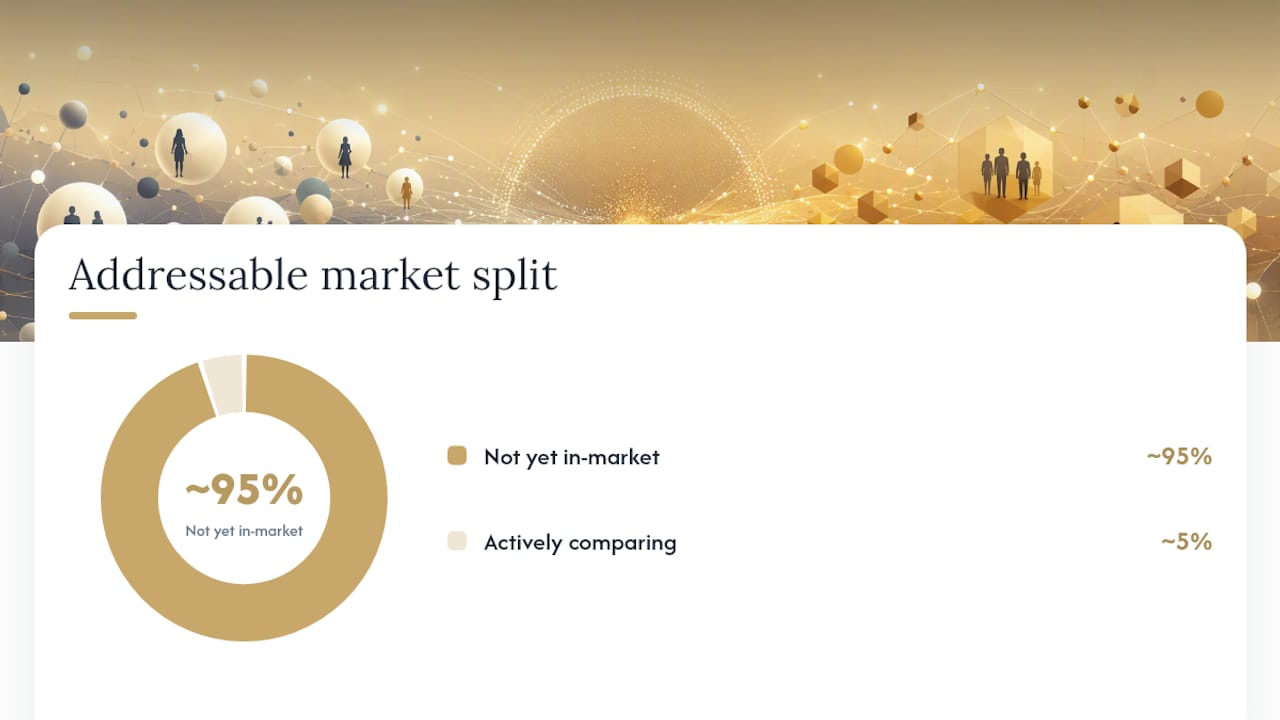
B2B demand capture converts active buyer intent into qualified pipeline by intercepting the roughly 5% of your addressable market that is researching and comparing solutions right now. It is not about building awareness or nurturing cold prospects. It is about being present, fast, and persuasive at the exact moment a buyer is ready to act.
B2B demand capture converts active buyer intent into qualified pipeline by intercepting the roughly 5% of your addressable market that is researching and comparing solutions right now. It is not about building awareness or nurturing cold prospects. It is about being present, fast, and persuasive at the exact moment a buyer is ready to act.
Three things define where capture sits in the funnel:
In-market buyers only. Capture targets accounts already evaluating vendors, not the broader market that needs educating first.
Bottom-of-funnel channels. Paid search on pricing queries, review-site listings, retargeting, and account-targeted ads are the primary vehicles.
Speed as a conversion lever. Fast routing and rapid SDR follow-up are what separate captured pipeline from wasted clicks.
Done well, demand capture produces more demo requests, faster MQL-to-SQL velocity, and shorter time-to-contact wins. It is the harvesting motion. Everything else in B2B marketing is planting.
Key Takeaways
B2B demand capture works when you combine the right bottom-of-funnel channels with fast routing, strong landing experiences, and a sales-marketing SLA that treats the five minutes after a high-intent form fill as the most critical window in the funnel.
Point | Details |
|---|---|
Target the in-market 5% | Demand capture focuses on the ~5% of your market actively comparing solutions, not the broader audience. |
Speed-to-lead is decisive | Contacting an inbound lead within five minutes materially raises qualification rates versus waiting hours. |
Commercial content is non-negotiable | Pricing pages, comparison guides, and demo schedulers are the conversion assets capture depends on. |
Measure cost per opportunity | Track cost per opportunity and close rate by source, not just MQL volume, to avoid optimizing for the wrong signal. |
Flockleads automates the full motion | Flockleads handles campaign setup, CRM routing, landing optimization, and weekly reporting for B2B companies. |
What is B2B demand capture, and how does it differ from demand generation?
Marketers conflate these three terms constantly, and the confusion costs budget. Here is the practical distinction:
Motion | Objective | Timeline | Target audience | Primary metrics |
|---|---|---|---|---|
Build awareness and preference across the buying committee | 6–18 months | The ~95% not yet in-market | Brand recall, pipeline influence, MQL volume | |
Convert in-market intent into pipeline | Days to weeks | The ~5% of your addressable market actively comparing solutions now | Demo requests, MQL→SQL rate, cost per opportunity | |
Collect contact information from interested buyers | Days to weeks | Buyers showing early intent | Leads, CPL, form fills |
Demand generation builds long-term authority and must be coordinated with sales enablement so marketing-created demand converts to closed deals. Demand capture is what happens when that long-term work pays off and a buyer finally enters the market.
Three quick scenarios show the difference in practice. A buyer visits your pricing page after a Google search for “[your category] software pricing” — that is a capture moment; a paid search ad and a fast SDR call are the right response. A buyer reads a comparison post on G2 and clicks through to your site — again, capture; retargeting and a trial offer close the loop. A buyer has never heard of your category and needs a whitepaper explaining why the problem matters — that is demand generation, not capture, and mixing up the two wastes spend on the wrong channel.
Which channels and offers actually intercept in-market B2B buyers?
The core capture toolkit is narrower than most teams think. Six channels do the heavy lifting:
Branded and high-intent paid search. Bid on “[category] pricing,” “[category] vs [category],” and your own brand terms. Google Search ads let you appear at the exact moment a buyer types a purchase-intent query. The offer on the landing page should be a demo, a free trial, or a pricing breakdown — not a blog post.
Bottom-of-funnel SEO. Pages targeting “best [category] software,” “[your product] alternatives,” and “[competitor] pricing” capture organic searchers mid-evaluation. Commercial content at the bottom of the funnel is where teams most often underinvest, and it is where in-market buyers get lost.
Review-site optimization. G2 and Capterra are where B2B buyers go to compare vendors. A complete profile, recent reviews, and a clear CTA on your listing are non-negotiable capture assets.
Intent-based retargeting. Buyers who visited your pricing or comparison pages but did not convert are your warmest audience. Retarget them with a specific offer — a case study relevant to their industry, a limited-time trial, or a direct “book a demo” ad.
Account-targeted capture ads. On LinkedIn, you can serve ads specifically to job titles at accounts already showing intent signals. The offer should be direct: a demo, a competitive comparison deck, or a pricing guide.
Rapid inbound SDR response. Contacting an inbound lead within five minutes dramatically raises qualification chances compared to waiting longer. Route high-intent form fills to an SDR immediately, not to a nurture sequence.
Pro Tip: On every capture landing page, obsess over five things: message match between the ad and the headline, load time under two seconds, a form with no more than four fields, one strong piece of social proof (a recognizable customer logo or a specific result), and a visible phone number or live chat option. Removing friction at this stage has an outsized effect on conversion.
How do you build a demand capture program step by step?
Run a focused 4–8 week pilot to prove capture lift before scaling budget. Here is the sequence:
Step 0: Define your ICP and intent signals. Identify the job titles, company sizes, and industries that close fastest. Then list the signals that indicate active buying: pricing page visits, competitor comparison searches, review-site profile views, and repeat site visits within 14 days.
Step 1: Map high-intent keywords and review queries. Pull your Google Search Console data for queries containing “pricing,” “cost,” “vs,” “alternative,” and “review.” Add competitor brand terms. These become your paid search and SEO target list.
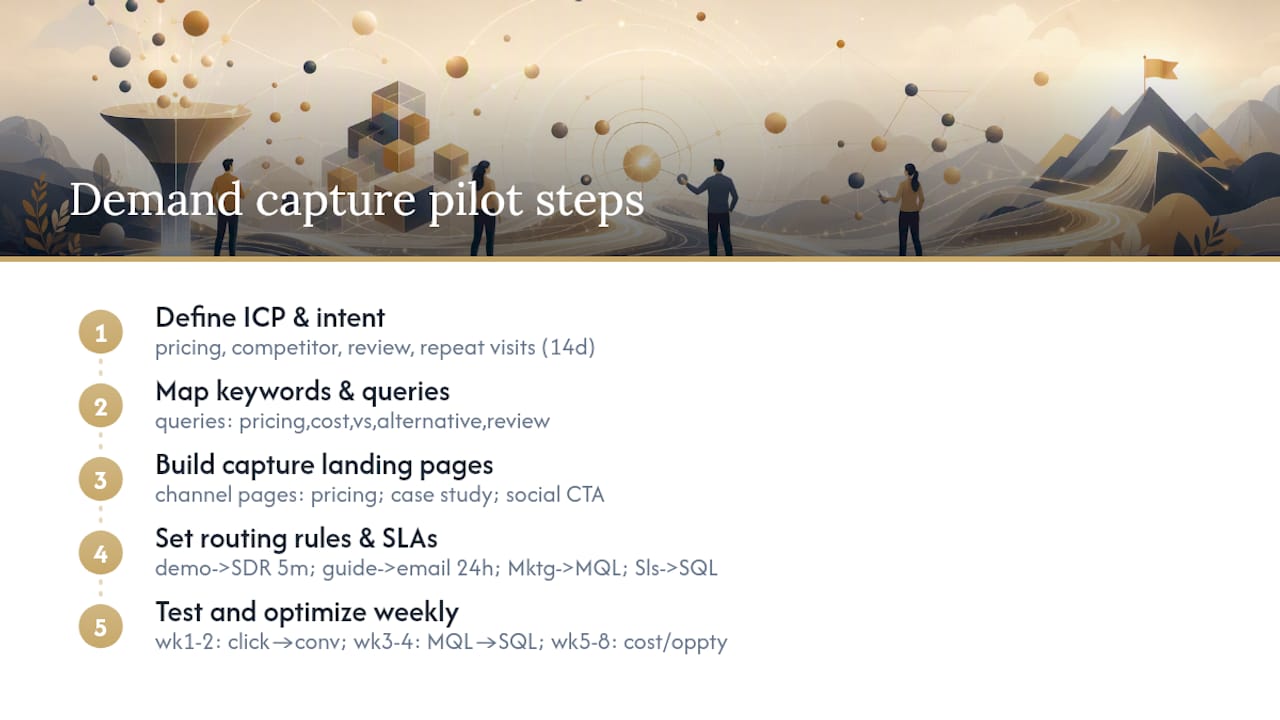
Step 2: Build capture landing experiences. Each channel needs a dedicated landing page. Paid search gets a pricing or demo page. Retargeting gets a case study or comparison guide. Review-site traffic gets a page with social proof and a direct CTA. Conversion infrastructure — messaging, load time, form length, and social proof — directly determines whether an in-market visit becomes pipeline.
Step 3: Set routing rules and SLAs. If a lead fills out a demo request form, route to SDR within five minutes. If a lead downloads a comparison guide, add to a three-touch email sequence within 24 hours. Assign clear ownership: marketing owns the lead to MQL, sales owns MQL to SQL.
Step 4: Test and optimize weekly. In weeks 1–2, measure click-to-conversion rate by channel. In weeks 3–4, measure MQL-to-SQL rate by source. In weeks 5–8, measure cost per opportunity and close rate by channel. Cut channels with a cost per opportunity above your target; double down on what converts.
What should you measure, and how do you attribute capture performance?
Use last-click attribution to measure activation — it tells you which channel triggered the conversion. Layer in multi-touch attribution to understand influence across the buying journey. For reporting: show Sales leadership MQL→SQL rate and lead response time; show the C-suite cost per opportunity and source-to-revenue. Avoid optimizing purely for MQL volume. A team that hits its MQL target with low-intent leads wastes sales capacity and inflates CAC.
How does marketing enable sales to close captured demand?
Marketing’s job does not end when a lead is captured. True demand capture requires tight sales-marketing alignment so in-market interest converts to deals. That means three things in practice.
SLA and scoring thresholds. A lead is sales-ready when it meets ICP criteria plus one behavioral signal (pricing page visit, demo request, or repeat visit within seven days). First-touch SLA: five minutes for demo requests, four hours for content downloads. Route high-intent accounts directly to a named AE, not a round-robin queue.
Sales-ready assets marketing must own:
Short case studies (one page, outcome-led, industry-specific)
Pricing breakdowns and ROI calculators
Competitive comparison decks (your product vs. the two most common alternatives)
Objection-handling one-pagers for the top three sales objections
Pro Tip: Speed-to-lead is the single most controllable variable in capture conversion. Build a Slack or CRM alert that fires the moment a high-intent form is submitted. An SDR who calls within five minutes while the buyer still has the tab open converts at a materially higher rate than one who calls the next morning.
What mistakes kill demand capture programs before they scale?
Assuming marketing’s job ends at lead capture. Fix: define a joint MQL→SQL SLA with sales before launch.
Slow follow-up. Fix: automate routing so high-intent leads reach an SDR within five minutes, not five hours.
Poor landing experience. Fix: audit every capture page for message match, load time, and form length. Underinvesting in commercial pages loses buyers at the conversion moment.
Wrong KPI focus. Fix: track cost per opportunity and close rate, not just MQL volume.
Ignoring review-site presence. Fix: assign someone to own G2/Capterra profiles, respond to reviews, and update listings quarterly. Directory and listing optimization captures buyers who find vendors through category searches.
U.S.-specific budget pressure. In competitive B2B categories, Google CPCs for high-intent queries can be significant. Manage this by prioritizing exact-match and phrase-match keywords, setting tight negative keyword lists, and supplementing paid search with bottom-of-funnel SEO to reduce paid dependency over time.
A copyable campaign checklist and 4-week pilot template
Campaign checklist:
[ ] ICP defined (industry, company size, job title, deal size)
[ ] Intent signals identified (pricing page, competitor queries, review-site visits)
[ ] High-intent keyword list built (pricing, vs, alternative, review terms)
[ ] Capture landing pages live (demo, pricing, comparison)
[ ] Retargeting audiences created (pricing page visitors, 14-day window)
[ ] Review-site profiles updated (G2, Capterra)
[ ] Routing rules documented and tested in CRM
[ ] An SLA with sales should be agreed upon to ensure a timely demo request response.
[ ] Success metrics defined (demo requests, MQL→SQL rate, cost per opportunity)
4-week pilot template:
Field | Your entry |
|---|---|
Goal | X demo requests from capture channels in — |
ICP | [Industry / size / title] |
Keywords | [Pricing, vs, alternative terms] |
Offer | Free demo / competitive comparison guide |
Landing URL | [Your pricing or demo page] |
SLA | 5 minutes for demo requests |
Success metrics | Demo requests, MQL→SQL rate, cost per opportunity |
Week 1: Launch paid search on high-intent keywords; publish or refresh pricing and comparison pages. Week 2: Activate retargeting for pricing page visitors; update G2/Capterra profiles. Week 3: Review click-to-conversion data; cut underperforming ad groups; test one new offer. Week 4: Measure MQL→SQL rate by source; present cost per opportunity to sales leadership; decide on scale or pivot.
The part most teams skip
Most B2B marketing teams I have seen build demand capture programs get the channel mix roughly right. They set up paid search, they run retargeting, they even clean up their G2 profile. Where they consistently fall short is the handoff. The lead arrives, the SDR gets a notification, and then nothing happens for six hours because there is no agreed SLA, no sales-ready one-pager, and no routing rule that distinguishes a pricing-page visitor from a whitepaper download.
The insight that actually changes outcomes: treat the five minutes after a high-intent form submission as the most valuable window in your entire funnel. Everything upstream — the ad spend, the landing page work, the content — exists to create that moment. If you do not have a system that acts on it immediately, you have built a pipeline that leaks at the bottom. Fix the handoff first, then scale the top.
Flockleads covers the full capture playbook for you
Most B2B teams have the intent to run demand capture well. What they lack is the execution infrastructure: campaigns that go live fast, landing pages that convert, CRM routing that fires in real time, and weekly optimization that compounds results.
Flockleads runs the entire capture motion for B2B companies — from Google Search ad campaigns targeting high-intent queries to qualifying lead forms, CRM integration, and weekly performance reporting. The free audit maps your current capture gaps across paid search, SEO, and review-site presence, then shows exactly where pipeline is leaking. No long-term lock-in. Leads delivered to your website from day one. To see where your capture program stands right now, start with a free audit at Flockleads.
Sources
Frequently asked questions
What is B2B demand capture in simple terms?
B2B demand capture converts active buyer intent into qualified pipeline using bottom-of-funnel channels like paid search, retargeting, and review-site optimization. It targets the roughly 5% of your addressable market that is actively comparing solutions right now.
How does demand capture differ from demand generation?
Demand generation builds awareness across the 95% of buyers not yet in-market over a 6–18 month timeline. Demand capture intercepts the 5% already evaluating vendors, typically within days to weeks.
Which metrics matter most for demand capture?
Track MQL-to-SQL conversion rate, lead response time, cost per opportunity, and close rate by source. MQL volume alone is a misleading signal if the leads are low-intent.
How fast should sales follow up on captured leads?
Contacting a high-intent inbound lead within five minutes raises qualification rates significantly. Route demo requests to an SDR immediately via CRM alert or Slack notification.
Can Flockleads run demand capture campaigns for my B2B company?
Yes. Flockleads manages the full capture motion including Google Search ad campaigns, qualifying lead forms, CRM integration, and weekly optimization, with leads delivered directly to your website.
NEED A CLEARER PLAN?
Let’s turn your next move into momentum.
Talk to us →