THE SHORT ANSWER
Community marketing is a strategy that brings existing customers and prospects together around a shared identity or interest, with the brand facilitating the space so members help each other, advocate publicly, and stay longer. The business case is direct: community marketing connects member activity to CRM data and demonstrates measurable influence on revenue, renewals, and customer acquisition
Community marketing is a strategy that brings existing customers and prospects together around a shared identity or interest, with the brand facilitating the space so members help each other, advocate publicly, and stay longer. The business case is direct: community marketing connects member activity to CRM data and demonstrates measurable influence on revenue, renewals, and customer acquisition cost.
Four components make it work:
Members with a shared interest or problem the brand can organize around
Brand facilitation that creates the space, rules, and content cadence
Many-to-many engagement where members talk to each other, not just to the brand
Business metric focus tied to retention, referrals, or product adoption
Key Takeaways
Community marketing works because member-to-member relationships generate retention and referrals that paid channels cannot replicate at the same unit economics.
Point | Details |
|---|---|
Definition | Community marketing facilitates member connections around a shared interest to drive loyalty, advocacy, and retention. |
Business case | Ties directly to CAC reduction, retention cohort lift, and referral volume when CRM-tagged from day one. |
Model choice | Sponsored/brand-hosted communities give more control and data than organic or third-party groups. |
Pilot first | Launch with 20–30 founding members, one activation per week, and CRM tagging before scaling. |
Avoid early monetization | Build trust for months before introducing paid offers; communities treated as funnels lose members fast. |
Pro Tip: Before you pitch a community program to leadership, pull your current referral and churn data. The gap between community-member retention and non-member retention is the number that gets budget approved.
Why community marketing delivers real business outcomes
The clearest ROI argument for community is what it does to your cost structure. When members answer each other’s questions, support ticket volume drops. When members refer peers, paid acquisition costs fall. When members feel ownership over a product, churn slows.
Community-based marketing shifts the brand-customer dynamic from a one-to-many broadcast into a network where members build relationships with each other. Once that network has momentum, it generates advocacy and retention independent of your next campaign budget. That is the compounding effect most paid channels cannot replicate.
A practical example: a SaaS company that routes common “how do I” questions to a member forum rather than a support queue can measurably reduce ticket volume. The same forum surfaces product feedback, which feeds the roadmap, which deepens member investment. One channel does three jobs.
What the main types of community marketing look like
Community marketing is commonly categorized as either organic (user-created) or sponsored (brand-hosted), and the distinction matters for how much control you have and how fast you can scale.
Type | Who creates it | Brand control | Discoverability | Time to value |
|---|---|---|---|---|
Organic / user-created | Members, fans, customers | Low | High (public platforms) | Slow; years to critical mass |
Sponsored / brand-hosted | Brand seeds and manages | High | Moderate (invite-based) | Faster with deliberate seeding |
Community-led growth | Brand + product team | High | Moderate | Medium; tied to product adoption |
Third-party group (e.g., Reddit) | Platform users | None | Very high | Unpredictable |
Organic communities form when customers care enough to organize themselves, as happened with open-source software user groups and fitness brand fan accounts. Sponsored communities are built intentionally: the brand creates the space, recruits founding members, and sets the rules. Brands often sponsor or seed communities to accelerate reach while preserving member autonomy.
Community-led growth is a specific model where the community is wired directly into the product: beta access, feature voting, and early releases are the membership benefit. It suits product-led B2B companies more than service businesses.
Pro Tip: Choose your model based on what you can sustain, not what sounds ambitious. A sponsored community with 200 highly engaged members outperforms a public group with 10,000 lurkers every time.
Practical tactics that actually move metrics
Tactics fall into four objectives. Pick the ones that match where your community is in its lifecycle.
Acquisition
Ambassador programs — recruit 10–20 customers who already refer peers organically. Give them early access, co-branded content, or event invites. Their credibility does what your ads cannot. Inviting customers into product feedback creates ownership that converts members into credible advocates over time.
Co-created content — publish member stories, case studies, or tutorials. It feeds SEO and signals to prospects that real people use and value your product. Pair this with a content-led SEO approach for compounding organic reach.
In-person and virtual events — trade shows and community events generate concentrated relationship-building that online channels rarely replicate. Even a monthly 45-minute webinar with Q&A builds familiarity faster than a newsletter.
Retention and product adoption
Product beta groups — give active members first access to new features. They test, report bugs, and feel ownership. That ownership is what community-led growth is built on.
Member forums and Q&A threads — a searchable forum deflects support tickets and surfaces real use cases. Assign a product liaison to monitor threads weekly so product insights reach the roadmap.
Moderation policies — set clear community rules on day one. Inconsistent moderation is one of the fastest ways to lose trust. Appoint a named moderator, not a rotating volunteer.
Advocacy
UGC programs — prompt members to share results, screenshots, or reviews with a branded hashtag. Curate the best and redistribute. Authenticity matters here; trust-based marketing principles apply directly.
Referral incentives — structured referral programs with a clear reward (account credit, swag, early access) convert word-of-mouth into a trackable acquisition channel.
Roles required: a community manager owns daily moderation and activation; a product liaison routes member feedback to the roadmap; an analytics owner tracks engagement and ties activity to CRM records. For a pilot, one person can cover all three at roughly 10–15 hours per week.
Pro Tip: Start with one retention tactic before adding acquisition tactics. A forum that helps existing members succeed gives you proof points and testimonials before you ask anyone to refer a friend.
Which platforms fit your community model
Platform choice determines moderation control, discoverability, and how cleanly member data flows into your CRM.
Platform type | Moderation control | Discoverability | CRM/analytics integration | Best for |
|---|---|---|---|---|
Hosted community software (Circle, Mighty Networks) | High | Low | Strong (native APIs) | B2B, subscription, education |
Facebook Groups | Medium | High | Weak (limited API) | Consumer brands, local communities |
Discord | Medium | Medium | Moderate (bots, Zapier) | Tech, gaming, creator audiences |
Slack | High | Low | Strong (Slack API, CRM connectors) | B2B, professional communities |
In-product community | Very high | None (gated) | Native | SaaS, product-led growth |
For B2B companies, hosted platforms like Circle or a Slack workspace give you the data you need: you can tag members by company, track engagement events, and push cohort IDs into your CRM. Facebook Groups are discoverable but give you almost no structured data to work with.
Key integration points to build from day one:
Tag every community member in your CRM with a “community member” field and join date
Log engagement events (post, reply, event attendance) as CRM activities
Track referral signals: which closed deals came from community members
Build a retention cohort comparing community members vs. non-members at 90 and 180 days
How to measure community marketing success
The metrics that matter connect community activity to revenue outcomes, not just engagement counts.
Metric | Definition | How to track | Frequency |
|---|---|---|---|
Active member rate | Members who posted or replied in the last 30 days / total members | Platform analytics | Monthly |
Retention cohort lift | Churn rate: community members vs. non-members | CRM cohort report | Quarterly |
Referral volume | New leads or customers attributed to community members | CRM source tagging | Monthly |
Support deflection | Support tickets avoided via forum self-service | Help desk + forum search data | Monthly |
Product adoption rate | Feature adoption among community members vs. control group | Product analytics | Quarterly |
NPS delta | NPS score: community members vs. non-members | Survey tool (Typeform, Delighted) | Quarterly |
Secondary signals worth watching: contribution rate (what percentage of members create content vs. consume it), UGC volume, and event attendance trends.
The CRM integration tip that most teams skip: create a “community member” boolean field and a “community join date” field in your CRM on day one. Without those two fields, you cannot run the retention cohort comparison that proves ROI to leadership. Everything else can be added later; those two fields cannot be retrofitted cleanly.
Common mistakes that kill communities before they scale
Most community failures are predictable. Here are the ones worth watching before you launch.
Monetizing too early. Members who feel like a lead funnel leave fast. A build-first, monetize-later approach means providing high-value access and content for months before testing any paid offer.
No clear ownership. A community with no named manager gets inconsistent moderation, slow responses, and eventual abandonment. Assign one owner before launch, not after.
Treating it as a broadcast channel. Posting announcements into a community space without responding to replies signals that the brand is not actually present. Members notice within weeks.
Ignoring the first 30 members. Early members set the culture. If they feel ignored or undervalued, the tone they set persists. Over-invest in the founding cohort.
No community rules. Without published guidelines, moderation becomes arbitrary and members lose trust. Write a one-page community charter before you invite anyone.
Scaling before the core is healthy. Running paid ads to grow a community that has a 5% active member rate just amplifies a broken experience. Fix engagement before adding volume.
No executive sponsorship. Communities that live only in the marketing team get cut when budgets tighten. Tie the community to a revenue metric and get one executive to own it as a business goal.
Measuring vanity metrics only. Member count and follower growth feel good but tell you nothing about business impact. Track retention cohort lift and referral volume from week one.
A minimal governance model: one community manager (daily), one executive sponsor (monthly check-in), a published community charter, and a clear escalation path for rule violations.
Real examples of community marketing that worked
Figma’s community model. Figma built a community of designers who share templates, plugins, and tutorials publicly. The community became a discovery channel: new users found Figma through community-created resources before they ever saw a paid ad. The lesson is that community-based marketing works best when member contributions create value for people outside the community, not just inside it.
Product beta feedback loops. B2B SaaS companies that run structured beta programs with a named community cohort consistently report two outcomes: faster bug detection and higher feature adoption rates among beta participants versus the general user base. The mechanism is ownership. Inviting customers into product processes humanizes the brand and creates advocacy that scales without additional ad spend.
Ambassador programs in professional services. A professional services firm that identifies its top 15 referrers and gives them a named “advisor” status, early event access, and a private Slack channel can convert informal referrals into a structured, trackable channel. The key is making the status feel real, not performative.
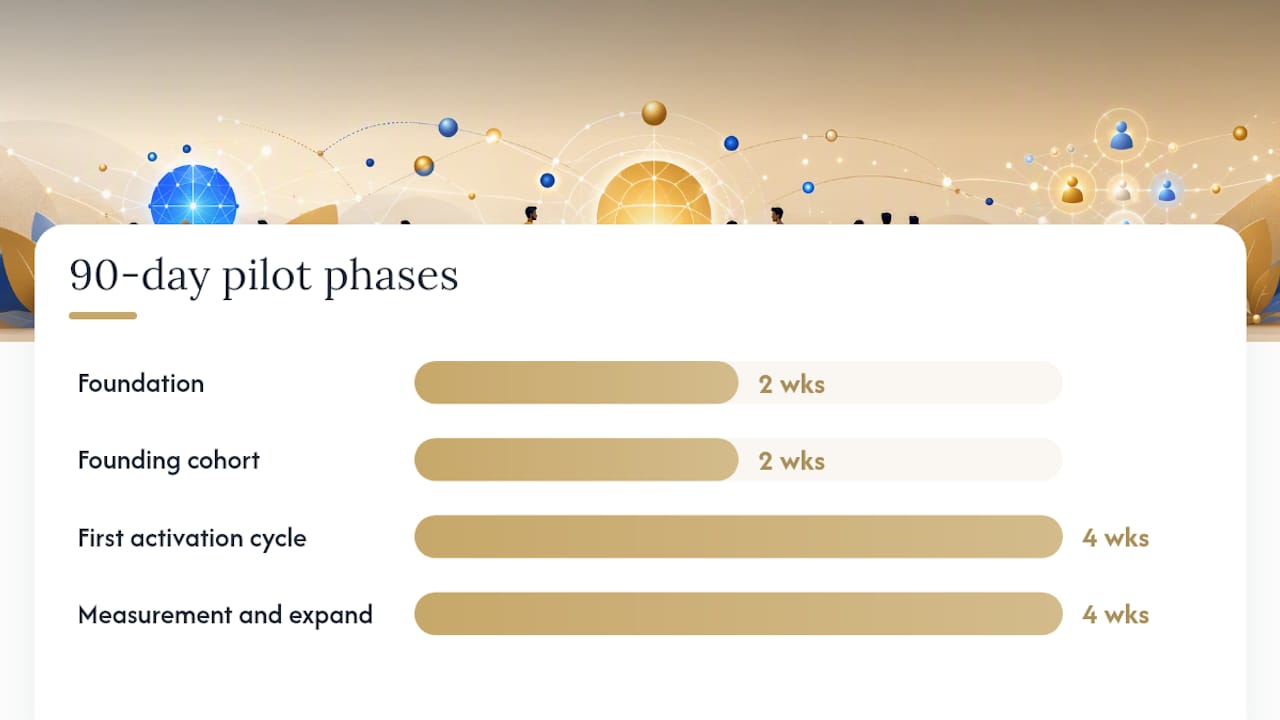
Your 90-day community pilot plan
A pilot needs a timeline, clear owners, and defined success criteria at 30, 60, and 90 days.
Weeks 1–2: Foundation
Define the community’s single purpose (support, product feedback, peer networking, or advocacy) and write the community charter
Choose your platform based on your audience and CRM integration needs
Set up CRM tagging: community member field, join date, engagement event logging
Weeks 3–4: Founding cohort
Invite 20–30 existing customers who already engage with your brand; do not open publicly yet
Run a live kickoff call with the founding cohort; let them shape the first discussion topics
Weeks 5–8: First activation cycle
Launch one weekly activation (a Q&A thread, a resource share, or a short live session)
Assign moderation ownership; respond to every post within 24 hours
Weeks 9–12: Measurement and expand
Pull your first retention cohort comparison: community members vs. matched non-members
Identify your top 5 contributors and invite them into an ambassador or beta program
Decide whether to open the community to broader membership based on active member rate
30-day success criteria: founding cohort recruited, platform live, CRM fields active, at least one weekly activation completed.
90-day success criteria: first retention cohort data available, at least two referrals attributed to community members, executive sponsor briefed with data.
Ownership matrix (minimum viable team):
Community manager: 10–15 hours/week (moderation, activation, reporting)
Executive sponsor: 2 hours/month (strategy, budget, escalation)
Product liaison: 2 hours/week (monitoring feedback threads, routing to roadmap)
Deciding whether to staff this in-house or outsource is a real question. The in-house vs. agency vs. buying leads trade-off applies here: community management requires consistent presence, which favors in-house ownership over a contracted agency.
The part most guides skip
Community marketing is genuinely one of the highest-leverage channels available to B2B marketers, but it is also the one most often killed by impatience. The brands that get it right treat it as a business function with an owner, a budget line, and a revenue metric attached, not a social media side project.
The practical recommendation: start with retention, not acquisition. Build a 30-person founding cohort from your best existing customers, give them something genuinely useful (early access, a direct line to your product team, a peer network they could not build elsewhere), and measure churn and referral rates at 90 days. That data is what gets the next budget cycle approved.
For B2B companies weighing community against paid channels, the honest answer is that community does not replace paid acquisition in the short term. It reduces your dependence on it over 12–24 months. If you need leads now, understanding how B2B lead generation differs from consumer acquisition is the right starting point. Community is the channel you build in parallel, not instead.
Sources
Frequently asked questions
What is an example of a community market?
Figma’s designer community is a widely cited example: members share templates and plugins publicly, which drives product discovery and adoption without paid advertising.
What is community-based marketing?
Community-based marketing is a strategy where a brand facilitates a space for customers and prospects to connect with each other, building relationships and advocacy that the brand alone could not generate through broadcast messaging.
What does a community marketing agent do?
A community marketing agent typically acts as a brand liaison, event lead, or local connector, representing the brand at activations and managing relationships between the brand and its community members.
How does community marketing differ from traditional marketing?
Traditional marketing broadcasts messages from brand to audience. Community marketing creates many-to-many conversations where members engage with each other, generating peer-driven trust and advocacy that paid campaigns cannot replicate.
NEED A CLEARER PLAN?
Let’s turn your next move into momentum.
Talk to us →