THE SHORT ANSWER
Customer acquisition is defined as the end-to-end process of attracting, engaging, and converting prospects into paying customers across five distinct stages: awareness, interest, consideration, conversion, and onboarding. Every B2B marketer and business owner needs to understand what is customer acquisition before they can measure it, fund it, or fix it.
Customer acquisition is defined as the end-to-end process of attracting, engaging, and converting prospects into paying customers across five distinct stages: awareness, interest, consideration, conversion, and onboarding. Every B2B marketer and business owner needs to understand what is customer acquisition before they can measure it, fund it, or fix it. The process does not end at the signed contract. It ends when the new customer has realized enough value to stay. Getting that definition right changes how you budget, how you hire, and how you grow.
What is customer acquisition and how does it work?
Customer acquisition is a structured, multi-stage process that moves a prospect from first contact to active, retained customer. Most B2B teams treat it as a sales function. The reality is that marketing, sales, and customer success all share ownership of the outcome.
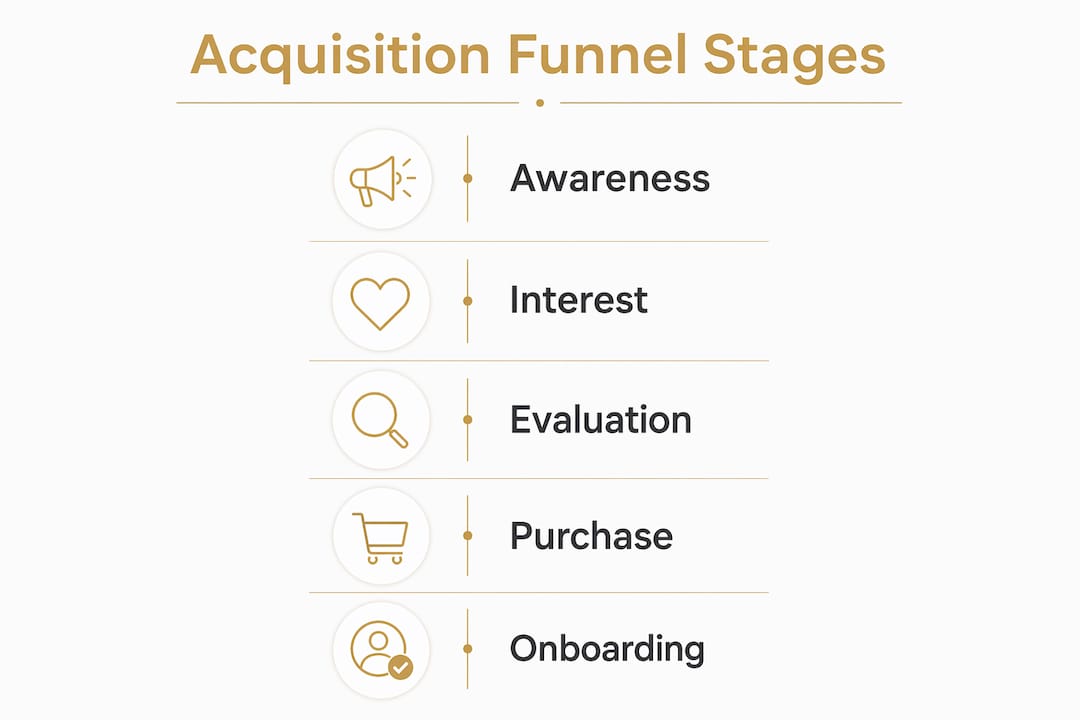
The five stages work as a connected chain:
Awareness: The prospect learns your company exists through content, paid ads, referrals, or outbound outreach.
Interest: The prospect engages with your brand, reads case studies, watches a demo, or downloads a resource.
Consideration: The prospect compares options and evaluates your fit against their specific problem.
Conversion: The prospect signs a contract or completes a purchase, becoming a paying customer.
Onboarding: The new customer receives structured support to realize value quickly and reduce early churn risk.
Sales and marketing alignment across all five stages is what separates efficient acquisition from expensive chaos. When marketing qualifies leads with one definition and sales uses another, prospects fall through the gaps between stages. That gap costs money without producing customers.
Onboarding belongs inside the acquisition process, not outside it. Customer retention hinges on delivering value post-sale, and a customer who churns in month two was never truly acquired. The acquisition spend on that customer is a total loss.

Pro Tip: Map each of your five funnel stages to a specific team owner and a measurable handoff metric. Undefined handoffs are where B2B acquisition budgets quietly disappear.
How is customer acquisition cost calculated and why does accuracy matter?
Customer acquisition cost, or CAC, is the total expense to gain a new customer, including every dollar spent on marketing, sales, software, and overhead during a given period. The formula is straightforward: divide total sales and marketing expenses by the number of new customers acquired in the same period. The difficulty is not the math. The difficulty is knowing which costs to include.
A fully loaded CAC calculation covers:
Advertising spend across all channels (paid search, social, display, sponsorships)
Sales team salaries, commissions, and benefits
Marketing team salaries and contractor fees
Software subscriptions (CRM, marketing automation, analytics tools)
Overhead costs attributable to sales and marketing operations
Many businesses calculate a simplified CAC that omits salaries and overhead. The result is an artificially low number that makes acquisition look profitable when it is not. Experienced operators insist on the fully loaded version because it reflects the actual cost of growth.
The benchmark that matters most is the LTV/CAC ratio. A healthy LTV/CAC ratio exceeds 3:1, meaning every dollar spent on acquisition returns at least three dollars in lifetime customer value. A 1:1 ratio means you are losing money on every customer you acquire.
Metric | Healthy Range | Warning Signal |
|---|---|---|
LTV/CAC ratio | 3:1 or higher | Below 2:1 |
CAC trend (year over year) | Flat or declining | Rising faster than LTV |
Payback period | Under 12 months | Over 18 months |
Pro Tip: Never benchmark your CAC against a single month. Track it as a rolling quarterly average to filter out seasonal spikes and campaign timing effects.
Tracking CAC as a trend matters more than any single snapshot. Businesses that monitor CAC trends against customer lifetime value catch efficiency problems early, before they compound into budget crises.
What are effective strategies to reduce customer acquisition costs?
Reducing CAC does not mean cutting marketing budgets. It means getting more customers from the same spend by removing friction at every stage of the funnel. Acquisition costs rose 35% between 2022 and 2025 while lifetime value grew only 4.5%. That gap makes funnel efficiency the most urgent priority for B2B teams right now.
The most effective tactics fall into four categories:
Tighten targeting with intent data. Stop spending on broad audiences. Use firmographic filters, technographic signals, and behavioral intent data to reach prospects who are already in a buying cycle. Fewer impressions on the right accounts cost less than mass outreach on the wrong ones.
Shorten the sales cycle. Every extra week in the consideration stage adds cost. Provide prospects with the information they need to decide faster: pricing transparency, ROI calculators, and reference customers in their industry.
Remove conversion friction. Audit every touchpoint where a prospect could drop off. Slow-loading landing pages, confusing forms, and unclear calls to action each add invisible cost to your CAC.
Allocate spend by channel performance. Not all acquisition channels produce the same quality of customer. Track CAC and LTV separately by channel, then shift budget toward the channels with the best ratio.
Small improvements across each funnel stage compound into large gains in acquisition efficiency. A 10% improvement in conversion rate at three consecutive stages does not produce a 30% improvement in overall acquisition. It produces a much larger one because the gains multiply.
Pro Tip: Before increasing your acquisition budget, run a conversion rate audit on your existing traffic. Most B2B funnels have at least one stage where 40% or more of qualified prospects exit without a clear reason.
Cross-selling and upselling to existing customers also reduce effective CAC. When you grow revenue from the customer base you already have, you lower the pressure on new acquisition to carry all your growth targets.
What common pitfalls should businesses avoid in customer acquisition?
The most expensive mistakes in customer acquisition are not obvious. They compound quietly over months before showing up in revenue numbers.
Treating acquisition as a transaction. Acquisition is a continuous process, not a one-time event. B2B companies that close a deal and move on immediately lose customers to churn, then spend again to replace them. This is the “leaky bucket” effect, and it inflates effective CAC without appearing in any single campaign report.
Ignoring onboarding. Onboarding reduces the leaky bucket effect by ensuring new customers reach value before they have a reason to leave. Skipping structured onboarding is the fastest way to waste acquisition spend.
Using incomplete CAC formulas. A CAC that excludes salaries looks healthy until you run payroll. Simplified calculations mislead budget decisions and produce growth plans that cannot survive contact with real operating costs.
Poor sales and marketing alignment. High lead volumes do not guarantee acquisition when sales and marketing disagree on what a qualified lead looks like. Misaligned teams generate activity without generating customers.
Ignoring the LTV/CAC ratio. A rising CAC is only a problem if LTV is not rising faster. Teams that track CAC in isolation miss the full picture and make cuts that hurt long-term growth.
Treating customer acquisition as a continuous, compounding process rather than a one-off event is the single most important shift a B2B team can make. Every customer who churns prematurely represents not just lost revenue but wasted acquisition spend that must be replaced at full cost.
The leaky bucket problem is particularly damaging in B2B because sales cycles are long and acquisition costs are high. One churned enterprise customer can erase the margin from ten smaller wins.
Key Takeaways
Effective customer acquisition requires accurate cost measurement, funnel-wide optimization, and a definition of “acquired” that includes successful onboarding, not just a signed contract.
Point | Details |
|---|---|
Acquisition spans five stages | Awareness through onboarding all count; stopping at conversion leaves revenue at risk. |
Use fully loaded CAC | Include salaries, software, and overhead to get a number you can actually trust. |
Target a 3:1 LTV/CAC ratio | Below 2:1 signals you are losing money on each new customer acquired. |
Funnel optimization beats budget cuts | Small conversion improvements at each stage compound into large CAC reductions. |
Sales and marketing alignment is non-negotiable | Misaligned teams waste spend on leads that never convert to paying customers. |
The metric most B2B teams are reading wrong
After working with B2B service businesses across multiple industries, the pattern I see most often is not a bad acquisition strategy. It is a misread CAC. Teams pull a number, compare it to last quarter, and make budget decisions based on a figure that excludes half the actual costs. The number looks fine. The business quietly bleeds.
The fix is not complicated. Build a fully loaded CAC calculation once, make it the standard, and track it as a trend against LTV every quarter. That single change gives you a reliable signal instead of a flattering one.
The second thing I have seen consistently is that the biggest acquisition gains come from the middle of the funnel, not the top. Most B2B teams pour budget into awareness while leaving the consideration and conversion stages full of friction. A prospect who found you, researched you, and then bounced off a confusing pricing page was not a bad lead. That was a fixable process failure.
Acquisition strategy works when it is treated as an engineering problem. Every stage has inputs, outputs, and a conversion rate. Measure each one. Fix the worst one first. Repeat. That approach produces compounding results that a single big campaign spend never will.
— Mieke
How Flockleads helps B2B businesses acquire better customers
B2B service businesses face a specific challenge: generating enough qualified leads to feed a sales team without letting CAC spiral out of control. Flockleads engineers lead flow directly to your website, so your sales team works with prospects who are already in a buying cycle rather than cold contacts who need months of nurturing.
Flockleads focuses on the quality and fit of leads, not just volume. That focus shortens sales cycles, improves conversion rates at the consideration stage, and brings down the fully loaded CAC that matters to your bottom line. If you are building or refining your acquisition process, Flockleads gives your team the lead flow foundation to make every other funnel improvement count.
Frequently asked questions
What is customer acquisition in simple terms?
Customer acquisition is the process of turning a prospect into a paying customer. It covers every stage from first awareness of your brand through onboarding and initial value delivery.
What costs should I include in my CAC calculation?
A fully loaded CAC includes advertising spend, sales and marketing salaries, software subscriptions, and overhead costs. Omitting salaries and overhead produces an artificially low number that misguides budget decisions.
What is a good LTV/CAC ratio for B2B companies?
A healthy LTV/CAC ratio exceeds 3:1. A ratio at or below 1:1 means you are spending as much or more to acquire a customer as that customer will ever return in revenue.
Why is onboarding part of customer acquisition?
Onboarding determines whether a new customer realizes value quickly enough to stay. A customer who churns in the first 60 days represents a complete loss of acquisition spend, so delivering post-sale value is inseparable from the acquisition outcome.
How can I reduce customer acquisition costs without cutting my marketing budget?
Tightening funnel conversion rates at each stage produces larger CAC reductions than budget cuts. Audit where qualified prospects drop off, remove that friction, and reallocate spend toward the channels with the best LTV/CAC ratio.
NEED A CLEARER PLAN?
Let’s turn your next move into momentum.
Talk to us →