THE SHORT ANSWER
Digital marketing for growth is the practice of using online channels — search, email, social, paid ads, and content — to systematically acquire new customers, convert them, and keep them buying, with every step measured and improved over time. The TL;DR: pick the right channels, track what matters, and iterate until your cost to acquire a customer is well below the lifetime value they deliver.
Digital marketing for growth is the practice of using online channels — search, email, social, paid ads, and content — to systematically acquire new customers, convert them, and keep them buying, with every step measured and improved over time. The TL;DR: pick the right channels, track what matters, and iterate until your cost to acquire a customer is well below the lifetime value they deliver.
The channels this guide covers:
Search (SEO + PPC): captures demand when buyers are actively looking
Email: owns the relationship and drives repeat revenue
Social media: builds awareness and community
Content and video: fuels discovery across search and social
Paid ads (Google Ads, Meta Ads): accelerates acquisition with measurable spend
What each digital marketing channel actually does for growth
Digital marketing channels include search, social, email, websites, mobile, and display — and each one plays a different role in moving a stranger toward a paying customer. Matching the channel to the objective is where most business owners go wrong.
SEO (organic search): Targets buyers who are already looking for what you sell. A plumbing company ranking for “emergency plumber Chicago” captures high-intent traffic at zero incremental cost per click. Best for businesses with a defined service area or a product with clear search demand. Favors B2B and local service businesses; takes 3–6 months to show meaningful results.
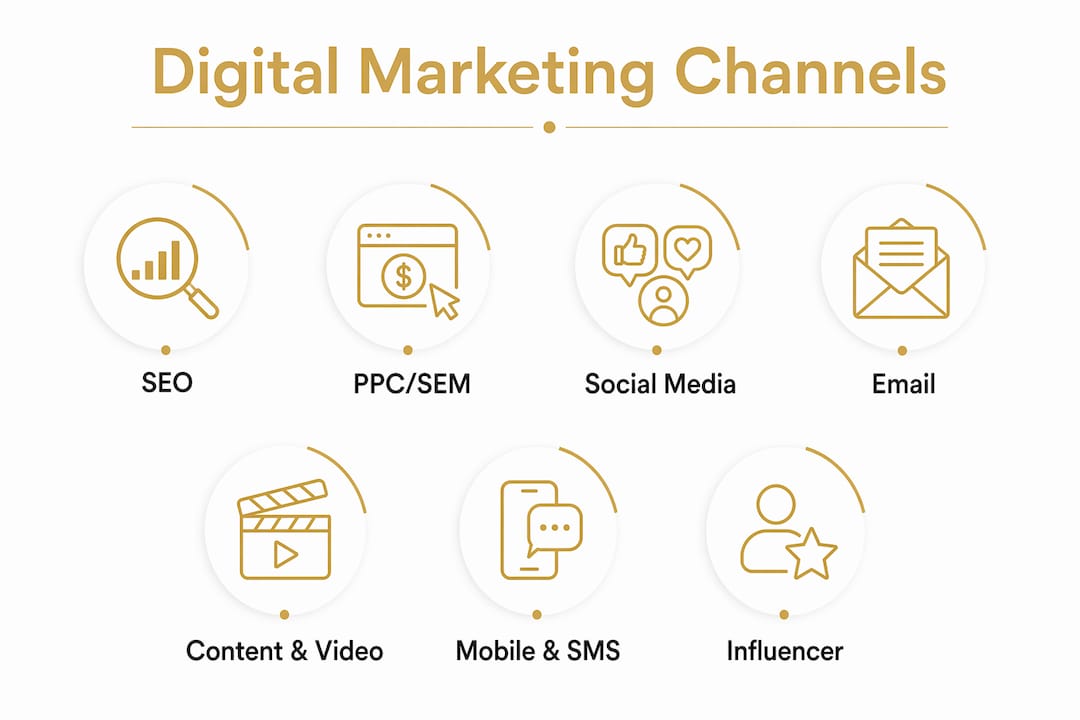
PPC/SEM (paid search): Google Ads puts you in front of the same high-intent searchers, but immediately. You pay per click, so the economics hinge on your conversion rate and average order value. A B2B software company running Google Ads for “project management software for construction” can generate qualified demos the same week a campaign launches. Favors businesses with a clear offer and enough margin to absorb cost-per-click.
Social media marketing: Facebook, Instagram, LinkedIn, and TikTok are discovery engines. A consumer brand running Instagram Reels can reach cold audiences who have never heard of them; a B2B firm using LinkedIn content can stay visible to prospects over months before a deal opens. Social rarely closes deals on its own — it warms audiences and builds the trust that makes other channels work better.

Email marketing: The highest-ROI channel for most businesses that already have a list. Email is owned — no algorithm can cut your reach overnight. A SaaS company sending a weekly product tip to trial users converts more of them to paid plans than any retargeting ad. Favors retention and monetization; works for both B2B and B2C.
Content and video: Blog posts, YouTube videos, and podcasts are the fuel that powers SEO and social simultaneously. A well-researched article ranks on Google and gets shared on LinkedIn. Video content on YouTube compounds over time. Content favors businesses willing to invest 6–12 months for compounding returns.

Mobile and SMS: SMS open rates run far above email, making it effective for time-sensitive offers, appointment reminders, and flash sales. A local restaurant sending a Thursday lunch special via SMS to opted-in customers sees same-day foot traffic. Highly regulated under the CAN-SPAM Act and TCPA — compliance is non-negotiable.
Influencer marketing and UGC: Partnering with creators or encouraging customers to post about your product builds social proof at scale. Influencer marketing has grown into a significant industry category, particularly for consumer brands in beauty, fitness, and food. Favors B2C; works best when the creator’s audience genuinely overlaps with your buyer.
How digital marketing actually drives growth — and the metrics that prove it
Growth marketing emphasizes analytics, experimentation, and optimization across the full customer lifecycle: acquisition, engagement, retention, and revenue. That lifecycle is the engine. Each channel feeds a different stage.
The mechanics work like this: SEO and paid ads bring strangers to your site (acquisition). Your landing page and offer convert them into leads or buyers (conversion). Email and retargeting bring them back (retention). Repeat purchases and referrals raise their lifetime value (LTV). The whole system is measurable, which is what separates digital from traditional advertising.
The metrics that matter:
Traffic: total sessions and organic vs. paid split — tells you if your acquisition channels are working
Conversion rate: percentage of visitors who take the desired action — the single most leveraged number in your funnel
CAC (customer acquisition cost): total marketing spend divided by new customers acquired — the cost side of the growth equation
LTV (lifetime value): average revenue a customer generates over their relationship with you — the return side
ROAS (return on ad spend): revenue generated per dollar of ad spend — the efficiency metric for paid channels
Retention rate and churn: how many customers stay vs. leave — the leak in the bucket
Average order value (AOV): revenue per transaction — raising AOV improves unit economics without adding acquisition cost
Precise measurement and attribution across the customer journey let teams adjust campaigns in real time rather than waiting for a monthly report. Attribution is where most teams struggle: a customer might click a Google Ad, read a blog post three days later, then convert from an email. Last-click attribution gives all credit to the email and makes the ad look worthless. Multi-touch attribution, available in GA4 and most CRM platforms, distributes credit more accurately.
Pro Tip: Set up GA4 conversion events before you spend a dollar on paid traffic. Without conversion tracking, you are flying blind — you will know how many people visited but not which channel or ad actually produced a customer.
How to start: a practical 6-step plan for your first 90 days
A 90-day plan forces prioritization. Six steps, in order:
Set specific growth goals (Week 1). “Get more leads” is not a goal. “Generate 50 qualified leads per month at a CAC under $150 by Day 90” is. Attach a number to every objective.
Define your audience (Week 1–2). Build one detailed buyer persona: job title, pain point, where they search, what they read. Everything downstream depends on this.
Select 2–3 channels maximum (Week 2). For most small businesses, start with Search (SEO or Google Ads), Email, and one social channel. Adding more channels before mastering two is the most common growth killer.
Create minimum viable content and offers (Weeks 2–4). One landing page, one lead magnet or offer, five foundational blog posts or ad creatives. Done beats perfect.
Set up analytics and tracking (Week 3). Install GA4, connect Google Search Console, set up conversion events, and link your ad accounts. This is the infrastructure that makes everything measurable.
Launch, measure, and iterate (Weeks 4–12). Run for two weeks before drawing conclusions. Then cut what is not converting, double what is, and test one variable at a time.
90-day milestone timeline
Weeks | Milestone | Key action |
|---|---|---|
1–2 | Foundation | Goals set, persona defined, channels selected |
3–4 | Infrastructure | GA4 live, ad accounts created, email list started |
5–8 | First data | Initial campaigns running, first conversion data in |
9–10 | Optimize | Cut underperformers, reallocate budget to winners |
11 | Scale | Increase spend on proven plays, add one new test |
Ballpark costs for common configurations
Lean solo owner (DIY): $200–$500/month in ad spend, free tiers of GA4, Mailchimp, and Google Search Console, plus 5–10 hours per week of your own time
Small team with tools: $1,000–$3,000/month covering ads, HubSpot Starter or Mailchimp, Hootsuite for scheduling, and a part-time content resource
Agency-assisted: $3,000–$8,000/month all-in, including management fees and ad spend, with faster results and less internal time required
Technical setup checklist
Google Analytics 4 (GA4) with conversion events configured
Google Search Console linked to your domain
Google Ads account with conversion tracking
Meta Ads (Facebook and Instagram) Business Manager with pixel installed
Email platform (Mailchimp for early stage, HubSpot as you scale)
CMS with clean URL structure and fast page load (Core Web Vitals matter for SEO)
For practical guidance on converting paid traffic into a repeatable lead engine, the sequencing of channel selection and budget allocation matters as much as the spend itself.
The minimum viable tech stack for growth-focused digital marketing
You do not need 15 tools. You need the right five or six, connected properly. Here is what a lean, functional stack looks like:
GA4 (Google Analytics 4): End-to-end traffic and conversion tracking. Free, and the non-negotiable foundation of any measurable program. Without it, you cannot calculate CAC or attribute revenue to channels.
Google Ads: Captures high-intent demand from people actively searching for your product or service. The fastest path to measurable acquisition for most businesses with a clear offer.
Meta Ads (Facebook and Instagram Ads): Reaches cold audiences at scale with visual creative. Best for B2C and for B2B businesses targeting specific demographics or interests. The pixel enables retargeting and lookalike audiences.
HubSpot or Mailchimp: HubSpot handles CRM, email, and basic marketing automation in one place — worth the cost once you have a sales team or a complex funnel. Mailchimp is the right starting point for a solo owner or small team focused on email campaigns and list growth.
Hootsuite (or Buffer): Social media scheduling and basic analytics. Saves time and keeps posting consistent without requiring someone to be online at 9 AM every day.
CMS (WordPress, Webflow, or Squarespace): Your website is the conversion hub. Every channel sends traffic here. Speed, mobile optimization, and clear calls to action are the three things that determine whether traffic becomes leads.
Adobe (for creative assets): Adobe Express or Adobe Photoshop for ad creative and social graphics. Creative quality directly affects ad performance — low-quality visuals raise your cost per click.
Integration priority: connect your CRM (HubSpot) to GA4 and your ad platforms first. That connection lets you see which campaigns produce actual customers, not just clicks. Own your data — export lists, back up audiences, and never let a single platform hold your customer data hostage.
Common challenges that block growth and how to avoid them
Most digital marketing programs fail for the same handful of reasons. Recognizing them early saves months of wasted spend.
Scattered channel approach: Trying to run SEO, Google Ads, Meta Ads, LinkedIn, TikTok, and email simultaneously with a small team produces mediocre results everywhere. Consolidate to 2–3 channels and do them well.
Poor attribution and tracking gaps: If GA4 is not configured with conversion events, you are optimizing on traffic instead of revenue. Audit your tracking setup before scaling any budget.
Under-resourced creative: Ad fatigue is real. Running the same three creatives for three months tanks performance. Budget for new creative every 4–6 weeks on paid channels.
Slow experiment cadence: Testing one variable per quarter means you learn 12 things per year. Testing one per two weeks means you learn 26. Speed of learning is a competitive advantage.
Misaligned goals between marketing and sales: Marketing celebrates MQLs; sales complains the leads are unqualified. Fix this by agreeing on a shared definition of a qualified lead before the first campaign launches.
Red flags that your plan is failing:
CAC is rising but LTV is flat or declining
Repeat purchase rate is below 20% for a product that should drive repurchase
Tracking is inconsistent across sessions (UTM parameters missing, conversion events firing incorrectly)
Every channel shows traffic growth but revenue is flat
Quick corrective actions:
Run a tracking audit using GA4’s DebugView before touching budgets
Set a biweekly experiment review — one hypothesis, one test, one decision
Align with your sales team on lead quality monthly, not quarterly
The SES framework: the smartest prioritization for small businesses
Strategy must come before tactics — deciding who you are trying to reach and where they spend time online is the work that makes every channel more efficient. The SES framework (Search, Email, Social) gives small teams a structure for that decision.
Why SES works: Search discovers you when buyers have intent. Email owns the audience you build, independent of any algorithm. Social builds the advocacy and word-of-mouth that makes the other two channels cheaper over time. Together, they cover acquisition, retention, and amplification without requiring a 10-person team.
Pick one strong play per pillar rather than trying to be everywhere. One search play (Google Ads or a focused SEO content program), one email play (a weekly newsletter or an automated nurture sequence), one social play (LinkedIn for B2B, Instagram for B2C). That is a complete, manageable program.
A focused SES approach in practice: A B2B service business starting from zero can realistically reach a steady flow of 20–40 inbound leads per month within 90 days by running Google Ads to a single optimized landing page (Search), building an email list from those leads with a 3-email nurture sequence (Email), and posting two LinkedIn updates per week to stay visible to prospects (Social). The key is not the volume of activity — it is the consistency and the measurement.
You can see real examples of this approach in action across different service business categories.
SES budget allocation by team size
Budget level | Search | Social | Monthly total | |
|---|---|---|---|---|
Lean ($500/mo) | — | — | $200 boosted posts | $500 |
— | $500 HubSpot + automation | — | Meta + LinkedIn | — |
90-day SES checklist
Search: Google Ads account live with conversion tracking; 5–10 target keywords; one optimized landing page
Email: List-building mechanism in place (lead magnet or contact form); 3-email welcome sequence written and scheduled
Social: Profile optimized; posting schedule set (2x/week minimum); one paid boost per week to test audience targeting
For small-business digital marketing tactics that go deeper on the social pillar, the SOL Social Media resource covers practical channel-by-channel execution.
Pro Tip: Run your first A/B test on your landing page headline before testing ad creative. Headline copy has the highest leverage on conversion rate, and a 10–20% lift there improves the economics of every channel simultaneously.
Key Takeaways
Digital marketing for growth works when you connect acquisition, conversion, and retention into one measurable system — and the SES framework (Search, Email, Social) is the most practical starting point for small teams.
Point | Details |
|---|---|
Start with SES | Focus one play each on Search, Email, and Social before adding any other channel. |
Track CAC and LTV first | Set up GA4 conversion events before spending on ads — these two metrics define your growth ceiling. |
90-day starter plan | Six steps: set goals, define audience, select channels, build minimum content, configure analytics, then launch and iterate. |
Creative and cadence matter | Refresh ad creative every 4–6 weeks and run at least one experiment every two weeks to maintain performance. |
Flockleads for engineered lead flow | For service businesses that want a done-for-you approach, Flockleads builds automated lead-generation workflows tied to measurable KPIs. |
The gap between what digital marketing promises and what it actually delivers
The honest version of this conversation is one most guides skip. Digital marketing for business expansion is not a switch you flip — it is a system you build, and the first 60 days usually look worse than you expected. Channels take time to optimize. Creative that works in month three rarely worked in month one. CAC almost always starts high and comes down as you learn.
The mistake I see most often is treating channel selection as a permanent decision. Business owners pick Google Ads in week one and then defend that choice for a year even when the data says otherwise. The SES framework is not a prescription — it is a starting hypothesis. If your buyers are not on LinkedIn, do not force LinkedIn into your social pillar. If email open rates are below 15%, fix the list quality before scaling the send volume.
The other honest caveat: there is a point where doing it yourself stops being the right call. If you are spending more than $3,000 per month on ads without a dedicated person managing optimization, you are almost certainly leaving money on the table. The signal is not budget size — it is whether you have the bandwidth to run weekly experiments, audit tracking, and refresh creative on a consistent cadence. When you do not, the cost of inaction exceeds the cost of hiring help.
Flockleads delivers leads without the guesswork of building it yourself
Most of what this article describes takes months to build and requires consistent attention to keep working. For service businesses that need a predictable flow of qualified leads without managing the full stack themselves, Flockleads offers a different path.
Flockleads builds engineered lead-flow systems for B2B service businesses — automated workflows that bring qualified leads to your website on a repeatable basis, connected to your analytics and CRM so every lead is tracked and attributed.
Predictable lead flow: campaigns built around your specific buyer, not generic templates
Full attribution: every lead tied back to the channel and campaign that produced it
Measurable KPIs: CAC, conversion rate, and lead volume tracked from day one
Most clients see consistent lead flow within 60–90 days of launch. To see how the system works and whether it fits your business, visit flockleads.com and review the approach.
Useful sources and further reading
Salesforce: Digital Marketing Guide — authoritative overview of measurement, attribution, and real-time optimization; useful for understanding the mechanics of growth marketing.
HubSpot: What Is Digital Marketing — comprehensive channel definitions and best practices; good reference for channel roles and setup.
Investopedia: Digital Marketing — credible, neutral overview of targeting, cost-efficiency, and scalability for small and midsize businesses.
Neal Schaffer: SES Framework — the source for the SES prioritization model and the “strategy before tactics” argument; practical and directly applicable.
Upgrad: Digital Growth Marketing — useful framing of growth marketing vs. campaign-based marketing, with lifecycle and metrics context.
FTC: CAN-SPAM Act Compliance Guide — primary regulatory source for email marketing compliance in the United States.
Flockleads: Projects — real examples of automated lead-generation workflows for service businesses; useful for benchmarking what a focused channel mix can produce.
SOL Social Media: Digital Marketing for Entrepreneurs — practical tactical guidance for small-business owners building their first digital marketing program.
Frequently asked questions
What is digital marketing for growth in simple terms?
Digital marketing for growth is using online channels — search, email, social, and paid ads — to acquire customers, convert them, and retain them, with every step tracked so you can improve results over time.
Is digital marketing still worth it in 2026?
Yes. Digital marketing outperforms traditional channels on targeting precision and cost-efficiency, and the ability to measure CAC and LTV in real time makes it the most accountable form of marketing available to small and midsize businesses.
What are the core types of digital marketing?
The main types are SEO (organic search), PPC/paid search, social media marketing, email marketing, content and video marketing, mobile/SMS, and influencer marketing — each serving a different stage of the acquisition-to-retention funnel.
How do I start in digital marketing?
Start with the SES framework: one search play (Google Ads or SEO), one email play (a nurture sequence), and one social play (LinkedIn or Instagram). Set up GA4 with conversion tracking before you spend anything on ads, then run for 60–90 days before drawing conclusions.
Does digital marketing really work for small businesses?
It does, but results depend on focus. Small businesses that concentrate on 2–3 channels, track CAC and LTV from the start, and run consistent experiments typically see measurable lead growth within 60–90 days. Spreading effort across too many channels at once is the most common reason it fails.
NEED A CLEARER PLAN?
Let’s turn your next move into momentum.
Talk to us →