THE SHORT ANSWER
Inbound lead generation is defined as the process of attracting potential customers to your business by publishing content and experiences that match what they are already searching for. Unlike cold outreach, inbound methods pull buyers toward you at the moment they are actively researching solutions. Inbound marketing creates 54% more leads than traditional outbound-only approaches.
Inbound lead generation is defined as the process of attracting potential customers to your business by publishing content and experiences that match what they are already searching for. Unlike cold outreach, inbound methods pull buyers toward you at the moment they are actively researching solutions. Inbound marketing creates 54% more leads than traditional outbound-only approaches. That gap exists because inbound meets buyers on their terms, building trust before a sales conversation ever starts. Flockleads works with B2B companies every day to build exactly this kind of predictable, qualified lead flow.
What is inbound lead generation and how does it work?
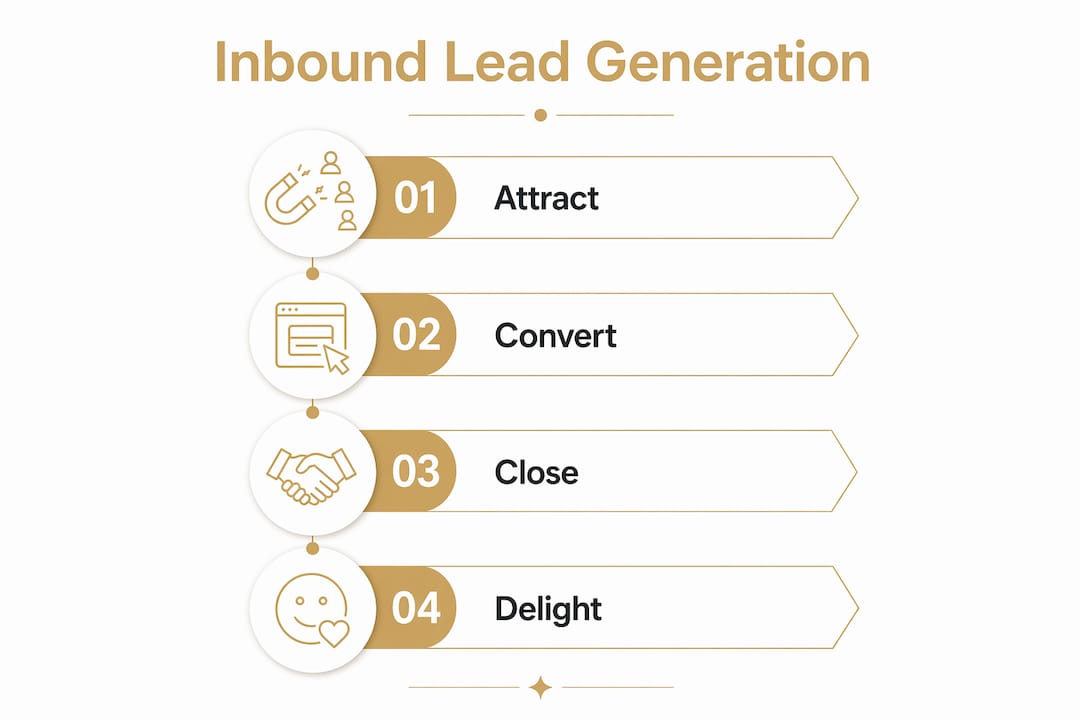
Inbound lead generation is built on four stages: attract, convert, close, and delight. Each stage has a specific job, and skipping one creates gaps that kill conversion rates.
The attract stage uses SEO, blog content, and social media to bring the right visitors to your site. The goal is not raw traffic. Inbound lead generation focuses on attracting the right audience actively researching solutions, not maximizing page views. A blog post ranking for “how to reduce customer churn in SaaS” attracts a buyer with a specific problem. A generic post about “business tips” attracts everyone and converts no one.

The convert stage turns visitors into leads through landing pages, forms, and content offers. This is where most B2B marketers leave money on the table. High-value gated assets outperform generic newsletters for lead capture. An ROI calculator, a detailed industry benchmark report, or a step-by-step playbook converts far better than a “subscribe to our newsletter” prompt. The reason is simple: the offer must match the visitor’s intent and stage in the buying process.
Content must align with where a buyer sits in the funnel:
Top of funnel (TOFU): Educational blog posts, how-to guides, and short videos that address broad awareness questions
Middle of funnel (MOFU): Case studies, comparison guides, and webinars that help buyers evaluate options
Bottom of funnel (BOFU): Free trials, demos, ROI calculators, and consultation offers that push toward a decision
The close and delight stages involve sales handoff, onboarding, and ongoing value delivery. Delight matters because satisfied customers become referral sources, which feeds the inbound cycle without additional spend.
Pro Tip: Focus on conversion quality, not volume. One hundred leads who match your ideal customer profile are worth more than one thousand leads who never intended to buy.
How does inbound lead generation differ from outbound?
Outbound lead generation pushes messages toward prospects who did not ask for them. Cold email campaigns, paid display ads, trade show booths, and telemarketing all fall into this category. Outbound can generate fast results, but it stops the moment you stop spending.
Inbound works differently. Inbound marketing builds compound marketing assets that continue generating leads after the initial investment. A well-optimized blog post written today can rank on Google and deliver leads three years from now. A cold email campaign from three years ago delivers nothing today.
Inbound leads carry higher conversion rates because they arrive with pre-existing interest before the first sales conversation. That pre-existing intent shortens sales cycles and reduces the cost of closing a deal.
Dimension | Inbound | Outbound |
|---|---|---|
Buyer intent | High, self-initiated | Low, interrupted |
Lead quality | Typically higher | Variable |
Cost over time | Decreases as assets compound | Stays flat or rises |
Speed to first lead | Slower (weeks to months) | Faster (days) |
Long-term ROI | Strong and compounding | Stops when budget stops |
The table above shows why most B2B companies use both methods but invest more heavily in inbound as they mature. Outbound fills the pipeline quickly. Inbound builds the foundation that makes outbound less necessary over time.
Why does lead nurturing matter for inbound programs?
Lead nurturing is the process of building relationships with leads who are not yet ready to buy by delivering relevant, timely content across multiple touchpoints. It is distinct from lead generation. Generation creates the contact. Nurturing converts that contact into a customer.
Lead nurturing is the strategic process that converts leads through relevant, stage-appropriate content to prevent disengagement. Without nurturing, most inbound leads go cold. A buyer who downloads a benchmark report on monday is rarely ready to speak with sales by friday. A nurture sequence keeps that buyer engaged until they are.
Effective nurturing tactics for B2B programs include:
Email sequences: A series of three to five emails triggered by a specific download or page visit, each delivering a new piece of value
Retargeting ads: Display ads that follow a lead across the web after they visit a key page, reinforcing your message without requiring them to return on their own
Sales alerts: Automated notifications to your sales team when a lead hits a lead score threshold, signaling readiness for outreach
Multi-channel touchpoints: LinkedIn connection requests, personalized video messages, and direct mail for high-value accounts
CRM alignment and lead scoring sit at the center of any functional nurture program. Lead scoring assigns point values to behaviors like opening an email, visiting a pricing page, or attending a webinar. When a lead crosses a score threshold, it triggers a sales handoff. Without this system, sales teams waste time on cold leads and miss warm ones.
Lead generation and lead nurturing are distinct but interdependent, requiring ongoing trust building after initial contact. The companies that treat nurturing as an afterthought consistently see lower conversion rates and longer sales cycles than those who build nurture programs before launching lead generation campaigns.
How to build an effective inbound lead generation strategy
A working inbound program starts with clear goals tied to revenue, not traffic. Successful inbound marketing ties goals directly to revenue outcomes to drive a scalable sales pipeline. That means defining how many qualified leads, demo requests, or closed deals the program needs to produce, then working backward to set content and conversion targets.
Follow these steps to build a program that delivers predictable results:
Define your ideal customer profile (ICP). Document the company size, industry, job title, and pain points of your best-fit buyers. Every content decision flows from this definition.
Map content to funnel stages. Create TOFU content that answers broad awareness questions, MOFU content that helps buyers evaluate options, and BOFU content that removes the final objections before a purchase.
Build high-value conversion offers. Replace generic newsletter sign-ups with specific assets tied to buyer pain points. An industry salary benchmark, a vendor evaluation checklist, or a cost-savings calculator converts at a higher rate than a generic content offer.
Set up your nurture sequences before launch. Build email sequences for each conversion offer before you publish. A lead who downloads your asset and receives nothing for two weeks is a lost opportunity.
Track metrics that connect to revenue. Monitor MQL-to-SQL conversion rate, cost per acquisition (CAC), and pipeline influenced by marketing. These numbers tell you whether inbound is working. Page views and social shares do not.
Audit and improve quarterly. Pull conversion data by content piece and offer type every quarter. Double down on what converts. Cut what generates traffic without leads.
Pro Tip: Avoid vanity metrics entirely. A blog post with 10,000 monthly visitors that generates zero leads is a cost center, not an asset. Tie every content investment to a measurable pipeline outcome.
Measuring revenue outcomes like demo requests and qualified leads ensures inbound marketing supports a scalable sales pipeline. Sales and marketing alignment is critical because handoff points are where inbound programs most often break down. Define what a qualified lead looks like in writing, and make sure both teams agree before the first lead enters the funnel.
Key Takeaways
Inbound lead generation works because it attracts buyers who are already searching for solutions, producing higher conversion rates and compounding returns that outbound methods cannot replicate.
Point | Details |
|---|---|
Definition is specific | Inbound lead generation attracts buyers through content they seek, not interruptions they ignore. |
Funnel alignment drives conversion | Map every content piece to TOFU, MOFU, or BOFU to match buyer intent at each stage. |
Nurturing prevents lead loss | Build email sequences and lead scoring before launching campaigns to keep leads engaged. |
Revenue metrics over vanity metrics | Track MQL-to-SQL rate, CAC, and pipeline influenced rather than traffic and social shares. |
Inbound compounds over time | Content assets keep generating leads long after creation, unlike outbound spend that stops when the budget stops. |
What I’ve learned from watching inbound programs succeed and fail
The most common mistake I see B2B marketers make is treating inbound lead generation as a content volume game. They publish three blog posts a week, grow their organic traffic, and then wonder why the pipeline stays flat. The problem is almost never the traffic. It is the offer.
Generic conversion offers are the single biggest drag on inbound performance. Most businesses still use newsletter sign-ups as their primary lead capture mechanism. Most businesses mistakenly use generic newsletter sign-ups which underperform compared to specific, high-value gated content aligned with buyer pain points. I have seen companies triple their lead capture rate simply by replacing a newsletter form with a targeted benchmark report or a free audit offer.
The second failure point is the sales and marketing handoff. Marketing generates a lead, marks it as an MQL, and drops it into the CRM. Sales looks at it, decides it is not ready, and ignores it. The lead goes cold. This happens because the two teams never agreed on what “qualified” means. Fix the definition first. Everything else follows.
The third thing I have learned is that content must be mapped to the buyer’s funnel stage and buying intent. High traffic without intent alignment yields low conversions. A company that writes exclusively for search volume, without asking whether the reader is ready to buy, will always struggle to close inbound leads. Write for readiness, not just reach.
— Mieke
How Flockleads delivers engineered lead flow for B2B companies
Building an inbound program from scratch takes time, and most B2B marketing teams do not have months to wait for organic content to compound. Flockleads solves that by delivering qualified leads directly to your website, engineered for the service businesses and B2B companies that need a predictable pipeline now.
Flockleads integrates with your existing inbound strategy rather than replacing it. The platform is built to send leads that match your ICP to your site, so your nurture sequences and sales team work with contacts who already have buying intent. You can see how it works and decide whether engineered lead flow fits your current pipeline goals. For B2B companies that want qualified leads without waiting years for SEO to compound, Flockleads is a direct path to a fuller funnel.
Frequently asked questions
What is inbound lead generation in simple terms?
Inbound lead generation is the practice of attracting potential buyers to your business through content, SEO, and targeted offers rather than cold outreach. Buyers find you because you publish what they are already searching for.
How does inbound lead generation differ from outbound?
Inbound pulls buyers toward you using content they seek out, while outbound pushes messages toward people who did not ask for them. Inbound leads convert at higher rates because they arrive with pre-existing intent.
What is lead nurturing and why does it matter?
Lead nurturing is the process of delivering relevant, stage-appropriate content to leads who are not yet ready to buy. Without nurturing, most inbound leads disengage before ever speaking with sales.
What metrics should I track for inbound lead generation?
Track MQL-to-SQL conversion rate, cost per acquisition, and pipeline influenced by marketing. Page views and social shares do not indicate whether inbound is driving revenue.
How long does inbound lead generation take to produce results?
Inbound programs typically take several months to generate consistent lead flow from organic content. Pairing inbound content with a service like Flockleads can accelerate pipeline results while organic assets build over time.
NEED A CLEARER PLAN?
Let’s turn your next move into momentum.
Talk to us →