THE SHORT ANSWER
A lead generation website is a site built with one job: turning visitors into contacts your sales team can actually follow up with. Unlike a standard business website that describes what you do and leaves visitors to browse, a lead gen site actively collects contact information through forms, gated content, and strategically placed calls to action.
A lead generation website is a site built with one job: turning visitors into contacts your sales team can actually follow up with. Unlike a standard business website that describes what you do and leaves visitors to browse, a lead gen site actively collects contact information through forms, gated content, and strategically placed calls to action. The visitor gets something useful, and you get a name and email address to work with.
The core mechanics are straightforward:
Forms and sign-ups: Visitors submit their name, email, and sometimes a phone number to access something valuable.
Gated content: Whitepapers, eBooks, webinars, and ROI calculators sit behind a form, so only people willing to identify themselves get access.
Consultation or demo requests: High-intent visitors book time directly with your sales team.
CRM integration: Captured contacts flow automatically into tools like Salesforce or HubSpot, where nurture sequences take over.
The end goal is not just a list of names. It is a pipeline of people who have already raised their hand and said they are interested, giving your team a real starting point instead of cold outreach.
How lead generation websites attract and convert visitors
Every lead generation website follows the same basic flow. Visitors arrive through organic search, paid ads, social media, or referral traffic. They land on pages built around a specific problem or need, get offered something worth their contact information, and either convert or leave.

The exchange principle is what separates a lead gen site from a brochure site. A visitor downloads a whitepaper and gets routed automatically into a CRM workflow. That workflow might send a follow-up email the next morning, assign the contact to a sales rep, and trigger a drip sequence over the next two weeks, all without anyone manually doing a thing.
Visitor acquisition channels typically include:
Organic search (SEO): Blog posts and landing pages optimized for keywords your prospects are already searching.
Paid ads: Google Ads and LinkedIn campaigns targeting specific job titles, industries, or behaviors.
Social media: LinkedIn outreach and content that drives traffic to a conversion page.
Referral traffic: Partner sites, directories, and press mentions that send warm visitors your way.
Once a visitor lands, lead scoring assigns points based on their behavior: which pages they visit, whether they attend a webinar, how long they spend on a pricing page. High-scoring leads get routed to sales immediately. Lower-scoring ones stay in automated nurture sequences until they are ready.
Pro Tip: Set up real-time alerts in your CRM so that a form submission triggers an immediate sales notification. Leads contacted within the first hour are far more likely to convert than those followed up with a day later.
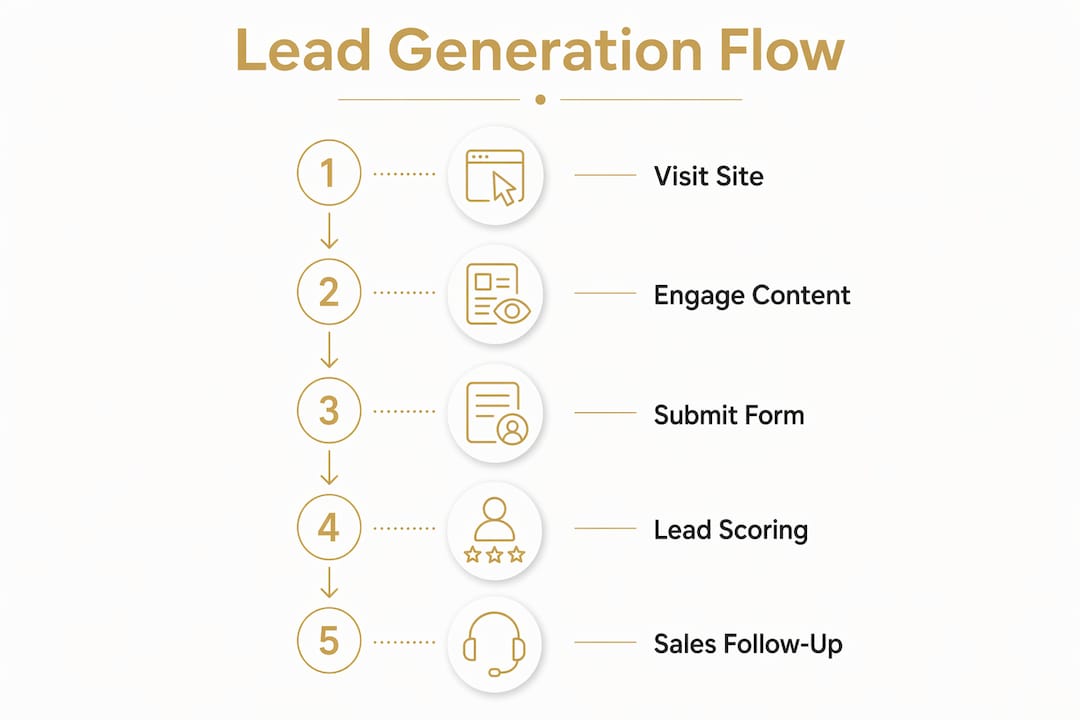
Effective lead generation treats the website as one component in a connected system, where form submissions lead to CRM alerts, which then trigger timely sales follow-up, ensuring leads remain engaged and the system functions efficiently.
How lead generation sites differ from standard business websites
A standard business website acts like a digital brochure. It tells visitors who you are, what you offer, and how to reach you. Visitors browse, maybe bookmark a page, and often leave without taking any action. There is nothing wrong with that for brand awareness, but it generates zero pipeline on its own.
A lead generation website treats every page as a conversion opportunity. Blog posts include content offers. Service pages feature consultation requests. Even the homepage guides visitors toward a specific action rather than leaving them to wander.
Feature | Standard business website | Lead generation website |
|---|---|---|
Primary purpose | Brand awareness and information | Capturing visitor contact information |
Design focus | Broad content, passive browsing | Targeted offers, clear conversion points |
Calls to action | Minimal or generic (“Contact us”) | Multiple, specific, and placed throughout |
Content strategy | Informational pages and blog posts | Gated content, lead magnets, landing pages |
Visitor outcome | Browses and leaves | Submits information and enters a nurture sequence |
CRM integration | Rarely connected | Central to the site’s function |
The design philosophy is the clearest difference. Standard sites give visitors many paths and let them choose. Lead gen sites narrow the path deliberately, guiding visitors toward one action per page. That focus is what drives multiple conversion points across the site rather than a single “Contact” page buried in the navigation.
What every effective lead generation website needs
Building a site that actually converts requires more than a form on the homepage. The components below work together; missing one tends to drag down the others.

Clear, specific calls to action
Generic CTAs like “Learn more” or “Contact us” underperform. Specific ones like “Download the free guide” or “Book a 15-minute call” tell visitors exactly what they are getting and what they need to do. Visitor engagement increases when content addresses a real pain point and the CTA offers a direct solution to it.
Optimized lead capture forms
Keep forms short. Asking for a name and email converts better than asking for a name, email, phone number, company size, and job title all at once. You can collect more information later once a relationship is established. Place forms above the fold on landing pages so visitors see them without scrolling.
Targeted landing pages
A dedicated landing page built around a single offer converts better than sending paid traffic to your homepage. Each page should match the ad or link that brought the visitor there, address one specific problem, and have one conversion goal. No navigation menu, no sidebar links, no distractions.
Valuable content offers
Gated content like eBooks, webinars, and consultation requests gives visitors a reason to hand over their contact information. The offer needs to be genuinely useful, not a thinly veiled sales pitch. A whitepaper that solves a real problem your audience faces will outperform a generic “industry report” every time.
Trust signals
Testimonials, client logos, security badges, and review counts reduce the friction visitors feel before submitting a form. A visitor who is on the fence about sharing their email address is more likely to convert when they see that others have done so and gotten value from it.
CRM and marketing automation integration
A lead captured without a follow-up system is a lead that goes cold. Integrating your CRM with LinkedIn strategy and other acquisition channels keeps your pipeline synchronized and your follow-up timely. Marketing automation platforms handle drip email sequences, lead scoring, and routing automatically, so your team focuses on the leads most likely to close.
Mobile responsiveness and fast load times
A site that loads slowly or breaks on a phone loses visitors before they ever see your offer. Mobile responsiveness and fast load times are technical requirements, not optional polish.
Analytics and tracking
You cannot improve what you do not measure. Google Analytics, heatmaps, and form analytics show you where visitors drop off, which pages convert, and which traffic sources bring the best leads. That data drives every optimization decision.
Continuous A/B testing
Successful lead generation strategies in 2026 require continuous A/B testing to optimize conversions. Test your headline copy, CTA button text, form length, and page layout. Small changes to a high-traffic landing page can produce meaningful lifts in conversion rate over time.
Pro Tip: Run one A/B test at a time on your highest-traffic landing page. Testing too many variables simultaneously makes it impossible to know what actually moved the needle.
How Flockleads puts this into practice for B2B companies
Flockleads builds engineered lead flow systems for B2B service businesses, combining the site-level conversion architecture described above with outbound intent-based outreach. The approach mirrors what the 2026 hybrid model recommends: inbound SEO-driven content for sustainable long-term leads, paired with outbound tactics that respond to immediate buying signals.
If you want leads coming to your website instead of chasing them manually, see how it works and find out whether Flockleads is the right fit for your business.
Key Takeaways
A lead generation website converts visitors into contacts by offering value in exchange for information, then routing those contacts into automated CRM and nurture workflows.
Point | Details |
|---|---|
Core purpose | A lead gen site captures contact information through forms, gated content, and CTAs, not just traffic. |
Exchange principle | Visitors trade their contact details for something valuable, like a whitepaper, demo, or consultation. |
CRM integration | Form submissions should trigger immediate CRM alerts and automated follow-up to prevent leads going cold. |
Key design difference | Lead gen sites place conversion points on every page; standard business sites leave visitors to browse freely. |
Continuous testing | A/B testing headlines, CTAs, and form length on high-traffic pages improves conversion rates over time. |
Frequently asked questions
What are lead generation websites?
A lead generation website is a site designed to capture visitor contact information through forms, gated content, and calls to action, then route those contacts into a sales or nurture workflow.
What is lead generation, with an example?
Lead generation is the process of attracting potential customers and collecting their contact details. A B2B SaaS company offering a free whitepaper download in exchange for an email address is a straightforward example: the visitor gets useful content, and the company gets a qualified contact to follow up with.
What is the primary purpose of a lead generating website?
The primary purpose is to convert anonymous site visitors into identified prospects your sales team can contact. Every design decision, from the CTA placement to the form length, serves that single goal.
How does a lead generation website differ from a landing page?
A landing page is one page focused on a single conversion goal. A lead generation website is an entire site built around capturing leads, with multiple pages and conversion opportunities working together across the visitor journey.
What tools do lead generation websites typically integrate with?
Most lead generation websites connect with CRM platforms like Salesforce or HubSpot and marketing automation tools that handle lead scoring, drip email sequences, and sales routing automatically.
NEED A CLEARER PLAN?
Let’s turn your next move into momentum.
Talk to us →