THE SHORT ANSWER
Social media marketing is the practice of using social platforms to build brand presence, connect with customers, and drive measurable business results. For business owners and marketers asking what is social media marketing, the short answer is this: it combines organic content, paid advertising, influencer partnerships, and community management into a single, coordinated effort.
Social media marketing is the practice of using social platforms to build brand presence, connect with customers, and drive measurable business results. For business owners and marketers asking what is social media marketing, the short answer is this: it combines organic content, paid advertising, influencer partnerships, and community management into a single, coordinated effort. The top benefits include increased exposure (83%), traffic (71%), leads (62%), and improved sales (46%). Those numbers reflect why social media has become a non-negotiable channel for businesses of every size.
What is social media marketing and how does it work?
Social media marketing is defined as the strategic use of platforms like Facebook, Instagram, YouTube, LinkedIn, TikTok, and X to achieve specific business goals. It is not simply posting content. It is a system that connects brand messaging to audience behavior, then measures the result.
The discipline splits into two distinct functions. Strategy covers the “what” and “why”: which goals to pursue, which audiences to reach, and which messages to deliver. Management covers the “how” and “when”: scheduling posts, responding to comments, and running paid campaigns. Separating strategy from management prevents fragmented messaging and keeps brand voice consistent across every platform.
Facebook holds over 3 billion monthly active users. YouTube exceeds 2.5 billion. Those two platforms alone represent a reach no traditional media channel can match. Platform choice, however, depends on where your specific audience spends time, not on raw user numbers.

What are the main components of a social media strategy?
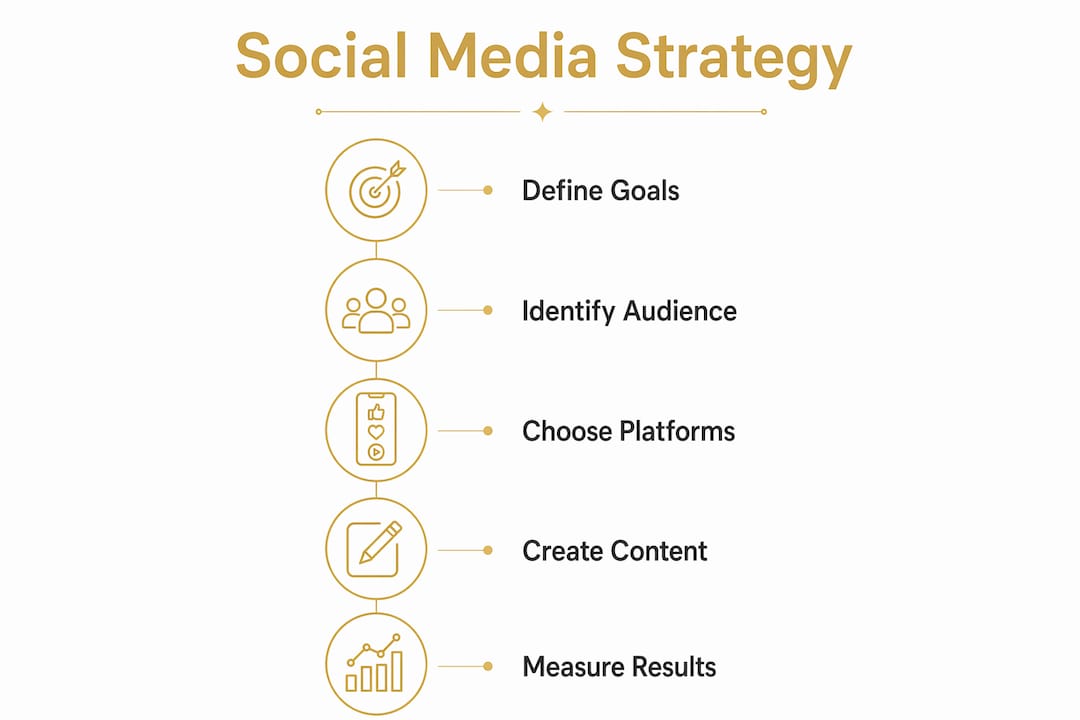
An effective social media marketing strategy follows a repeatable cycle. Each step builds on the previous one, and skipping any step creates gaps that show up in your results.
Set SMART goals. Every campaign needs a specific, measurable objective. “More followers” is not a goal. “Generate 50 qualified leads per month from LinkedIn” is.
Define your audience. Age, industry, job title, and platform behavior all shape which content works. A B2B audience on LinkedIn responds differently than a consumer audience on TikTok.
Choose content pillars. Pick three to five recurring themes that reflect your brand’s expertise. For a B2B service company, those might be case studies, industry news, and client results.
Select platforms strategically. Platform selection should match audience presence and marketing goals. Instagram, LinkedIn, TikTok, Facebook, YouTube, and X each serve different demographics and content formats.
Build a content calendar. Consistency matters more than volume. Posting three times per week on two platforms outperforms posting daily on five platforms with no coherent plan.
Analyze and refine. Review performance data monthly. Double down on what earns engagement. Cut what does not.
Brands that try to execute every method at once rarely succeed. Combining three to four methods, such as organic content, paid ads, and influencer partnerships, produces better results than spreading effort across every available tactic.
Pro Tip: Start with one or two platforms where your audience is most active. Master those before expanding. Gradual scaling beats scattered presence every time.
Why is social media marketing vital for brand growth?
Social media is now a critical touchpoint in the customer journey, not just a broadcast channel. Customers discover brands, research products, and make purchase decisions without ever leaving their feed. 63% of Gen Z and 49% of millennials report that social media ads or recommendations significantly influence their purchasing decisions. That shift in consumer behavior means brands that ignore social media lose discovery opportunities to competitors who show up consistently.
Social platforms also function as real-time intelligence tools. Comments, shares, and direct messages reveal what customers actually want, what frustrates them, and what language they use to describe their problems. Smart marketers treat this data as product research, not just feedback.
“Social media now serves as both the voice and the ears of the organization. It drives customer engagement and provides real-time market intelligence that shapes innovation and reputation management.”
Social listening, the practice of monitoring brand mentions and industry conversations, gives businesses early warning of reputation risks. It also surfaces unmet needs that can inform new products or services. Community management and social listening reduce customer service workload by addressing common questions publicly, which builds trust at scale.
The brands that grow fastest on social media do not just broadcast. They earn attention by creating content that people choose to engage with. Authentic connection in the attention economy is the competitive advantage that no ad budget alone can buy.
How to implement social media marketing effectively
Execution separates brands that grow from brands that stall. The following practices define what effective implementation looks like in practice.
Match platform to audience. LinkedIn works for B2B lead generation. Instagram and TikTok work for visual consumer brands. YouTube works for long-form education and product demonstrations. Choosing the wrong platform wastes budget and effort.
Create content that earns engagement. Useful, specific, and honest content outperforms polished but generic content. A short video explaining a real client problem gets more shares than a branded graphic with a tagline.
Post consistently. Algorithms on every major platform reward accounts that publish on a regular schedule. Inconsistent posting signals low priority to both the algorithm and the audience.
Manage your community actively. Responding to comments and messages within 24 hours signals that a real person is behind the account. That responsiveness builds loyalty faster than any single piece of content.
Measure what matters. Track metrics tied to your SMART goals: reach for awareness campaigns, click-through rate for traffic goals, and cost per lead for paid campaigns. Vanity metrics like total followers rarely correlate with revenue.
Pro Tip: Use native analytics on each platform before investing in third-party tools. Facebook Insights, LinkedIn Analytics, and Instagram’s built-in dashboard give you enough data to make smart decisions at no extra cost.
The biggest implementation mistake is treating social media as a one-way channel. Brands that engage customers where they spend hours daily, rather than just broadcasting messages, build communities that generate referrals and repeat business.
What trends and challenges are shaping social media marketing now?
The channel is changing faster than most marketing playbooks can keep up with. Three forces are reshaping how businesses approach social media marketing in 2026.
Generative AI and authenticity. AI tools have made content production faster and cheaper. The tradeoff is real: 43% of marketing professionals cite maintaining authenticity as their top challenge when using AI-generated content. Audiences detect generic, templated content quickly, and it erodes trust. The brands winning with AI use it for ideation and drafts, then apply human judgment before publishing.
Advertising spend growth. Global social media advertising spending surpassed $275 billion in 2025 and is projected to exceed $480 billion by 2030. That growth signals both opportunity and increased competition for audience attention. Organic reach alone is no longer sufficient for most brands.
Social media as a search engine. Platforms like TikTok and Instagram are increasingly rivaling Google and AI chatbots as discovery engines. Younger audiences search for product reviews, tutorials, and brand comparisons directly on social platforms. Optimizing content for in-platform search is now as important as traditional SEO for many categories.
Trend | Business impact |
|---|---|
Generative AI in content creation | Faster output, but authenticity requires human oversight |
Rising ad spend | Higher competition for attention; organic reach declines |
Social search growth | Content must be discoverable within platforms, not just on Google |
Social listening as intelligence | Real-time data informs product and service decisions |
Key Takeaways
Social media marketing drives business growth when strategy, consistent execution, and real-time audience intelligence work together as a single system.
Point | Details |
|---|---|
Definition matters | Social media marketing combines organic content, paid ads, and community management toward specific business goals. |
Strategy before management | Set SMART goals and define audiences before scheduling a single post. |
Platform selection is critical | Choose platforms based on where your audience is active, not on platform size alone. |
Authenticity beats volume | Consistent, genuine content earns more engagement than high-frequency generic posting. |
Measure tied to goals | Track reach, click-through rate, or cost per lead depending on your campaign objective. |
Social media marketing requires more than posting
Most business owners I work with treat social media as a task, not a system. They post when they have time, respond to comments when they remember, and measure success by follower count. That approach produces inconsistent results and eventually leads to abandoning the channel entirely.
The insight that changed how I think about this: social media marketing is a business intelligence function, not just a communication channel. The comments on your posts tell you what your customers actually care about. The content that gets shared tells you which messages resonate. Brands that read those signals and act on them make better product decisions, write better ads, and build stronger customer relationships.
The other mistake I see constantly is conflating strategy with management. A business owner who spends two hours a day scheduling posts but has never defined a content pillar or a SMART goal is doing management without strategy. The result is activity without direction. Separating those two functions, even if one person handles both, creates clarity that shows up in the results.
Authenticity is not a soft concept. It is a measurable competitive advantage. The brands that grow sustainably on social media are the ones that show up as real, specific, and useful. No AI tool replaces that. It has to come from a genuine understanding of your audience and a willingness to say something worth hearing.
— Mieke
How Flockleads fits into your social media marketing system
Social media marketing generates attention. The real challenge is converting that attention into a consistent flow of qualified leads. Flockleads is built for exactly that problem.

Flockleads helps B2B service businesses turn website traffic into a steady lead engine, whether that traffic comes from organic social content, paid campaigns, or influencer referrals. The platform is designed for businesses that want leads arriving predictably, not in bursts tied to a single campaign. If your social media marketing is generating clicks but not converting them into pipeline, Flockleads gives you the infrastructure to close that gap.
Frequently asked questions
What is the social media marketing definition?
Social media marketing is the use of social platforms to build brand awareness, engage audiences, and drive business outcomes through organic content, paid advertising, and community management.
What platforms are used for social media marketing?
The main platforms are Facebook, Instagram, YouTube, LinkedIn, TikTok, and X. Platform choice depends on your audience demographics and marketing goals.
What are the top benefits of social media marketing?
The top benefits include increased brand exposure (83%), website traffic (71%), lead generation (62%), and improved sales (46%), based on global marketing research.
How do you measure social media marketing success?
Measure success using metrics tied to your goals: reach for awareness, click-through rate for traffic, and cost per lead for paid campaigns. Avoid relying on follower count alone.
How does social media marketing differ from social media management?
Strategy defines goals, audiences, and content direction. Management handles scheduling, posting, and community engagement. Both are necessary, but confusing them leads to activity without results.
NEED A CLEARER PLAN?
Let’s turn your next move into momentum.
Talk to us →