THE SHORT ANSWER
Top of funnel B2B marketing, known in the industry as TOFU (Top of Funnel), is the awareness stage where potential buyers first recognize a problem and begin searching for educational content before they consider any purchase. At this stage, prospects are not evaluating vendors.
Top of funnel B2B marketing, known in the industry as TOFU (Top of Funnel), is the awareness stage where potential buyers first recognize a problem and begin searching for educational content before they consider any purchase. At this stage, prospects are not evaluating vendors. They are asking broad questions like “why is our sales cycle so long?” or “how do other companies generate leads?” Your job is to answer those questions better than anyone else. Industry standards recommend that 60–70% of total B2B content production targets TOFU to maximize discovery and feed the rest of the funnel. That single allocation rule explains why TOFU is the engine behind every healthy B2B pipeline.
What is top of funnel B2B, and what does it actually measure?
TOFU’s primary goal is awareness and education about problem categories, not product sales. That distinction matters more than most B2B marketers realize. When a prospect lands on your content for the first time, they are not ready to buy. They are trying to understand whether their problem is real, how common it is, and what category of solution exists.
The metrics that reflect TOFU success are traffic volume, social engagement, and time on page. Sales conversion rate is not a TOFU metric. Tracking demos booked from a blog post that targets a broad awareness keyword will produce misleading data and bad decisions.
47% of B2B buyers consume between 3 and 5 pieces of educational content before engaging with a sales team. That number tells you something concrete: buyers are doing independent research long before they raise their hand. If your content is not present during that research phase, a competitor’s content is.
TOFU also builds brand recognition that compounds over time. A prospect who reads your guide today may not convert for six months. When they finally enter a buying cycle, your brand is already familiar. That familiarity shortens sales cycles and increases close rates downstream.
Pro Tip: Set up a separate analytics view for TOFU content. Track average time on page and scroll depth, not form fills. If readers spend less than 60 seconds on a 1,500-word guide, the content is not matching search intent.
Which content types and channels work best for B2B TOFU?
TOFU content formats that consistently perform include blog posts, how-to guides, explainer videos, infographics, and glossary pages. Each format serves the same purpose: answer a question the prospect is already asking. The format choice depends on where your audience spends time and how they prefer to consume information.

SEO is the most durable TOFU channel in B2B. A well-optimized blog post targeting a question keyword can generate qualified traffic for years without additional spend. Paid promotion accelerates early visibility but stops the moment budget stops. Organic search compounds. The best TOFU programs use both: paid to test which topics resonate, organic to build lasting authority.
Social media extends reach and drives engagement, particularly on LinkedIn for B2B audiences. Sharing a guide on LinkedIn does not replace SEO. It amplifies content that already exists and creates additional touchpoints with prospects who are not yet searching.
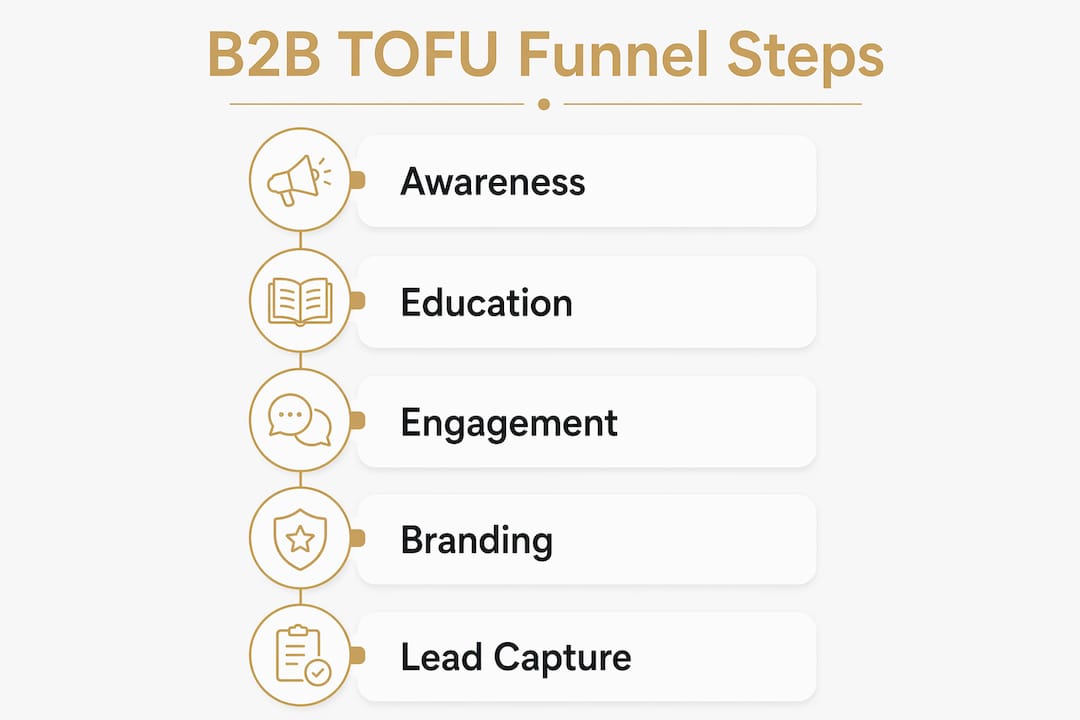
The most common TOFU channel mistake is targeting broad keywords that attract irrelevant audiences. High traffic with irrelevant topics harms funnel quality and brand authority. A software company that ranks for “what is a spreadsheet” will get traffic. None of it will convert into pipeline.
Effective TOFU content targets the actual questions your ideal buyers type into search engines. Use keyword research tools to find question-based queries in your category. Then write content that answers those questions completely.
Blog posts targeting problem-aware search queries
How-to guides that explain solution categories without naming products
Explainer videos under five minutes covering industry concepts
Infographics summarizing research or frameworks
Glossary pages defining terms your buyers search for
Pro Tip: Interview your sales team about the questions prospects ask in the first discovery call. Those questions are your TOFU content calendar. Prospects who found your content before the call will already know the answers, which moves the conversation faster.
How does TOFU fit into the full B2B marketing funnel?
B2B marketing funnels typically have four main stages: awareness, consideration, intent, and purchase. TOFU covers awareness. The middle of funnel (MOFU) covers consideration, where buyers evaluate solution categories and compare approaches. The bottom of funnel (BOFU) covers intent and purchase, where buyers choose a specific vendor.
Each stage requires a different message. At TOFU, the message is “here is how to understand your problem.” At MOFU, the message shifts to “here is how different solutions compare.” At BOFU, the message becomes “here is why our company is the right choice.” Mixing these messages at the wrong stage breaks the buyer’s trust.
B2B funnels are more complex than B2C because multiple stakeholders are involved and sales cycles run longer. A single purchase decision may involve a marketing director, a CFO, and an IT lead, each consuming content at different funnel stages simultaneously. TOFU content must speak to the problem broadly enough to resonate with all of them.
The table below shows how the three primary funnel stages differ in focus, content type, and success metric.
Funnel stage | Primary focus | Content examples | Key metric |
|---|---|---|---|
TOFU (awareness) | Educate on the problem | Blog posts, guides, videos | Traffic, time on page |
MOFU (consideration) | Compare solution approaches | Case studies, webinars, whitepapers | Leads, email signups |
BOFU (decision) | Justify vendor selection | Demos, pricing pages, testimonials | Demos booked, close rate |
A Forrester study found that 47% of B2B buying decisions involve significant activity at the MOFU stage. That means TOFU content must be strong enough to move buyers into consideration. Weak TOFU means thin MOFU, which means a starved pipeline.
Some B2B teams now use the Flywheel model, which replaces the linear funnel with a circular loop where customers become advocates who feed new awareness. The Flywheel does not eliminate TOFU. It adds a referral layer on top of it. TOFU remains the entry point for buyers who have not yet heard of your brand.
What are the most common TOFU mistakes, and how do you fix them?
The biggest barrier to effective TOFU is treating it as a conversion stage. Attempting to convert buyers at TOFU increases bounce rates and erodes trust. A prospect who lands on a blog post and immediately sees a pop-up asking for a demo will leave. They were not ready for that conversation.
The second most common mistake is prioritizing traffic volume over audience quality. More visitors is not better if those visitors have no connection to your product category. Audience quality at TOFU dictates funnel health more than sheer visitor numbers. Irrelevant traffic inflates vanity metrics and produces no pipeline.
The third mistake is content imbalance. Teams that invest heavily in BOFU content (pricing pages, case studies, demos) while neglecting TOFU will eventually see their pipeline thin out. Content imbalance with too little TOFU starves middle and bottom funnel stages over time. The fix is a deliberate content allocation review every quarter.
Here is a practical framework for fixing common TOFU problems:
Audit your existing content. Categorize every piece as TOFU, MOFU, or BOFU. Most teams discover they have far more BOFU content than they realized.
Map content to buyer questions. For each TOFU piece, confirm it answers a question a prospect would ask before they know your brand exists.
Remove conversion friction from TOFU pages. Replace demo CTAs with low-commitment offers like newsletter signups or downloadable guides.
Measure engagement, not conversions. Set TOFU success benchmarks around time on page, scroll depth, and return visits.
Publish consistently. Consistent content production weighted 60–70% at TOFU creates compounding assets that feed downstream funnel stages sustainably.
Pro Tip: Use a content calendar with explicit funnel-stage labels for every piece. If your next 12 planned pieces are all BOFU, your pipeline will feel the gap in about 90 days.
Key Takeaways
TOFU is the awareness stage of the B2B marketing funnel, and its health directly determines how many qualified leads reach MOFU and BOFU.
Point | Details |
|---|---|
TOFU is not a conversion stage | Measure traffic, engagement, and time on page, not demos or sales. |
Content allocation matters | Allocate 60–70% of content production to TOFU to sustain pipeline volume. |
Audience quality beats volume | Irrelevant traffic harms funnel health and brand authority over time. |
Funnel stages need different messages | TOFU answers “what is the problem,” BOFU answers “why choose us.” |
Consistent publishing compounds | Regular TOFU content builds lasting assets that feed MOFU and BOFU sustainably. |
Why most B2B teams underinvest in TOFU until it’s too late
Most B2B marketing teams I have worked with share the same blind spot: they measure marketing by pipeline and revenue, which means TOFU never looks productive on a short-term dashboard. A blog post that gets 2,000 readers and zero form fills looks like a failure. Six months later, three of those readers are in a demo. The attribution model never connects the dots.
The shift I always recommend is treating TOFU as brand infrastructure, not a lead generation tactic. You do not measure a billboard by how many people called the number that day. You measure it by whether the right people saw it repeatedly. TOFU content works the same way.
The teams that get this right publish consistently, target real buyer questions, and resist the urge to gate everything behind a form. They treat their blog and video library as a public resource that earns trust before a buyer ever raises their hand. That trust is what makes the sales conversation easier when it finally happens.
The teams that get it wrong chase traffic numbers, publish content that is too product-focused for the awareness stage, and then wonder why their pipeline is lumpy. TOFU is a long game. The marketers who play it well build pipelines that are predictable, not reactive.
— Mieke
How Flockleads helps B2B companies build a healthier top of funnel
Building a consistent TOFU content engine takes time, and most B2B marketing teams are already stretched thin. Flockleads is built for exactly this situation.
Flockleads generates qualified leads for B2B companies by driving targeted traffic directly to your website. The approach is built around engineered lead flow, which means every visitor is matched to your actual buyer profile, not just anyone who clicks an ad. For service businesses that need a steady, predictable flow of qualified prospects, Flockleads handles the top of funnel work so your sales team can focus on the conversations that close. Learn more about how Flockleads works and what a healthier pipeline looks like for your business.
Frequently asked questions
What is top of funnel in B2B marketing?
Top of funnel (TOFU) in B2B marketing is the awareness stage where prospects first recognize a problem and seek educational content. The goal is to educate, not sell.
What metrics should I track for TOFU?
Track traffic volume, time on page, scroll depth, and social engagement. Sales conversions are not a reliable TOFU metric because buyers at this stage are not ready to purchase.
What is the difference between TOFU, MOFU, and BOFU?
TOFU covers awareness, MOFU covers consideration and solution comparison, and BOFU covers vendor selection and purchase. Each stage requires different content and a different message.
How much content should target the top of funnel?
Industry standards recommend allocating 60–70% of total content production to TOFU. That ratio ensures enough awareness-stage content to feed consideration and decision stages downstream.
Why does TOFU content fail to generate leads?
TOFU content is not designed to generate leads directly. It builds brand familiarity and trust that converts into leads at MOFU and BOFU, often weeks or months after the first touchpoint.
NEED A CLEARER PLAN?
Let’s turn your next move into momentum.
Talk to us →