THE SHORT ANSWER
Consistent leads are the single most important control a small business has over revenue predictability. Without a steady inflow of qualified prospects, every other business decision — hiring, pricing, investment — becomes a guess. Start a 30-day lead rhythm today: set up a capture form, define a qualification question, and commit to a same-day follow-up protocol.
Consistent leads are the single most important control a small business has over revenue predictability. Without a steady inflow of qualified prospects, every other business decision — hiring, pricing, investment — becomes a guess. Start a 30-day lead rhythm today: set up a capture form, define a qualification question, and commit to a same-day follow-up protocol.
This week, track three things:
Total leads received (volume)
Percentage that match your ideal customer profile (quality proxy)
Average time from inquiry to first human response (response time)
Those three numbers tell you more about pipeline health than any vanity metric. If lead volume is low, the problem is reach. If quality is low, the problem is targeting or messaging. If response time is slow during business hours, you’re losing deals before the conversation starts.
What do ‘consistent leads’ actually mean for a service business?
Consistent leads are not a flood of inquiries. They are a steady, predictable inflow of qualified prospects at a cadence your team can actually handle and convert. For a solo contractor, that might be several qualified inquiries per month. For a five-person B2B service firm, it might be dozens. The number matters less than the rhythm.
Volume and quality are two separate problems, and confusing them is one of the most common mistakes small business owners make. High volume with poor fit wastes sales time and inflates your cost per acquisition. Low volume with perfect fit starves the pipeline. The goal is enough qualified prospects, arriving regularly, to support your capacity and growth plan.
“Most newly generated leads don’t immediately result in a purchase. Lead nurturing is the process of developing and reinforcing relationships with buyers at every stage of the sales funnel — providing the information and answers needed to build trust until they’re ready to buy.” — Oracle CX
Seasonality is real and often underestimated. Home services spike in spring and fall. B2B consulting slows in late November and August. A roofing contractor who generates many leads per week in May and fewer in January does not have a lead generation problem in January — they have a cash flow planning problem. Knowing your seasonal baseline lets you distinguish a normal dip from a structural failure in your pipeline.
Service businesses typically convert a moderate share of qualified leads into paying customers, depending on deal size, competition, and follow-up quality. The precise conversion rate will vary; improving messaging and follow-up speed usually has more impact than increasing ad spend.

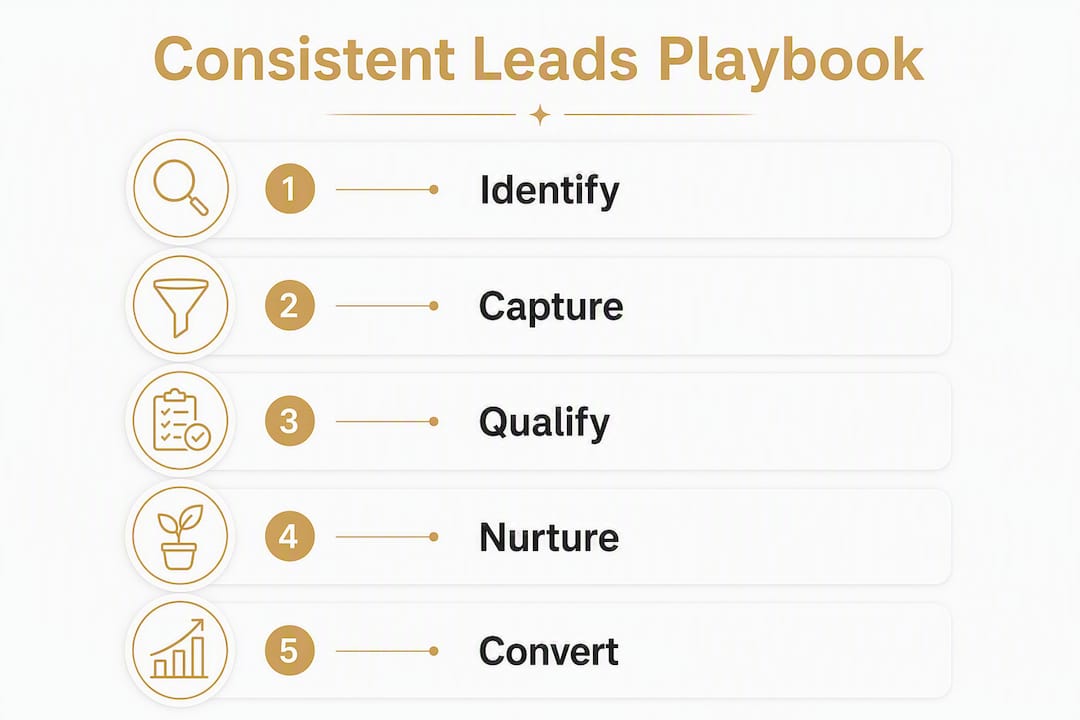
What happens when your lead flow goes inconsistent?
The most immediate consequence is pricing pressure. When the pipeline runs dry, owners discount to close whatever is in front of them. That reactive pricing trains clients to expect lower rates and erodes margin across the board. A feast-or-famine cycle doesn’t just hurt revenue — it changes how you sell.
Operationally, the damage compounds fast:
Staffing mismatches: You hire during a busy stretch, then can’t cover payroll when leads dry up. Or you turn away work because you’re understaffed during a surge.
Unused capacity: Equipment, software subscriptions, and salaried staff cost money whether or not you have clients to bill.
Overtime burn: When a lead surge hits an unprepared team, quality drops and burnout follows.
The sales consequences are subtler but just as damaging. Lead generation that runs consistently supplies richer interaction history, which shortens deal cycles and improves close rates. When leads arrive sporadically, your sales conversations start cold every time. You lose the referral momentum that builds when clients overlap — one happy client refers another while the relationship is fresh, not six months later when they’ve moved on.
Three quick scenarios that illustrate the pattern:
Small contractor: Books solid for three months, stops marketing, then spends two months with almost no new work. Takes emergency jobs at below-market rates to cover overhead.
Local service provider (cleaning, landscaping): Relies entirely on one referral source. That source moves or stops recommending them. Revenue drops significantly with no backup channel.
B2B consultant: Lands a large retainer, deprioritizes outreach for six months. When the retainer ends, the pipeline is empty and rebuilding takes another three to four months.
All three situations share the same root: no system running in the background while the current work gets done.
Why does lead flow become inconsistent in the first place?
Most pipeline problems trace back to one of five causes. Identifying yours takes about thirty to sixty minutes of honest self-assessment.
The five root causes:
Single-channel dependency. One ad platform, one referral partner, one directory listing. When that source hiccups, everything stops. Over-reliance on a single source is the most common failure mode in small business lead generation.
Weak or unclear offer. If your messaging doesn’t answer “why you, why now, why at this price,” prospects don’t convert. Broad, generic positioning attracts browsers, not buyers.
Poor capture or follow-up systems. A form that doesn’t notify anyone, a CRM nobody checks, or a response time measured in days rather than minutes. Human follow-up within minutes of a qualified inquiry materially improves conversion — hours-long delays do not.
Audience mismatch. Targeting too broadly, or targeting the wrong segment entirely. Ads reaching people who can’t afford your service generate volume without revenue.
Stopping when things are good. Businesses that pause marketing after hitting short-term goals reliably create the next dry spell. The pipeline has a lag — what you do today shows up as revenue in sixty to ninety days.
30-minute diagnostic checklist:
List every channel currently sending you leads. If it’s fewer than three, single-channel dependency is your primary risk.
Pull your last thirty days of inquiries. If a low percentage matched your ideal customer profile, this signals a targeting or messaging problem.
Check your average response time to new inquiries. Over two hours during business hours is a conversion leak.
Review your last three months of lead volume by week. If you see wide swings from week to week, that’s a consistency problem, not a seasonality problem.
Ask: did you actively market last month, or did you coast on existing work? Honest answer reveals whether the problem is structural or behavioral.
Pro Tip: Set a recurring Monday morning calendar block — thirty minutes — to review last week’s lead count, response times, and channel performance. Owners who do this weekly catch problems in days, not months.
How consistent leads measurably change your business performance
The business case for steady lead flow isn’t abstract. It shows up in specific numbers that owners track every month.

CRM integration, lead scoring, and automated nurture sequences improve lead-to-customer conversion and lower wasted sales effort. When those systems run on a consistent inflow, the compounding effect on revenue is significant. A predictable lead rhythm also enables safer hiring and investment decisions because monthly revenue forecasts become actionable within a small error band.
Measurable outcomes from pipeline stability:
Lower customer acquisition cost (CAC) as messaging and targeting improve with sustained outreach
Higher lead-to-customer conversion rates from faster follow-up and better-fit prospects
Steadier monthly cash flow that supports payroll and vendor commitments
Hiring confidence — you can bring on staff when the pipeline justifies it, not in a panic
Sustained outreach improves targeting and message-market fit over time, which means the quality of leads tends to rise even when volume stays flat. That’s the compounding effect: the same budget produces better results in month six than in month one.
KPI | Unstable pipeline | Stable pipeline |
|---|---|---|
Lead volume variance (week-to-week) | large swings | relatively small swings |
Lead-to-customer conversion rate | lower range | higher range |
Average response time to inquiry | multiple hours | under an hour |
CAC trend (month 3 vs. month 9) | Flat or rising | Declining |
Revenue forecast accuracy | ±40% | ±10–15% |
The conversion rate gap between an unstable and stable pipeline is not primarily a marketing problem. It’s a systems problem. Faster response, better qualification, and consistent follow-up account for most of the difference.
A 90-day playbook to build steady lead flow
The sequence matters. Owners who try to automate before they’ve confirmed their capture and qualification systems are working waste money and time. Do this in order.
Phase 0: Days 1–7 — capture and qualify
Audit every place a prospect can contact you (website form, phone, email, social DMs). Confirm each one notifies a real person within five minutes.
Add one qualifying question to your primary contact form: budget range, project type, or timeline. This alone filters out a large share of poor-fit inquiries.
Set a response SLA: first human contact within sixty minutes during business hours. Write it down and assign it to a specific person.
Create a simple spreadsheet with four columns: date, source, qualified (yes/no), outcome. Fill it daily.
Phase 1: Days 8–30 — daily outreach rhythm and channel diversification
Identify your three best-performing channels from the past six months. If you only have one, add two more from this list: Google Search Ads, Google Local Services, Meta Ads, LinkedIn Ads, a relevant directory, or a referral program.
Commit to one outreach action per day: a LinkedIn connection request, a follow-up email to a warm prospect, a Google Business Profile post, or a referral ask from a recent client.
Daily lead generation builds momentum that sporadic campaigns don’t produce. Small, repeated actions compound into a pipeline over months.
Phase 2: Days 31–90 — automation and nurture
Set up a three-email nurture sequence for leads that don’t convert immediately: a value piece, a case study or proof point, and a direct offer. Space them five to seven days apart.
Use your CRM (even a free one like HubSpot CRM) to tag leads by stage and source. This lets you see which channels produce the highest-quality prospects, not just the most volume.
Reserve human follow-up for high-value leads. Automation handles the rest. A six-step framework covering capture, diversification, qualification, automated follow-up, and measurement is the reliable path from sporadic to consistent leads.
Prioritization rule: If you have no leads, fix capture and reach first. If you have leads but low conversion, fix qualification and follow-up speed. If you have good conversion but high CAC, fix targeting and channel mix.
Pro Tip: Build a one-page lead-tracking dashboard in Google Sheets. Five columns: week, lead count, qualified count, conversions, and source. Review it every Monday. You’ll spot problems in real time instead of at the end of a bad quarter.
How long does each channel take to produce reliable leads?
Every channel has a ramp period before it delivers predictable volume. Owners who expect immediate results from SEO or referral programs set themselves up for disappointment and premature abandonment.
Channel | Ramp time to reliability | Typical monthly spend | Reliability |
|---|---|---|---|
4–8 weeks | — | High (scales with budget) | |
Google Local Services | 2–6 weeks | Pay-per-lead | High for local service |
4–8 weeks | — | Medium (creative-dependent) | |
6–10 weeks | — | Medium-high for B2B | |
4 weeks | — | Low-medium | |
SEO / organic | 4 months | Time + ongoing monthly cost | High (long-term) |
Referral programs | 2–6 months | Low cost | High (relationship-dependent) |
1–2 weeks | Pay-per-lead | Medium (shared leads) |
Practical limits matter as much as ramp time. Google Search Ads scale well but hit a ceiling when search volume in your niche is limited. Meta Ads require fresh creative every four to six weeks or performance drops from ad fatigue. Directories saturate quickly in competitive markets. SEO takes the longest to ramp but produces the lowest long-term CAC of any channel.
Diversifying entry points — paid, organic, listings, and referrals — reduces volatility. The recommended approach staggers investment so channels reach reliability at different times, which means you’re never dependent on a single source recovering.
Pro Tip: Start with one paid channel and one free channel simultaneously. The paid channel gives you leads while the free channel (SEO, referrals, or a directory listing) builds in the background. By month three, you’ll have data on which paid channel converts best before you scale spend.
How do you measure lead consistency and predict next month’s volume?
Tracking the right numbers is what separates owners who react to problems from those who prevent them. Most businesses track the wrong things — raw traffic, social followers, form submissions — and miss the metrics that actually predict revenue.
Weekly KPIs to track:
Lead volume (total inquiries received)
Qualified lead rate (percentage that match your ICP)
Lead-to-customer conversion rate
Average response time to new inquiries
Source breakdown (which channel sent each lead)
Monthly KPIs to track:
Customer acquisition cost (total marketing spend divided by new customers)
Pipeline coverage ratio (total pipeline value divided by monthly revenue target — aim for 3x)
Rolling 30-day lead volume standard deviation (your consistency metric)
Cost per lead and lead-to-customer conversion rate are far more predictive of revenue than raw traffic or form submissions. Owners who focus on CPL and conversion rate catch problems early; those who watch traffic and impressions often don’t notice a pipeline problem until it’s already a cash flow problem.
Your simple dashboard (build this in Google Sheets or Notion):
Column | What to track |
|---|---|
Week | Date range |
Total leads | Raw inquiry count |
Qualified leads | Leads matching ICP |
Conversions | New customers closed |
CAC | Spend ÷ new customers |
Top source | Channel with most qualified leads |
Two alert conditions to act on immediately:
If your qualified lead rate drops noticeably for two consecutive weeks, this signals a targeting or messaging drift — your ads or content are reaching the wrong audience.
If your week-over-week lead volume drops sharply, check your capture systems, ad delivery status, and tracking pixels before assuming a market problem.
Set a monthly optimization ritual: on the first Monday of each month, review the previous month’s CAC by channel, qualified lead rate, and conversion rate. Reallocate budget away from the highest-CAC channel toward the best-performing one. This single habit compounds into meaningfully lower acquisition costs over a year.
What to do when your leads suddenly drop
A lead dip is not always a strategy problem. Often it’s a technical one. Check the mechanics before you change anything strategic.
Immediate checks (run these first, in order):
Confirm your contact forms are submitting correctly and notifications are firing
Check your CRM for any alert or routing failures
Verify tracking pixels are firing on thank-you pages
Log into your ad accounts and confirm campaigns are active and not paused for billing or policy issues
Test your phone routing — call your own business number
If the mechanics are fine, move to quick fixes:
Restart any nurture email sequences that may have stalled or expired
Increase human outreach during business hours — personal emails or calls to warm prospects who haven’t converted
Temporarily boost a low-cost channel: add a directory listing, post on Google Business Profile, or ask three recent clients for referrals
Patch any broken capture flows you found in the mechanics check
When to pause paid campaigns vs. when to double down:
Pause when your cost per qualified lead has risen more than 50% above your baseline for two consecutive weeks and you’ve already refreshed creative. Doubling down on a broken campaign wastes budget. Double down when volume is down but CPL is stable — that’s a market timing issue, not a campaign quality issue, and increasing budget often recovers volume.
Pro Tip: Keep a “break-glass” list of five warm prospects you haven’t followed up with in sixty or more days. When leads dip, reach out to all five within twenty-four hours. This costs nothing and often produces one or two conversations that bridge the gap while you fix the structural issue.
Triage checklist (60 minutes):
Test all capture forms (5 minutes)
Check ad account delivery and billing (10 minutes)
Review CRM for missed or unrouted leads (10 minutes)
Verify tracking pixels with a browser extension like Meta Pixel Helper or Google Tag Assistant (10 minutes)
Send five personal follow-up messages to warm prospects (15 minutes)
Post one piece of content or update your Google Business Profile (10 minutes)
Key Takeaways
Consistent leads are the foundation of predictable revenue — without a steady pipeline, every other business decision from hiring to pricing becomes reactive rather than strategic.
Point | Details |
|---|---|
Volume vs. quality | Track both: high volume with poor fit inflates CAC; low volume with perfect fit starves the pipeline. |
Root cause first | Diagnose before spending: single-channel dependency, slow follow-up, and weak offers cause most pipeline failures. |
Channel ramp times | Paid search takes 4–8 weeks; SEO takes 4 months; referrals take 2–6 months — stagger investment accordingly. |
KPIs that matter | Monitor CPL, qualified lead rate, and pipeline coverage ratio weekly; raw traffic and impressions predict nothing. |
Flockleads | Flockleads delivers automated, qualified B2B leads via managed campaigns across Meta, Google, LinkedIn, and SEO with CRM integration and weekly optimization. |
The part most lead generation advice gets wrong
Most articles about lead generation focus on tactics: which ad platform to use, what copy to write, how to optimize a landing page. That’s useful, but it misses the actual problem most small service businesses face.
The problem isn’t a lack of tactics. It’s a lack of rhythm.
Small business owners are operators first. They’re excellent at delivering their service and genuinely terrible at maintaining a marketing cadence while doing it. The moment a project gets busy, outreach stops. The moment the project ends, the pipeline is empty. This isn’t a discipline failure — it’s a structural one. The business was never set up to generate leads in the background while the owner works in the foreground.
The advice to “just be consistent” is correct but useless without a system that runs whether or not the owner remembers to push it. That’s why the playbook in this article prioritizes automation and delegation over willpower. A nurture sequence that fires automatically is more reliable than the best intentions.
There’s also a quality-versus-quantity trap that trips up a lot of SMBs. Owners who’ve been burned by low-quality leads from ad platforms often swing to the opposite extreme: they focus exclusively on referrals and word-of-mouth, which produces high-quality leads but almost no volume control. You can’t scale a referral program the way you can scale a paid channel. The answer is both, not either.
One more thing worth saying plainly: the businesses that figure out consistent lead generation earliest in their growth curve have a structural advantage that compounds over time. Lower CAC, better hiring decisions, less discounting under pressure, and more negotiating leverage with clients. The gap between a business with a stable pipeline and one without it widens every quarter.
Flockleads turns lead generation into a system you don’t have to manage manually
If the playbook in this article describes what you need to build, Flockleads is the faster path to getting there. Instead of spending three to six months testing channels, writing ad creative, and debugging capture flows yourself, Flockleads runs managed campaigns across Meta, Google, LinkedIn, TikTok, and SEO, with qualifying lead forms, CRM integration, and weekly optimization built in from day one.
The practical difference: leads arrive pre-qualified and delivered directly to your CRM, with instant notification so your response time stays under sixty minutes without manual monitoring. Weekly reporting shows you CPL, qualified lead rate, and source breakdown — the exact KPIs this article recommends tracking. Ramp time aligns with the channel estimates above: paid channels typically produce reliable volume within four to eight weeks, with SEO building in the background for longer-term CAC reduction.
Flockleads starts with a free audit of your current lead generation setup. If you’re a contractor or service business looking for a predictable lead engine, see how lead generation works for contractors or compare Google Ads versus buying leads to find the right starting point for your situation.
Useful sources and further reading
The findings and frameworks in this article draw from the following sources:
What is Lead Generation? Guide & Best Practices | Salesforce — Industry-standard guidance on how systematic lead generation shortens deal cycles and improves buyer context.
What is lead generation? A guide to generating leads | Zendesk — Practical coverage of CRM integration, lead scoring, and nurture sequences as conversion drivers.
Lead Generation | CX | Oracle — Authoritative definition of lead nurturing and the relationship-building process across the sales funnel.
Why Businesses That Generate Leads Daily Make More Money Over Time | The Growth Coaching Collective — Evidence for the compound effect of daily outreach habits versus sporadic campaigns.
The strongest signal that your lead generation is working isn’t lead volume — it’s whether you can predict next month’s revenue within a reasonable range. That predictability is what separates businesses that grow intentionally from those that grow accidentally.
Frequently asked questions
Why do businesses need consistent leads to survive?
Without a steady pipeline, revenue becomes unpredictable, which forces reactive pricing, poor hiring decisions, and emergency discounting. Consistent leads give you the forecast accuracy to make deliberate decisions about growth.
What is the most important KPI for lead consistency?
Cost per lead and lead-to-customer conversion rate are the most predictive metrics. Raw traffic and form submissions tell you little about pipeline health or future revenue.
Why is consistency important in business lead generation?
Consistent outreach compounds over time: it refines targeting, improves message-market fit, and builds referral momentum that sporadic campaigns never produce. Stopping and starting resets that compounding effect every time.
How long does it take to get consistent leads from paid channels?
Google Search Ads and Meta Ads typically reach reliable, predictable volume within four to eight weeks. SEO takes four to twelve months. Referral programs generally take two to six months to produce steady inbound flow.
How does Flockleads help businesses get consistent leads?
Flockleads runs managed B2B lead generation campaigns across Meta, Google, LinkedIn, and SEO, with qualifying forms, CRM integration, and weekly optimization — delivering pre-qualified leads directly to your pipeline without requiring you to manage the campaigns yourself.
NEED A CLEARER PLAN?
Let’s turn your next move into momentum.
Talk to us →