THE SHORT ANSWER
Email marketing grows business because it turns paid traffic and qualified lead forms into an owned, automated pipeline you control — no algorithm can take it away, and behavioral signals inside your list tell you exactly who is ready to buy.
Email marketing grows business because it turns paid traffic and qualified lead forms into an owned, automated pipeline you control — no algorithm can take it away, and behavioral signals inside your list tell you exactly who is ready to buy.
TL;DR:
Your email list is an owned asset. When ad platforms shift costs or throttle reach, your list keeps delivering.
Every open, click, and pricing-page visit is a qualification signal that shortens deal cycles and surfaces hot prospects for sales.
Automation scales conversion without scaling ad spend — once sequences run, they work around the clock.
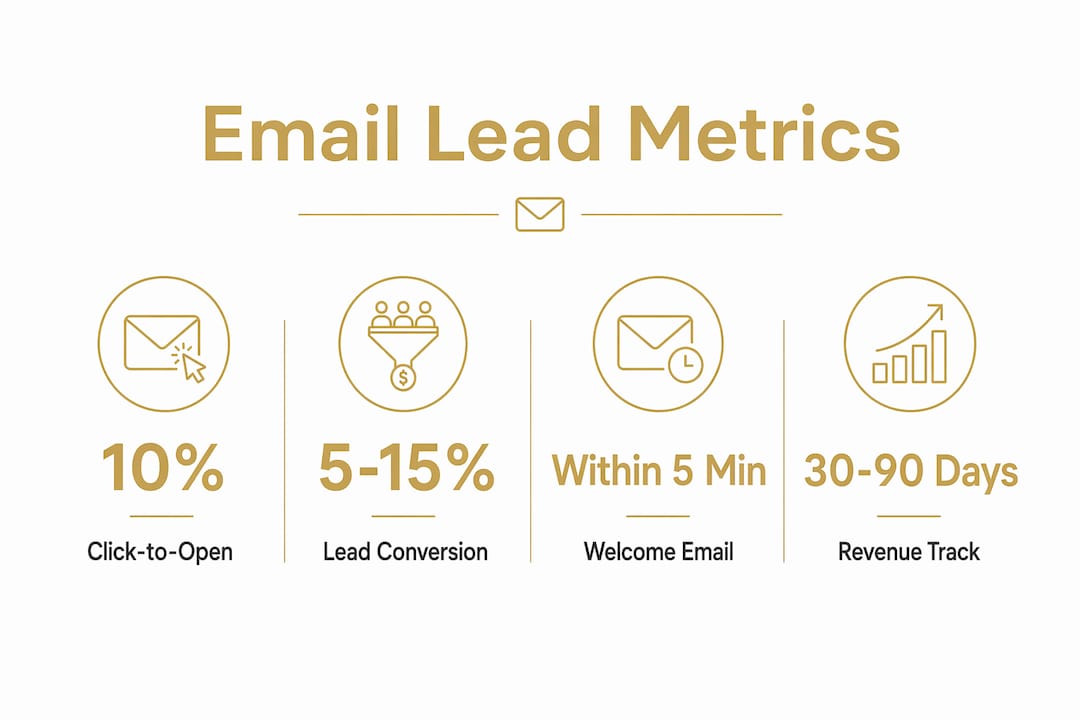
Track this first: Revenue Per Email (RPE). Do this today: send a welcome email within five minutes of every form submission.
Why email marketing grows your B2B pipeline
The core reason email drives sales for B2B companies is structural. When someone clicks your ad and fills out a qualified form, they hand you permission to continue the conversation on your terms. That permission, combined with behavioral data from every subsequent interaction, is what lets you educate decision-makers across long sales cycles and surface intent signals that shorten the path to purchase.

Owned channels protect you from the volatility that eats into paid-ad budgets. Algorithm changes and rising ad costs can erode your reach overnight; your email list cannot be taken from you. That stability compounds over time: list growth does not require proportional increases in spend, so the cost-per-contact drops as the list matures.
How does email fit into an ad-driven lead funnel?
The handoff sequence is: ad click → landing page with a qualified form → CRM and email platform ingest → immediate welcome send → trigger-based nurture → sales notification.
Each step requires clean data. Capture UTM parameters at the form level so every lead is tagged by campaign, ad set, and keyword. Collect firmographic answers (company size, role, use case) directly in the form and map them to segments in your email platform. Record opt-in consent with a timestamp — this is non-negotiable for CAN-SPAM compliance and list hygiene.
Implementation checklist:
Tracking pixels and UTM parameters firing on every ad and landing page
Five-minute maximum delay on the welcome/confirmation send
Bidirectional CRM sync so lead scores update in real time
Lead-score rules that weight form answers, email clicks, and page visits
Sales notification SLA: alert the rep within minutes when a lead crosses the score threshold
Pro Tip: Speed is the single biggest lever on intent. A welcome email sent within five minutes of form completion converts at a materially higher rate than one sent an hour later. Set this up before anything else.
The paid traffic to lead engine connection only works when the data handoff is clean. Garbage tags produce garbage segments, and garbage segments produce irrelevant emails that kill deliverability.
What actually converts ad leads into customers?
Four mechanisms do the heavy lifting.
Nurture sequences reduce friction in long B2B sales cycles by delivering education, case studies, and ROI calculators in a logical order. Each email moves the prospect one step closer to a buying conversation without requiring a sales rep to manually follow up.
Behavioral signals are where email earns its keep as a qualification tool. Multiple opens of the same email, a click on a pricing link, or a download of a technical guide are each a data point. High-intent signals like these should trigger real-time lead-enrichment pushes to sales for faster follow-up.
Lead scoring combines form data with email behavior. A simple formula: assign 10 points for a qualified form answer (e.g., “50+ employees”), 5 points per email click, 15 points for a pricing-page visit. When a lead crosses 40 points, push an alert to the sales rep. That threshold is adjustable; the point is to make the handoff automatic and consistent.
Triggered flows that directly build pipeline:
Pricing-interest trigger: fires when a lead clicks a pricing link; sends a case study and a demo CTA within the hour
Trial or proposal expiry: sends a reminder with a clear next step 48 hours before expiry
Technical-review content: sends a deep-dive guide when a lead downloads an introductory asset, advancing them to the next funnel stage
High-impact tactics to convert qualified traffic from ads and forms
Priority tactics to build first:
Instant welcome series — three to five emails, starting within five minutes of form submission
Progressive profiling — ask one additional qualifying question per email rather than overwhelming the form
Behavior-triggered sequences — pricing click, content download, page revisit
Personalized CTAs — match the CTA to the lead’s segment and funnel stage, not a generic “Book a call”
Mobile-first design — Over 50% of B2B emails are opened on mobile; a broken layout kills conversion.
Early A/B tests worth running: subject-line angle (question vs. benefit statement), first-CTA placement (above vs. below the fold), and offer type (case study vs. ROI calculator).
Sample welcome sequence for qualified form leads from paid campaigns:
Email 1 (0–5 min): Confirmation + what to expect; one sentence on your core value proposition
Email 2 (Day 1): The problem you solve, with a short case study or outcome metric
Email 3 (Day 3): Educational content matched to their stated use case from the form
Email 4 (Day 5): Social proof — a client result or a specific measurable outcome
Email 5 (Day 7): Direct ask — demo, audit, or discovery call with a clear CTA
How do you measure email’s impact on B2B revenue?
Revenue Per Email (RPE) is the metric that cuts through vanity numbers. Calculate it by dividing campaign revenue by the number of emails delivered. Track three windows: 30-day RPE (immediate campaign impact), 90-day RPE (nurture contribution), and total RPE across the full sequence.
Metric | Sample Calculation | What It Tells You |
|---|---|---|
30-day RPE | $3,000 revenue ÷ 1,000 delivered = $3.00 | Immediate campaign return |
90-day RPE | $9,000 revenue ÷ 1,000 delivered = $9.00 | Nurture sequence contribution |
Email-sourced pipeline | Opportunities where first touch was email | Direct attribution |
Email-influenced pipeline | Opportunities with at least one email interaction | Assisted attribution |
For attribution windows, use 30 days for immediate, 60 days for mid-funnel, and 90 days for full-cycle B2B deals. Track both email-sourced and email-influenced pipeline so leadership sees the full contribution.
Note on open rates: Apple Mail Privacy Protection has significantly inflated open-rate figures. Prioritize click-to-open rate (CTOR), conversion rate, and RPE instead. Opens are a directional signal at best.
Realistic B2B benchmarks: target a click-to-open rate above 10%, a lead-to-opportunity conversion rate of 5–15% from nurture sequences, and a 90-day RPE that exceeds your cost-per-lead from the originating ad campaign.
What do you need to stay compliant and protect deliverability?
CAN-SPAM requires every commercial email to include a clear sender identification, a working unsubscribe mechanism, and a physical mailing address — non-compliance carries penalties, so treat these as table stakes, not optional.
Deliverability checklist:
SPF, DKIM, and DMARC records configured and verified
List hygiene: remove hard bounces immediately, soft bounces after three attempts
Engagement-based pruning: suppress contacts with zero engagement over 90 days
Test rendering across Gmail, Outlook, and Apple Mail before sending
Pro Tip: Before suppressing unengaged contacts permanently, run a re-permission campaign: one short email asking if they want to stay on the list. Those who click stay; those who don’t get suppressed. This protects sender reputation and occasionally recovers leads you thought were gone.
Email’s privacy resilience comes from its first-party, permissioned data structure. As third-party tracking weakens, owned list data becomes a more valuable competitive asset.
How Flockleads turns ad-driven leads into paying customers
Flockleads configures the full stack: sector-brand ad campaigns on Meta, LinkedIn, Google, and TikTok feed into qualified landing pages with forms that capture firmographic data and UTM tags. The moment a lead submits, an instant welcome email fires, and the lead enters a segmented nurture sequence matched to their stated use case.
What Flockleads sets up:
Ad targeting to sector-specific landing pages with qualifying forms
Instant welcome send (under five minutes) triggered by form completion
CRM integration with bidirectional lead-score sync
Segmented nurture sequences based on form answers and behavioral signals
Weekly optimization of ad creative, form copy, and email subject lines
Reporting dashboard showing RPE, pipeline influenced, and demo requests generated
The system is designed to deliver an initial RPE snapshot within the first 30 days, with compounding results as the nurture sequences accumulate behavioral data. Explore real project examples to see how this plays out across different B2B service categories.
What does a 90-day email launch plan look like?
Days 1–30: Foundation
Configure tracking (UTM, pixels, form fields) and CRM sync
Launch the five-email welcome sequence
Set up the pricing-interest trigger flow
Publish one gated asset (ROI calculator or sector-specific guide) as a lead magnet
Days 31–60: Build
Create two to three additional segments based on form answers and email behavior
Build the core nurture sequence (eight to ten emails, 30-day cadence)
Establish attribution windows and pull the first 30-day RPE snapshot
Set lead-score thresholds and automate sales notifications
Days 61–90: Optimize
Run A/B tests on subject lines, CTA placement, and offer type
Refine lead-score rules based on actual conversion data
Automate the sales handoff SLA
Report pipeline-influenced opportunities and demo requests to leadership
Pro Tip: The 14-day quick wins that prove momentum: instant welcome live, pricing-page trigger active, and one gated asset generating downloads. These three alone generate the first RPE data point and give leadership something concrete to evaluate.
B2B email programs typically reach compounding results at the six-to-twelve-month mark. Set that expectation early.
Key Takeaways
Email marketing grows B2B business by converting owned, permissioned list data into automated pipeline — the combination of behavioral signals, triggered sequences, and RPE measurement is what separates predictable revenue from ad-spend dependency.
Point | Details |
|---|---|
Own the audience | An email list is immune to algorithm changes; build it from every qualified form submission. |
Measure RPE, not opens | Revenue Per Email (RPE) across 30- and 90-day windows shows true pipeline contribution. |
Automate behavioral triggers | Pricing clicks, content downloads, and page revisits should fire sequences automatically. |
Protect deliverability | SPF/DKIM/DMARC, engagement pruning, and CAN-SPAM compliance preserve sender reputation. |
Flockleads engineered approach | Flockleads configures the full ad-to-email stack — forms, CRM sync, nurture, and weekly optimization — with an RPE snapshot in the first 30 days. |
The backbone of every lead engine I trust
Every ad-driven funnel I have analyzed that stalls does so at the same point: the lead submits the form, gets a generic confirmation, and then hears nothing for days. The ad spend did its job. The form did its job. Email failed to show up.
What makes email the backbone of a reliable lead engine is not the technology — it is the discipline of treating the list as a revenue asset rather than a broadcast list. Behavioral signals inside an email sequence tell you more about purchase intent than any ad-platform metric. When those signals connect directly to sales notifications and lead scoring, the funnel stops leaking.
The Flockleads projects page documents how this plays out in practice across B2B service categories. The pattern is consistent: fast welcome send, clean segmentation, and RPE tracking produce measurable pipeline within 30 days.
Flockleads builds the lead engine for you
Most B2B owners running paid ads are leaving pipeline on the table between the form submission and the first sales conversation. Flockleads closes that gap with a fully managed system: qualified ad campaigns, sector-specific landing pages, instant email delivery, CRM integration, and weekly optimization — all reported in a single dashboard.
What you get from day one: a free audit of your current ad-to-form setup, fast integration with your existing CRM, an initial RPE snapshot within 30 days, and a weekly optimization cadence that compounds results over time. No guesswork on attribution, no manual follow-up sequences to build from scratch.
B2B owners who want a predictable pipeline without managing the technical stack themselves can get started with Flockleads and see measurable outcomes within 90 days.
Useful sources
HubSpot: B2B Email Marketing and Pipeline Growth — deal velocity, behavioral signals, and pipeline measurement
Forbes Advisor: Benefits of Email Marketing — Optimove/Dana Carr quote on psychographic and demographic targeting
monday.com: Benefits of Email Marketing — automation scaling, cost structure, and privacy resilience
DiscoveredLabs: Email Conversion Rate Optimization — RPE calculation method and Apple MPP impact on open rates
Afterpay: Email Drive Sales — owned channel protection and welcome/trigger flow guidance
Flockleads Blog — tactical posts on paid traffic, lead-gen automation, and B2B funnel optimization
Frequently asked questions
Why does email marketing outperform paid ads for B2B pipeline?
Email runs on first-party, permissioned data you own, so costs do not rise with competition. Behavioral signals inside sequences qualify leads automatically, shortening sales cycles in ways paid ads alone cannot.
What is Revenue Per Email and how do you calculate it?
Divide campaign revenue by the number of emails delivered. Track it at 30 and 90 days to separate immediate campaign impact from nurture sequence contribution.
How quickly should you send a welcome email after a form submission?
Within five minutes. Speed locks intent — a fast, personalized confirmation converts at a materially higher rate than a delayed generic response.
How does Flockleads connect paid ads to email nurture?
Flockleads configures UTM tracking, qualified forms, instant welcome sends, CRM integration, and segmented nurture sequences as a managed system, delivering an RPE snapshot within the first 30 days.
When should you expect compounding results from B2B email?
Most B2B email programs reach compounding pipeline results at the six-to-twelve-month mark, once behavioral data has accumulated enough to refine lead scoring and sequence targeting.
NEED A CLEARER PLAN?
Let’s turn your next move into momentum.
Talk to us →